Before buccaneers became pirates, they were hunters whose days began by calling their dogs. On Hispaniola, those dogs could find a bull, stop a boar, and sometimes make a governor wish he had never met them.
Exquemelin’s boar fight imagined: two men watch from the trees as a wild pack holds a boar at bay for the best part of an hour. Dogs in History (AI).
The wild boar had backed against a tree and reared onto its hind legs. Around it a pack of wild dogs barked and kept their distance, and any dog that came within reach of the tusks did not come back for a second try. It went on for the best part of an hour. Then the boar dropped and made a break for it, and a dog came in from behind and ended it.
Two men with muskets were watching from nearby trees. One was a buccaneer. The other was Alexandre Exquemelin, who had come out to Tortuga in 1666 as an indentured servant. The buccaneer had brought him to see the wild dogs at work. Told about it secondhand, he said, he would never have believed it. Now he had a good view.
After the boar was killed the pack did not rush to eat. Instead, the dogs withdrew and lay around the boar while one of their number took the first meal: the hound that had found it. Only after that dog had eaten did the others move forward.
Exquemelin, up in his tree, decided that beasts could teach men to give honor where it was owed. He put the scene in a book about the pirates of the Caribbean, De Americaensche Zee-Roovers, published in Amsterdam in 1678. But buccaneer was a hunter’s name before it was a pirate’s. The men it first described lived in the woods of Hispaniola, and they lived with dogs.
What the Spaniards Left Behind
The dogs of Hispaniola had a history older and more disturbing than the French hunters who used them. The Spanish brought war dogs to the island, among them lebreles, greyhound-type hounds that charged with the horsemen in Columbus’s campaign of 1495. Within a few decades, the chronicler Gonzalo Fernández de Oviedo found Hispaniola overrun with fierce dogs from Spain, gone wild through carelessness.
Exquemelin, writing a century and a half later, added a darker detail. In his telling, Spaniards also used dogs to pursue Indigenous islanders into the forests, then turned some loose when that work ended. He offered this as an explanation, not an origin he could prove.
What Exquemelin could describe firsthand was their abundance. They ran in packs of fifty or sixty, attacking wild boar and taking newborn calves and foals. Dogs once controlled by men now competed with them.
Yet the distinction between wild and working dog was thin. Hunters found their dens, took their puppies, and raised them to hunt. A creature that could deprive a settlement of meat could, if caught young, help supply it.
Five or Six Barks in the Woods
The most important dog in a hunt was not necessarily the fiercest. It was the one that found the quarry. Exquemelin’s companion had seen it many times: in every wild pack, one dog ran ahead, and when it found something, it gave just five or six barks. Once the others arrived, the finder stood aside.
The hunters had their own version of this arrangement. Each kept a brak, a scent hound that searched ahead while the remaining dogs stayed behind. Once the brak found the quarry, it rested as the men dealt with the animal. The hunter then gave it a piece of meat, and off it went in search of another animal.
The finder could do its job, wait through the dangerous part, collect its portion, and be ready to start again. For men trying to bring home meat or hides day after day, a nose that located the next animal was worth more than a heroic but injured dog.
The bull hunters’ day imagined: the dogs hold a wild bull at bay so the hunter can take his shot. Dogs in History (AI).
The bull hunters were the ones Exquemelin called boekaniers. Each morning at first light they called their dogs together and headed into the trees, toward the places where they expected to find the most bulls. Their name would travel far beyond the island. Their dogs had a price. A dog fit to hunt sold for six pieces of eight, a fixed price among the hunters.
On Tortuga, the small island where the hunters went to buy powder and spend a year’s earnings in a month, there were wild boars too. Hunting them with dogs was forbidden. The island was small, and the dogs would have wiped them out. Not everybody welcomed the dogs’ success.
The Packs Outlast the Poison
A hunter fires at a wild bull while his dog holds it at bay, drawn in Saint-Domingue in 1685. Paul Cornuau, Plan des passes et du bourg du Cap. Source gallica.bnf.fr / BnF.
The wild cattle were disappearing from two directions. The Spaniards killed as many as they could to spite the French, and the wild dogs ate the calves. The buccaneers had once numbered five or six hundred on the island. By the time Exquemelin wrote, there were fewer than three hundred, because the bulls had grown so scarce.
The wild dogs were so numerous they provoked an extraordinary campaign against them. In 1668 Bertrand d’Ogeron, the French governor of Tortuga, had seen the dogs taking the wild boar the hunters needed to feed the plantations, and went after them. He sent to France for poison, had horses shot, cut open and strewn with it, and kept this up for six months.
At the end of the six months, nobody could discern a reduction in the wild-dog population. Wild packs continued hunting while the world of the buccaneer hunters was changing.
Pirate’s Dog Left on the Beach
Hunting, planting, and raiding at sea were now overlapping livelihoods. Most of the pirate stories that followed made the buccaneer a man with a musket aboard a ship.
When the privateer Henry Morgan marched on Panama in 1671, two hundred French buccaneers went ahead of his force because they were particularly well armed and accurate shots. Not every hunter became a pirate, but their skills went to sea, and so did the name, which stayed there.
Half a century later, a pirate captain’s dog turns up in the record, and it is not on a ship. In June 1722, at Port Roseway in Nova Scotia, the crew of the pirate Edward Low came back from shore and left Low’s dog behind. Low saw it on the beach, howling to be taken off, and ordered men into the boat to fetch it.
Two young captives from Marblehead, Massachusetts, John Holman and Benjamin Ashton, jumped in. They rowed for the shore and did not come back, and the pirates, as another captive, Philip Ashton, later recorded, found “they were deprived of their Men, their Boat, and their Dog.”
Did You Know?
Hides were the bull hunters’ living: one man pegs a skin out while another carries one in, his dog at his heels. Paul Cornuau, Plan du cul de sac de Léogane, 1685. Source gallica.bnf.fr / BnF.
Hispaniola’s hunting dogs appear on official maps. Surveying French Saint-Domingue in 1684–86, Paul Cornuau drew hunters and their dogs on his plans of Le Cap and Léogane.
Henry Morgan sued over this book and won. The privateer who sacked Panama, later knighted and made Jamaica’s lieutenant governor, won £200 for libel from its English publishers.
Feral dogs still hunt on the Hispaniola’s. A venomous, shrew-like mammal, found only on the island, had no natural predators before the dogs arrived.
Discover More Working Dogs Who Earned Their Keep…
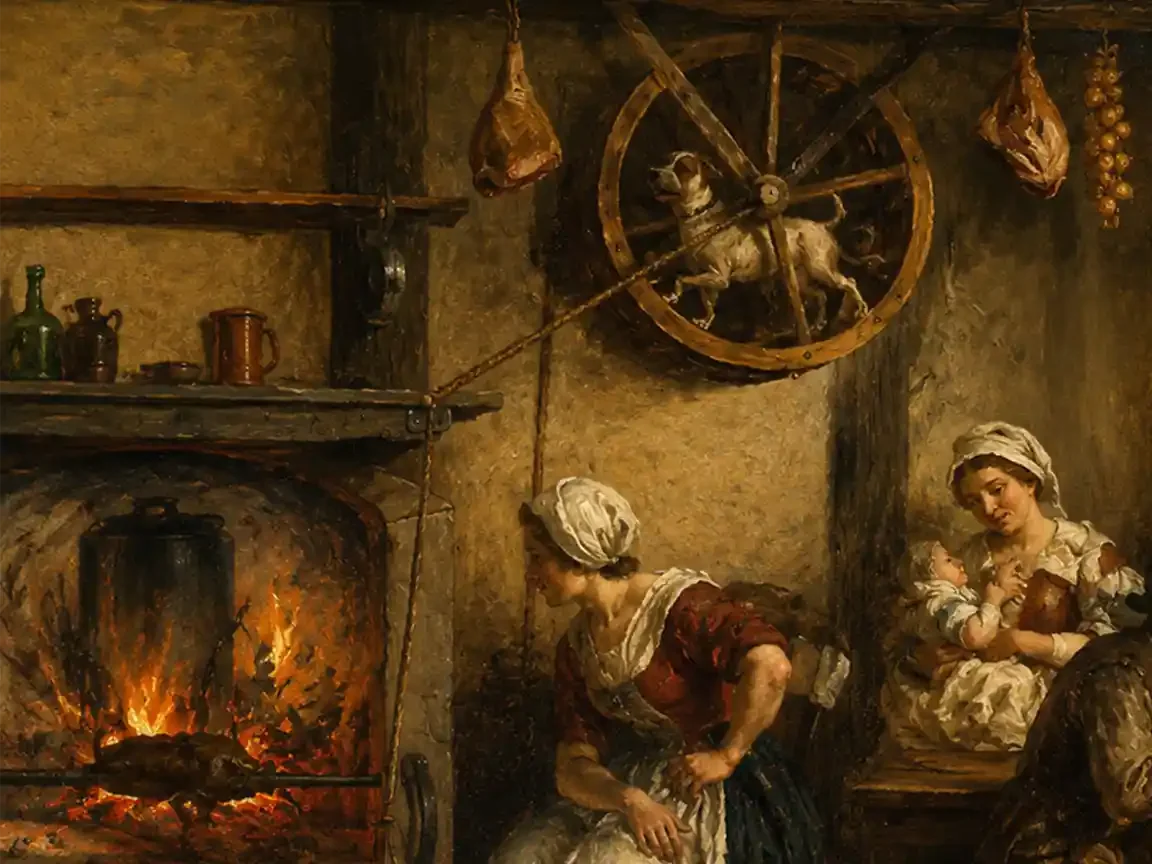
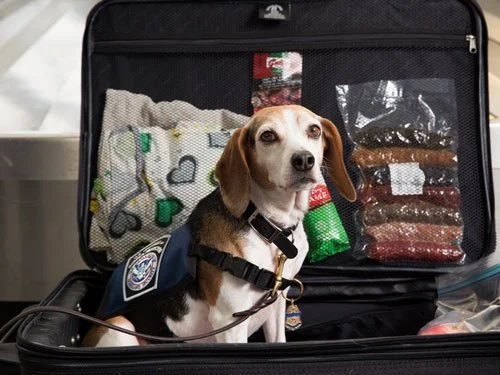
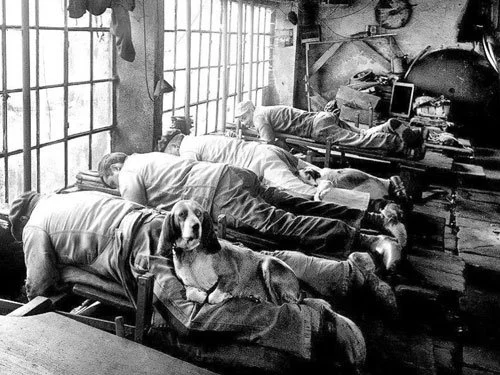
On Hispaniola, a dog fit to hunt sold for six pieces of eight. Other dogs were valued for the work they did — beside the knife grinders of nineteenth-century France, among the luggage at American airports, and inside a wooden wheel by a British kitchen fire.