The Knife Grinders and Their Warmhearted Helpers
In the damp workshops of Thiers, France's knife grinders worked face-down over the wheel for twelve hours at a stretch. What kept them at it through the winter was lying across their legs.
Knife grinders working in their workshop in Thiers with dogs keeping their legs warm c.1900s. Public domain via Wikimedia Commons.
France’s Four-Legged Furnaces
In a workshop built over the river at Thiers, a dog lies curled across a man's calves, holding still. The man is stretched face-down along a wooden bench, chest on a padded plank, legs sprawled behind him, guiding a blade against a wheel that throws off water and yellow sandstone grit. The room is damp and barely heated. Beneath the rumble of the stone and the hiss of metal, a soft thud marks a shift of weight. The man does not look up. The dog stays put.
This was once an ordinary sight in the knife-making country of central France. Before insulation, before workplace safety, some of the most skilled metalworkers in the country warmed themselves with a dog.
It sounds like folklore. It was an arrangement so ordinary in Thiers that nobody troubled to write it down in any detail, which is why most of what survives of it is photographs.
Thiers the Cutlery Capital
To understand the knife grinders, one must first understand Thiers. Tax registers from the 15th century already name thirty knife makers in this corner of the Auvergne, and the town's economy and culture came to be dominated by the production of knives, scissors, razors, and other finely honed tools.
Industrialization arrived in the 19th century, but slowly. Knife-making in Thiers remained a hybrid of old craft and new machinery. Many workshops were family-run, cramped, and improvised, attached to homes or tucked into the backs of barns. A great number were built over water channels so the grindstones could be turned by the flow of the Durolle.
The workshops were called rouets, and they ran on other people's terms. A rouet belonged to a landlord who rented out places at the wheels. The stone, the plank and the tools belonged to the man who lay on them. In a hard frost or a dry summer, when the river slowed, the wheels stopped and the men went home unpaid. This was the world the cutlers (couteliers) and the grinders (émouleurs) worked in, and it outlasted the century that made it.
Twelve Hours on the Plank
Grinding a blade took stamina and precision. The plank was raised at the head end and cut away at the chest and arms, so that a man could bring his whole weight down onto the stone through his forearms and still steer the edge. He lay prone on it, feet extended behind him, for twelve hours. As the sandstone wore thin the plank was dropped a notch on a rack of pins and holes, following the shrinking wheel down.
What came off the stone as it turned settled on the men stretched above it. Thiers knew them by it: les ventres jaunes, the yellow bellies.
It was punishing work and, crucially, bitterly cold. In winter, with poor heating and a constant spray of water off the wheels soaking the room, it became nearly unbearable.
Enter the warmth of a dog.
Enduring long hours in cramped, noisy workshops, a French knife grinder and his loyal dog c. 1900s. Public domain via Wikimedia Commons.
These were not pampered pets. The job was simple: lie on the grinder's legs and keep them warm. Sometimes one dog was enough. In colder shops two might be pressed into service, one per leg. They learned the rhythm of the rouet, holding still through the long stretches at the wheel and rousing only at breaks and at the end of the day.
They were as much a part of the operation as the grindstones and the leather belts.
Dogs Chosen for Stillness
No breed was made for this. The surviving photographs show no single type. In one shop the dog nearest the camera is a basset — long, low, heavy-eared, filling the length of a man's calves as though built for it. Two benches down, the dog is small and white with a dark patch over one eye. In another shop it is a slight dark terrier with tan points, ears up, awake. Whether the basset was a pedigree animal or a crossbreed the picture cannot say.
The named dogs point the same way. Pomponnette, companion to the last of the traditional émouleurs, was a cocker spaniel cross, and the dogs that followed her were a spaniel and a black mongrel.
What the grinders were choosing was not a breed but a temperament. A dog that fidgeted was useless. The animal had to settle across a man's legs and stay there through the noise, the water and the grit, close enough to a spinning sandstone wheel to be killed if it burst. The dogs that could manage that came back the next morning, and the morning after.
What the Work Cost
The grinders paid a high price for the trade. Flying metal, rotating belts, cuts that turned septic, and above all the stone dust they breathed twelve hours a day. Many of them died consumptive. The posture did its own damage: crushed ribs, bent spines, joint pain, numb legs.
The wheel itself could kill outright. A worn stone turning at speed sometimes burst, and a man lying across it had nowhere to go.
The dogs shared the risk and some of the conditions — the wet floors, the metal shavings underfoot, the same bursting stone a few inches from their heads. What the photographs do not show is any sign of neglect.
What a Hot Brick Could Not Do
The evidence for what the dogs meant is small and practical. Grinders fed them before they ate. Some slept beside them. There are accounts of men who would not part with a particular dog at any price, in a trade where nobody had money to turn down.
None of that had to happen. A heated stone would have warmed a man's legs and cost nothing to keep. What the dog did that a hot brick could not was be there for twelve hours in a room where nobody spoke over the noise of the wheel.
Whether the men would have called it companionship is not recorded. What is recorded is that they chose the more expensive option, every winter, for as long as the trade lasted.
French knife grinder lying over a sharpening wheel with a dog resting on his legs c. 1900s. Public domain via Wikimedia Commons.
The End of the Grind
The photographs come from the last stretch of it. By the time a camera was carried down to the rouets, the men lying over the wheels with dogs across their legs were working a trade already being replaced — electricity taking over from the water, upright grinding from the plank. The pictures do not show an old custom hanging on. They show a working practice, in its last years, still doing the job it was there to do.
Look at what the dogs are doing in them. Not one is watching the wheel or the door. They are settled, heads down along a man's thigh, in a room loud enough that a bursting grindstone could kill them both. Whatever the men had trained into them had gone past obedience into something closer to trust.
Thiers still makes knives. The workshops are dry now, and lit, and the grinders stand up to work. What ended was not the trade but the need — for a body warm enough to lie across a man's legs for twelve hours, and willing to do it.
Did You Know?
The dogs were not the grinders' idea alone. Workshop owners encouraged the practice — a warm grinder worked longer than a cold one.
Grindstones burst. The sandstone wore thin as it turned, and a wheel that failed at speed could kill the man lying over it — which is why the plank sat on a pin-and-hole rack that dropped closer to the stone as it shrank.
Thiers stamps a dog on the blade of the couteau Chien. Made in the town for over a century, it is sold almost entirely in Martinique and Guadeloupe, where it sits in nearly every kitchen — and the herb sauce chopped with it, sauce chien, took its name from the knife.
The town never stopped. Thiers still accounts for around 70 percent of France's cutlery production, by the local industry's own reckoning.
Discover More Dogs From Different Worlds…
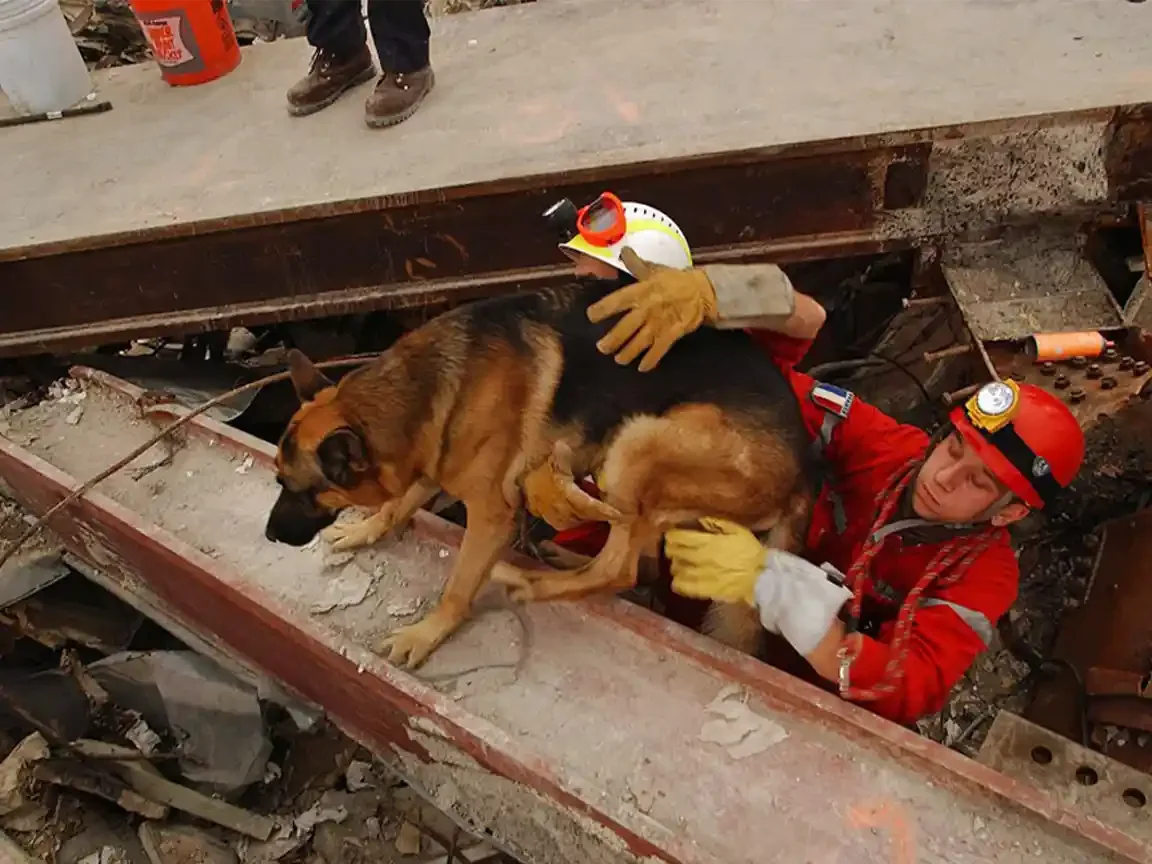
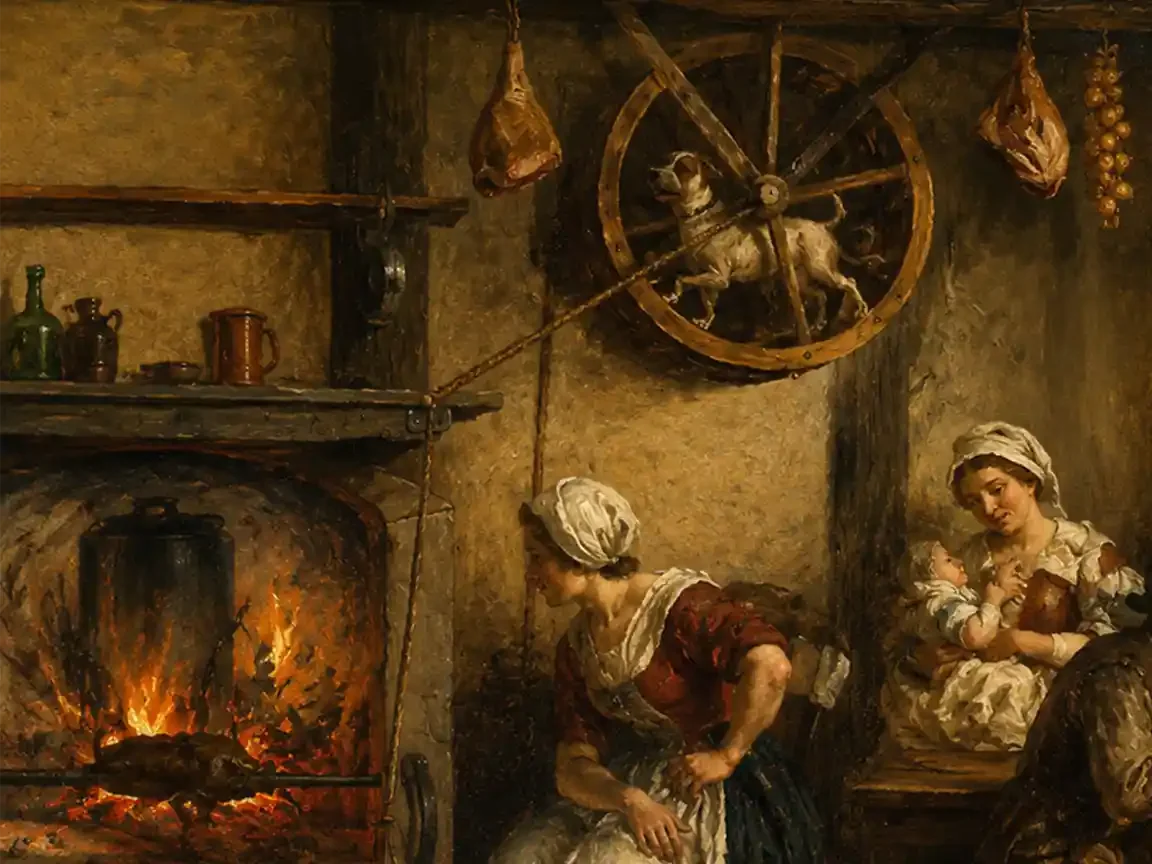
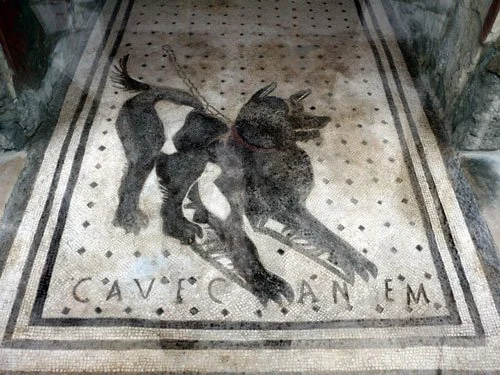
In Thiers, a dog’s body was the primary heating a grinder had. Other dogs worked harder still — those on guard in Roman doorways, Turnspit dogs that walked in wheels above kitchen fires, the dogs of 9/11 who searched for survivors, recovered the dead and comforted exhausted responders.