The Beagle Brigade: The Last Line of Defense
How rescued beagles became America’s most effective barrier against diseases that could cost the pork industry billions.
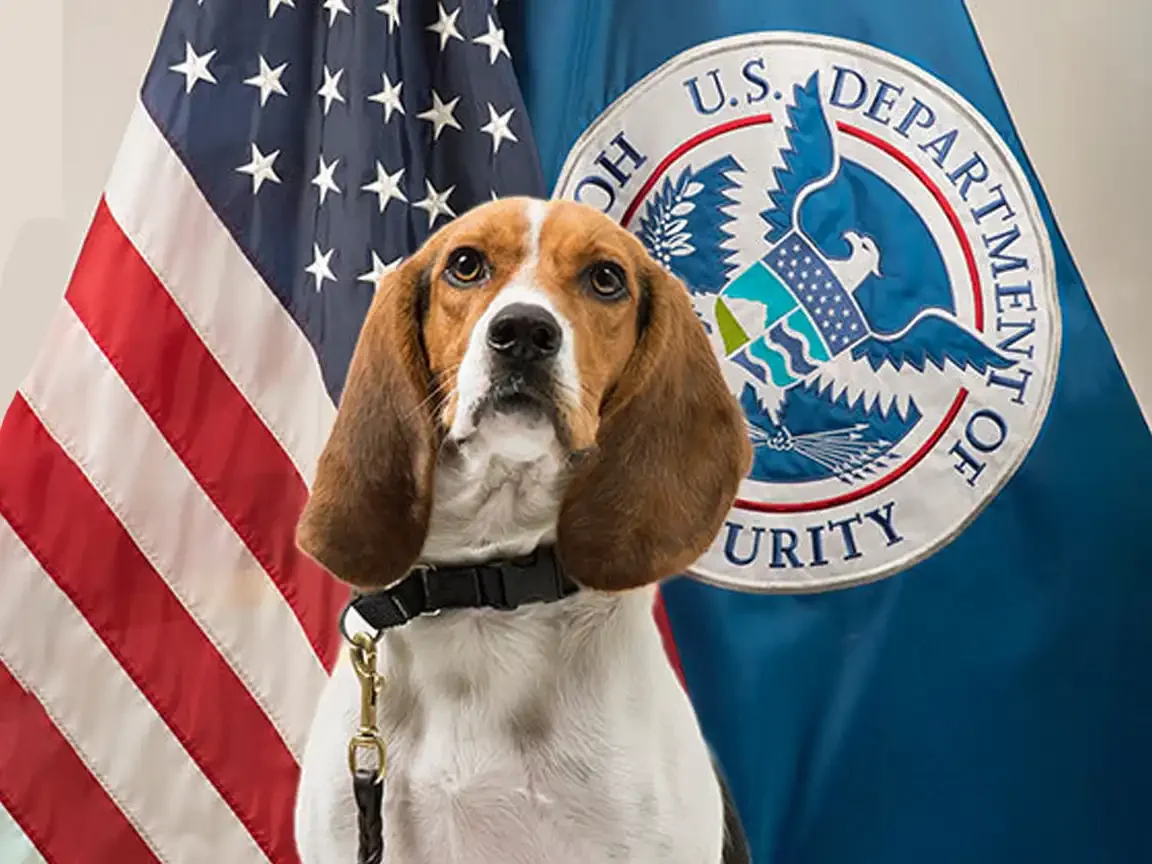
Hardy is a member of the Customs and Border Protection “Beagle Brigade” and got his job in 2015. U.S. Customs and Border Protection.
The bag came off a flight from Ecuador, pushed on a cart by an airport attendant helping an elderly woman in a wheelchair. It looked like any other checked luggage at Atlanta’s Hartsfield-Jackson International Airport on the morning of October 11, 2018. Then Hardy sat down.
He didn’t bark. He didn’t lunge. He simply stopped moving and lowered himself to the floor, the way he had been trained to do, and waited. His handler, Charron Byndloss, asked him to show her which bag. Hardy pressed his nose against the side of the cart. That was enough.
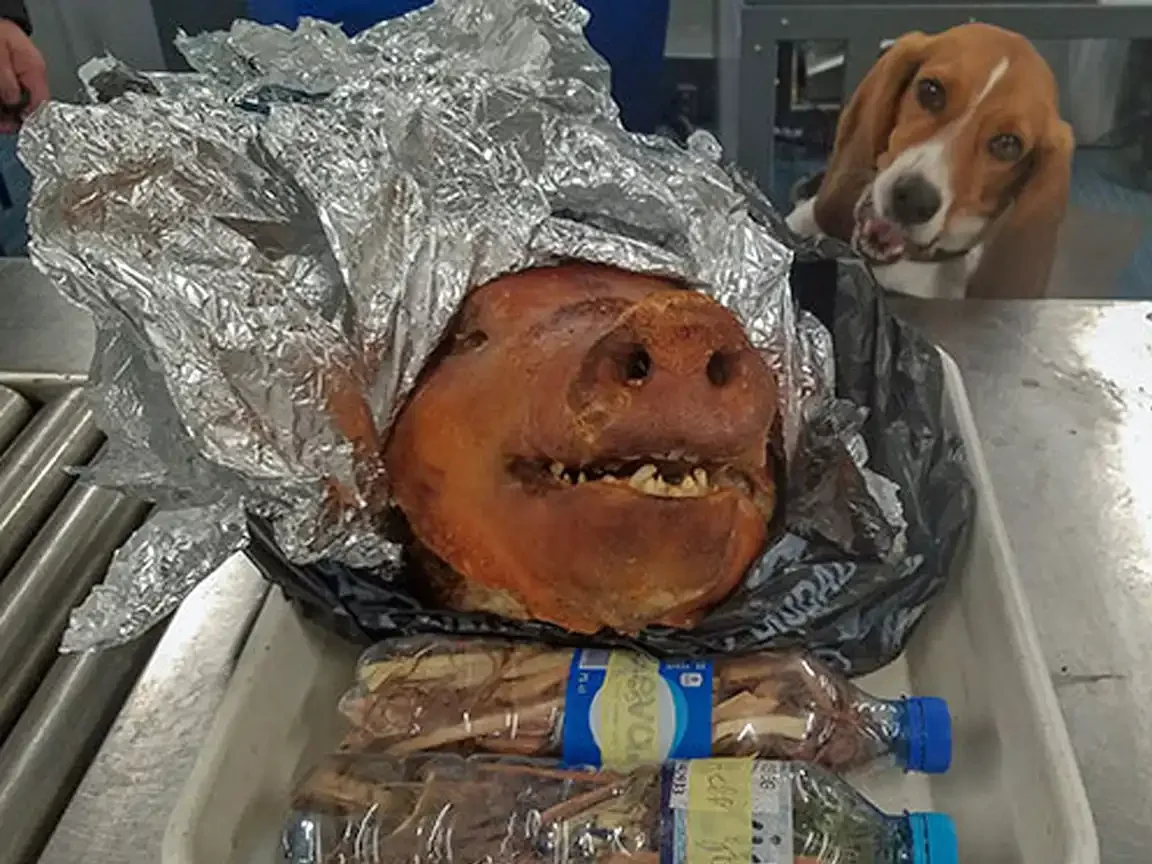
Hardy detected this roasted pig's head in luggage at Atlanta’s Hartsfield-Jackson International Airport. U.S. Customs and Border Protection.
Inside the suitcase was a roasted pig’s head, wrapped and packed for the journey. It weighed just under two pounds. It was seized and destroyed. Within eleven days, the U.S. Secretary of Agriculture had issued a public statement citing the find by name. The reason the stakes were so high had nothing to do with the pig, and everything to do with what might have been traveling with it.
A Disease Without a Cure
By the autumn of 2018, African Swine Fever had been confirmed in China and across the European Union. The disease is caused by a virus for which there is no vaccine and no treatment. It is almost entirely fatal in domestic pigs, and it spreads with alarming efficiency — through direct contact between animals, through contaminated materials, and through infected meat products carried across borders by travelers who may have no idea what they are transporting.
China’s outbreak, which had only just been reported when Hardy made his find, would prove to be the most devastating livestock disease event in modern history. Unofficial estimates would later put the number of pigs that died or were culled in China alone at between 150 and 225 million — roughly a quarter of the global pig population. The economic losses exceeded $200 billion.
The United States had not seen a case. But its pork industry — which generates tens of billions in annual output and exports more pork by volume than any other country — was acutely aware of what arrival of the disease would mean. Economic modeling by Iowa State University has estimated that a large-scale outbreak in the U.S. could cost the swine industry $8 billion in its first year alone, with potential losses approaching $50 billion over a decade if the disease established itself in the feral hog population and proved impossible to eradicate. The moment African Swine Fever crossed into the United States, its trade partners would impose restrictions immediately — regardless of where in the country the outbreak occurred.
Hardy, a six-year-old beagle who had been working the baggage claim at Hartsfield-Jackson since 2015, was not thinking about any of this. He had detected a scent he recognized. He had done his job. The implications were for the humans to consider.
One Beagle, One Airport, 1984
The program that produced Hardy began with a single dog, at a single airport, forty years earlier.
In 1984, the U.S. Department of Agriculture’s Animal and Plant Health Inspection Service placed one beagle into service at Los Angeles International Airport. The assignment was straightforward: to detect prohibited agricultural products — fruits, vegetables, meat, plant material — in the luggage and carry-on bags of international arrivals. The dog was trained to find specific scents, to sit when it detected one, and to wait.
The breed was chosen carefully. German shepherds and Belgian Malinois were already fixtures in law enforcement; they were large, visually authoritative, and associated in the public mind with force. A beagle presented no such associations. It was small, friendly, and familiar — the kind of dog that people actively wanted to approach. In a baggage claim area full of tired international travelers who had done nothing wrong and simply needed to collect their suitcases, that quality mattered. The beagle could move through a crowd without alarm. It could work in close proximity to luggage without its presence suggesting accusation.
There was a practical advantage, too. Beagles were bred for scent tracking. They carry over 220 million olfactory receptors, compared to roughly five million in a human nose. They can detect the presence of pork inside an air-tight thermos buried at the bottom of a checked bag. They can smell meat that has been cooked, spiced, vacuum-sealed, and wrapped in clothing. And they are driven by hunger — their high food drive, which makes them difficult pets in kitchens, makes them ideal working dogs, because every alert is rewarded with something they want urgently.
The program was a success. Within two decades, the single LAX beagle had become a fleet. By 2004, more than sixty Beagle Brigade teams were working at twenty-one international airports across the country. Today, CBP’s agriculture canine program encompasses more than 180 teams operating at airports, seaports, border crossings, cruise terminals, and international mail facilities.
The Shelter Dog at the End of the Chain
Almost none of the dogs who do this work were bought. They were rescued.
The USDA’s National Detector Dog Training Center in Newnan, Georgia — a facility built in 2009 to modern biosecurity standards — does not purchase its animals. Every dog in the program comes from an animal shelter, a humane society, a rescue league, or a private owner who can no longer keep the animal. The qualities that make a beagle a challenging household companion — relentless energy, an appetite that appears to know no limit, an inability to simply settle — are precisely the qualities the training center looks for.
Not every beagle that arrives qualifies. The dogs go through an initial two-week evaluation that assesses temperament, energy level, and food drive. They must be friendly, confident around crowds, and undisturbed by the chaos of an international terminal — the announcements, the rolling suitcases, the children, the strangers wanting to reach down and pet them mid-shift. The ones who pass go on to a ten-to-thirteen week training program at which they are introduced, through positive reinforcement, to the scents they will spend their careers hunting.
They begin with five: apples, mangoes, citrus, beef, and pork. Over time, working dogs tend to expand this repertoire on their own. As one handler at the training center explained it, the logic is straightforward: if a dog is rewarded for alerting on an orange, it begins to ask whether the leaves attached to the orange might also earn a reward. The appetite for recognition drives a natural broadening of expertise.
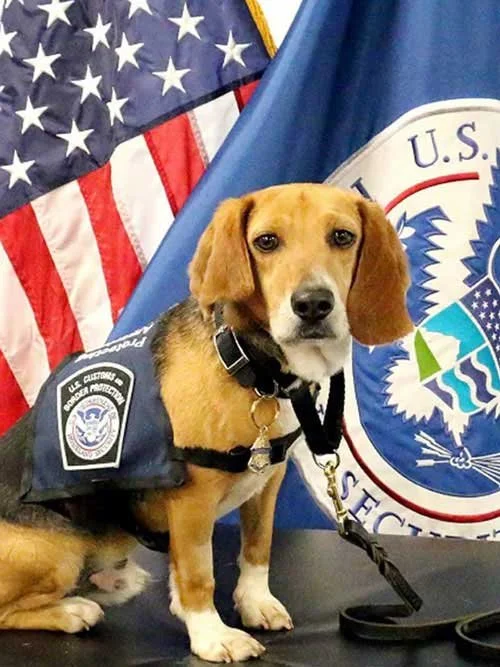
Officer Murray, a former abused rescue dog now a star of the Beagle Brigade. USDA Public Domain Wikipedia Commons
Murray, a beagle who came to the program from a Northeast Georgia animal shelter with part of his ear missing and most of his tail amputated — injuries consistent with neglect and an illegal attempt to dock it — was considered unsuitable for adoption because of his injuries and his relentless energy. He graduated the Newnan program and was assigned to Hartsfield-Jackson. His handler described him, some months into the job, simply as a superstar.
Two Pigs, One Airport, Two Years Apart
Two years before Hardy’s find, a different beagle at the same airport had intercepted something even larger.
In 2016, K9 Joey alerted to the baggage of a passenger arriving from Peru. When the bag was opened, it contained an entire roasted pig. The animal was seized and destroyed. Joey was from the same training program. He worked the same baggage claim. The difference between the two finds was one of scale: a whole carcass had become a head. The program had stopped both.
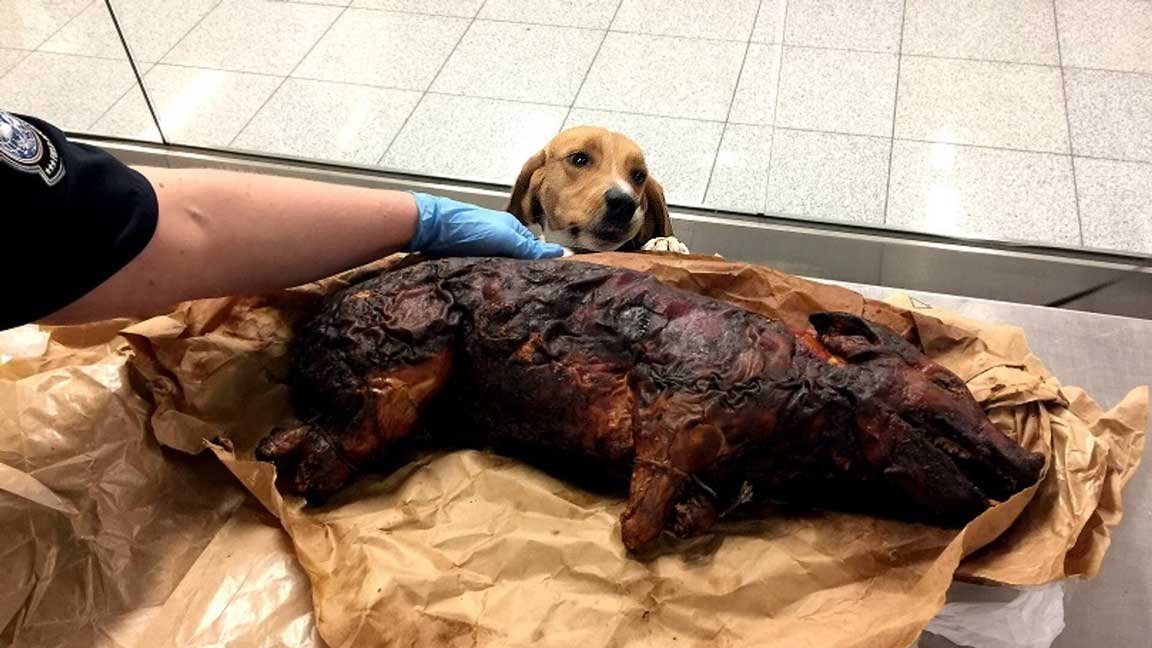
Joey admires a whole pig intercepted at Hartsfield-Jackson. U.S. Customs and Border Protection
The pairing of the two cases — same airport, same breed, same program, two years apart — illustrates something about how the Beagle Brigade operates. It is not a deterrent in the conventional sense. There are no signs warning travelers that dogs are working the baggage claim, no visible enforcement presence designed to make people reconsider their declarations before they land. The beagle is simply there, moving quietly through the arrivals hall, nose working while the rest of its face appears to be smiling at everyone it passes. The interception is not a confrontation. It is a discovery.
What Hardy found in October 2018 may or may not have been infected. CBP’s statement noted that it was unclear whether the pig’s head carried the African Swine Fever virus. The pig was seized and destroyed regardless, because the risk of not doing so was too large. That is the nature of the work: the dog finds the thing that cannot be allowed in, and the thing is removed. Whether it would have caused harm is a question that never needs to be answered.
The Scent at the End of the Carousel
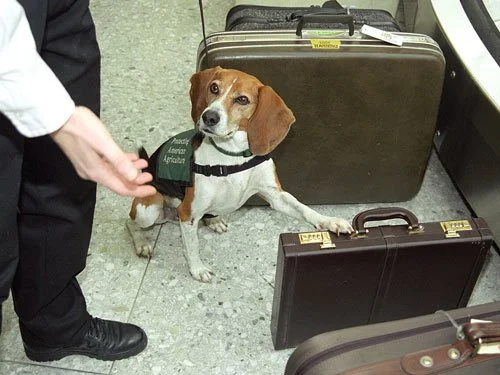
A typical day on the job - every bag a potential threat. U.S. Customs and Border Protection
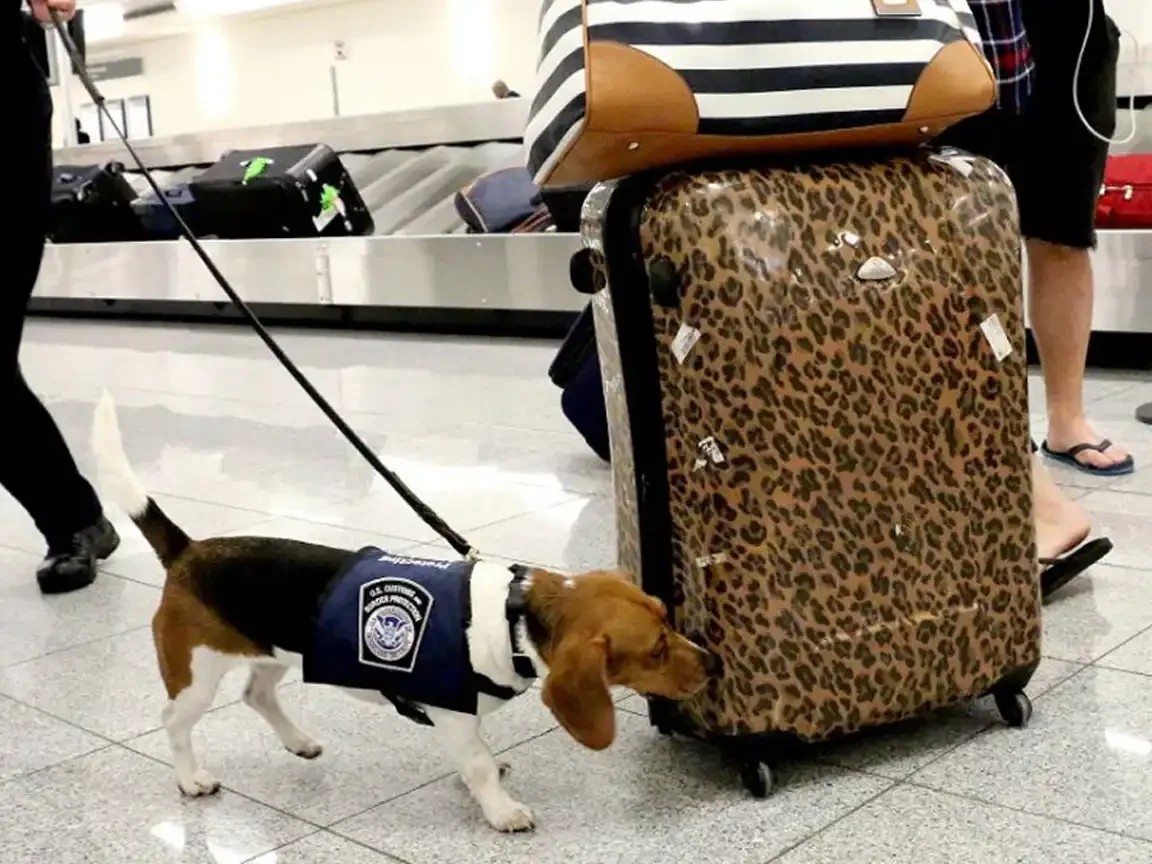
The Beagle Brigade are taught to identify a smorgasbord of target odours. U.S. Customs and Border Protection
In the years since Hardy’s find, the program has continued to expand. Beagles are trained and deployed in greater numbers each year; CBP has stated its ambition to double the number of dogs in the field, with African Swine Fever listed among the primary reasons. The Dominican Republic and Haiti confirmed outbreaks of the disease in 2021, bringing it within reach of the continental United States for the first time.
The detection work continues in mail facilities, cargo warehouses, and cruise terminals, environments where the risks are different in character but not in stakes. A package of cured pork products sent by mail from an affected country carries the same potential as a roasted pig head in a checked bag. The beagle working a mail facility does not know that. It knows the scent, and it knows to sit.
None of this appears on the faces of the dogs. Charron Byndloss, who was Hardy’s handler on the morning of October 11, described the moment of the alert with characteristic directness: Hardy sat down, she asked him to show her which bag, he touched it with his nose. That was the interception. The Secretary of Agriculture would issue a statement eleven days later. Economists would model scenarios worth billions of dollars. Pig farmers across Iowa and North Carolina would never know the pig’s head existed.
Hardy went home that evening and was fed.
Did You Know?
Beagles have around 220 million scent receptors, compared to about 5 million in humans.
Each Brigade dog is trained to identify over 50 different odours associated with banned food products.
The Beagle Brigade operates in more than 80 airports and border crossings across the United States.
A single fruit fly, carried in on banned produce, can spark a multi-million dollar quarantine effort.
Breed: Beagle | Country of origin: Great Britain | First use: Hunting rabbits and hares | Origins: 14th century