His Master's Voice: How Nipper Became a Global Icon
In 1898, a small terrier cocked his head at a gramophone horn—and accidentally became the face of recorded sound. Nipper’s story runs from a Bristol living room to global branding, powered by one haunting idea: recognition.
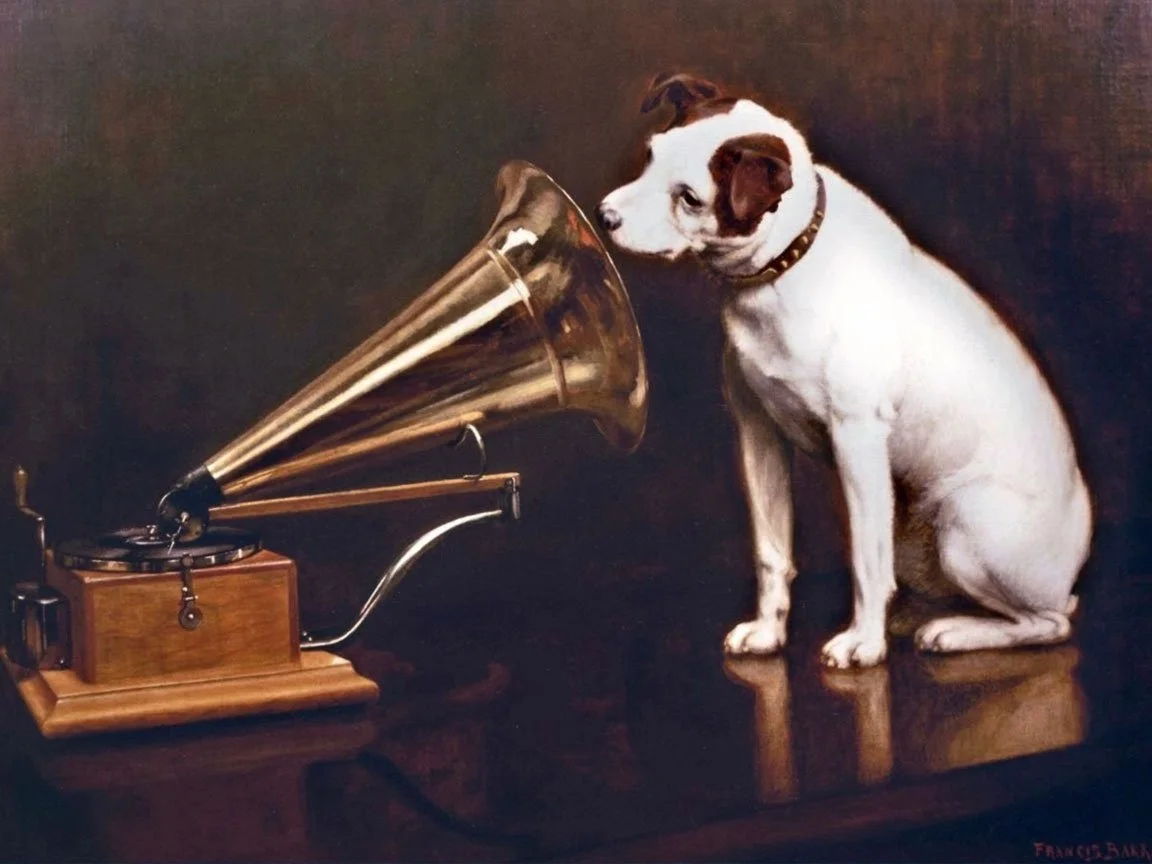
Nipper listening to a gramophone in the famous painting His Master’s Voice by Francis James Barraud, 1898. Public domain.
The Dog Who Listened to History
In a modest painting completed in 1898, a small dog tilts his head inquisitively at the mouth of a gramophone horn. It is a moment of silence and curiosity, one captured so perfectly that it would echo across a century of sound. The dog is Nipper, and the painting is His Master’s Voice, an image that would become not just a beloved Victorian vignette, but a symbol for an entire industry.
From humble beginnings in Bristol to posthumous fame as the face of gramophones, records, and music retail chains, Nipper’s story is one of art, sound, and enduring nostalgia. His legacy - part terrier, part titan of branding - reminds us of a time when the arrival of recorded sound felt like magic, and when a dog’s loyalty could sell the idea of it.
Nipper’s Early Days
Nipper was born in 1884 in Bristol, England. His breed, as stated in an EMI Archive Trust article, was a Fox Russell terrier, and what stood out most about Nipper was his ears. One ear up, the other flopped, a look of perpetual attention.
He was named Nipper because of his habit of gently nipping at the backs of visitors' legs. His first owner, Mark Henry Barraud, was a theatrical set designer and amateur painter. Nipper lived with Mark in Liverpool, accompanying him to the theatre and lounging backstage. By all accounts, he was a well-mannered, curious little dog, with a fondness for music and a tendency to pose in interesting positions.
Sadly, Mark died in 1887, and Nipper was taken in by Mark’s younger brother, Francis James Barraud, a struggling artist based in London. Francis had recently lost his own pet and gladly took Nipper in. Their bond would produce one of the most enduring images in commercial art.
The Painting: His Master’s Voice
It was three years after Nipper’s death in 1895 that Francis began work on a painting based on a memory. He recalled how Nipper had always reacted to phonographs — listening intently to the sounds that came from the trumpet, especially if it was a recording of Mark’s voice. There was something poetic in it: a dog recognising the voice of a departed master.
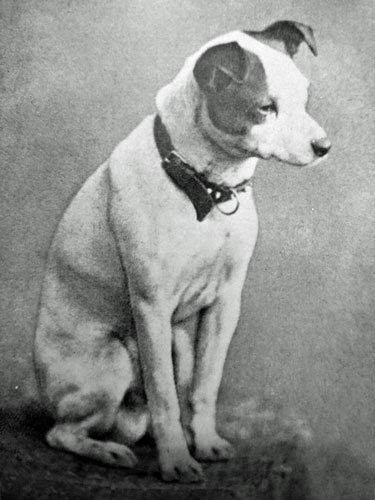
Nipper (1884-1895). Public domain.
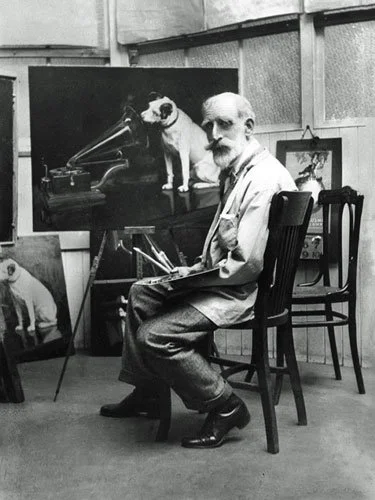
Francis James Barraud at his easel painting His Master’s Voice, 1895-1900. Public domain.
The initial painting, however, didn’t feature the gramophone we now recognise. Francis first painted Nipper listening to an Edison cylinder phonograph. The result was rejected by several publishers and phonograph companies. One apparently remarked: “Dogs don’t listen to phonographs.”
It wasn’t until Francis replaced the Edison machine with a Berliner disc gramophone, at the suggestion and expense of The Gramophone Company’s founder, William Barry Owen, that the image found a home.
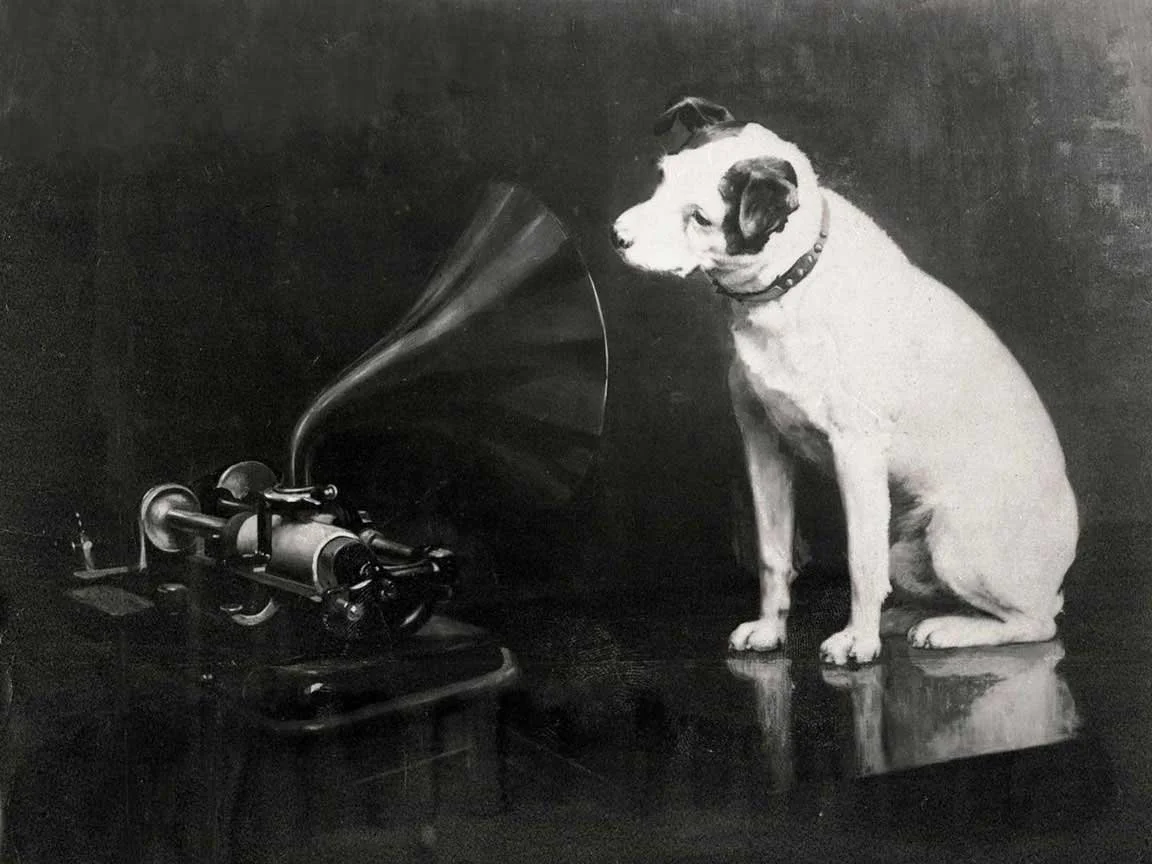
Francis Barraud's original painting of Nipper looking into an Edison Bell cylinder phonograph, 1898. Public domain.
“The manager, Mr. Barry Owen, asked me if the picture was for sale and if I could introduce a machine of their own make, a gramophone, instead of the one in the picture. I replied that the picture was for sale and that I could make the alteration if they would let me have an instrument to paint from.”
In September 1899, The Gramophone Company bought the painting from Francis Barraud for £50, and paid a further £50 for the copyright. The title was Francis’s own suggestion: His Master’s Voice.
Placed above the counters of record shops, on early record sleeves, and in advertisements, the image of the loyal terrier caught in a moment of aural recognition struck a chord with the public. It suggested devotion, memory, and the intimate emotional power of recorded sound.
Becoming a Global Trademark
His Master’s Voice was more than a painting; it became the branding linchpin for The Gramophone Company, and soon after, for its American affiliate, the Victor Talking Machine Company. In 1901, the painting was adopted as the official trademark for Victor, and the dog-and-gramophone image began to appear on phonographs, record labels, and marketing materials across the Atlantic.
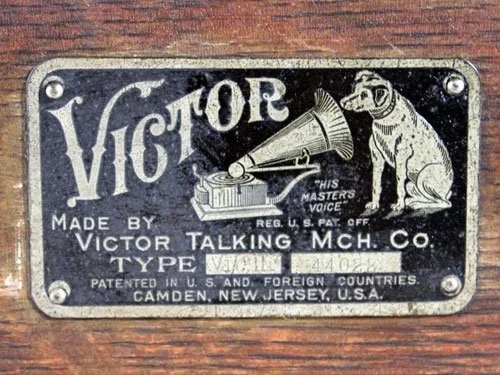
Victrola gramophone logo featuring Nipper listening to his master's voice, 1906. Public domain.
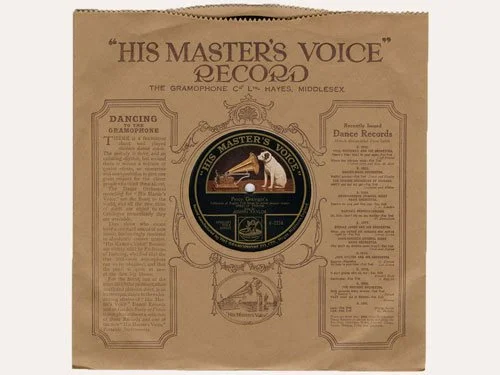
Vintage His Master’s Voice record sleeve and central label with Nipper the dog. Public domain.
In Britain, the image became synonymous with HMV (His Master’s Voice) the commercial face of The Gramophone Company. It lent an air of elegance and reassurance to an emerging technology. For many, the image embodied the idea that recorded sound could bring distant loved ones into the room, conjure memory, and preserve presence. Nipper wasn’t just listening — he was remembering.
By the 1920s and 1930s, the image was one of the most widely recognised logos in the world. It featured on shellac discs, wireless sets, radio receivers, and later on television sets and music retail storefronts.
HMV: From Sound to Storefronts
The first HMV-branded store opened at 363 Oxford Street, London, in 1921. Nipper, usually in profile next to the horn, was prominently displayed on signage and record sleeves. The brand expanded quickly, reflecting the boom in consumer demand for gramophones and records. Nipper became a kind of ambassador for sound.
Through mergers and acquisitions, HMV became part of EMI, and the logo continued to adorn record covers from The Beatles to classical compilations. The image gained renewed visibility with the post-war boom in radio and television, and remained a trusted emblem as vinyl gave way to cassettes, and then CDs.

HMV’s London flagship, where Nipper greeted customers for decades. Public domain.

Modern HMV store in Coventry with updated logo, 2018. Photo by Hazel Nicholson, CC BY 2.0.
In the United States, RCA Victor, which evolved from the original Victor Talking Machine Company, also retained the image. Nipper was joined in the 1990s by a younger companion, Chipper, as RCA attempted to modernise its brand while nodding to its legacy.
Though the technology changed, the image stayed constant, a terrier listening for a familiar voice.
Larger Than Life: Nipper’s Lasting Presence
Nipper may have died in 1895, but his presence remains strikingly physical. In Kingston upon Thames, where Nipper is buried in a small garden (now under a bank car park, marked only by a small plaque), the local community still holds affection for their famous four-legged resident.
Statues of Nipper can be found in several locations worldwide. The most famous is in Albany, New York, where a 28-foot-tall fibreglass Nipper peers from the roof of what was once an RCA warehouse. Originally erected in the 1950s, this version of Nipper wears a studded collar and remains one of Albany’s most beloved landmarks.
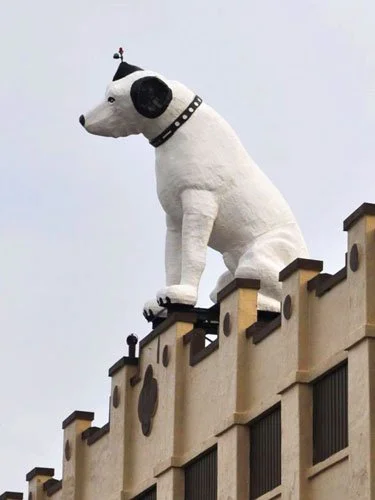
A 28-foot Nipper atop the old RCA warehouse in Albany, New York. Public domain.
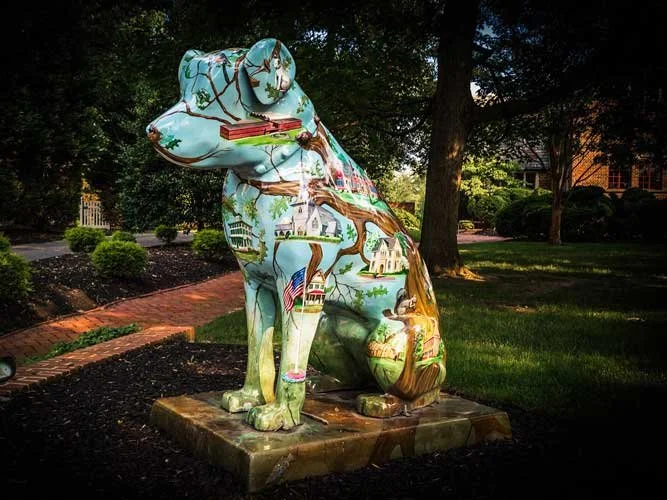
30 5-foot fiberglass statues were decorated by artists for the Nipper 2005 public art project in Moorestown, New Jersey. Public domain.
Smaller statues appear at EMI offices, in Japanese electronics shops, and in collectors’ homes. Vintage HMV memorabilia, from enamel signs to record players bearing Nipper’s image, remain popular with collectors.
In the 1950s RCA sold Nipper dogs to masses of Elvis fans and Elvis had his own Nipper that sat on the stage with him. The statue became something of a stage prop particularly during performances of Hound Dog.
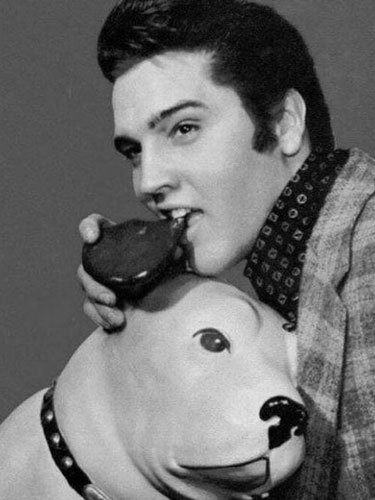
Elvis Presley playfully poses with his Nipper prop, 1950s. Public domain.
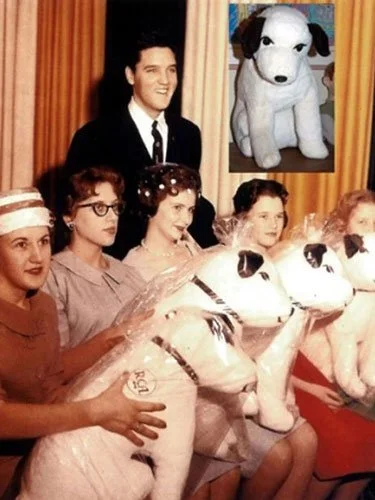
Elvis Presley poses with fans holding large RCA-branded Nipper dogs at a promotional event, 1950s. Public domain.
Even today, Nipper still pops up in cultural references. He’s been parodied in cartoons, referenced in advertising, and turned into figurines and fridge magnets. In an age of AI voices and streaming, the image of a dog listening to a horn reminds us of a time when the arrival of recorded sound felt like a miracle.
A Legacy Beyond the Logo
What makes Nipper’s story enduring isn’t just the marketing genius of His Master’s Voice, but the emotional resonance the image carries. It’s a story about loyalty, memory, and recognition. It asks the viewer to imagine what Nipper is thinking. Does he recognise the voice? Is he confused? Comforted? Awaiting a command?
The painting invites speculation, and in doing so, humanises the machine. It tells us not just about a dog, but about ourselves. How we listen, how we remember, and how we use technology to bridge the distances between us and those we love.
For a dog who never lived to see his own fame, Nipper has achieved something rare: an icon status that transcends time, industry, and even species. He is not merely a mascot, but a metaphor, for sound, memory, and the longing that lives in every listen.
Did You Know?
The original His Master’s Voice painting is part of the EMI Archives Trust and is not on public display. If viewed close-up from the right angle, the outline of the original Graphophone can be seen under the overpaint.
A copy of the His Master's Voice painting (known as The Chinese Copy), replicates the original painting, including the overpaint. This painting is in the possession of Universal Music's headquarters in Los Angeles .
Nipper’s grave lies under a branch of Lloyds Bank in Kingston upon Thames, marked by a discreet plaque.
Other record labels like Columbia Records, with its early use of a listening dog, and Arista Records, featuring a soaring bird, have also used animal imagery in their branding to create memorable and symbolic identities.