Sergeant Stubby: America’s First War Dog
A tailless brindle stray wandered onto a Connecticut training field and refused to be left behind. Eighteen months and seventeen battles later, Sergeant Stubby had sniffed out gas, found wounded men, and become the Great War’s most decorated canine.
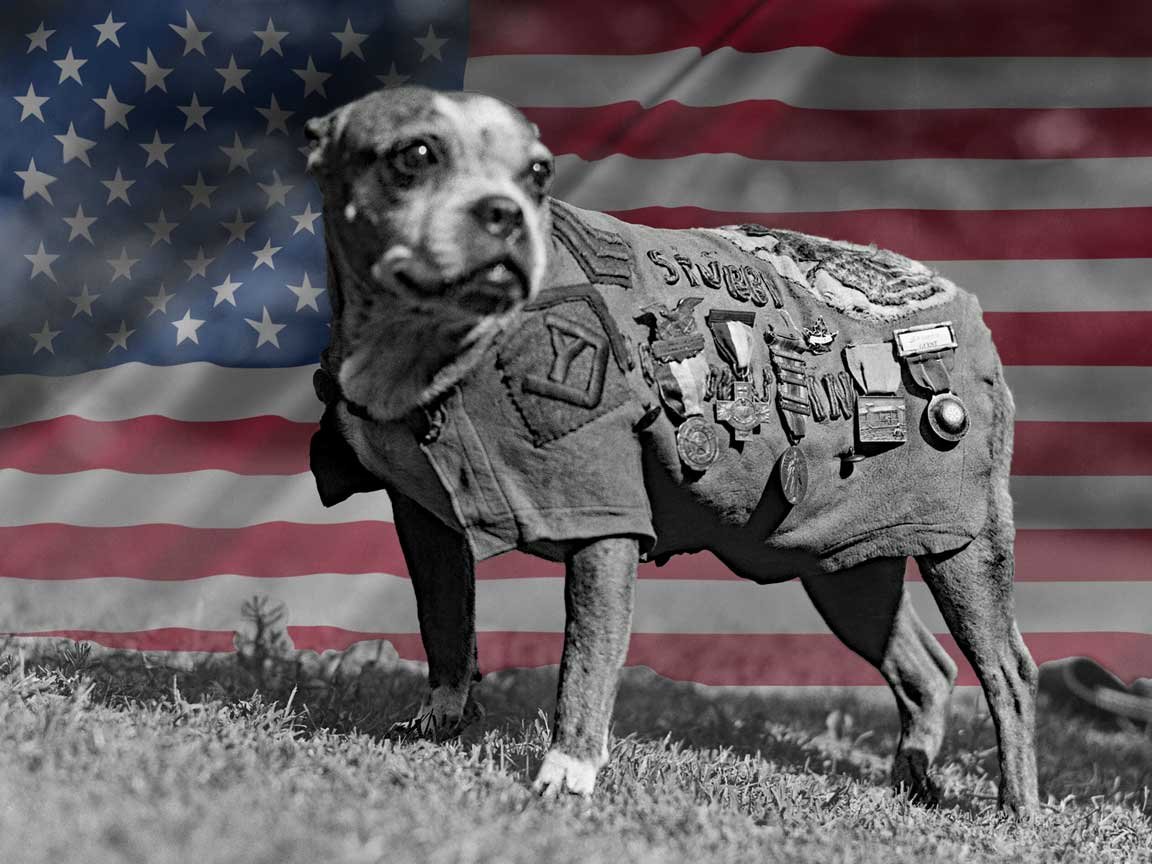
Sgt. Stubby (ca 1916-1926) wearing military uniform and decorations, Public domain, via Wikimedia Commons. US Flag image by Tumisu from Pixabay.
A Mascot Who Refused to Stay Behind
In the long shadow cast by the First World War, stories of individual heroism are often crowded out by the sheer scale of the conflict. Millions served, millions suffered, and the language of remembrance tends towards abstraction: divisions, offensives, casualty figures. Yet occasionally, history leaves behind a figure so specific, so improbable, that it punctures the fog of numbers and reminds us that wars are also lived at ground level. Sergeant Stubby was one such figure.
Stubby was small, brindle-coated, and didn’t have a tail. He was not bred for war, trained for service, or even owned when his story began. Yet by the end of the conflict he had served eighteen months on the Western Front, taken part in seventeen battles, survived gas attacks and shellfire, and accumulated a collection of medals unmatched by any other dog of the Great War. His fame would stretch from the trenches of France to the White House, and finally to a permanent place in the Smithsonian.
Threaded quietly through this extraordinary public story is a private one: the steady companionship between Stubby and a young American soldier, James Robert Conroy, who never intended to make history when he bent down to greet a stray dog on a Connecticut training field. Their bond was not sentimentalized at the time, nor should it be now. It was practical, affectionate, and enduring, shaped by shared routines, danger, and survival. In a war that specialized in separation, Stubby and Conroy remained together from beginning to end.
Early Life: A Stray on the Yale Fields
Stubby entered the historical record in the summer of 1917 with no pedigree and no known owner. He appeared on the grounds of Yale University in New Haven, Connecticut, where units of the 102nd Infantry Regiment, part of the 26th “Yankee” Division, were training ahead of deployment to Europe. Soldiers drilled, marched, and waited. The dog watched.
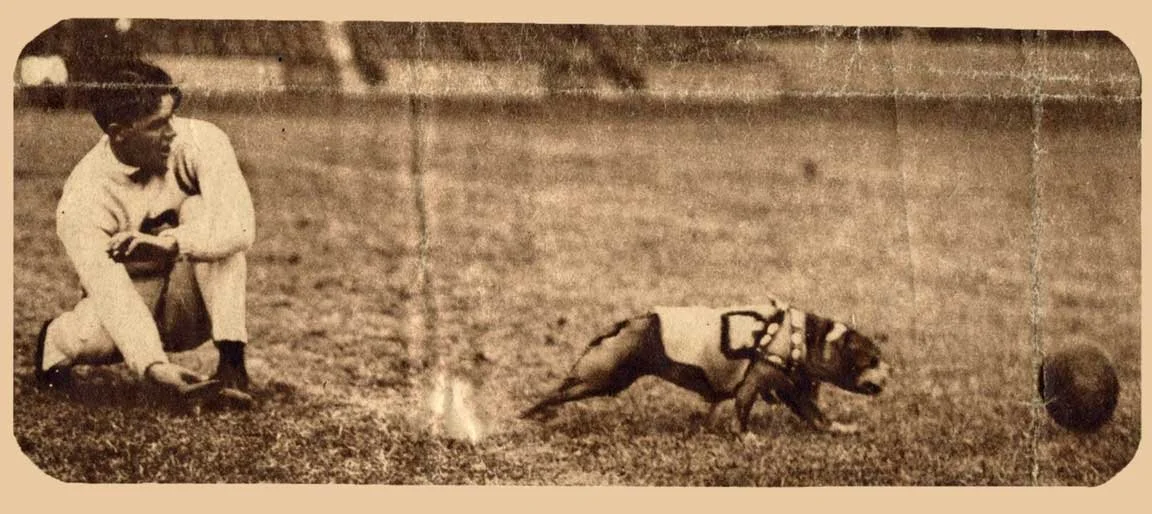
Sgt. Stubby at a Georgetown-Holy Cross game at American League Park,1922, Stubby’s Scrapbook, Smithsonian Institution CC0.
It was Private James Robert Conroy, a young soldier from Connecticut, who first took a liking to the short-tailed stray. Conroy shared food, offered shelter, and allowed the dog to follow him back to camp. The name “Stubby” came naturally, a nickname rather than a christening, and it stuck. What began as a casual kindness became a daily presence. Stubby learned the rhythms of camp life with remarkable speed: the bugle calls, the drills, even a rough approximation of a salute, performed by lifting a paw when officers passed.
Officially, animals were not permitted in training camps. Unofficially, Stubby proved difficult to remove. He raised morale, amused officers, and quickly became a familiar sight among the men of the 102nd. When a commanding officer finally confronted the issue, Stubby’s improvised salute reportedly did more to resolve the matter than any argument Conroy might have made. The dog stayed.
From the outset, the relationship between Stubby and Conroy was defined by proximity rather than sentimentality. Stubby slept where Conroy slept, followed where he went, and responded to his voice above all others. In return, Conroy accepted responsibility for the dog’s presence in a world that was about to grow far more dangerous.
Military Service: From Stowaway to Sergeant
Crossing the Atlantic
In late 1917, the 102nd Infantry embarked for France aboard the American built ocean-liner SS Minnesota. Stubby was not on the manifest. Conroy smuggled him aboard, hiding the dog in a coal bin until the ship was safely at sea. When Stubby eventually emerged, sailors were more charmed than alarmed, and no serious attempt was made to send him back.
By the time the unit disembarked in France, Stubby was effectively part of the regiment. He was discovered by officers once more, tolerated again, and ultimately granted informal permission to accompany the unit as its mascot. It was a small administrative concession that would place a dog directly into the machinery of modern warfare.
Life at the Front
The 102nd reached the front lines in February 1918. Stubby’s first weeks were an education in noise and danger: artillery barrages, rifle fire, the constant concussion of shells. Like the men around him, he adapted. His first injury came not from shrapnel but from gas exposure. Removed to a field hospital and nursed back to health, Stubby emerged with a heightened sensitivity to chemical agents.
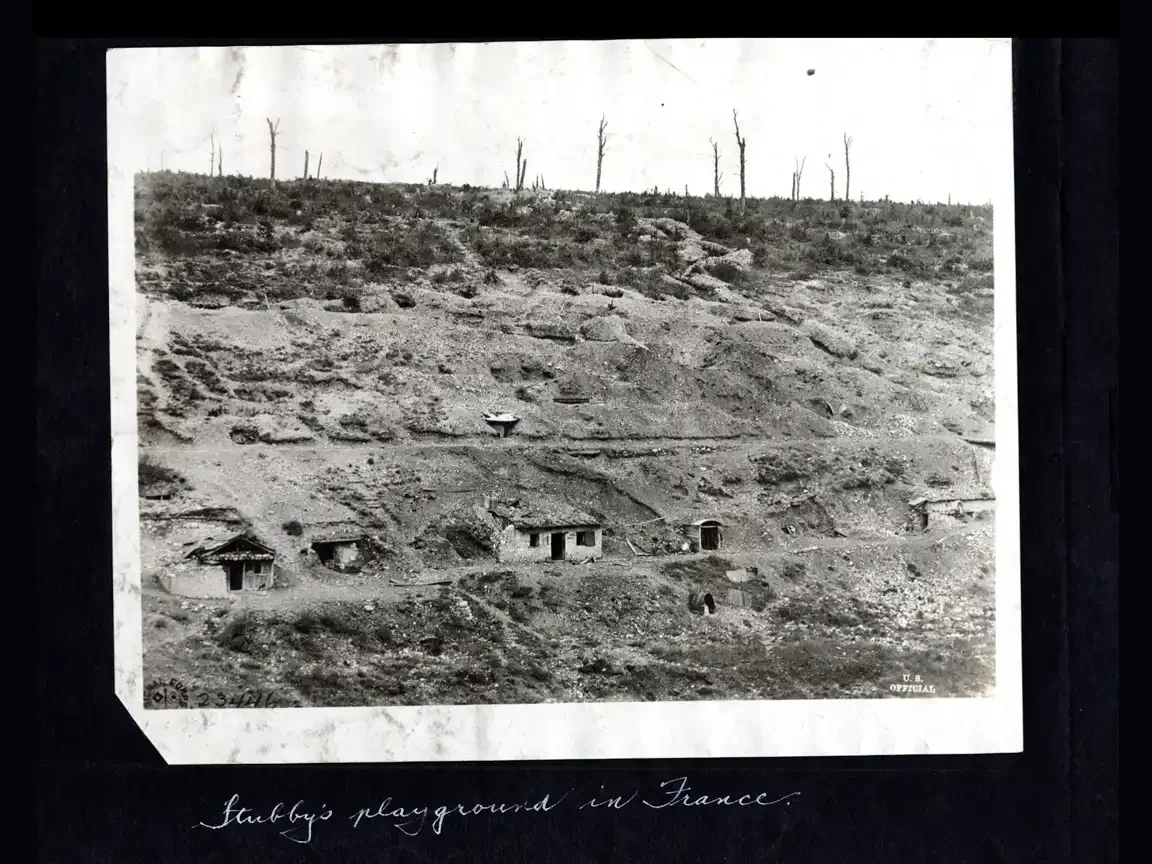
Sgt. Stubby’s playground in France, Stubby’s Scrapbook, Smithsonian Institution CC0.
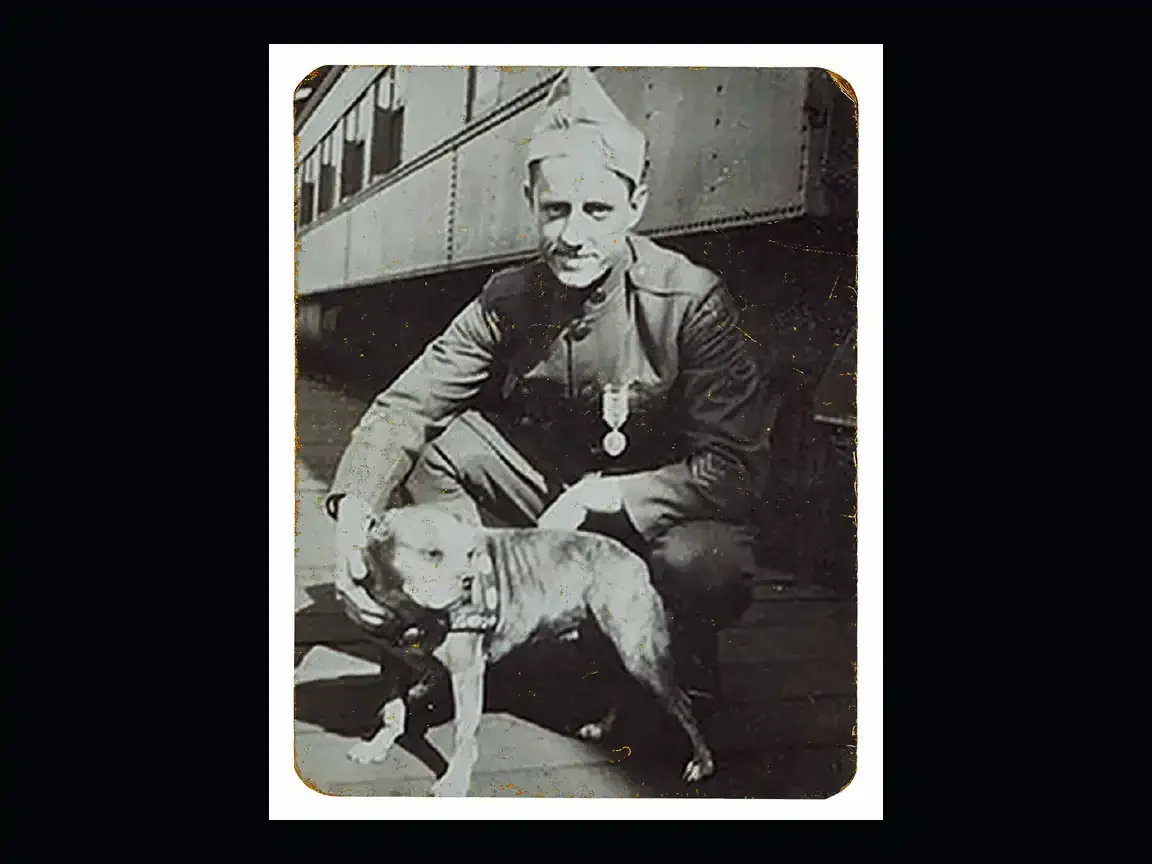
Conroy and Sgt. Stubby in France, Stubby’s Scrapbook, Smithsonian Institution CC0.
This sensitivity would soon prove invaluable. Gas attacks were often launched at dawn, when troops were asleep and slow to react. On more than one occasion, Stubby detected the faintest trace of gas before human senses registered danger. He ran through the trenches barking and biting at sleeping soldiers, giving early warnings and buying crucial seconds. Men woke coughing but alive.
Stubby’s role expanded beyond warning. He learned to recognize wounded soldiers lying between the trenches in No Man’s Land, responding to their voices and leading medics to their positions. He became a familiar sight at aid stations, moving among the injured, tolerated where few others were allowed.
Throughout this period, Conroy remained Stubby’s anchor. He romped and roamed between the various units of the division, but he returned consistently to the man who had brought him to France. In all his varied wanderings he only lost contact with his division three times and on all three occasions he managed to return unharmed after a few days absence.
Wounds, Capture, and Promotion
On 20 April 1918, during fighting near Seicheprey, Stubby was wounded by shrapnel from a German hand grenade, sustaining injuries to his chest and leg. He was evacuated, treated, and recovered. An experience mirrored by thousands of soldiers around him.
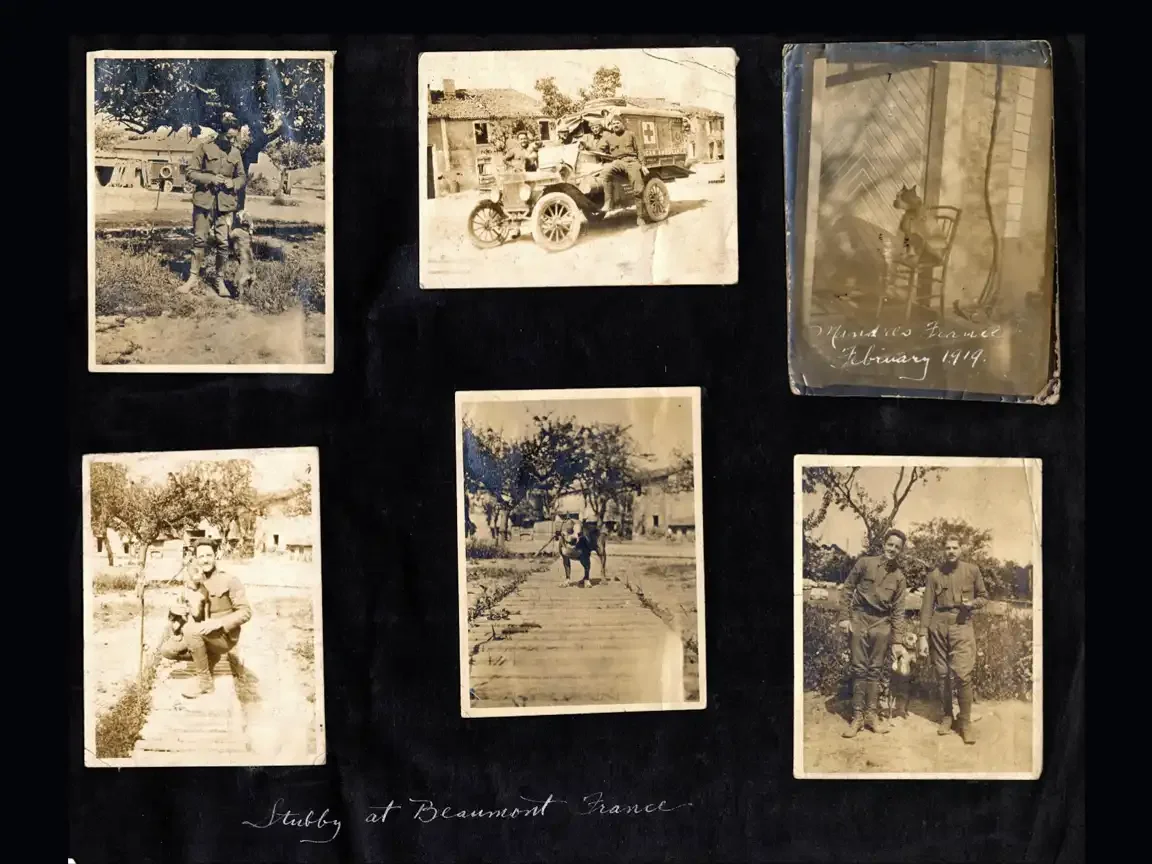
Photos of Conroy and Sgt. Stubby in France, Stubby’s Scrapbook, Smithsonian Institution CC0.
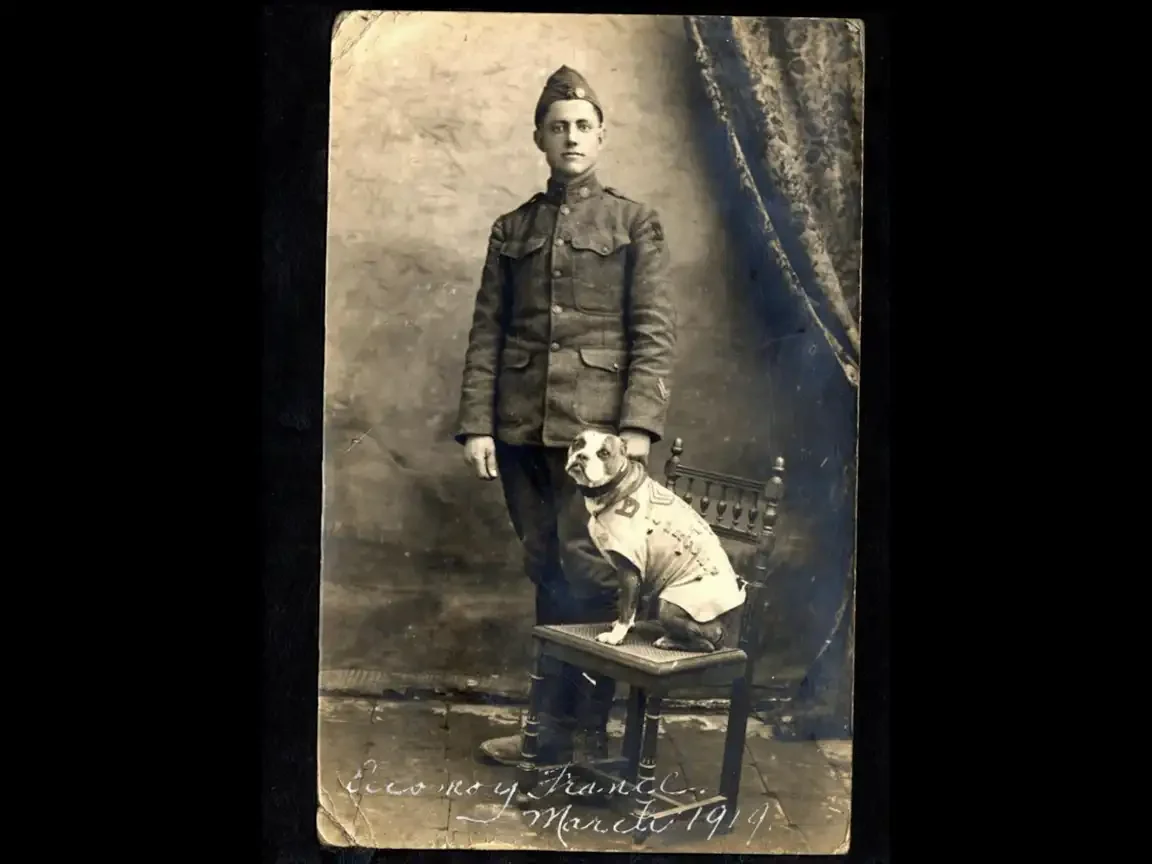
Conroy and Sgt. Stubby, March 1919, France, Stubby’s Scrapbook, Smithsonian Institution CC0.
Later that year, during the Argonne fighting, Stubby became involved in the episode that would define his legend. Encountering a German soldier attempting to gather intelligence near Allied lines, Stubby barked and chased him as he fled. The dog caught the man by the seat of his trousers and held him until American soldiers arrived. For this act, Stubby was promoted to sergeant, an honorary rank, but one acknowledged formally within the regiment.
By the end of the war, Stubby had participated in seventeen battles across four major offensives on the Western Front. His service was neither symbolic nor ceremonial. He endured the same environment as the men he served alongside, and his actions had tangible effects on their safety.
Medals and Decorations: A Uniform of Honors
The most arresting visual record of Stubby’s career is the chamois blanket he wore in later life, decorated with fancy needlework done by women of France, now preserved in the Smithsonian. It is not a costume assembled for effect, but a working garment to which honors were added over time. It is decorated with various badges, medals and insignia, listed below.
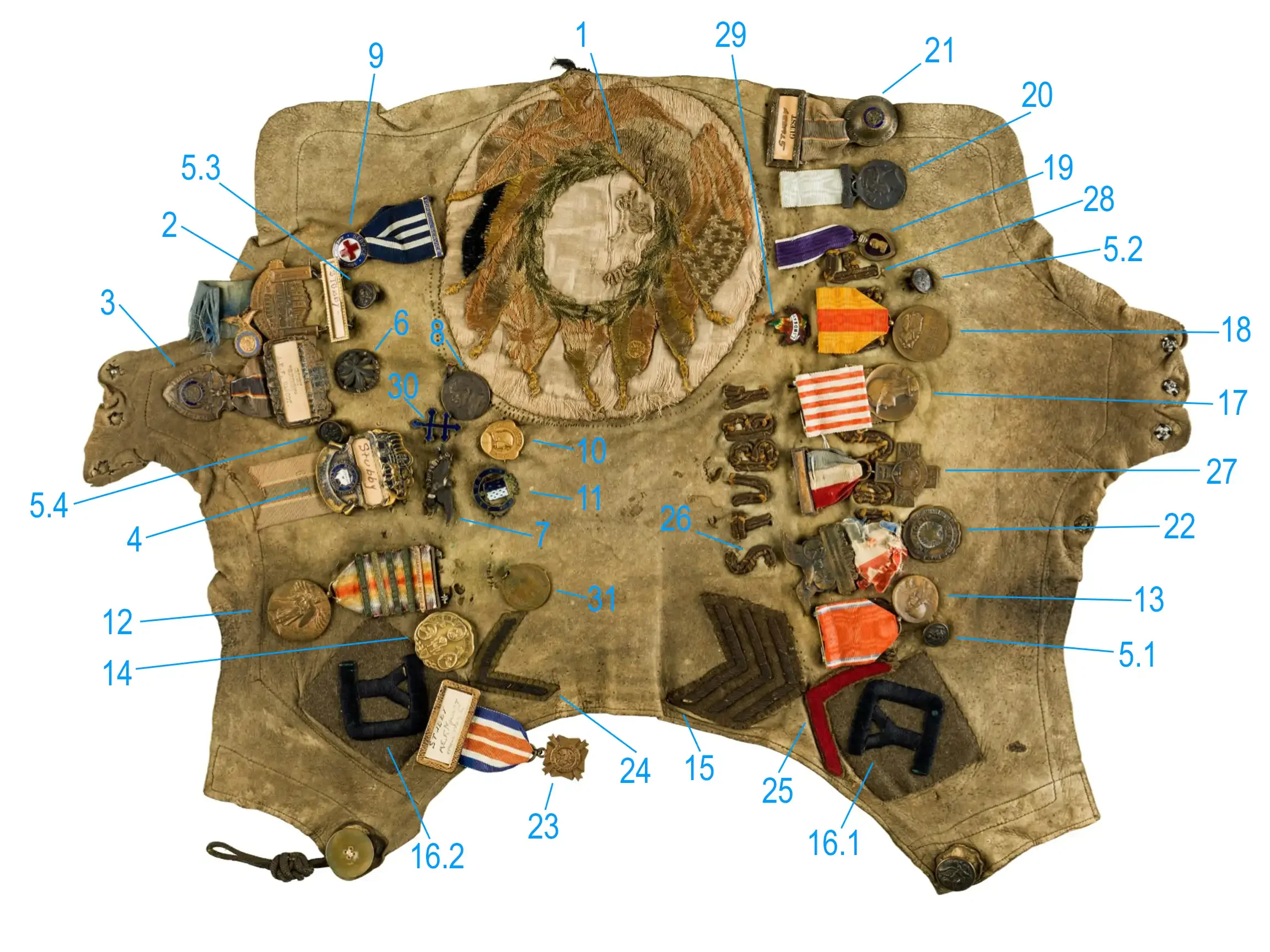
Blanket worn by Sgt. Stubby, Smithsonian Institution CC0. The following medals, badges and insignia are attached to the blanket: 1. Victory patch (embroidered wreath-flags of allies) 2. American Legion (New Orleans) 3. American Legion (Kansas City) 4. American Legion (Omaha) 5. US Army General Service button (there are 4) 6. Chatillon badge 7. Ste Genevieve French campaign badge 8. Marshal Foch Commander in Chief of the Allied Forces 1918 patriotic medal 9. American Red Cross badge 10. Jeneanne D'Arc badge 11. Brest medal 12. WWI Victory medal with five campaign clasps - Champagne-Marne, Aisne-Marne, St. Mihiel, Meuse-Argonne and Defensive Sector 13. NE PASSE PAS (They Shall Not Pass) medal front commemorating the Battle of Verdun 14. Stubby, May 13, 1921 badge 15. WWI 3-year service stripe, enlisted man 16. 26th Yankee Division patch (there are 2) 17. Republique Francaise medal 18. St. Mihiel French campaign medal 19. Miniature Purple Heart, retrospectively awarded after the medal’s formal establishment in 1932, replacing an earlier wound stripe for injuries sustained at Seicheprey 20. Chateau Thierry/Cote 204 badge 21. St. Paul Minnesota American Legion Convention badge 22. Minneapolis American Legion Annual Convention badge 23. Stubby A.E.F. Mascot World War I identification tag 24. WWI wound stripe 25. U.S. Army honorable discharge chevron 26. Stubby braided cord 27. New Haven cross of service in WWI 28. Stubby 102nd US braid sewn to fabric 29. Lindsay Canadian maple leaf 30. Cross of Lorraine, WWI, 79th Infantry Division 31. NE PASSE PAS (They Shall Not Pass) medal back commemorating the Battle of Verdun.
For a time, Stubby also wore a captured German Iron Cross on the rear of his blanket, taken from the soldier he apprehended in the Argonne. This artefact is no longer attached to the display.
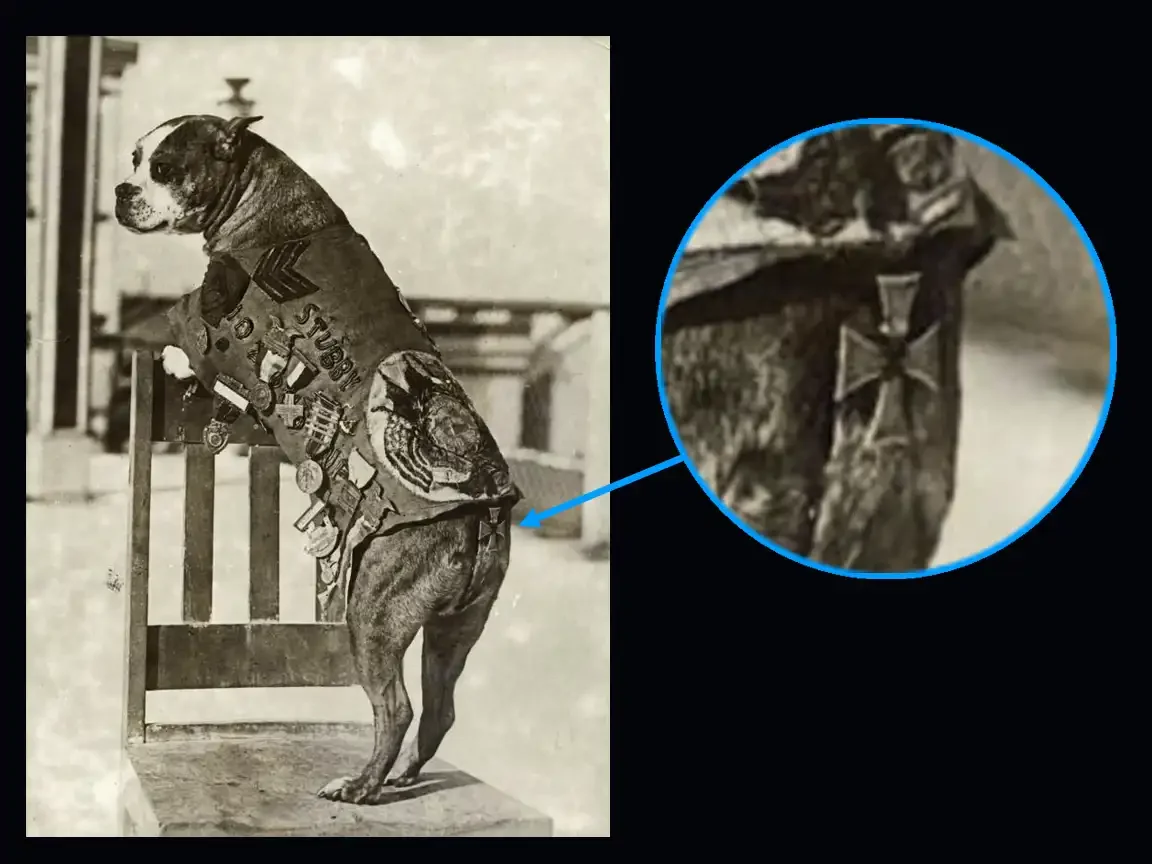
Sgt. Stubby with a captured German Iron Cross on the rear of his blanket, National Archive, Public domain, via Wikimedia Commons.
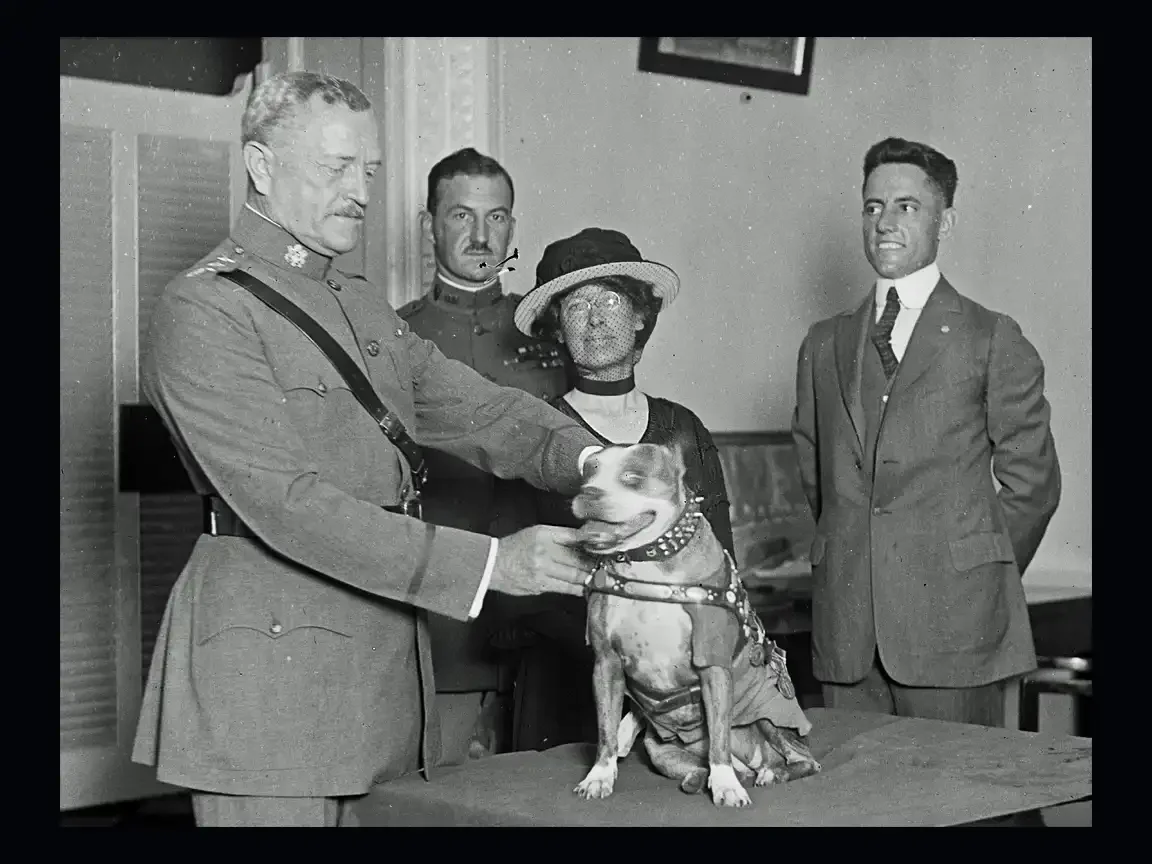
Gen. John J. Pershing awards Sgt. Stubby a Humane Society medal, 1921, Conroy on the right. Photo by Harris & Ewing, Public domain, via Wikimedia Commons.
By any contemporary measure, Sergeant Stubby was the most decorated dog of war. No other military dog has matched his combined breadth of honors and length of continuous front-line combat service in the First World War.
After the War: Fame Without Separation
When the war ended, Stubby returned to the United States with Conroy. Unlike many wartime mascots, he was not quietly retired. Instead, he became a public figure at a moment when the nation was eager for symbols of endurance and loyalty.
Stubby led victory parades, appeared at American Legion events, and met three presidents: Woodrow Wilson, Warren G. Harding, and Calvin Coolidge.
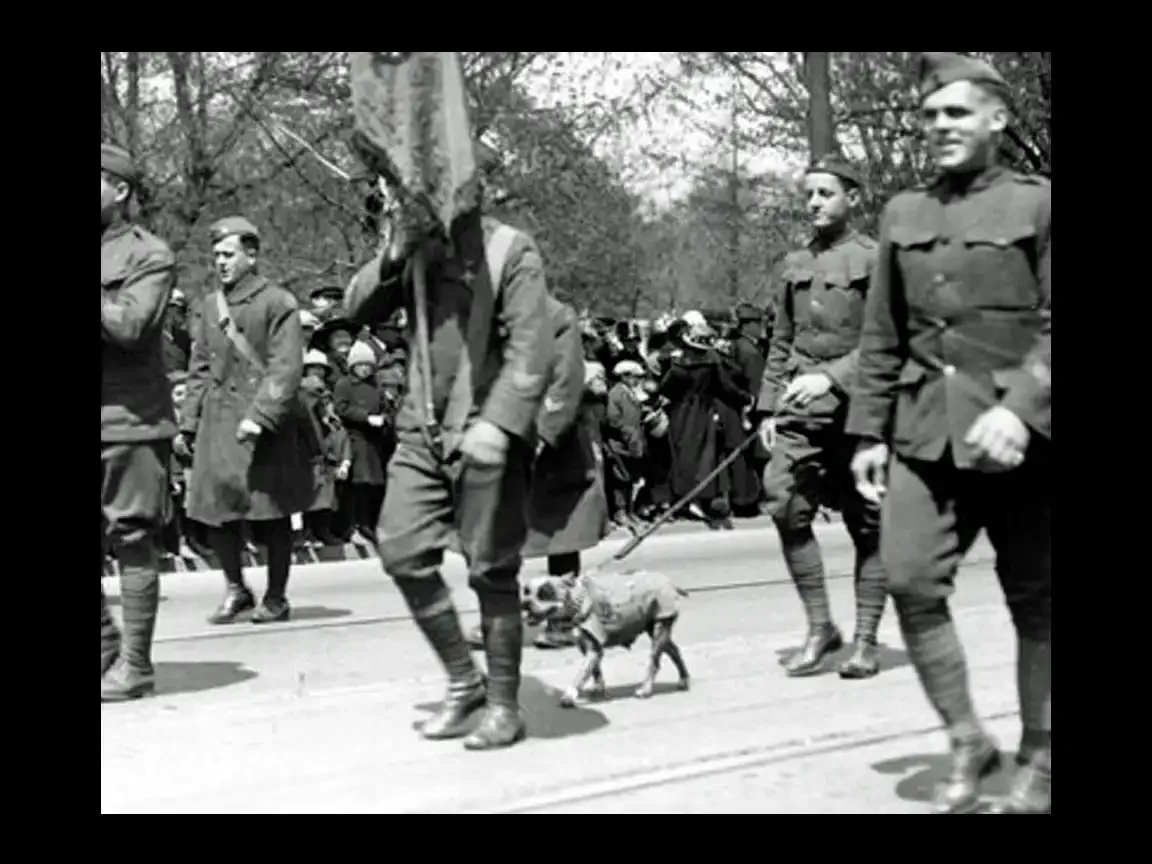
Sgt. Stubby walking in a Homecoming Parade for World War I Veterans 1919. Public domain.
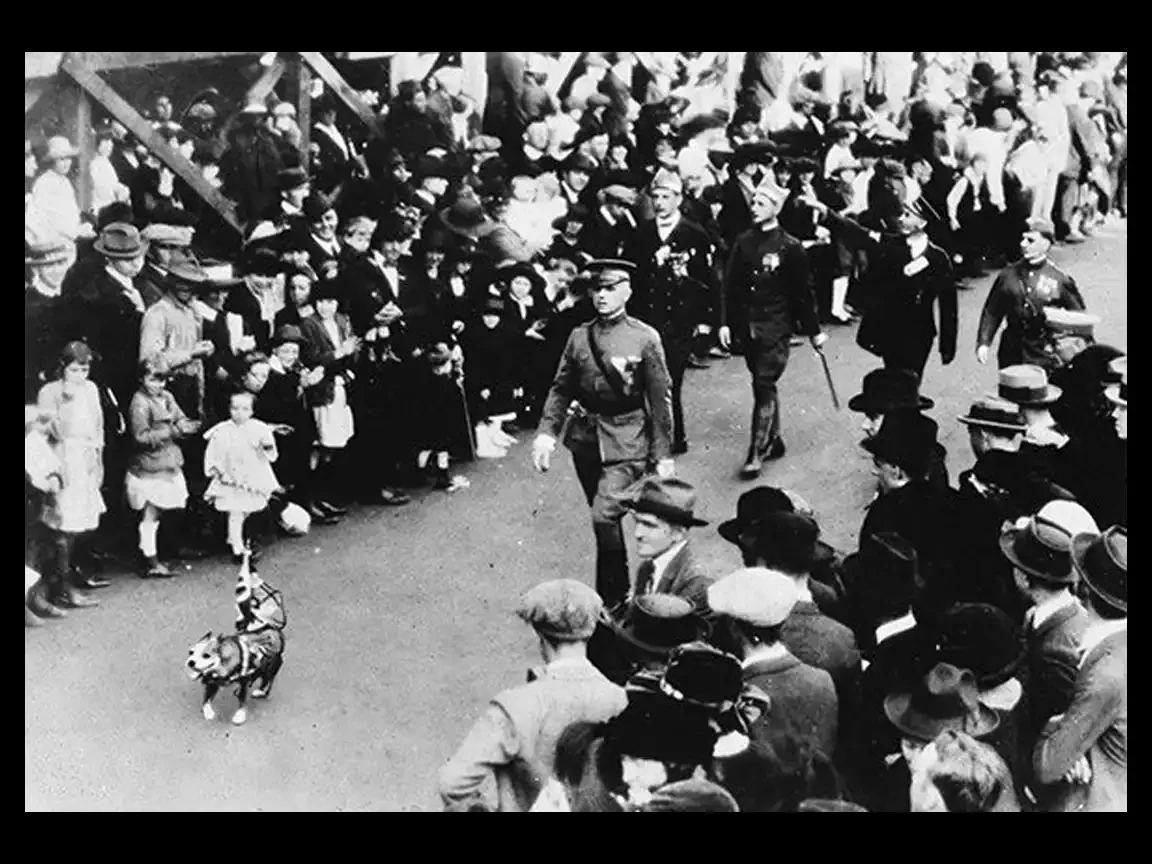
Sgt. Stubby proudly leading American Legion parade at National Convention, Stubby’s Scrapbook, Smithsonian Institution CC0.
Newspapers followed his movements with enthusiasm. In 1919, he marched at the head of the 102nd Infantry in review, his coat already heavy with medals.
Conroy, meanwhile, resumed civilian life. He enrolled at Georgetown University to study law, and Stubby went with him. The dog became the university’s unofficial mascot, attending football games and appearing at public events. He slept in Conroy’s room, followed him across campus, and adjusted once again to a new routine.
What did not change was their proximity. Stubby’s post-war fame did not separate him from Conroy, nor did Conroy seek to trade on the dog’s reputation beyond what circumstances required.
Legacy: Memory, Preservation, and Meaning
Death and Burial
Stubby died peacefully at midnight on March 16, 1926 in Washington DC, in Conroy’s arms. His death prompted an outpouring of coverage unusual for an animal. The New York Times published a half-page obituary, printed on April 4, 1926, an extraordinary gesture that reflected Stubby’s unique place in public memory as a veteran rather than a curiosity.
Stubby was not buried in a public monument. Instead, his body was preserved by taxidermy by scientists of the Smithsonian Institute. This was in keeping with the practices of the time and with Conroy’s desire to see his companion remembered accurately rather than sentimentally.
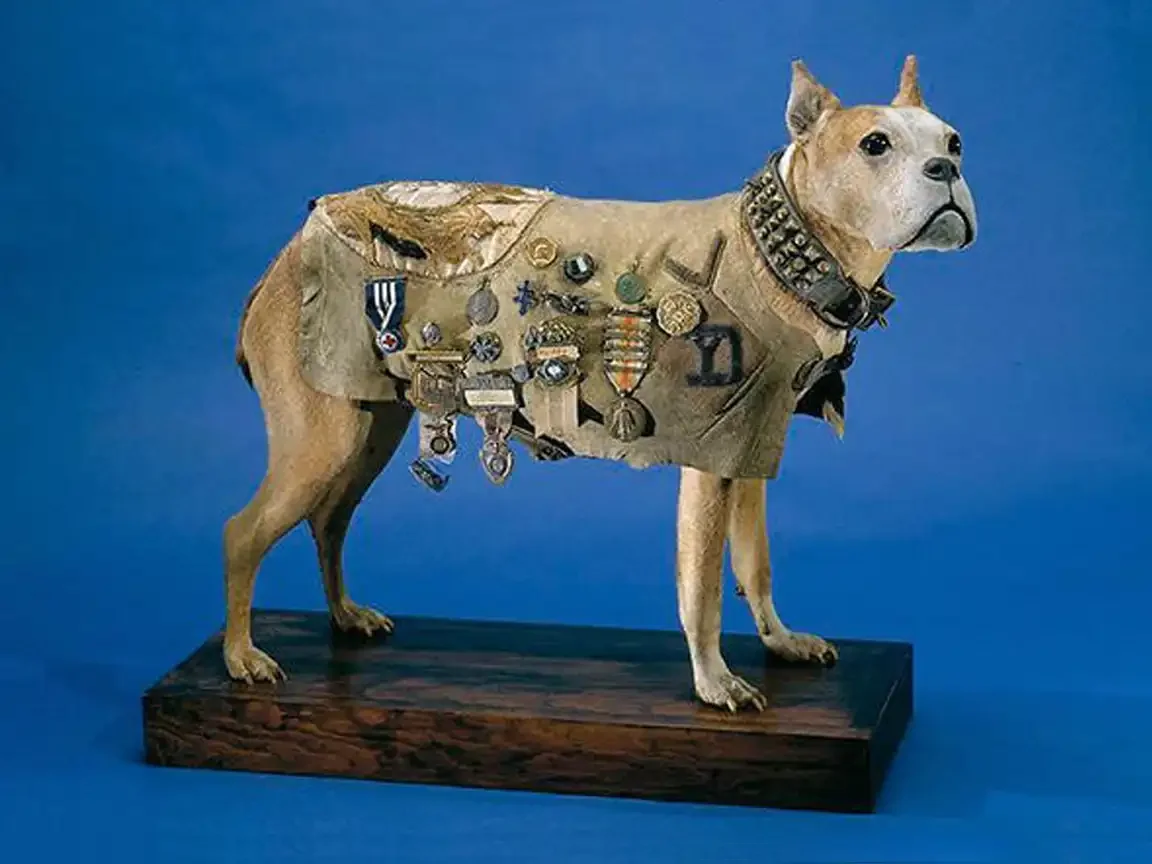
Sgt. Stubby preserved via taxidermy, front, National Museum of American History, Smithsonian Institution CC0.
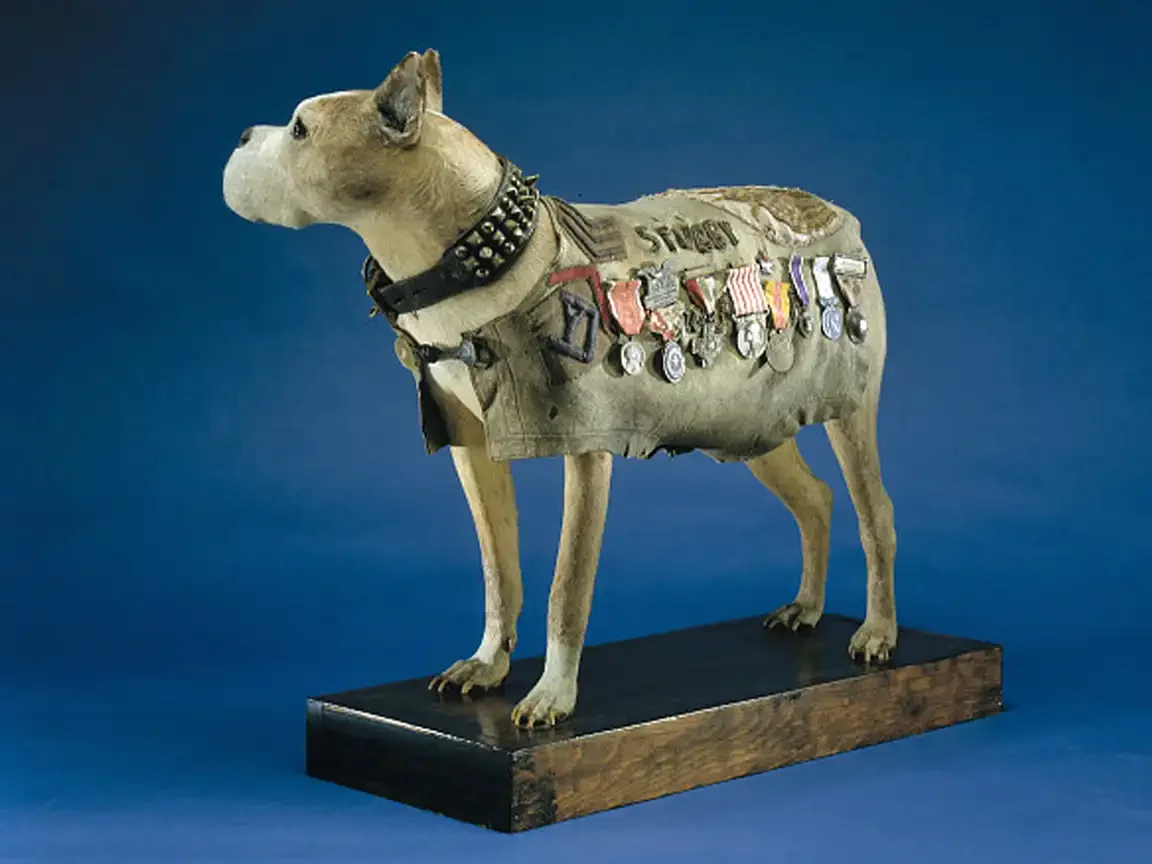
Sgt. Stubby preserved via taxidermy, back, National Museum of American History, Smithsonian Institution CC0.
The Smithsonian and Historical Context
Stubby’s preserved remains are held by the Smithsonian National Museum of American History, where they form part of the exhibition The Price of Freedom: Americans at War.
His inclusion is not novelty driven. It acknowledges that animals, too, were participants in industrial warfare, and that their stories illuminate aspects of human experience otherwise overlooked.
The Smithsonian also holds Conroy’s meticulously compiled scrapbook, a primary source that anchors Stubby’s story in documentation rather than folklore. Letters, photographs, programs, and press clippings provide a verifiable record of the dog’s service and public life, helping historians separate fact from embellishment.
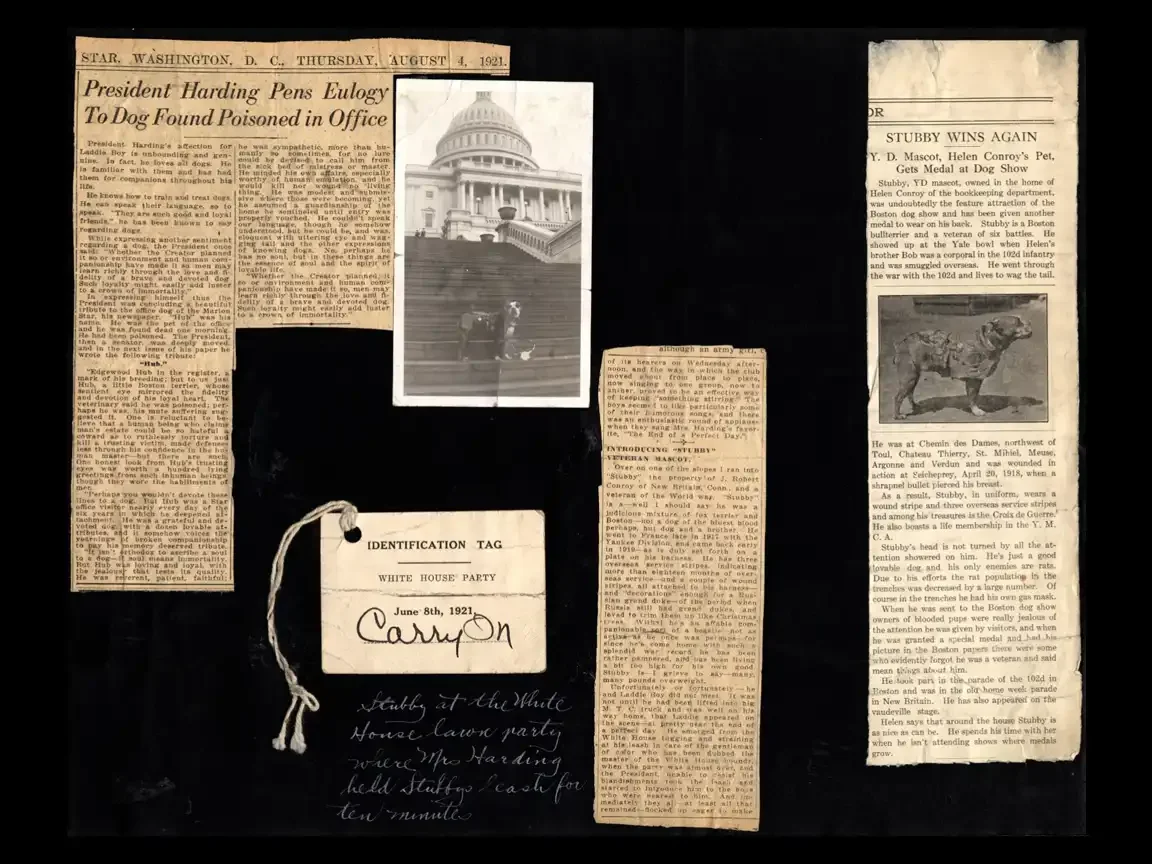
Page from Stubby’s Scrapbook, Smithsonian Institution CC0.
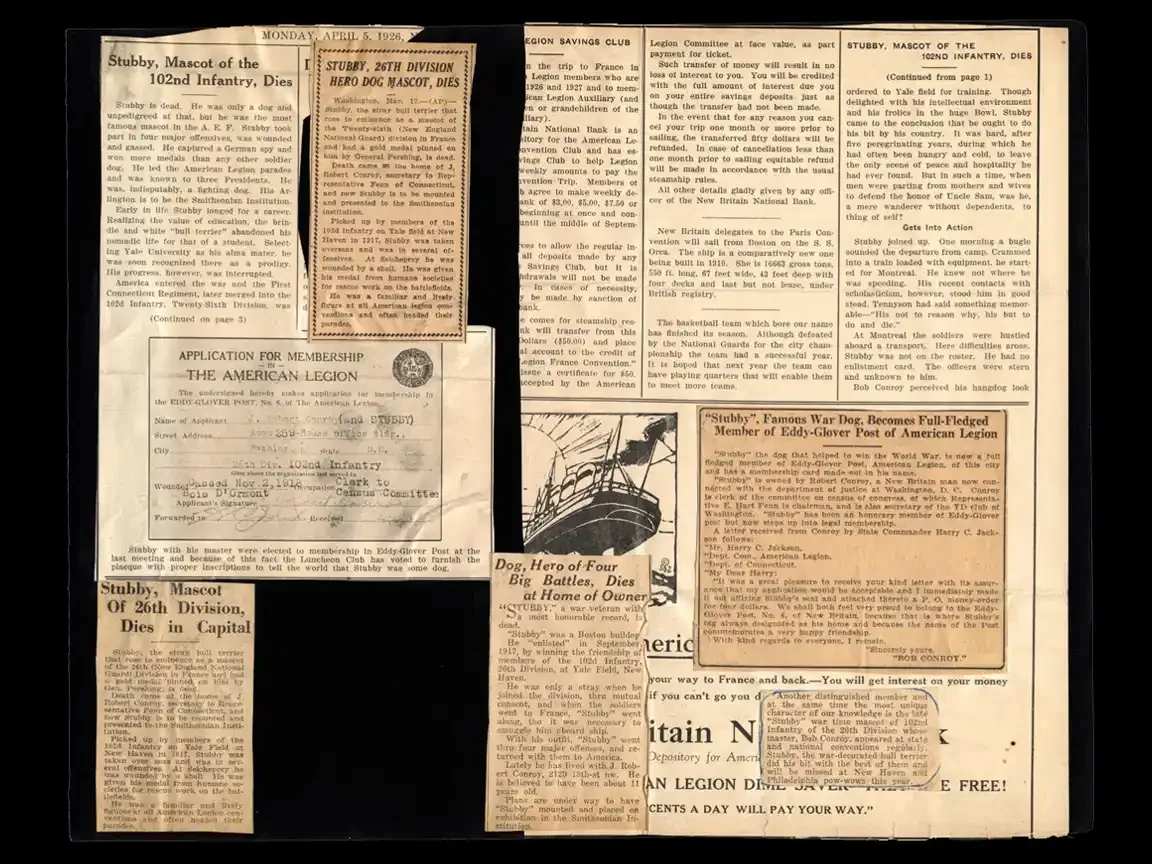
Page from Stubby’s Scrapbook, Smithsonian Institution CC0.
Comparison with Other War Dogs
Stubby’s reputation has inevitably invited comparison. In the Second World War, dogs such as Chips, decorated and later controversially stripped of honors, performed similar roles. Yet Stubby’s context was different. He operated before formal canine units were established, before protocols governed animal service. His actions were improvisational, his status ambiguous, his recognition earned piecemeal.
This combination, early adoption, extensive combat exposure, and sustained public recognition, remains unique.
Books, Films, and Memorials
Stubby has been the subject of numerous books, both scholarly and popular, and in 2018 his story reached a new audience through the animated film Sgt. Stubby: An American Hero, which, while simplified, adhered closely to the historical record.
Physical memorials also exist, including statues and plaques in Connecticut and elsewhere, often emphasizing Stubby’s service rather than sentiment. Each serve as a point of entry into a wider conversation about memory, war, and companionship.
A Measured Kind of Heroism
Sergeant Stubby’s story endures not because it is extraordinary, but because it is specific. He was not a symbol invented after the fact, nor a mascot confined to safe spaces. He lived alongside soldiers, suffered their dangers, and returned with them when the war ended.
The bond between Stubby and James Robert Conroy was central to this story. It was shaped by shared conditions rather than grand gestures. In a conflict defined by separation and loss, their continuity stands out.
Stubby does not represent all war dogs, nor should he. But he offers a rare lens through which to view the First World War at eye level: close to the ground, alert to danger, and sustained by companionship rather than ideology.
What breed was Sergeant Stubby?
Sergeant Stubby’s exact breed is unknown. Most historians and canine experts describe him as a mixed-breed dog, commonly thought to have had Boston Terrier or bull-type terrier ancestry. This assessment is based on his brindle coat, stocky build, short muzzle, and upright ears, which were visible in contemporary photographs and preserved remains.
In newspaper reports from the 1920s often referred to as a Boston bull terrier, and Stubby was awarded a special prize by the Washington Boston Terrier Club on March 7, 1921.
Did You Know?
Stubby had his own set of “dog tags” - two aluminum discs bearing his name and serial number.
Stubby learned to recognize and respond to multiple bugle calls.
The French gas mask first made for Stubby wouldn’t fit, and another was never procured.
His promotion to sergeant was unique in U.S. military history, as no formal process for animal ranks existed at the time.
When a “leave ticket” was issued to Conroy, it always read “James R. Conroy and Stubby”.
Conroy’s scrapbook is considered one of the most complete archival records of an animal in wartime.
Stubby became a life member of the American Legion and the YMCA, honours rarely extended to animals. He was entitled to three bones a day and a place to sleep for the rest of his life.
Stubby was painted by famous artist Charles Ayre Whipple, who painted many high-ranking military officers.
Stubby’s story helped shape early public attitudes toward the recognition of military working animals.
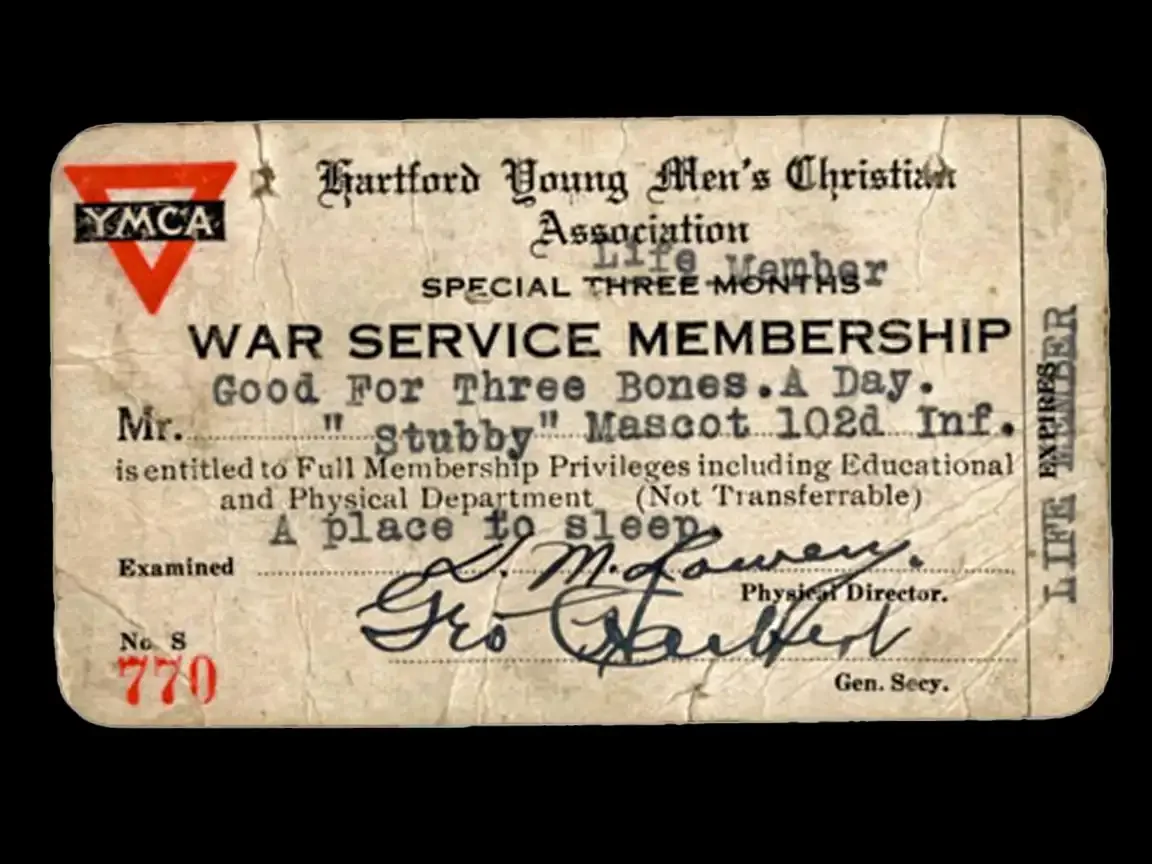
Sgt. Stubby’s YMCA membership card, Stubby’s Scrapbook, Smithsonian Institution CC0.
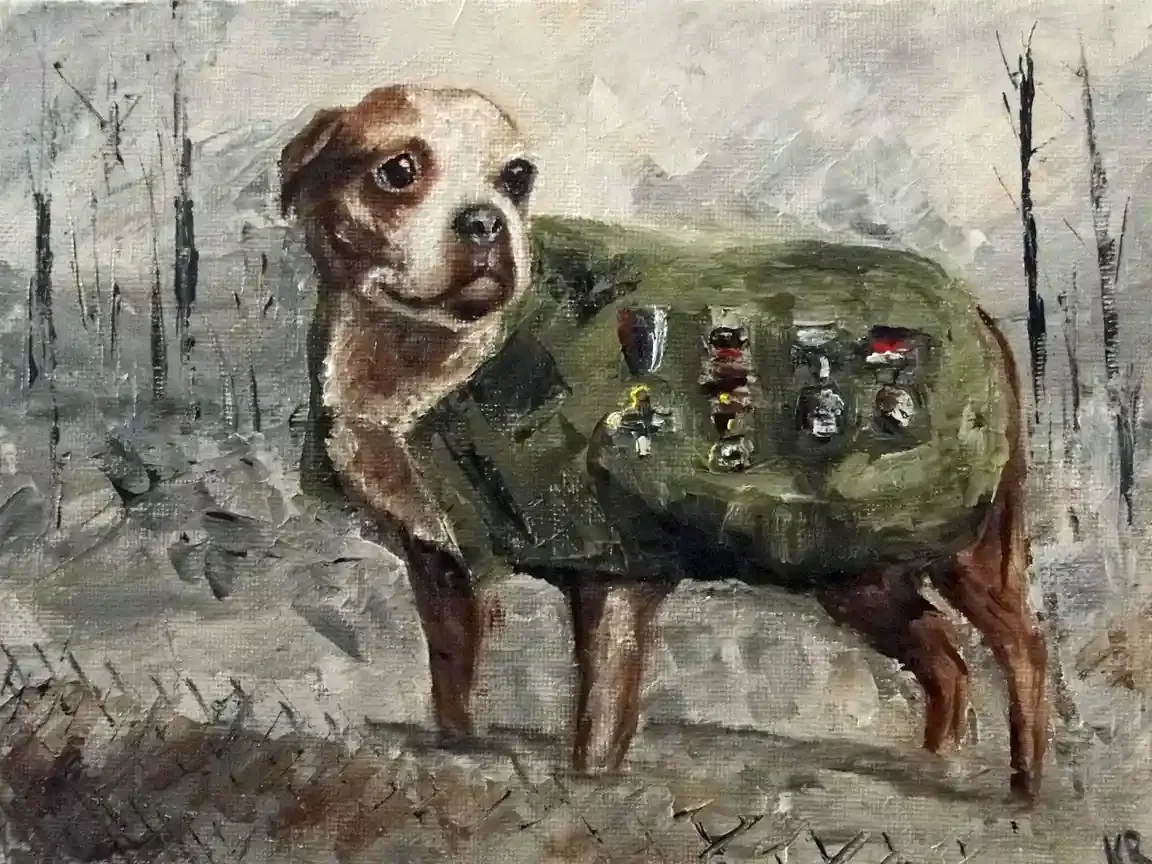
Sgt. Stubby painted by Charles Ayer Whipple. Public domain.
Breed: Boston Terrier | Country of origin: United States | First use: Fighting | Origins: 19th century