Pal: The Stunt Double Who Became Lassie
Rejected as only pet quality, given away for ten dollars, and overlooked by MGM, Pal seemed an unlikely candidate for stardom. Then one river scene changed everything, turning an unwanted rough collie into the original Lassie and one of Hollywood's most famous dogs.
Pal, the dog MGM turned down, with Roddy McDowell now selling the picture. Restored photograph from September 1943 Good Housekeeping magazine advertisement for the film Lassie Come Home.
In the summer of 1942, a rough collie named Pal was turned down for the part of Lassie. The studio recorded four faults against him: he was male, his eyes were too large, his head was too flat, and a white blaze ran down his forehead. He was kept on to do the stunts.
The Star They Overlooked
Pal was born on June 4, 1940, at Cherry Osborne’s Glamis Kennels in North Hollywood, with a pedigree running back to Old Cockie — the Victorian dog from whom most of the modern rough collie’s appearance descends. None of it helped him.
The kennel graded him pet quality. It is the verdict given to a dog whose conformation will not stand up in a show ring, and it is a judgment about the animal’s face and frame rather than his character. Among the faults recorded against him was the white blaze down his forehead. He was sold on accordingly, to a man named Howard Peck, who was an animal trainer himself and would shortly conclude that he had been sold a problem.
The Ten-Dollar Comeback
Rudd Weatherwax and the dog he took against an unpaid ten-dollar training bill, gave away, then bought back for ten dollars more. Photo: Batten, Barton, Durstine & Osborn. Public domain, via Wikipedia Commons.
At eight months Pal arrived at the Studio Dog Training School in North Hollywood, which Rudd Weatherwax had opened in 1940 with his brother Frank. The complaints were ordinary and comprehensive. He barked without stopping. He chewed whatever was in reach. He would not housebreak. He chased motorcycles. The fee was ten dollars for a week.
Weatherwax was by then among the busiest animal men in Hollywood — Asta in the Thin Man pictures, Daisy in the Blondie series — and boarding other people’s difficult pets was sideline work. He thought Pal exceptionally intelligent. He could not stop him chasing motorcycles.
Peck declined to take the dog back and settled his training bill with him instead. Weatherwax, who saw no screen career in the animal, gave him away to a friend. When he heard that MGM had bought Eric Knight’s novel, Lassie Come Home, he went and bought Pal back for ten dollars — the same sum the failed training had cost.
The Lassie MGM Overlooked
Marguerite Kirmse's collie for the 1940 first edition. No white on the forehead, which is why MGM's objection to Pal's blaze was fair. Jacket: John C. Winston Company, 1940. Public domain.
The Lassie of Knight’s book is a she. She had appeared first as a short story in The Saturday Evening Post in December 1938 and then, expanded, as a novel in 1940: a collie sold away from a Yorkshire family that could no longer feed her, walking hundreds of miles back to the boy who owned her.
MGM saw roughly fifteen hundred collies for the part. A prize-winning female show collie took the role, Weatherwax was hired to train her, and Pal was kept on as her backup and stunt dog. Weatherwax had read the script and did not believe the cast dog could do what it asked.
Pal being male was a fair objection, and so was the white blaze — Marguerite Kirmse's collie, painted for Knight's first edition and the only Lassie the reading public had yet seen, carries no white on the forehead at all. MGM looked at Pal and marked him down. Within a decade it was the most recognizable animal face in the world.
The Stunt Dog Stole the Scene
The take that changed the casting. Pal leaves the river without shaking the water off, exactly as Weatherwax had trained him. Still: Lassie Come Home, Metro-Goldwyn-Mayer, 1943.
The sequence in question called for Lassie to cross a river and come out the far side too spent to move. According to the account Rudd’s son Bob gave the Chicago Tribune in 1989, the director, Fred M. Wilcox, chose to shoot it with the stunt dog rather than tire his leading dog. Other accounts differ. Some say a river had flooded and the production went to take advantage of the water. Some say the female was shedding heavily as the summer shoot ran on and a replacement was already being sought. A New York Times piece written while the film was still in production says Wilcox cast Pal after first rejecting him, having found no other dog with the near-human quality he wanted.
What every version agrees on is what happened in the water. Pal swam the river, hauled himself out, and did not shake the water off. He crawled a few feet, went over on his side, and lay still.
The not shaking is the detail everyone remembers, and it was not the dog’s idea. Weatherwax had trained him against it. Nor was Pal working alone out there. Weatherwax stood on the bank through the whole crossing, shouting and waving and moving — running right when the dog drifted left, calling him out of the water and onto his mark, easing him down at the end. Trainers who worked with him later described the method as constant motion and constant noise, all of it happening a few feet outside the frame. What the camera caught, and what put tears in the director’s eyes, was a directed performance by an animal his employers had ranked below the dog he was standing in for.
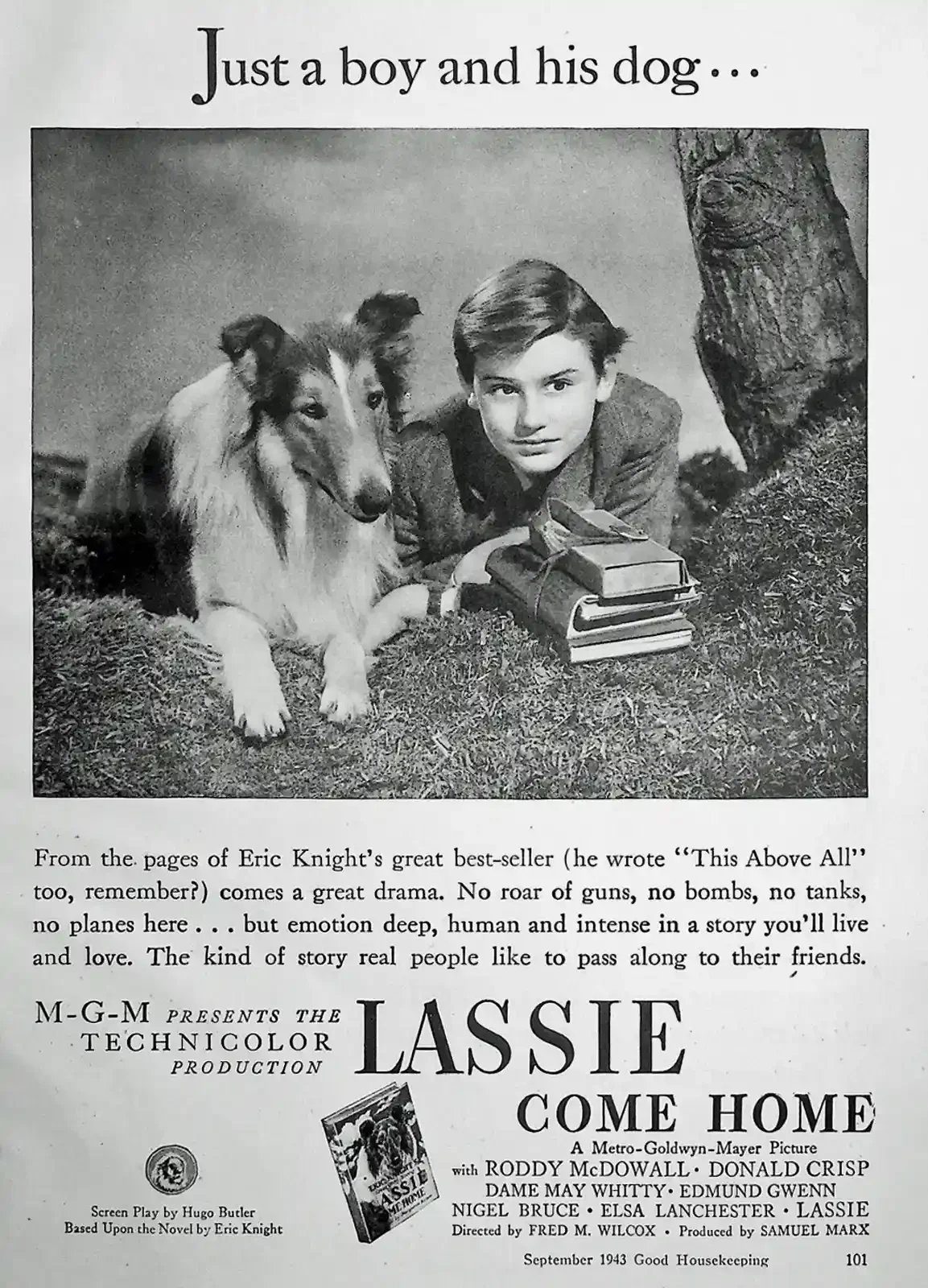
Advertisement: Metro-Goldwyn-Mayer, Good Housekeeping, September 1943
Wilcox ordered the first six weeks reshot with Pal in the part. MGM, which had planned a modest black-and-white children’s picture, upgraded it to Technicolor and gave it the full publicity apparatus. Lassie Come Home opened on October 7, 1943, with Roddy McDowall and an eleven-year-old Elizabeth Taylor, whom this advertisement did not name. MGM sold it on what it did not contain: no guns, no bombs, no tanks, no planes. In the third autumn of the war, a picture about a dog walking home returned a profit of more than two million dollars.
Why Lassie Was Always a Boy
The publicity department kept one fact back. The dog carrying the picture was male, and the studio saw no advantage in saying so. It did not hold for long. Groucho Marx was soon joking that the discovery had confirmed the public’s worst suspicions about Hollywood, and Weatherwax put the matter in print himself in 1950, in a book about the dog’s training.
What did hold was the casting. Every dog credited as Lassie since 1943 has been male. The reason usually given is that male collies carry a fuller coat through the summer and photograph more consistently across a long shoot. A second reason came later, once the work moved to television: a male collie is the bigger animal, and a bigger dog keeps a growing child actor looking small for another season or two. Both are real considerations. Neither was the reason.
There was never a decision. A director spared his leading female dog a cold river, the male stand-in did the scene, and the studio kept him. The explanations came afterward, the way they do once a habit needs defending. Bob Weatherwax was still giving a reporter the one about summer coats in 1989, forty-seven years on.
The Gamble on Lassie
By 1954 the dog was attending the meetings. Pal with a sponsor's executive, the year Lassie reached CBS and the ten-thousand-dollar gamble paid. Credit: Batten, Barton, Durstine & Osborn for the show's sponsor, Campbell's Soup. Public domain, via Wikimedia Commons.
Six more MGM features followed, ending with The Painted Hills in 1951. The studio then decided the character had run its course and told Weatherwax his services were no longer required. He got MGM to sign the rights to the Lassie name over to him in lieu of his final year’s salary — about seventeen and a half thousand dollars, and a few dollars.
The trade is usually told as a masterstroke. His son’s account is plainer, and less flattering. Rudd Weatherwax did not foresee television. He wanted the name so that he could keep touring personal appearances with the dog, and he reckoned Pal was good for another five or six years.
For the next two years the two of them worked the road. Weatherwax built an eighteen-minute act and took it to dog shows, county fairs, rodeos, and department stores, which was exactly what he had wanted the name for. At one appearance he stepped away from a ring of children for a moment and came back to find a boy cutting hair from the dog’s coat; asked what he thought he was doing, the child explained the going rate — one lock of Lassie traded for three autographed pictures of Lana Turner.
What he had failed to see in 1951, he saw within two years. He put up ten thousand dollars of his own money and gave his services free to get a television pilot made and sold —a bet on a character MGM had written off. Lassie went on CBS on September 12, 1954, and ran for 591 episodes across nineteen seasons.
When the boy had to be cast, Weatherwax narrowed it to three and let Pal decide, keeping the candidates at the house for a week to see which one the dog went to. Pal chose Tommy Rettig, who got the part and who was allergic to dogs. Pal shot the two pilots and retired. His son, Lassie Jr., took over.
Pal Was Gone, but Lassie Went On
By 1957 Pal was going blind and deaf, stiff in the hips, and rarely came to the set. Jon Provost, the child actor then playing Timmy, said later that even at that age he could see what the old dog meant to Weatherwax.
Pal died at the North Hollywood house on June 18, 1958, at eighteen years old — sixteen years past the audition that rejected him, and a decade past the span his owner had allowed him. Weatherwax buried him privately in a marked place on the ranch and went back to the grave often. His son said the loss hit him very hard, and that he would never again watch an MGM Lassie picture. He could not bear to see Pal.
The work went on without interruption. Pal’s descendants carried the part for another fifteen years and the audience was never told, so that the dog on screen appeared to be one animal who would have been well past thirty by the final episode. Weatherwax maintained that fiction for the rest of his working life. He was the only person who always knew exactly which dog was in front of the camera, and the only one who could not watch.
Did You Know?
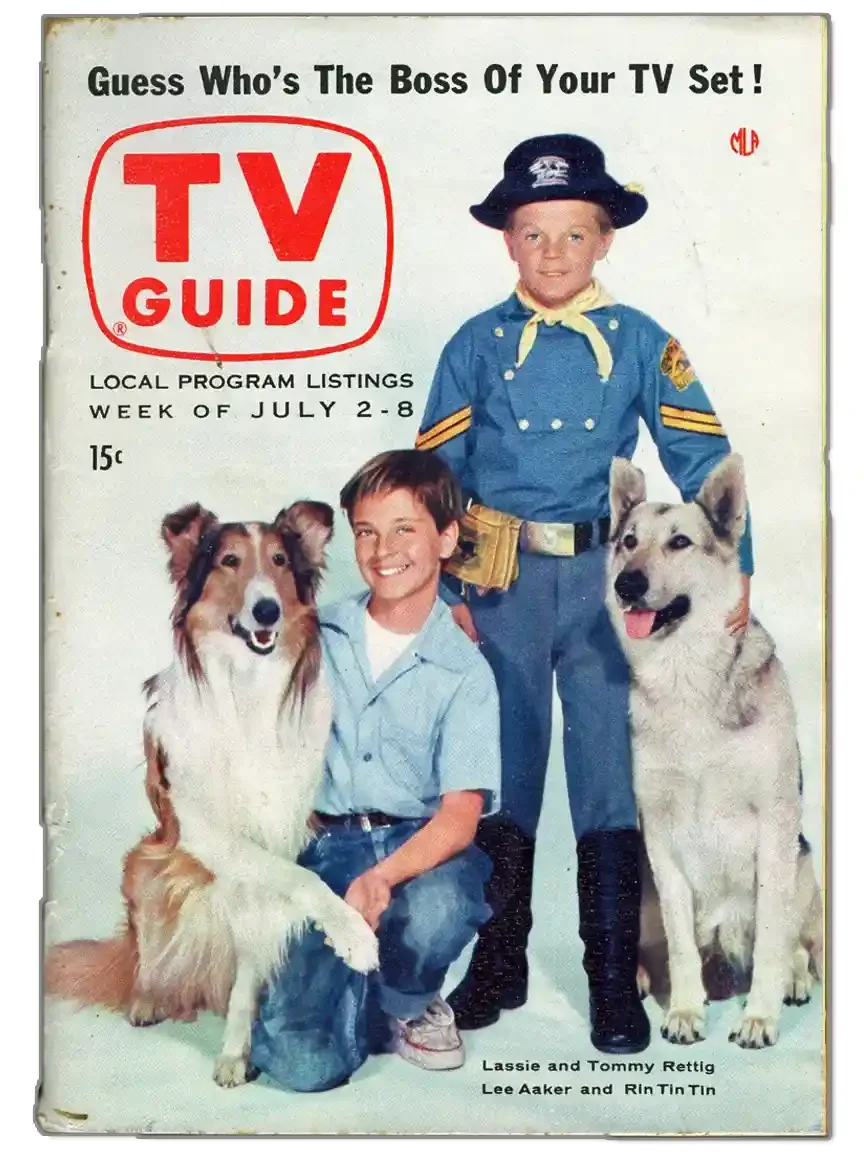
Two rival networks' biggest stars, sharing a cover. Lassie was CBS, Rin Tin Tin was ABC. TV Guide, week of July 2-8, 1955, Triangle Publications.
Eric Knight never saw the film Lassie Come Home. He died on January 15, 1943, when his plane went down over Dutch Guiana, nine months before the premiere. He had visited the set the previous year and met Pal.
The Lassie of the novel was modeled on Knight’s own collie, Toots, who waited at the gate of their Pennsylvania farm for him to come home from Washington. She is buried there.
The sum MGM avoided paying has never been settled. Retellings put it at $40,000; the family put it at about $17,500 and a few dollars.
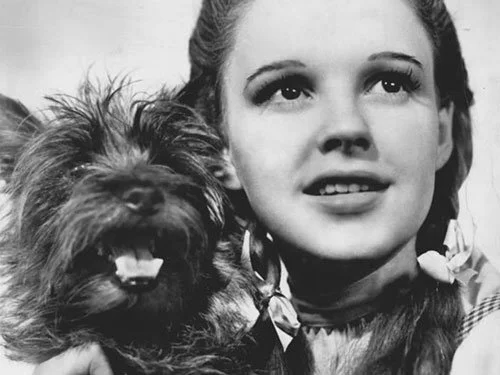
Rudd’s brother Frank trained Terry, the cairn terrier who played Toto in The Wizard of Oz. Two of the most recognizable dogs in film history came out of the same family’s kennels.
In July 1955 Lassie and Rin Tin Tin shared the cover of TV Guide, each sitting beside his own child co-star — Tommy Rettig and Lee Aaker.
Breed: Rough Collie | Country of origin: Scotland |First use: Herding and driving sheep | Origins: 17th century