Rin Tin Tin: The Dog Who Saved Warner Bros.
A US Army corporal found him in a bombed-out French kennel in 1918. Within five years, the dog was keeping a Hollywood studio solvent. The studio returned the favor by dropping him when sound arrived.
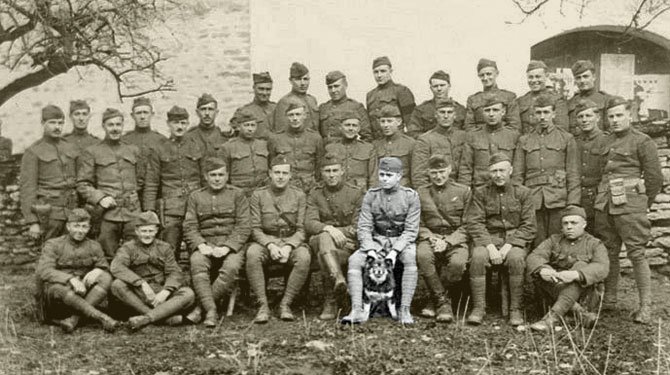
Lee Duncan (highlighted center, holding Rinty) with the 135th Aero Squadron, France, 1918. The puppy found in a bombed German kennel would change both their lives. Air Service, United States Army, Public domain, via Wikimedia Commons.
On September 15, 1918, a US Army corporal named Lee Duncan walked into the ruins of a German military kennel near the village of Flirey in northeastern France. The German forces had retreated. The dogs had been left behind. Among a litter of five newborn German shepherd puppies — their eyes not yet open — Duncan found the one he would name Rin Tin Tin.
Within five years, that dog would be the most popular film actor in Hollywood. Within ten, the studio that owed him its survival would drop him without ceremony.
An Orphan Finds an Orphan
Lee Duncan was born in 1892 in Hanford, California. His father left the family when he was five. His mother, unable to support two children alone, placed Lee and his sister in an Oakland orphanage in 1898. He spent several years there before she was in a position to bring them home. By the time he enlisted in November 1917 Duncan had long practice in making do with what he found.
He was assigned to the 135th Aero Squadron, one of the first American units sent to France. He served in the Battle of Saint-Mihiel. He was wounded, and awarded the Purple Heart. On September 15, 1918, in the aftermath of that engagement, he was sent ahead to assess whether the small village of Flirey might serve as an airfield for his unit's planes.
What he found instead was a bombed-out German war dog station: a female German shepherd lying exhausted in the rubble, and five puppies beside her, still blind. Duncan gave the mother and three pups to fellow soldiers. He kept two — a male and a female — and named them Rin Tin Tin and Nanette, after the small yarn dolls French children gave to American soldiers as good luck charms.
Having persuaded his commanding officer to help him smuggle both dogs aboard the homeward ship, Duncan set sail for New York. Nanette did not survive the crossing. A German shepherd breeder on Long Island gave him a replacement, and he arrived in Los Angeles with Rin Tin Tin and a new Nanette.
He would never be without a dog again.
Poverty Row, One Take at a Time
By 1922, Duncan was convinced he had something exceptional. Rinty — his nickname, never used formally — competed in Los Angeles dog shows and could clear a vertical jump of thirteen and a half feet. Duncan spent his evenings writing a screenplay built around the dog’s abilities and his instinct for dramatic reaction. He spent his days walking Hollywood’s Poverty Row, the strip of low-budget studios clustered on Gower Street, knocking on doors.
The first real break was accidental. A Warner Bros. film crew was shooting a scene for The Man from Hell’s River (1922) with a wolf that refused to cooperate with the director. Duncan was nearby. He offered his dog. Rinty did the scene in one take.
He was hired for the rest of the shoot. When it was done, Duncan went home and finished Where the North Begins — a screenplay he had written himself, shaped entirely around what he knew his dog could do. He took it to Warner Bros. The studio agreed to produce it.
The Mortgage Lifter
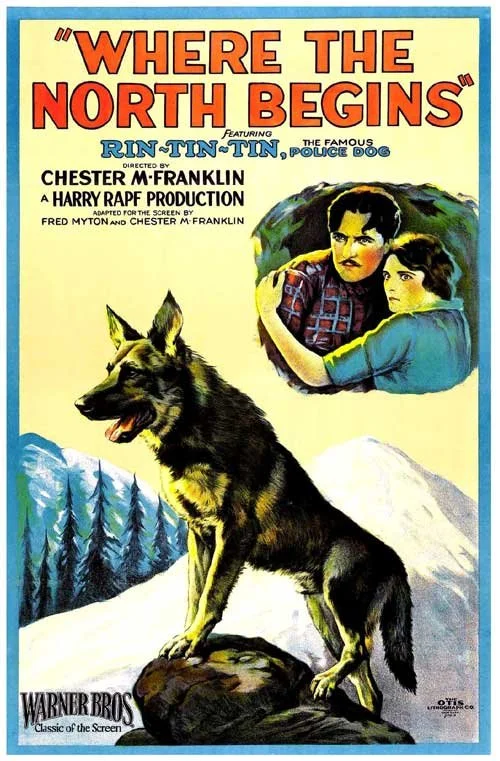
Lobby card for Where the North Begins (1923). Warner Bros-Lithograph by Otis Lithograph, Cleveland, Public domain, via Wikimedia Commons.
Warner Bros. in 1923 was not yet the studio it would become. The brothers — Harry, Albert, Sam, and Jack — had opened their Sunset Boulevard lot five years earlier and had spent the intervening years fighting for survival. As Jack Warner described it, the studio had a constant “lack of money, popular stars, and story ideas.” They were renting out equipment to other productions just to stay solvent.
Where the North Begins cost $100,000 to produce. It made $352,000.
Studio insiders called Rinty “the mortgage lifter.” The phrase was accurate. Warner Bros. signed Duncan and the dog to a contract: $1,000 a week, plus ten percent of net profits. They made film after film — each a reliable draw, each returning more than it cost. By 1927, Rin Tin Tin was the studio’s most bankable star.
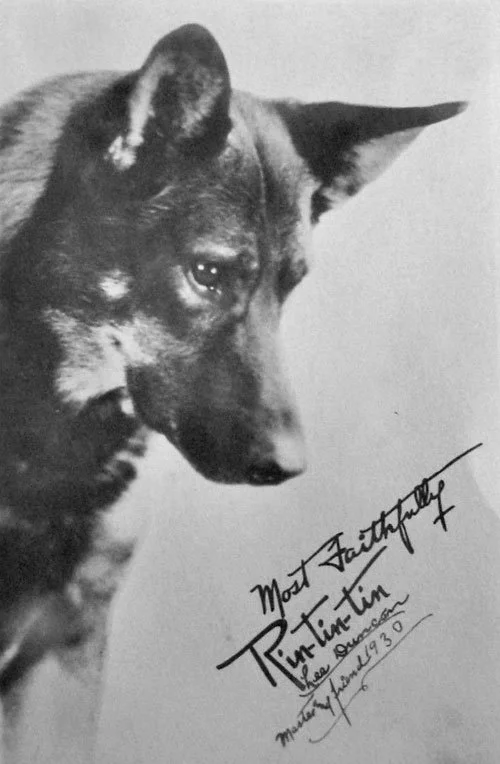
Photograph of Rin Tin Tin signed by Lee Duncan, 1930. It was a promotional photo for dog food company Chappel Bros. Inc, Rockford, IL. Public domain, via Wikimedia Commons.
Mayor Jimmy Walker gave him the key to New York City. Fan letters arrived by the thousands; each received a glossy photograph bearing a paw print and a line Duncan wrote by hand: Most faithfully, Rin Tin Tin.
At the height of his popularity, Warner Bros. employed eighteen trained stand-in dogs to reduce the strain on their star. Rinty had a private chef. Warner Bros. publicists claimed his daily lunch was tenderloin steak, served while a musician played classical music to ease the dog's digestion. His collar was lined with diamonds, which Duncan covered with a blanket whenever they left the studio.
A young screenwriter named Darryl F. Zanuck had been assigned to produce stories for the Rin Tin Tin films. He later said, with characteristic bluntness, that he had hated doing it. But the profits the dog generated carried Zanuck through the studio system, from screenwriter to producer to one of the most powerful executives in Hollywood. The man who resented the job owed much of his career to the dog he resented doing it for.
The Dog That Sound Forgot
The Jazz Singer opened in October 1927. It was not the first sound film, but it was the one that made the industry understand the era was over. Within two years, the silent picture was finished.
Rin Tin Tin’s problem was not his voice. Duncan trained him to respond to hand signals so that verbal commands wouldn’t register on the microphones during sound takes. The problem was the genre those films inhabited. The stories that had made Rinty famous — lone heroes, wilderness landscapes, physical feats without dialogue — were precisely the kind of stories audiences were walking away from. The Depression was tightening. People wanted gangsters, comedians, musicals. They did not want a silent German shepherd running through the snow.
In December 1929, Warner Bros. terminated Rinty’s contract. Six years after the dog had kept the studio solvent, the studio let him go.
Duncan took him to Mascot Pictures, a Poverty Row outfit — the kind of place he had started from. Rinty made a final 12-part serial, The Lightning Warrior, in 1931. He was thirteen years old.
A Bronze Casket and a Plain Wooden Cross
Rin Tin Tin died on August 10, 1932. Duncan heard him bark in an unfamiliar way and found him lying outside, barely alive. Regular radio programming was interrupted by a news bulletin. Newspapers across the country ran obituaries. An hourlong broadcast the following day traced his life.
Duncan buried him in the backyard in a bronze casket, with a plain wooden cross to mark the spot. He could not afford more. The Depression had taken most of what he had. The expensive Hollywood house he had been able to buy during Rinty’s peak years was already gone — lost to foreclosure.
What remained was the dog, the casket, and the cross.
The famous story about Rin Tin Tin — that he won the most votes for Best Actor at the first Academy Awards and was quietly passed over because the Academy didn’t want a dog to take the prize — is not true. The original ballots are preserved at the Academy’s Margaret Herrick Library, signed rather than secret, and none of them carries Rinty’s name. The story traces back to a satirical letter Darryl Zanuck wrote mocking the very idea of an industry awards ceremony. Jack Warner later recycled the joke as his real nomination ballot, and over decades the punchline hardened into legend.
The real story is smaller and less tidy. A man who spent part of his childhood in an orphanage found a litter of abandoned dogs on a battlefield, brought one home, trained it, wrote its first screenplay, and watched it save a studio that would one day discard them both. The dog died celebrated. The man buried him with what he could afford, then lost the house.
Duncan spent the rest of his life breeding Rinty’s descendants, giving puppies to anyone who asked. He died in September 1960, at a ranch in Riverside, California, which he had named El Rancho Rin Tin Tin.
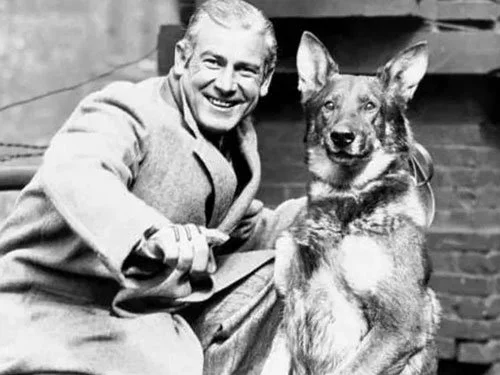
Lee Duncan with one of Rin Tin Tin's descendants, late 1950s. He spent the rest of his life breeding Rinty's line, giving puppies to anyone who asked. Public domain, via Wikipedia Commons.
Did You Know?
During World War II, Lee Duncan trained more than 5,000 war dogs for the US Army K-9 Corps at Camp Hahn, California — applying the same skills that had made Rinty famous.
The grave in Asnières, France long believed to be Rin Tin Tin’s belongs to a different German shepherd of the same name, owned by French entertainer Teddy Michaud. The original Hollywood Rinty’s actual burial site is now unmarked.
Rin Tin Tin’s films are credited with dramatically increasing German shepherd adoptions across America in the 1920s — a breed that, only a decade earlier, Americans had associated primarily with the German enemy.
Rin Tin Tin received a star on the Hollywood Walk of Fame on February 8, 1960 — eight months before Lee Duncan died.
Actor Jason Robards Sr. — father of the later stage and screen star — appeared in three Rin Tin Tin films and afterward complained to Jack and Harry Warner: “Is that nice? To make a man act with a dog?”
Breed – German Shepherd Dog | Country of Origin – Germany | First Use – Military and police work | Origins – 19th century