He is lying on a dung heap outside the palace gate when Odysseus arrives. Twenty years have passed. The greatest hero of the ancient world — who has outwitted the Cyclops, survived Scylla and Charybdis, and resisted the song of the Sirens — is disguised as a beggar. No one knows him. No one, that is, except the dog.
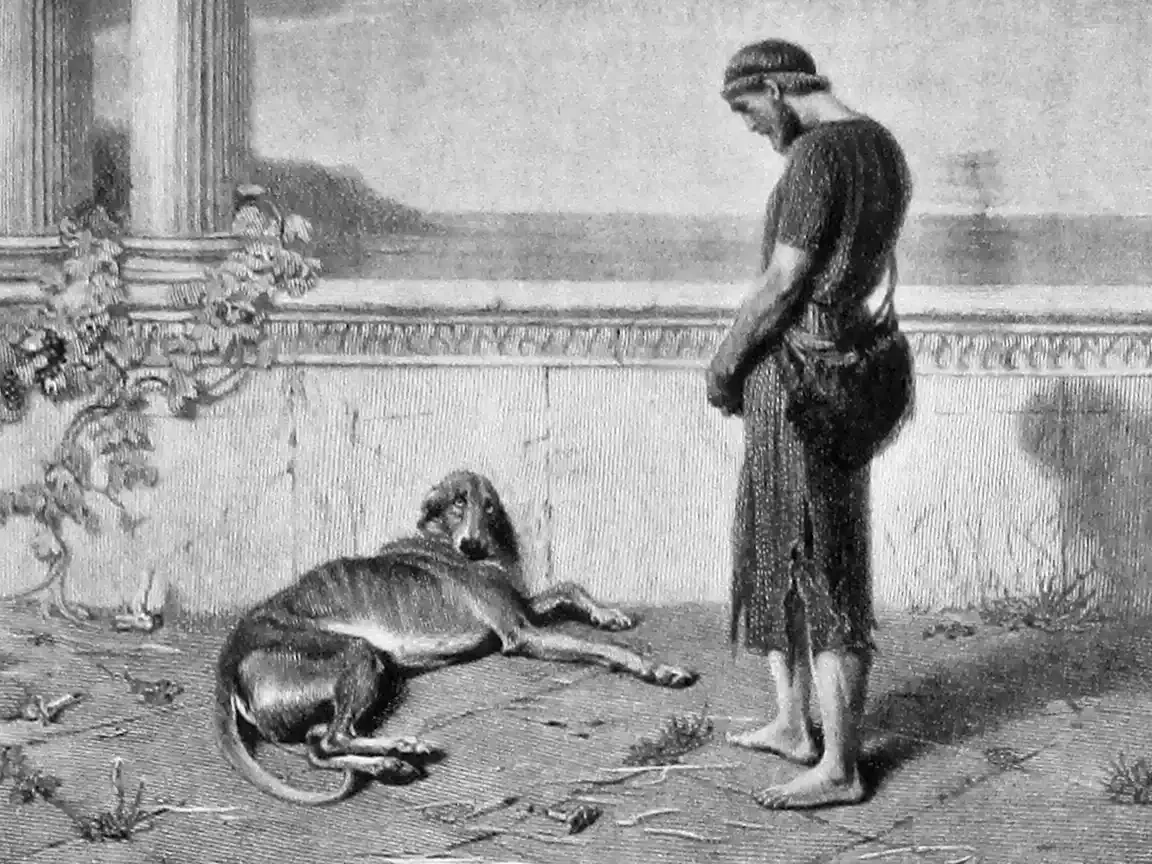
Argos recognizes Odysseus on his return to Ithaca, after twenty years apart. Print titles Ulysses and Argus, 1885, made by Frederick Stacpoole, after Briton Rivière, published by Thomas Agnew & Sons. British Museum CC BY-NC-SA 4.0. Public domain.
The Dog He Never Hunted With
Odysseus bred Argos himself — that much Homer tells us clearly. He raised him as a hunting dog, trained for the rough terrain of Ithaca: quick enough for deer, keen-nosed enough for hares and wild goats in the thick underbrush. But before Argos was old enough to hunt, the call came. Troy. The fleet was assembling. Odysseus left.
What followed is compressed into a single Greek phrase that scholars have examined for centuries: Odysseus raised Argos, Homer writes, but “got no joy of him.” The dog was bred, trained, prepared for a life alongside his master — and then the master was gone before any of it could happen. The young men of Ithaca took Argos out hunting in Odysseus’s absence, and he proved himself a superlative animal: fast, relentless on a scent, incapable of losing a trail. But he never hunted with the man who made him.
The phrase carries unusual weight in the Odyssey’s structure, and not only because of Argos. One book earlier, in the sixteenth book, Telemachus uses almost identical language to describe his father: Odysseus “had no joy” of his son either, having left the boy a newborn when he sailed for Troy. The echo is not accidental. Homer uses the same phrase to link Argos and Telemachus — the dog left behind and the son left behind — as parallel expressions of the same loss. Odysseus departed before he could be a father to either of them. What Argos and Telemachus share is not merely grief but a specific, particular deprivation: they were made for a relationship that never had the chance to begin.
Twenty Years on the Dung Heap
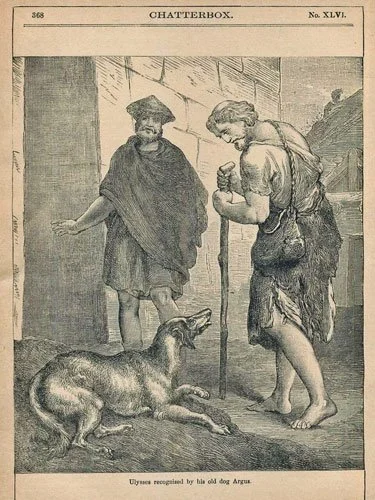
Ulysses recognised by his old dog Argus. The man who survived Troy could not kneel down. Chatterbox magazine, 1886, Public domain.
By the time Odysseus returns to Ithaca, Argos is very old. Homer does not spare the details of his condition. He lies on a heap of mule and cattle dung outside the palace gates — dung that has piled up because the servants, without a master to command them, have stopped clearing it. He is infested with ticks. He cannot move. The palace behind him is full of Penelope’s suitors, eating through Odysseus’s stores, drinking his wine, waiting for his widow to choose one of them. Everything that was orderly has become disordered. Everything that was maintained has been abandoned.
Argos is a mirror of all of it. Eumaeus, the loyal swineherd who walks beside the disguised Odysseus, tells the apparent beggar about the dog: he was once a magnificent animal, swift and keen and without equal on a trail. But now, Eumaeus says, his master has died far from his own country, and the thoughtless women neglect him. (Eumaeus believes Odysseus is dead. He has believed it for years.) The degradation of the dog is the degradation of the household, rendered in flesh and bone and parasites. The palace has been occupied by men who use what they find there without caring for it, and Argos is what that looks like by the end of two decades.
What Homer does not say — but what a careful reading of the Greek yields — is that the “young men” who hunted with Argos in Odysseus’s absence were almost certainly the same suitors now occupying the palace. The dog was not simply neglected after Odysseus departed; he was used, then discarded. He served others and was left on a dung heap when he was no longer useful to them. Scholars who have noticed this have found in it an additional layer of irony: the loyal dog of Odysseus spent his working years in the service of his master’s enemies.
The Only One Who Knew Him
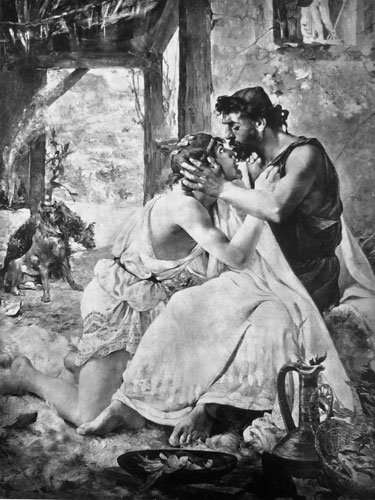
Odysseus reveals himself to Telemachus. The reunion Homer allowed — unlike the one at the gate, where a dog recognized him first and nothing could be said. Ulysses and Telemachus painting by Georges Truffaut, 1880. VladoubidoOo, CC BY-SA 4.0, via Wikimedia Commons.
When Argos lifts his head and pricks up his ears, it is because he has heard Odysseus’s voice.
He is the only figure in the entire Odyssey to recognize Odysseus immediately and without assistance. Telemachus required a divine transformation — Athena restored Odysseus to his true appearance before his son would accept him. Penelope demanded proof, then more proof, then the test of the bed. Eurycleia the nurse recognized him only by a scar on his thigh. The suitors never recognize him at all. Argos, nearly blind, too weak to crawl, hears something in the voice of a ragged beggar that no human ear detects. He wags his tail. He drops his ears. He does not have the strength to move toward his master.
Odysseus sees him. He knows the dog at once. And he can do absolutely nothing.
This is the scene’s hidden architecture. It is not a reunion. It cannot be a reunion. If Odysseus breaks his disguise — if he kneels, if he weeps openly, if he reaches for the dog — the plan collapses. The suitors will know the beggar is not a beggar. Everything Odysseus has worked toward since arriving on Ithaca will unravel. The man who held his grief together through ten years of war and ten years of ocean has to keep holding it together now, at the gate of his own palace, watching his dog recognize him and die.
He turns his face aside. He wipes away a tear, making sure Eumaeus does not see. Then he remarks, in a steady voice, what a fine animal that is lying in the dung — such a shame about its condition. Was it a hunting dog, or just a table dog kept for show? It is, of all the performances Odysseus gives in the poem, the most costly. He has disguised himself from gods and monsters. He has never disguised himself from a dog before.
In the Twentieth Year
Homer closes the Argos scene in a single sentence, placed immediately after Odysseus enters the palace. The translation varies by edition, but the Greek is precise: the fate of dark death seized Argos “when he had seen Odysseus in the twentieth year.”
The phrase “in the twentieth year” carries specific weight in the Odyssey. Throughout the poem, Homer reserves it for moments when Odysseus reveals himself — when he tells another character who he really is after the long disguise. It is the poem’s language of disclosure, of identity restored. Here, Homer applies it to Argos. The dog’s death is written with the same grammatical ceremony as the hero’s own recognition scenes. A dog on a dung heap is given, by the poem’s grammar, the same weight as a king reclaiming his throne.
Scholars of classical literature have described the Argos scene as one of the most emotionally powerful passages in Western epic — not despite its brevity, fewer than forty lines in the Greek, but because of it. Homer gives Argos nothing he does not need. No inner monologue. No extended description of the dog’s face or posture. What the dog does is minimal: he lifts his head, pricks his ears, wags his tail, drops his ears. Then the darkness takes him. What Odysseus does is also minimal: he turns away, wipes a tear, speaks of other things. The restraint of both is where the scene lives.
The man who bred the dog, and got no joy of him, goes inside to reclaim everything he left behind. The dog, having given everything he had left to give, is gone.
Did You Know?
Argos is the first named dog in Western literature. In the Iliad, Achilles’ horses Xanthus and Balius are named, but no dog in any surviving earlier text receives one. Homer’s decision to name Argos — and only Argos, among all the dogs in the poem — is without precedent.
The Greek word Ἄργος (Argos) means “bright” or “swift.” It is also the name of the mythological hundred-eyed giant Argus Panoptes, set by Hera to watch over Io, and the name of a major city in the Peloponnese. A dog named “swift” who was bred to hunt but never got to run with his master — the name carries its own quiet irony.
Ralph Hardy’s novel Argos (HarperCollins, 2016) retells the Odyssey entirely from the dog’s point of view, following him from puppyhood through Odysseus’s departure and the twenty years of waiting. It is among the few works of literary fiction to place an animal narrator at the center of a canonical epic.
Eumaeus’s aside at the gate — that Zeus “takes away half the good” from a man on the day he becomes a slave — is one of antiquity’s most-discussed observations on servitude, and has drawn scholarly attention from classical antiquity onward. That Homer places it here, beside a dog who was himself used and discarded by men with no stake in his welfare, suggests the comparison is deliberate.
The Odyssey’s opening encounter with dogs on Ithaca is very different from its last. When Odysseus first arrives at Eumaeus’s farm, four unnamed dogs rush at him — snarling, ready to tear apart a stranger. Eumaeus must drive them off with stones. The contrast with Argos — who cannot move, but knows — is one Homer could hardly have staged more deliberately.