Scooby-Doo: The Dog Who Was Drawn Wrong
Scooby-Doo was never meant to look like a Great Dane. The story of how animator Iwao Takamoto deliberately got the breed wrong—and turned an awkward, anxious dog into one of television’s most enduring characters.
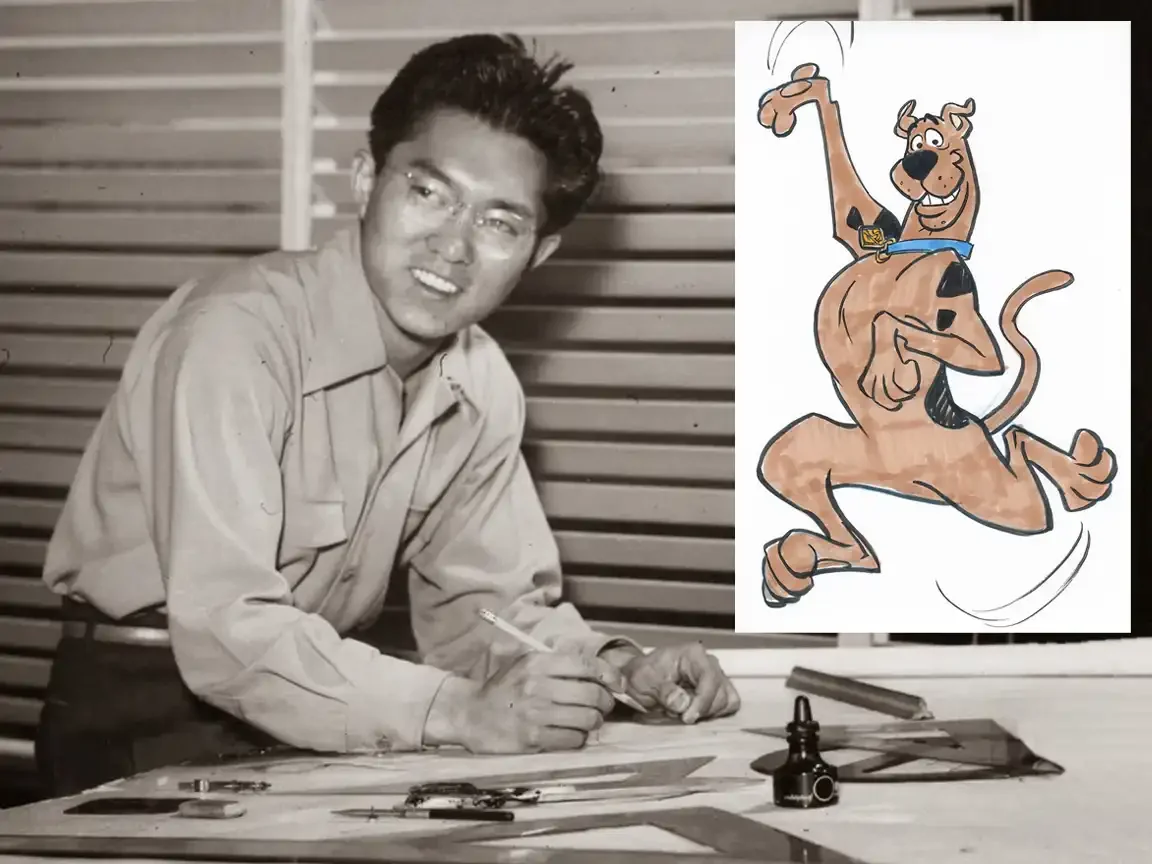
Iwao Takamoto (29 April 1925 – 8 January 2007) was an animator and character designer at Hanna-Barbera Productions © Hanna-Barbera.
In the spring of 1945, a twenty-year-old Japanese American man walked out of a concentration camp in the Californian desert and presented his sketchbook to Walt Disney. By the end of the week, he had a job.
His name was Iwao Takamoto. Over the next thirty years he would become one of the most prolific character designers in the history of American animation — responsible, between Disney and Hanna-Barbera, for hundreds of beloved characters. But only one of them made him immortal. And he drew it completely wrong, on purpose, having first studied exactly how to draw it right.
That dog was Scooby-Doo.
The Show That Almost Wasn't
By 1968, Saturday morning television was in trouble. Parent groups had spent years lobbying against violence in children's cartoons — and they were winning. Hanna-Barbera action shows were cancelled one by one under pressure from watchdog groups. Fred Silverman, CBS's head of daytime programming, needed something new: a children's show with enough excitement to hold young viewers, but nothing that would get a letter written about it.
His solution was a mystery show. Teenagers, a haunted house atmosphere, rubber-masked villains — the thrill of fright without actual menace. Writers Joe Ruby and Ken Spears developed the concept, and a dog was included as a comic presence. His working name was Too Much.
When the show was presented to CBS executives under the title Who's S-S-Scared?, the network passed. CBS president Frank Stanton said plainly: "We can't put that on the air. That's just too frightening."
Silverman sent it back to be reworked. The rock band subplot was cut. The scares were softened. The dog was promoted from supporting gimmick to co-star — the emotional hinge the show now needed, a character so thoroughly frightened that audiences could laugh at their own fear rather than be overwhelmed by it.
The show also needed a name. According to Ruby and Spears, Silverman was inspired by Frank Sinatra's scat at the end of his recording of "Strangers in the Night" — the "doo-be-doo-be-doo" — heard on a red-eye flight to one of the development meetings. He wrote two words in his notebook. The dog had a name. The show had its title. Now someone had to draw him.
The Man From Manzanar
That task fell to Iwao Takamoto — and to understand what Takamoto brought to the drawing board, it is necessary to understand where he had been.
Takamoto was born in Los Angeles, the son of a father who had emigrated from Hiroshima. He graduated from Thomas Jefferson High School at fifteen. He was sixteen years old when Pearl Harbor was bombed.
After Pearl Harbor and the signing of Executive Order 9066, Takamoto, his parents, and his siblings were interned as enemy aliens in the Manzanar internment camp. Over 110,000 Japanese Americans were held in camps across the United States, most of them — like Takamoto — American citizens. He was a teenager from Los Angeles. He had never been to Japan.
At Manzanar, in the high desert east of the Sierra Nevada, Takamoto began to draw. He was noticed by the camp's educational director, who gave him art supplies and encouragement. He also encountered two fellow internees who had worked as Hollywood art directors before the war, and who taught him the fundamentals of the craft. He sketched his impressions of camp life at every opportunity — someone who loved watching people and capturing their attitudes in a drawing. Even behind barbed wire, the habit was unstoppable.
When the war ended, Takamoto left camp. He bought two inexpensive drawing pads, filled every page with whatever caught his eye, and took them to Walt Disney Animation Studios. He was shown into an office. A man named Mike Nelson looked through the pads for a long time, then disappeared. He returned twenty minutes later and asked: "Can you start Monday?"
Takamoto was, by his own account, totally stunned.
Fifteen Years of Learning to Be Perfect
At Disney, Takamoto worked as an apprentice under the tutelage of the Nine Old Men — the studio's legendary master animators — particularly Milt Kahl, who was widely regarded as the most technically exacting of the group, a perfectionist who understood the anatomy of animals and humans with an almost surgical precision. Under him, Takamoto learned how things were supposed to look: correct proportion, correct weight, correct line.
He worked on Cinderella, Peter Pan, Lady and the Tramp — for which he was given sole charge of Lady's design — and Sleeping Beauty. Fifteen years at the highest level of the craft, absorbing everything the Nine Old Men knew.
In 1961 he left Disney for Hanna-Barbera, where the budgets were lower, the schedules tighter, and the visual demands of weekly television production entirely different from those of the Disney feature film. He adapted. He designed characters for The Flintstones, The Jetsons, Wacky Races, Atom Ant. He was, by the time Scooby-Doo came to him, one of the most experienced character designers working in American animation.
He knew exactly how to draw a Great Dane.
The Decision to Get It Wrong
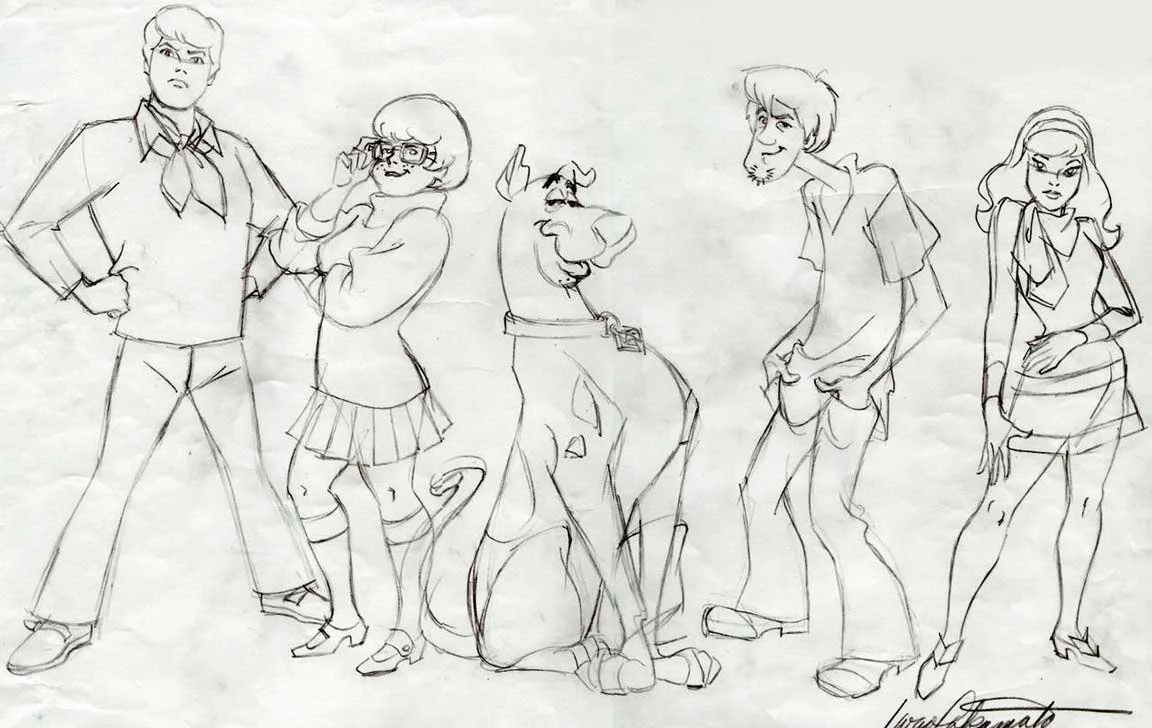
Takamoto's original drawing Hanna-Barbera, showing Scooby and the gang. © Hanna-Barbera
Before beginning the design, Takamoto consulted a colleague at Hanna-Barbera who bred Great Danes professionally. She walked him through the anatomy of a prize-winning specimen in careful detail: straight back, straight legs, refined chin, elegant proportions. The architecture of a dog built for the show ring.
Takamoto listened to every word. Then he reversed it.
He gave Scooby a hunched back. He bowed the legs. He weakened the chin. He made the body apologetic where a Great Dane's should be proud, and ungainly where it should be precise. In his own words: "I decided to go the opposite and gave him a humpback, bowed legs, small chin and such. Even his colour is wrong."
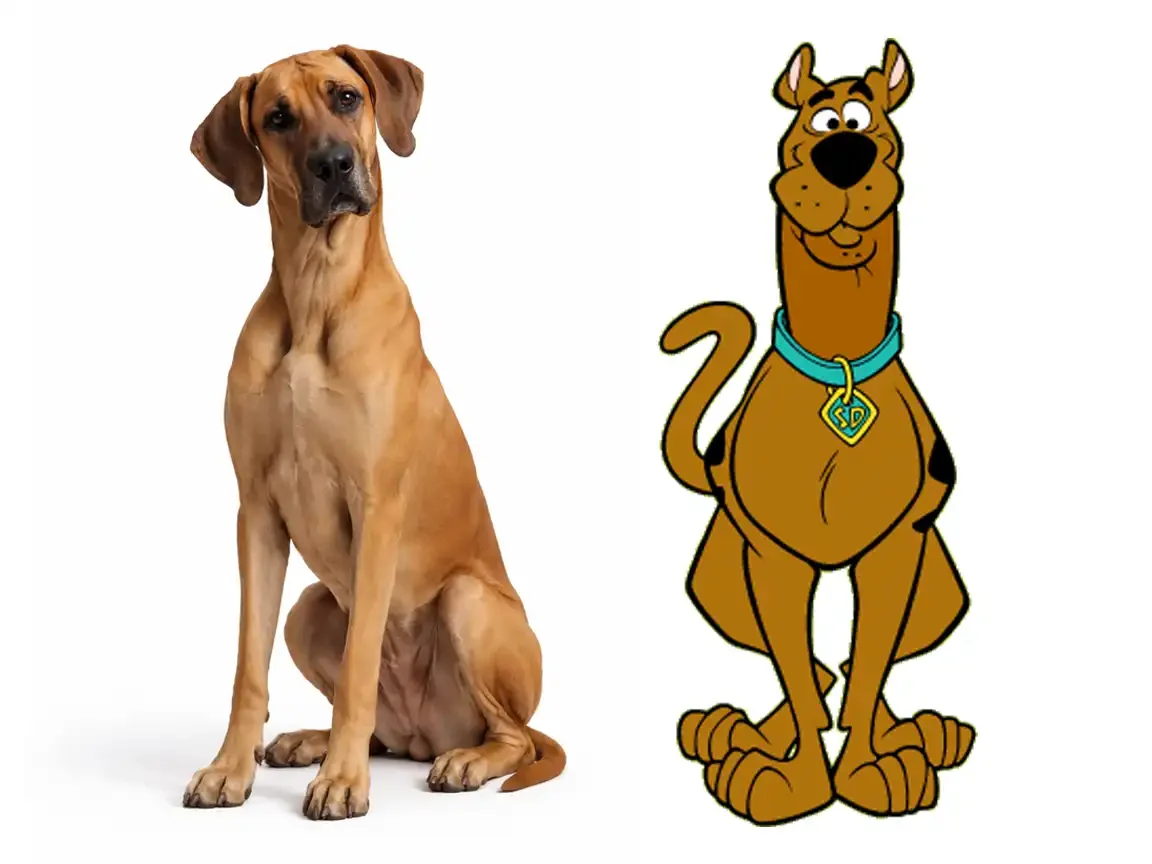
The breed standard, and Takamoto's deliberate departure from it. Scooby-Doo © Hanna-Barbera
The result was a Great Dane that no Great Dane breeder would recognise. Ungainly, lopsided, improbably proportioned — and immediately, unmistakably loveable. His silhouette communicated anxiety at a glance. His posture — permanent, apologetic, gravitationally uncertain — was funny while standing still, which is a remarkable thing to achieve in any medium, let alone animation.
Scooby's apparent wrongness was, in fact, his precision. Takamoto had designed not a Great Dane, but the feeling of being a Great Dane who would really rather be somewhere else — and he had done it by knowing exactly what a Great Dane should look like and then making every informed, intelligent choice to be otherwise.
Saturday Morning, 13 September 1969
Scooby-Doo, Where Are You! debuted on CBS on a Saturday morning in September 1969. It was an immediate hit.
The show's formula was simple and completely reliable. A monster appears, creaking corridors and all. Clues accumulate. Panic rises — embodied most visibly by Scooby, whose fear gives the audience permission to find the whole thing funny rather than frightening. Then the unmasking: the monster is always a person, the supernatural is always a trick, and the world becomes understandable again. Every episode performed the same emotional operation, and every episode worked.
What made it work was the dog at the centre. Scooby did not follow the clues. He registered how the room felt. When he panicked, the story remembered it was supposed to be spooky. When he relaxed, the audience relaxed with him. His bond with Shaggy — built on shared hunger, shared cowardice, and a loyalty that pulled them both back into danger no matter how urgently they tried to leave — was the warm engine underneath the comedy. They ran first, but they never ran for long.
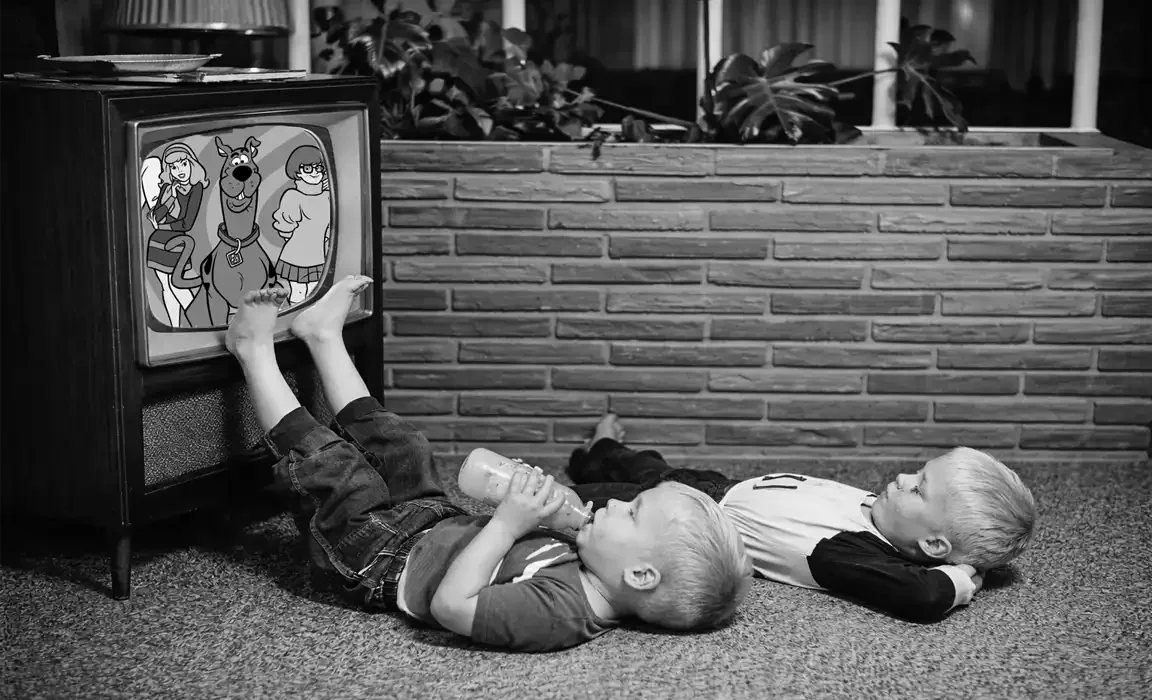
Saturday morning, sometime in the early 1970s. The show Takamoto helped design became a ritual for a generation of children — and then their children, and then their children's children. Photo by Dogs in History (ai).
The show ran on CBS until 1976, moved to ABC, spawned decades of spin-offs, films, and reinventions, and has never been off the air since. It is the longest-running animated franchise in Saturday morning television history.
The Man Behind the Dog
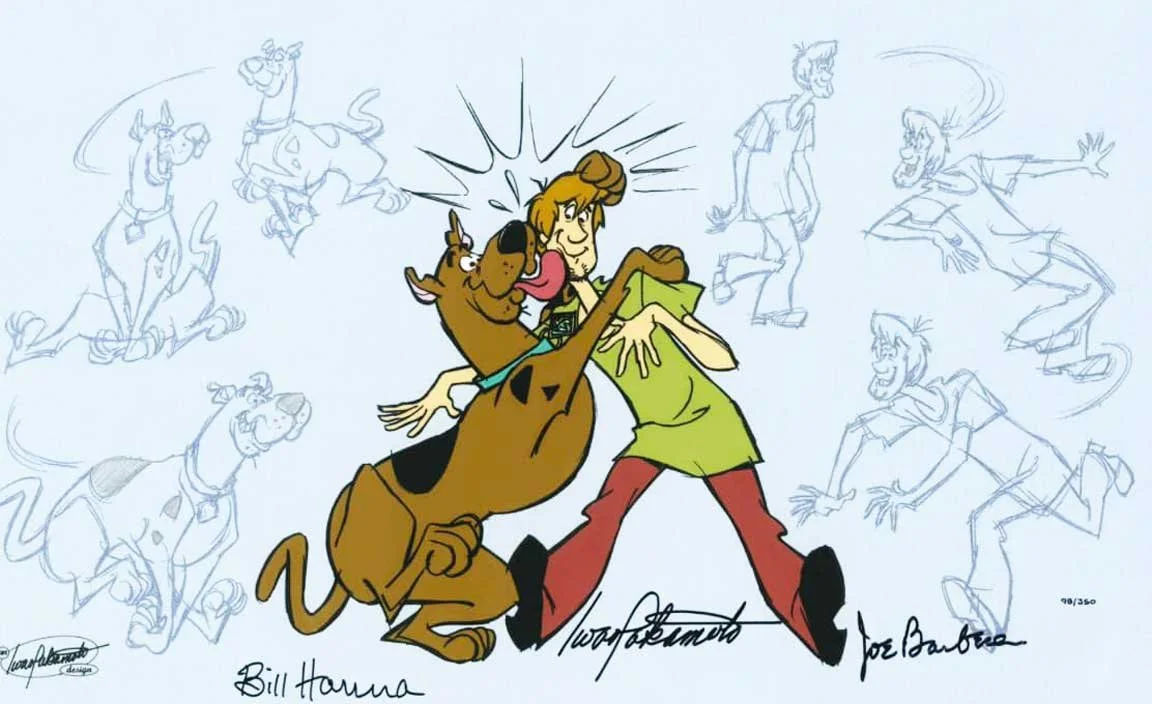
“And Scooby Makes Two” by Iwao Takamoto signed by him, Hanna, and Barbera. © Hanna-Barbera
Iwao Takamoto received the Winsor McCay Award — the lifetime achievement honour from the International Animated Film Association — in 1996. He received an honorary citation from the Japanese American National Museum. At the time of his death in 2007, he was a vice president at Warner Bros. Animation. His memoir, My Life with a Thousand Characters, was published posthumously in 2009.
He never made much of the Manzanar years in interviews — not out of denial, but out of a characteristic refusal to be defined by them. He was, by all accounts, a man oriented towards the next drawing rather than the last injustice. His biographer noted that he came out of the concentration camp not with bitterness, but with — of all things — a walloping sense of humour.
It is perhaps not entirely surprising that the man who emerged from that experience went on to design a character whose central insight is that fear is something you can joke with, dodge, and still come back from. Scooby-Doo is not brave. He never pretends to be. But he always returns — usually for a snack, but partly for something else. And that, in the end, is what Takamoto gave him: not perfection, but something better than perfection. A dog who gets it wrong and shows up anyway.
Did You Know?
Scooby's full name is Scoobert Doo — though no one, including Shaggy, has ever called him that.
Takamoto also designed Astro, the Jetsons' dog, giving him a near-identical speech pattern to Scooby's. Both were voiced by Don Messick. The two dogs are, in a sense, brothers.
In British rhyming slang, "a Scooby" means a clue — as in "I haven't got a Scooby." The phrase has been recorded in major UK dictionaries, proof that Takamoto's creation didn't just entertain audiences, it furnished them with language.
Takamoto was the key designer on Hanna-Barbera's 1973 feature film Charlotte's Web, where he faced the challenge of making a spider sympathetic — solving it, as he always did, by concentrating on the eyes.
The original show debuted on the same Saturday morning schedule as The Brady Bunch premiered in primetime. It outlasted every show from that era, and most that followed.
Iwao Takamoto: My Life with a Thousand Characters (University Press of Mississippi, 2009) is the definitive account of Takamoto's life and career, told in his own words.
Watch a short video…
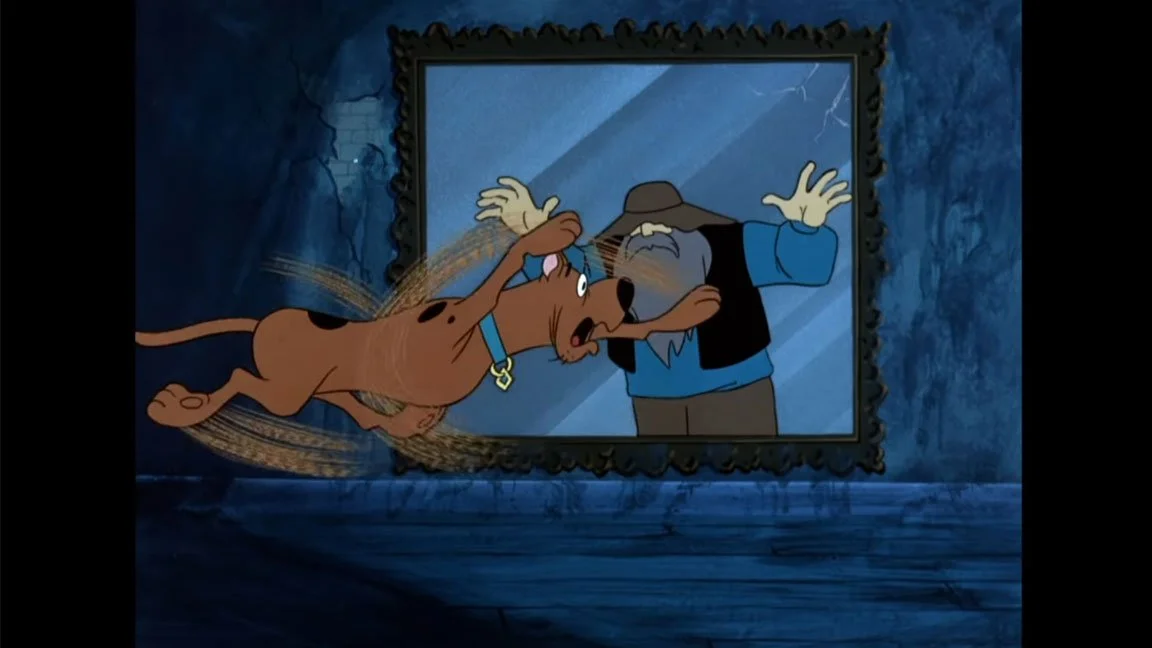
When the Mystery Inc. gang get stuck in a tight spot, sometimes there's only one thing to do... RUN FOR IT! Screenshot from Scooby-Doo Where Are You! Hanna-Barbera™