The Dog Who Upstaged James Bond
How a stray dog at a Bahamian carnival gate-crashed the world's most glamorous film shoot — and refused to leave the final cut.
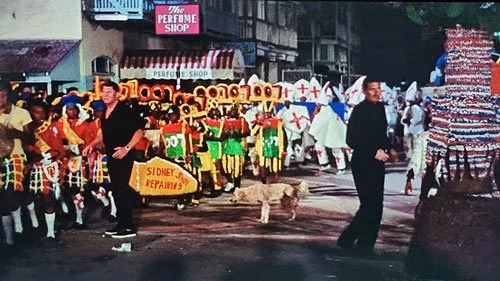
A stray dog casually peeing in the Junkanoo parade in James Bond’s Thunderball (1965).
It had no agent, no billing, and no intention of following direction. But the unnamed dog that wandered into a shot during the filming of Thunderball in Nassau, 1965, ended up in the finished film — and took an entire editorial team down with it.
The Canine Cameo That Made the Cut
It is Easter 1965, and Bay Street in downtown Nassau is in full carnival uproar. Goatskin drums and cowbells ricochet off the shopfronts. Sequined floats press through the crowd. Hundreds of performers — in paper-layered costumes months in the making — are rushing the street in a two-mile loop that nobody, the crew has been warned, is allowed to stop or redirect. Somewhere in the middle of this organised chaos, a dog is conducting its own business entirely.
The dog is not in the script. It has not been cast, trained, or invited. It belongs to no identifiable owner. It simply wanders into the shot and, at the moment the camera is rolling, relieves itself on the pavement with complete serenity. Supervising editor Peter R. Hunt watches the footage and cuts it. The producers watch the dailies, and demand it back. The dog stays in Thunderball — and in doing so, creates a problem that no amount of editing can solve.
A Festival That Could Not Be Stopped
The Junkanoo is one of the oldest celebrations in the Bahamas, its roots reaching back to the plantation era, when enslaved Africans were given three days' holiday at Christmas — days they filled with costumed processions, drumming, and dance. By the 1960s it had evolved into something formidable: an organised, competitive parade of elaborate floats and uniformed groups, judged on choreography, costume, and rhythm. The city took it seriously. Sponsors took it seriously. The groups spent most of the year preparing.
Eon Productions took it seriously too, in their way. The real Junkanoo fell on Boxing Day; the production needed it in April. So the producers offered to fund the entire parade — cash prizes for the most elaborate costumes — and Nassau obliged with a special Easter edition. Five hundred and forty-eight local participants were hired, along with 55 European extras. Third assistant director Richard Jenkins recalled the briefing from director Terence Young with some precision: whatever happened, nobody was to try to stop it or move it backwards. The parade was two miles long, with forty companies co-sponsoring it. To halt it, Young told his crew, might cause a riot. They were to shoot around it, doing the best they could.
It was not, in other words, a controlled environment. A film set it was not. And into this organised carnival mayhem, without announcement, walked the dog.
One Moment, One Nature Call, One Disaster
The Junkanoo sequence serves a specific dramatic purpose in Thunderball. James Bond — played by Sean Connery, visibly exhausted by press intrusion and in a deteriorating marriage that would end the following year — is being pursued through the carnival by Spectre assassin Fiona Volpe and her associates. The parade provides cover, chaos, and escape. It is supposed to feel like controlled danger: the camera tracking Connery through the noise and colour, the crowd a beautiful, overwhelming shield.
At around eighty-seven minutes into the finished film, the camera catches something the script did not anticipate. A dog — breed unknown, allegiance entirely its own — has wandered into the frame. It is not doing anything especially dramatic. It is, in the parlance of the industry, answering a call of nature.
Peter R. Hunt cut the footage. He was the supervising editor, and his judgment was straightforward: the take was not that great. The dog went to the cutting-room floor.
Then the producers saw the dailies.
Cubby Broccoli and Harry Saltzman had built James Bond into the biggest film franchise on earth through a combination of extravagance, instinct, and an apparently unerring sense of what audiences would enjoy. They looked at the dog urinating during the world's most elaborate spy film, and they enjoyed it enormously. They demanded the footage go back in. The dog was reinstated.
The Group in the 007 Hats
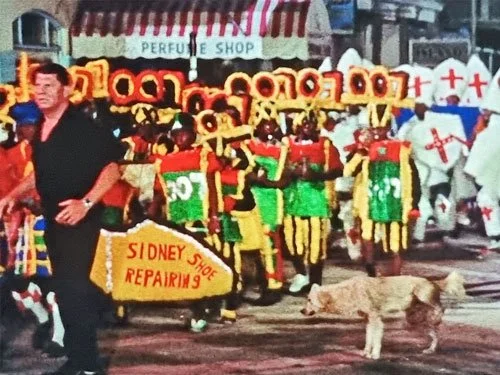
The Junkanoo parade with people wearing 007 hats, James Bond’s Thunderball (1965).
During the filming of the Junkanoo This decision had consequences nobody had foreseen.
Extras had shown up and marched in the parade wearing hats bearing the number "007". They had not been hired. They had not been briefed. They had simply appeared, apparently in good spirits, and inserted themselves into the scene.
The filmmakers had been trying to edit around them. The hats were a problem — too on-the-nose, too knowing, the wrong kind of self-awareness for a film that preferred its glamour straight. Frame by frame, Hunt and his team were working to keep them out of the cut.
The dog made this impossible. The shot in which the dog appears is also the shot in which the 007 group is most visible. To keep the dog — which the producers had now expressly demanded — was to keep the group. To remove the group was to remove the dog. The producers had made their position clear. The group stayed. The hats stayed. The dog, naturally, had already moved on.
The Limits of Control
Thunderball was not a production accustomed to the word 'no'. It was, by most accounts, the most expensive Bond film yet made — shot across France, England, and the Bahamas, with an underwater battle sequence so elaborate it required its own specialist photographer and prompted an Academy Award for special effects. The explosion of the villain's yacht, detonated with experimental rocket fuel by effects supervisor John Stears, shattered windows along Bay Street some thirty miles away. The production had funded an entire national festival. It had hired hundreds of extras. It had imported a jetpack, flown by one of only two people in the world qualified to operate it.
It could not stop a dog.
There is something quietly instructive in this. The Bond films presented a version of the world in which competence, resources, and cool judgment could master any situation. The dog in the Junkanoo sequence is a small rebuke to that premise. It did not know it was on a film set. It did not know it was disrupting an editorial decision. It was not available for negotiation. And because the producers decided to find it charming rather than problematic — because they watched the dailies and laughed — it became permanent. The most carefully controlled franchise in cinema history contains, at eighty-seven minutes, one entirely uncontrolled moment. It has never been edited out.
Thunderball Itself
The film was released in December 1965 — delayed three months from its original September date after Hunt met United Artists executive David Picker and convinced him the edit was not yet ready. It opened to enormous commercial success, becoming the highest-grossing Bond film to that point, and won the Academy Award for Best Visual Effects. Sean Connery, who had spent much of the Nassau shoot refusing to speak to journalists and declining a substantial fee for a promotional television special, was by now the most recognised film actor on earth.
The Junkanoo sequence runs for several minutes and is generally regarded as one of the more effective action passages in the film — precisely because it feels genuinely hectic, genuinely uncontrolled. Which it was. The drums, the costumes, the two-mile circuit of Bay Street, the group in the 007 hats, and the dog: all of it captured in a running camera doing its best around a parade nobody was allowed to stop.
The dog, of course, is uncredited. It appears, does what it came to do, and vanishes into the Nassau afternoon. Its breed is unrecorded. Its name, if it had one, is unknown. In the long history of the Bond franchise — its Aston Martins and vodka Martinis, its hatched villains and improbable escapes — it remains the only performer to have defeated the editorial team entirely, without trying, and without ever being asked.
The Final Cut
Peter R. Hunt cut the dog. The producers put it back. That is the full extent of the story, and it is enough. In a franchise built on the idea that professionalism, money, and sheer nerve could accomplish anything, one unscripted animal on a Bahamian street corner turned out to be the one variable nobody could account for. It is, in its way, the most honest moment in any Bond film: not a gadget, not a villain, not a perfectly timed quip, but a dog, doing what dogs do, in the middle of a parade, on a hot afternoon in Nassau. The camera was rolling. The producers were watching. The rest, as they say, is in the film.
Did You Know?
Although dogs do not feature in the Ian Fleming books, a few dogs have actually been cast in the James Bond films:
Moonraker (1979) — Drax's Dobermans are trained to wait obediently beside raw meat until their master snaps his fingers — a detail that establishes him as the kind of villain who treats animals as instruments of control. He later commands them to kill his assistant Corinne Dufour, whom he knows has been helping Bond. It is one of the few times a dog is used as an active instrument of villainy in the franchise.
On Her Majesty's Secret Service (1969) — A St. Bernard ambles up to Bond at the end of the film. A brief, gentle appearance in one of the series' most emotionally weighted conclusions, and an odd tonal counterpoint to what has just happened.
Skyfall (2012) — Kincade's black Labrador Retrievers appear alongside him as Bond and the old gamekeeper prepare to defend Skyfall Lodge. They are working dogs on a working estate — the one moment in the Craig era where Bond's world briefly resembles something domestic.
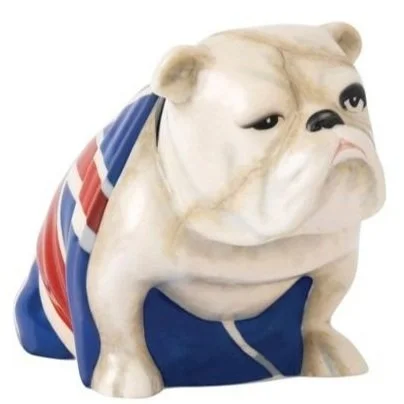
Jack the Bulldog with his chips and cracks after being blown up in Spectre.
Skyfall / Spectre / No Time to Die — M's (played by Judi Dench) ceramic Union Jack bulldog — a Royal Doulton figurine — sits on her desk throughout Skyfall. After her death she bequeaths it to Bond. It survives an explosion in Spectre with little more than a few cracks, reappears in No Time to Die, and has become the most durable dog in the franchise's history — fictional or otherwise.
Blofeld’s iconic cat, a white Persian, plays a more prominent and recurring role in James Bond books and films than any dog. Often serving as a chilling symbol of the villain’s presence even before he appears on screen.