Señor Xólotl: Frida Kahlo Named Her Dog After the Aztec God of Death
How a hairless Mexican dog became the psychopomp of Frida Kahlo’s home, the Blue House (La Casa Azul).
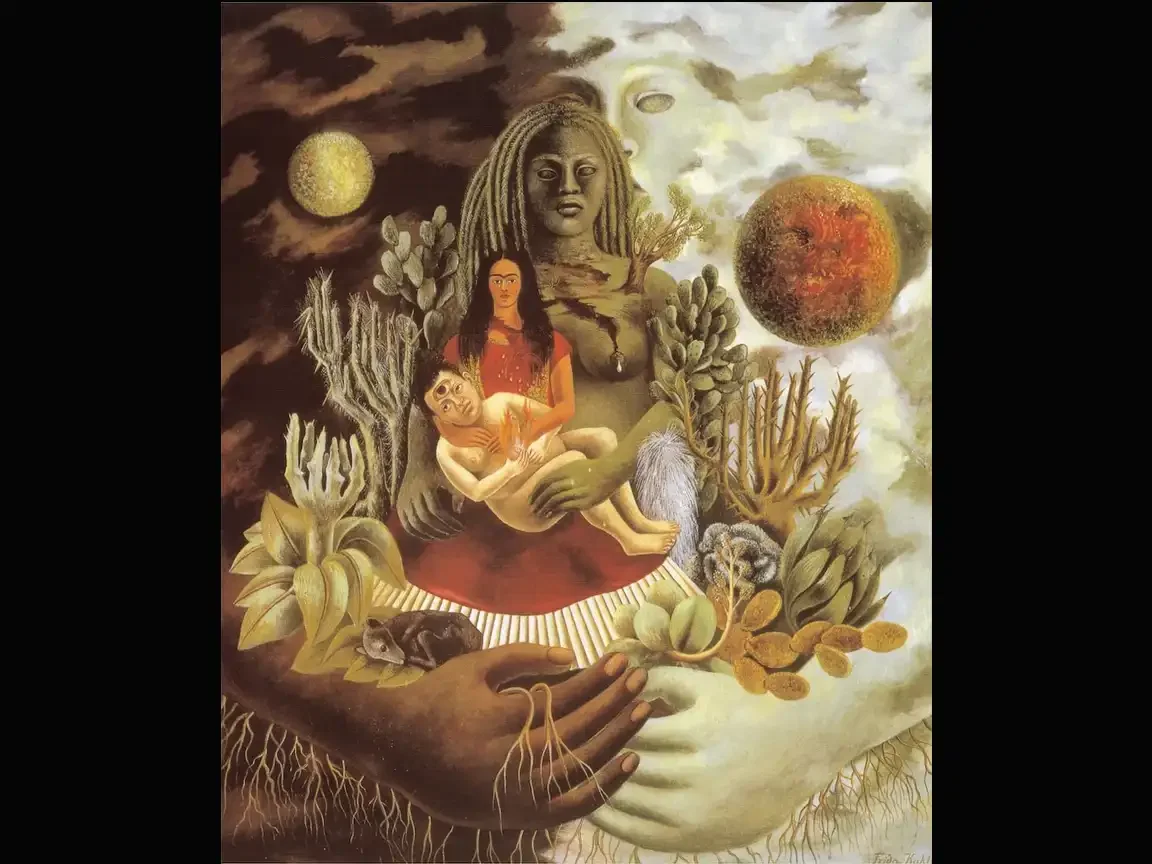
Señor Xólotl sleeps at the base of the composition — beneath Kahlo, Diego, the earth, and the universe. The Love Embrace of the Universe (1949). © Frida Kahlo Foundation, via Wikipedia Commons.
In 1949, Frida Kahlo finished a painting she called The Love Embrace of the Universe, the Earth (Mexico), Myself, Diego and Señor Xólotl. Most visitors read the title as far as “Diego” and stop. The small hairless dog at the bottom of the canvas—curled in the crook of an enormous arm, apparently sleeping—is easy to overlook. But the name Kahlo gave him is the key to the whole painting. And it is the key, too, to understanding something essential about how she lived.
Xólotl was the Aztec god of death.
The God at the Edge of the World
In Aztec cosmology, Xólotl was the twin brother of Quetzalcóatl—but where his brother represented the rising sun, the morning star, and the light of creation, Xólotl was the evening star, the setting sun, the darkness that follows. His function was specific and essential: he was the guide of souls through Mictlan, the Aztec underworld, a realm that stretched across nine layers of trial and transformation. Without Xólotl, souls could not complete the journey. In the language scholars use for such figures, he was a psychopomp—a conductor of souls from one world to the next.
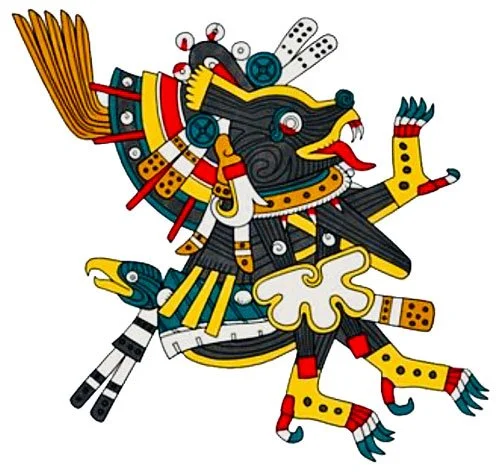
Xólotl, the dog-headed god of death and guide of souls, as depicted in the Codex Borgia. Pre-Columbian Aztec manuscript, c. 1500. Public domain, via Wikimedia Commons.
He was depicted as a dog-headed man—sometimes skeletal, sometimes weeping, always liminal, always at the threshold between one state and another. When he wept, his eyes fell from their sockets. He was the god, too, of sickness and deformity: the twin who drew to himself all the conditions that marked a body as different, as suffering, as marked by pain.
The dog that bore his name—the Xoloitzcuintli, or Xolo—was the living form of this passage. Aztec families raised and kept these hairless dogs throughout their lives. When an owner died, the dog was sacrificed and cremated alongside the body, so that it could cross the first and most treacherous obstacle in the underworld: the wide river Apanohuaya, where the dead could not cross alone. The dog knew the owner. The dog carried them.
A Spine Broken in Three Places
On September 17, 1925, Frida Kahlo was eighteen years old and riding a bus home from school in Mexico City when it collided with a streetcar. The impact fractured her spinal column in three places. Her right leg broke in eleven places. Her pelvis fractured in three. A steel handrail tore through her abdomen and exited through her pelvis. Several passengers died at the scene; others died in hospital in the days that followed.
Kahlo survived. She did not stop surviving for almost thirty years—but the accident left no clean ending. It left something that never resolved. She underwent more than thirty surgical operations in the course of her life, many of them on her spine. Between 1940 and 1954 alone, she wore twenty-eight separate supportive corsets, varying from steel and leather to plaster. Pain was not occasional; it was structural. It was the architecture of her days.
She was, by any clinical measure, a person who lived permanently at the edge of death. She had miscarried pregnancies she had badly wanted; her injuries had damaged the possibility of carrying a child to term. She kept company with what could not be fixed.
The paintings registered all of it. The Broken Column (1944) shows her torso split open, a crumbling Ionic column where her spine should be, nails driven into her skin. Henry Ford Hospital (1932) depicts her alone on a hospital bed, surrounded by floating objects tethered to her by red lines—the foetus she lost, the medical equipment that defined the space around her. She did not soften any of it. She painted what was true.
What this meant—what it meant to live that particular life in that particular body—was something Kahlo processed not only in oils but through the symbols she chose to carry. She was deeply and deliberately connected to pre-Columbian Mexican culture, and collected Aztec figurines and artifacts that spoke of the indigenous Mexico she considered her inheritance. Death, in that tradition, was not an end. It was a passage. It required a guide.
La Casa Azul and Its Xolos
By the 1940s, La Casa Azul—the Blue House in Coyoacán where she had been born—had become something close to a private world. As her health deteriorated, Kahlo grew less able to leave. She managed the household, maintained the garden, received visitors from across the world, and was kept company by a household that included spider monkeys, parrots, a tame eagle named Gertrude Caca Blanca, and, always, her Xoloitzcuintlis.
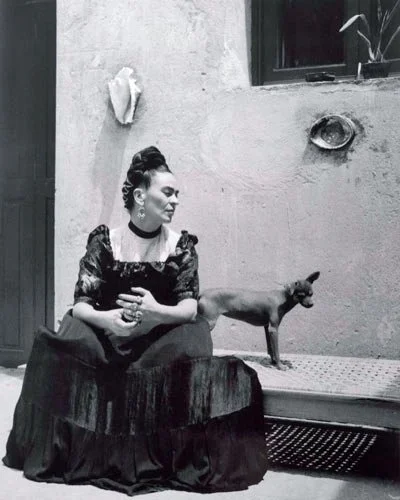
Frida Kahlo with a Xoloitzcuintli at La Casa Azul, c. 1944. © Frida Kahlo Foundation
She and Diego Rivera shared the dogs and gave them Nahuatl names—pre-Hispanic names that belonged to the indigenous Mexico they were both committed to reclaiming as a living culture rather than a historical artifact. The most significant of these dogs was Señor Xólotl. He appears in photographs at La Casa Azul: hairless, warm-bodied, a dog reported to be acutely sensitive to the moods of the people around him.
Xolos run several degrees warmer than other dogs—a quality that Aztec healers had turned to practical use. The dogs were placed against the bodies of the sick, their warmth transferred like a kind of remedy. Kahlo was often ill. The dog was often near her.
The Ambassador
In the last decade of her life, Kahlo kept a diary. She painted in it, drew in it, wrote fragments and letters and notes in it. It covered the years 1944 to 1954—the same years in which her health reached its lowest points, including her seventh spinal surgery in 1950 and the 1953 amputation of her right leg below the knee.
In the diary, she wrote about Señor Xólotl. She gave him a title. She named him, in full, the “Ambassador of the Universal Republic of Xibalba Mictlan, Chancellor and Minister Plenipotentiary.” Xibalba was the Mayan name for the underworld; Mictlan was the Aztec equivalent. She brought both together in one compound. The dog was the plenipotentiary of death—the fully accredited representative of the place she was going.
This was not morbid in the way the phrase might first seem. For Kahlo, who had been moving toward death since she was eighteen and had outlived that movement many times over, the underworld was simply another country—one with its own protocols, its own officials, its own passage routes. What you needed was a trustworthy guide. She had named hers. He slept on her bed.
The Painting
In The Love Embrace of the Universe, the Earth (Mexico), Myself, Diego and Señor Xólotl, Kahlo arranged the structure of everything she loved. At the center of the composition she holds Diego Rivera, cradling him as she might a child—an inversion of their actual relationship, and a comment on it. Around her, the earth takes the form of a woman with a cracked stone face, embracing them both. Beyond that, the universe holds everything, enormous and dark, ringed with stars and night.
And at the bottom, barely visible in the crook of the earth’s arm, Señor Xólotl sleeps.
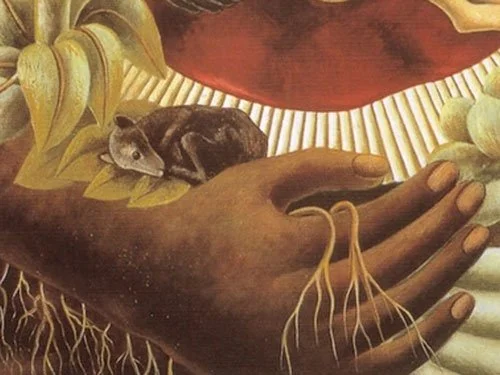
Señor Xólotl, detail from The Love Embrace of the Universe (1949). Curled in the earth's hand, beneath everything. © Frida Kahlo Foundation.
His placement—at the base, at the foundation, at the point where all the human figures rest—gives him a specific role. He is underneath everything. He is the ground beneath the ground. In Aztec belief, the dog at the base of all things is not a pet or a comfort; it is the being without whom none of the rest of the journey continues.
Kahlo knew how to read a symbol. She had spent years painting from within a tradition in which objects and animals carried specific weight. She had placed a dog in a cosmic painting, named him after the guide of the dead, and written in her diary that he was the ambassador of Mictlan. This was not decoration. It was a statement about what she had come to understand, through thirty years of living at the edge of death, about the nature of the company that keeps you there.
The Photograph, 1953
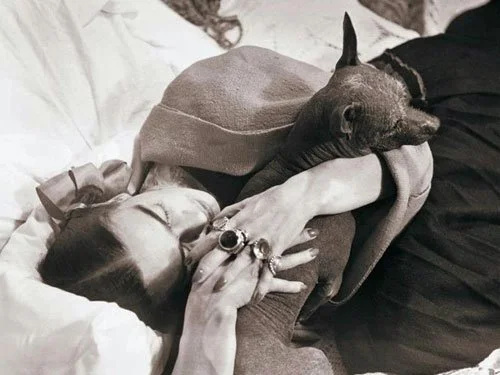
Frida Kahlo embracing her favorite dog Señor Xólotl, c. 1950s. © Frida Kahlo Foundation
That year the photographer Héctor García photographed Kahlo holding Señor Xólotl. She was forty-six years old. Her right leg had been amputated earlier that year. The photograph shows her cradling the dog the way you hold something you do not intend to put down.
She died in July of the following year. She was forty-seven.
The xolos at La Casa Azul outlived her. Rivera gave two of them to Dolores Olmedo, the collector and patron who became the primary keeper of their artistic legacy. Their descendants roam the grounds of Olmedo’s Mexico City museum still—the same museum that holds the world’s largest collection of Kahlo’s paintings. A statue has been erected there in the dogs’ honor.
They are, in a manner of speaking, still on duty.
Did You Know?
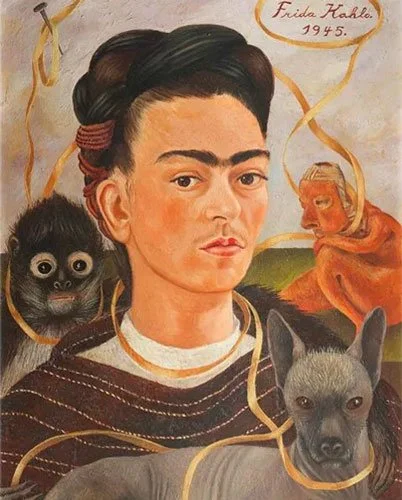
Self-Portrait with Small Monkey (1945). Kahlo bound herself, her spider monkey, and Señor Xólotl with a single ribbon. © Frida Kahlo Foundation.
Señor Xólotl appears in at least three of Kahlo’s paintings. In Self-Portrait with Small Monkey (1945), a single yellow ribbon connects Kahlo to the dog, a spider monkey, and a pre-Columbian idol—as if she were binding together, in one image, everything she considered essential to herself.
In Aztec belief, the color of your dog determined whether it could guide you across the first river of Mictlan. Yellow dogs were considered the most reliable; they would carry the soul across. White and black dogs were said to refuse—white because they had just washed themselves, black because they were too dirty to return. It was therefore advisable, in this life, to treat your dog accordingly.
The Xoloitzcuintli breed was officially designated a national symbol of Mexico in the twentieth century. The professional football club of Tijuana—known as the Xolos—takes its name and identity from the breed, a rare case of an ancient god’s dog becoming the mascot of a Primera División side.
Breed: Xoloitzcuintli (Mexican Hairless) | Country of origin: Mexico | First use: Companion and watchdog | Origins: 11th century BC