Cave Canem: What Rome’s ‘Beware of Dog’ Signs Really Mean
The most famous "Beware of Dog" sign in the ancient world has been staring up at visitors for two thousand years. Almost nobody has read it correctly.
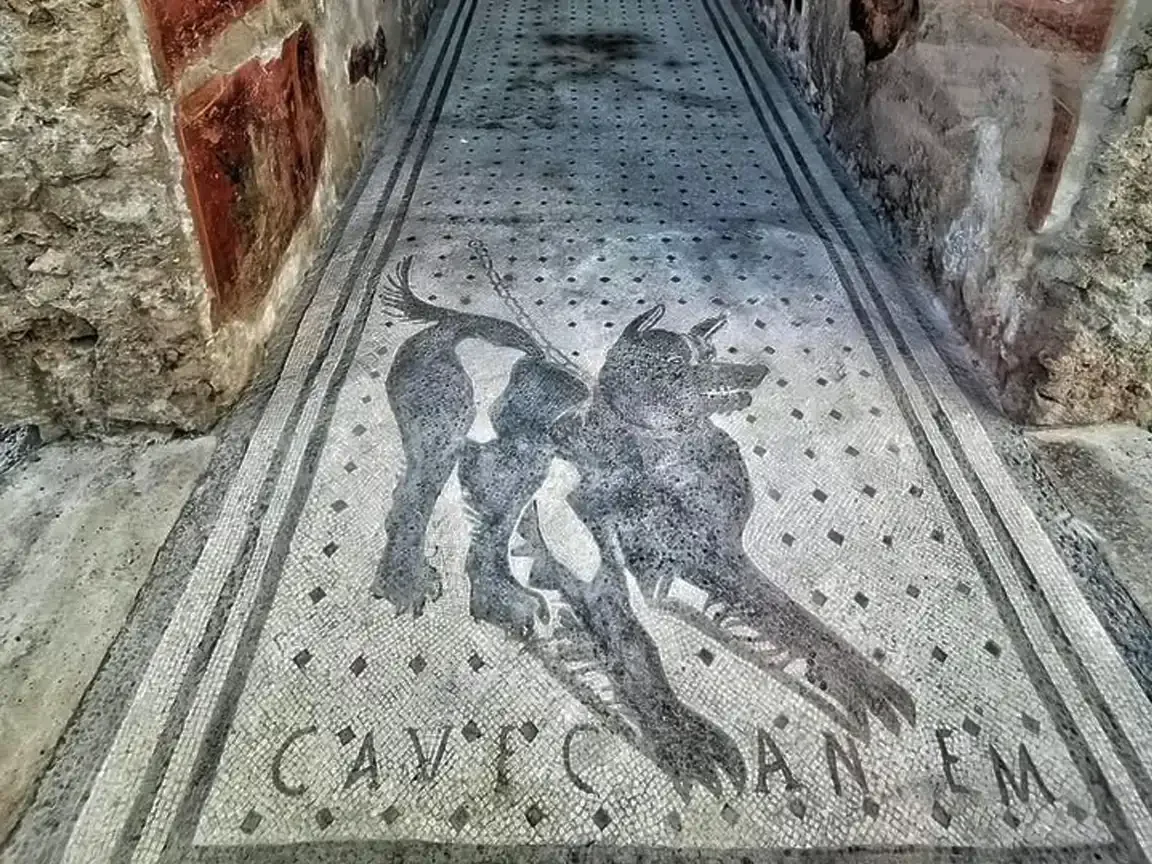
Ancient Roman mosaic of a black guard dog on a leash with the Latin warning “Cave Canem” (Beware of the Dog), from the House of the Tragic Poet in Pompeii. Sailko, CC BY-SA 4.0, via Wikimedia Commons.
You see the dog before you cross the threshold. Set flat into the stone floor of the vestibule, a dog lunges at the end of a chain — frozen mid-snarl, teeth bared, body braced. Beneath him, cut into tesserae in careful capital letters: CAVE CANEM. Beware of the dog.
Most visitors to the House of the Tragic Poet in Pompeii laugh when they see it. The recognition is instant: someone, two thousand years ago, put up a “Beware of Dog” sign. It feels close, familiar, almost funny. That feeling of familiarity is exactly the problem. The mosaic is not doing what you think it is.
What You See on the Floor
The mosaic is small by the standards of Roman domestic art — modest in scale, high in craft. It is composed of tesserae in black, white, and red against a light background, bordered by a double black frame. The dog is rendered in profile, body low and taut, chain trailing behind him. He is not sitting. He is not resting. He is caught in the first second of a lunge, the posture held permanently in stone.
The image was discovered in November 1824, when the archaeologist Antonio Bonucci excavated the vestibule of a modest atrium house in the far-western quarter of Pompeii — Regio VI, Insula 8, a street’s walk from the Forum baths. The house was not large. Its owner was clearly not among the city’s wealthiest. But the interior was exceptional: painted frescoes and mosaics of unusual quality, depicting scenes from Greek mythology. The theatrical scene that gave the house its name — actors gathered backstage, preparing for a performance — was found in the tablinum and is now in Naples. What remained in place, protected under glass, is the dog.
The original mosaic is held at the Museo Archeologico Nazionale di Napoli. The replica that visitors see today at the site is set into the fauces — the “throat” of the house, the narrow entrance corridor where the street ended and the household began.
The Throat of the House
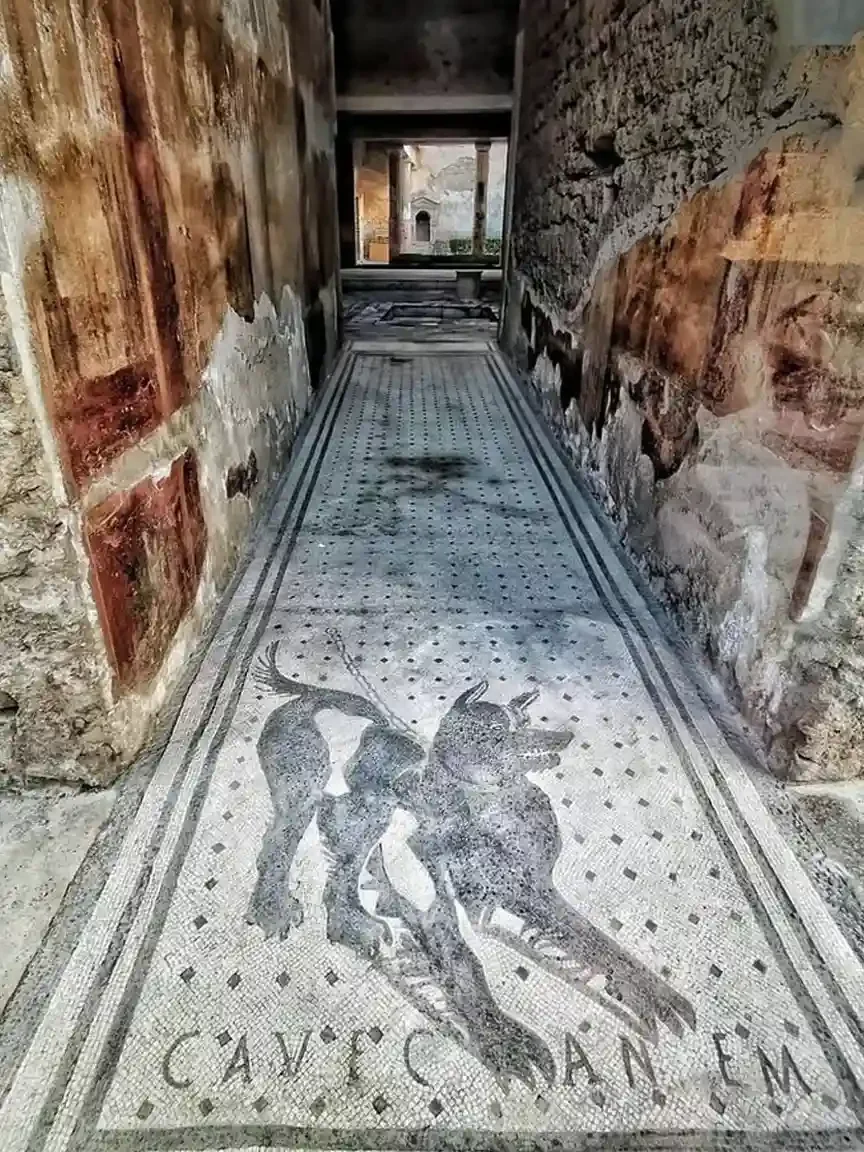
View of the threshold of the House of the tragic poet, Pompeii. Sailko, CC BY-SA 4.0 Public domain via Wikipedia Commons
To understand what the mosaic is doing, it is necessary to understand what a Roman threshold was for.
The Latin word “limen” meant boundary, edge, threshold — and it carried a weight far beyond what the English word suggests. Janus, the two-faced god, presided over beginnings, gates, and passages; every crossing from outside to inside was his domain. The vestibule of a Roman house was not merely the place where you wiped your feet. It was a charged, liminal space: the zone where the public world of the street gave way to the private world of the family. Roman ritual treated it accordingly. Brides were carried over the threshold. The dead were carried out across it. Even standing in a doorway was considered bad luck.
Scholarship on Pompeian domestic architecture has shown consistently that the vestibule was one of the most carefully managed spaces in the Roman house. It was where the dominus — the master of the household — made his first statement to the world. Floors in entrance corridors were painted to mimic expensive marble. The inscription SALVE — “welcome” or “be well” — was worked into vestibule mosaics to signal hospitality and ease. And sometimes, in place of welcome or alongside it: CAVE CANEM. The two impulses coexisted at the same threshold, in the same house, as two faces of the same performance.
The threshold was not merely where you entered. It was where the household defined itself.
Trimalchio’s Dog
Around 60 CE, the Roman writer Petronius published the Satyricon — a picaresque, partially surviving novel built around a dinner party hosted by Trimalchio, a freed slave who has made an obscene fortune and spends it with magnificent tastelessness. The narrator describes arriving at Trimalchio’s house: entering the vestibule, he nearly jumps out of his skin at the sight of a large dog painted on the wall beside the gate, with the inscription CAVE CANEM above it in large capitals.
The joke is layered. Trimalchio has no actual guard dog; he has a painting of one. He has absorbed the visual language of the Roman elite — the warning at the door, the declaration of property and danger — and replicated it as spectacle. Petronius is satirizing him for it: the cave canem sign, in the world of the novel, is something wealthy Romans do. Trimalchio does it too, and the doing marks him as an arriviste aping a custom he doesn’t quite possess by right.
That satirical edge tells us something important. By the 1st century CE, the cave canem display had become sufficiently widespread and sufficiently associated with domestic status that a satirist could mock it. It was legible as a fashion. And like any fashion, it communicated more than its surface meaning. A mosaic in your vestibule — tesserae hand-laid by skilled craftsmen, bordered and framed, placed where every visitor would walk over it — cost money. It required a patron who could commission one and a house fine enough to give it context. The snarling dog was not only a warning. It was a marker of means.
This is especially pointed in the case of the House of the Tragic Poet. The house is not large. Its footprint is modest compared to the grand villas that dominate Pompeii’s tourist itineraries. But its art — the quantity and quality of its frescoes and mosaics, the Homeric themes, the theatrical scenes — suggests an owner of real cultural ambition, someone projecting sophistication rather than sheer acreage. The cave canem mosaic, at the entrance, is the first statement made to anyone who approached. It said: this house has something worth protecting. It said: someone here has the means to protect it. And it said: you are entering somewhere that matters.
More Than the Dog You Cannot See
There is a third function, less often discussed, that the cave canem mosaic may have served. And it requires thinking about what Romans believed happened at thresholds.
Roman domestic space was understood as spiritually vulnerable. The threshold was the point at which the household’s protective sphere was thinnest — the crack in the armor through which misfortune, illness, and malicious spirits might enter. The household gods, the Lares, were kept in a shrine in the atrium, watching over the interior. But the vestibule and the fauces were where you had to manage the outside world before it got that far.
Apotropaic imagery — images designed to ward off evil, to turn away the malign eye — was everywhere in Pompeii. Phallic symbols were carved above doorways and hung as bronze wind chimes. Figures of Priapus, the guardian deity of boundaries, stood in gardens. Gladiatorial imagery appeared near thresholds, where scholarship has increasingly suggested it served a protective rather than purely decorative function. The threshold was a place where you invoked what you wanted and repelled what you feared.
The snarling dog in the vestibule of the House of the Tragic Poet belongs to this tradition. It confronts whatever crosses the threshold — not just the potential thief, but the potential harm. A menacing dog, frozen in permanent aggression at the point of entry, was a ward as much as a warning. The chain in the image is significant: the dog is dangerous, but it is controlled. The household masters that danger. It does not master them.
None of these three functions — warning, status display, apotropaic protection — cancels the others. They operate simultaneously, layered into the same twelve square feet of stone. That is the sophistication of what looks, at first glance, like a sign you could buy at a garden center.
The Dog Across the City
The mosaic dog never bit anyone. The real ones did.
Romans kept large dogs for guard work as a matter of course, and the breeds they favored were not chosen for temperament.
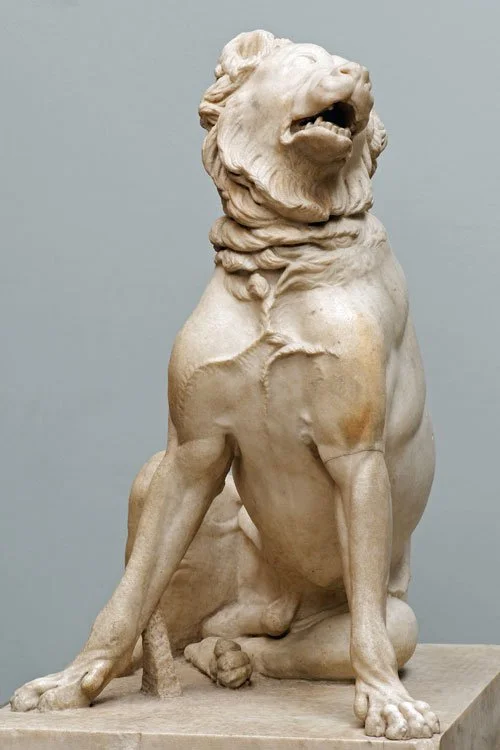
Molossian dog. The Jennings Dog on display in the British Museum. Photo by Marie-Lan Nguyen CC BY 2.5 via Wikipedia Commons.
The Molossian — an ancestor of the modern mastiff, originally from the mountainous regions of northwestern Greece — was the standard recommendation for serious domestic protection. Heavy-boned, deep-chested, capable of real violence, it appears in Roman agricultural writing as the obvious choice for anyone with property worth defending. The agricultural writer Columella, in the 1st century CE, was specific about deployment: guard dogs should be dark in color, to be less visible to intruders approaching at night, and chained at the entrance of the property during daylight hours, released after dark. The fauces — the narrow entrance corridor of the Roman house — was precisely where a chained dog would be positioned. The mosaic in the House of the Tragic Poet sits in exactly that space.
Roman law formalized the relationship between the real dog and the stone one. Under the Twelve Tables, one of Rome's earliest legal codes, a householder who kept a known aggressive dog was liable for any harm it caused to a visitor — unless adequate warning had been given. The cave canem inscription was not merely a cultural gesture. It was a legal declaration, a transfer of risk from the owner to anyone who chose to proceed past it regardless. The mosaic, in this reading, was doing something a modern lawyer would recognize: documenting that the householder had discharged his duty of care. The stone dog protected the real one's owner.
It is worth noting that the two did not always coexist. Petronius's Trimalchio has a painted cave canem and, as far as the narrator can tell, no actual dog behind it. The warning had become sufficiently standardized that it could operate as pure performance — the sign without the animal. But in houses where the dog was real, the mosaic and the beast formed a single system: the image announced what the animal enforced.
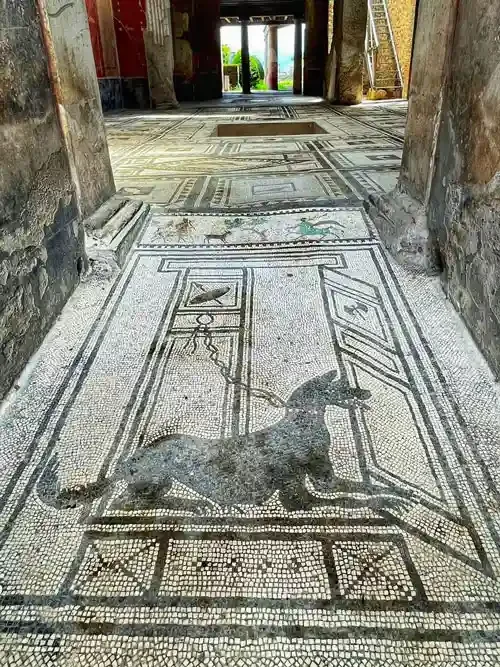
The dog mosaic in the fauces of the House of Paquius Proculus — leashed, mid-stride, positioned where every visitor would walk over it. © Pompeii Archaeological Park
The House of the Tragic Poet is the most famous example, but not the only one. Cave canem mosaics and dog-at-entrance images appear across Pompeii, each with its own character. In the House of Paquio Proculus, the dog is depicted on what appears to be a half-open door — the image implies the animal might be released at any moment. In the House of Orpheus, now at the Archaeological Museum in Naples, the dog is rendered more docile, tied to a leash but without the snarl. The variety matters. These were not mass-produced signs. Each was a commission, a choice. The designer of the House of the Tragic Poet mosaic chose a dog at the extreme edge of menace. Someone else chose restraint. The convention was stable; the execution was personal.
What the Threshold Still Holds
In 79 CE, Vesuvius buried the House of the Tragic Poet under meters of volcanic ash and pumice. The dog in the vestibule, mid-lunge, was sealed in darkness for nearly eighteen centuries. When Bonucci uncovered the house in November 1824, the dog was there, still snarling at the threshold, chain still trailing behind him, teeth still bared against whatever had been coming through the door.
The house’s owner is unknown. No name survives. The theatrical mosaic that gave the house its modern name — the “Tragic Poet” — depicts actors backstage, not the family who commissioned it. What remains most legible, most immediate, is the dog at the door: the first thing anyone saw approaching this house, the last thing protected when the city ended.
Reproductions now appear on mugs, tote bags, and key rings across every souvenir stand within a mile of Pompeii. The phrase has traveled so far from its origin that most people who buy it have no idea what they are really carrying home. Not a joke about ancient dog ownership. A declaration, in stone, that this threshold was guarded. That what lay beyond it was worth the watching. That the dog — permanent, implacable, frozen in the act of defense — would still be there when you returned.
Did You Know?
The Roman calendar included festivals to protect thresholds and boundaries. Compitalia honored the gods of crossroads with offerings and small shrines, underscoring the importance Romans placed on the boundary between inside and outside.
Petronius’s Satyricon, which satirizes cave canem as a status symbol, survives only in fragments. Its famous “Dinner of Trimalchio” section, containing the dog passage, was discovered in a Croatian library in 1650.
Ancient Rome had its own dog-breeding literature. The writer Columella recommended white dogs for shepherds, so they could be distinguished from wolves at night, and dark dogs for guarding farms.
The Roman custom of carrying a bride over the threshold survives today. Plutarch records that a Roman bride was carried into her new home rather than stepping over the threshold herself.
Pompeii’s House of the Tragic Poet became a setting in Edward Bulwer-Lytton’s 1834 novel The Last Days of Pompeii. The novel helped turn Pompeii into a popular historical subject for Victorian readers.
Where to view this object?
Location: Archaeological Park of Pompeii, Italy
You can see this famous "Cave Canem" mosaic at the Archaeological Park of Pompeii in Italy. It is located at the threshold of the House of the Tragic Poet (Casa del Poeta Tragico).
The Archaeological Park of Pompeii is a UNESCO World Heritage Site preserving the ancient Roman city buried by Mount Vesuvius in 79 A.D. It features remarkably intact streets, villas, and temples across 44 hectares, it provides an unparalleled glimpse into Roman life.