Cerberus: The Dog Who Guarded the Underworld
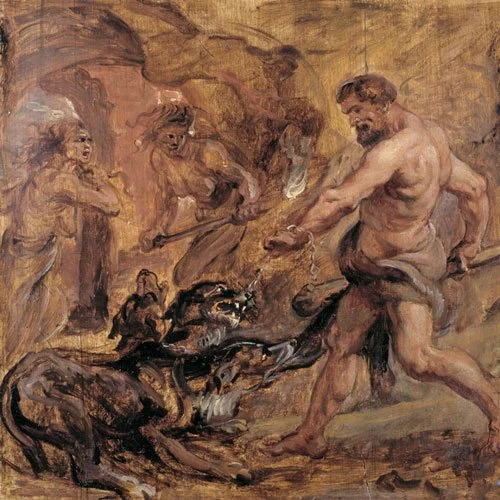
Rubens painted Cerberus in 1636 on a panel barely bigger than a sheet of letter paper, and got one thing right that almost every artist since has gotten wrong. His dog is going the wrong way.
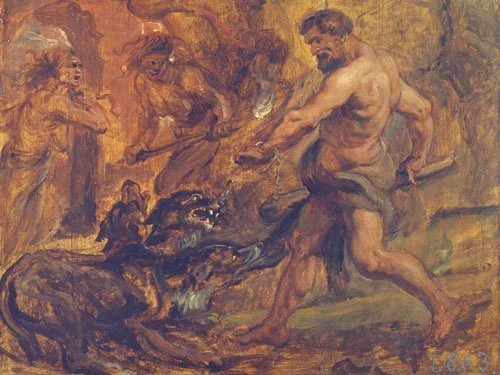
“Hercules and Cerberus,” Peter Paul Rubens, 1636–37. Hercules is on his way out and the dog is coming with him — the one direction Cerberus existed to prevent. Prado, P002043. Public domain via Wikimedia Commons.
Cerberus is losing. Rubens has him down in the bottom corner of the panel, a dark mass strung along the ground with his jaws open and his heads crowded toward the light, and Hercules is a stride ahead of him already on his way out. There is no club in Hercules’s hands. There is no blade either.
The direction is the whole story. For as long as most people have known the name, Cerberus has been the thing in the doorway with its teeth out, refusing to let you in. That is not what he was for, and this small brown panel in Room 79 of the Prado is one of the few pictures in Western art that gets it right.
The Dog Going Out
Rubens gives Cerberus a body built for holding ground and then takes the ground away. The dog is painted low and stretched out, the heads angled apart rather than massed forward — the shape an animal makes when it is being pulled, not the shape it makes when it is coming at you. Snakes come off the tail. The coat is a mottled brown, the one unglamorous thing in a cave lit like a furnace.
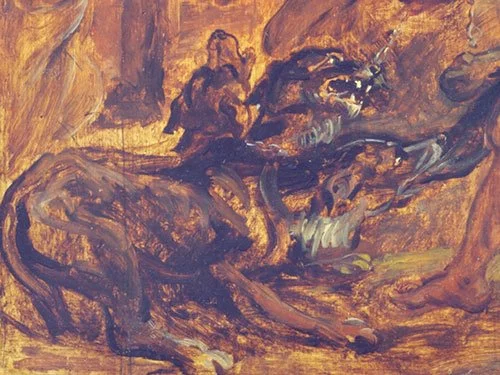
Detail of the same panel. The heads are angled apart rather than massed forward — the shape a dog makes when it is being pulled. Public domain via Wikimedia Commons.
Two figures stand behind the struggle, and it is worth being careful about them. The Prado identifies them only as possibly Pluto and Proserpina, the underworld’s own gods, watching. Rubens painted their faces as three or four strokes each. Anything past “watching” is the viewer’s invention.
What is not open to interpretation is the traffic. Hercules is walking out and the dog is coming with him. Everything in the animal that resists — the flattened body, the angled necks, the weight held low and back — is resisting an exit.
Ovid, whom the Prado names as Rubens’s direct source for the scene, describes precisely this. In Book VII of the Metamorphoses, Hercules drags the dog up through a cave in chains of adamant, and the detail Ovid stops on is that Cerberus turns his eyes aside from the daylight. Not from Hercules. From the light. The dog had spent his whole existence standing at a door, and this was the first time anyone had taken him through it.
He Let Hercules In
Cerberus was never a doorman. He was a one-way valve.
Hesiod’s Theogony, composed in the eighth or seventh century BC and the earliest surviving text to give the dog a name, sets him in front of the halls of Hades and describes his working method in two directions. To those arriving, he fawns. He goes at them with his tail and both ears down, and lets them through. Then he watches the door, and anyone who turns around and tries to leave he catches and eats.
That is not security against intruders. It is security against desertion. The underworld, in the oldest account we have of it, took walk-ins and had no exit policy at all beyond a dog.
It explains a great deal that otherwise looks like carelessness in the myths. Orpheus walked in. Aeneas walked in. Odysseus reached the border and Psyche went the whole way down. Nobody had to defeat anything to get into the land of the dead, because getting in was the easy part and always had been. What none of them could do was leave with something.
Which is what Hercules was sent to do. The twelfth labor, as Apollodorus sets it out, was not to enter the underworld — Theseus had managed that, badly — but to bring something out of it, and the something was the mechanism that made leaving impossible. Rubens is not painting a break-in. He is painting the only successful removal on record, and the thing being removed is the dog.
Fifty Heads, Then Three
The heads are a later invention too. Hesiod gives Cerberus fifty of them. Pindar, a couple of centuries on, raised the figure to a hundred. Horace went the other way entirely and gave him a single dog’s head ringed with a hundred snakes.
Three arrives with the mythographers. Apollodorus settles on three dog heads with the heads of every kind of snake running down the back, and the Byzantine scholar John Tzetzes later tried to reconcile everyone by proposing fifty heads of which three were canine and the rest belonged to assorted other beasts. Nobody was working from a description. They were working from each other.
What settled it was not literature but pottery. Greek vase painters worked on a curved surface, in a narrow register, in silhouette — conditions in which three heads is roughly the most that reads as a dog rather than as a shrub. The surviving pots are consistent with that: two heads appear far more often than three, sometimes only one, but never more than three. Whether the pottery drove the number or simply recorded it is not something the evidence can settle. What can be said is that the count which became standard is also the count a pot could hold.
Hercules Puts Down His Club
Look at the hands in the Prado panel and then look at a Greek pot.
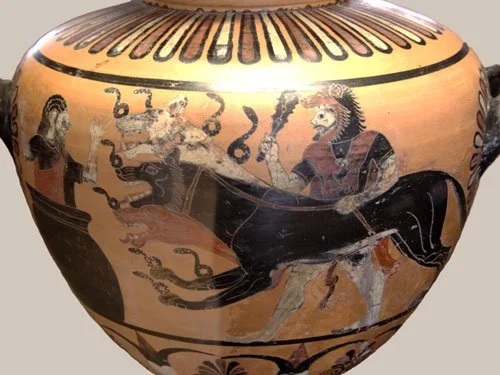
Herakles carries the club Hades had forbidden him. Caeretan black-figure hydria, ca. 525 BC, attributed to the Eagle Painter. Musée du Louvre, E 701. Public domain via Wikimedia Commons.
On a Caeretan hydria of about 525 BC, now in the Louvre, Herakles brings the dog to a terrified Eurystheus, who has climbed into a storage jar and is peering over the rim. Herakles has the leash in his left hand and his club raised in his right. It is the standard iconography, and by the terms of the labor it should not be there at all.
Apollodorus is specific. Hercules asked Hades for the hound and was told he could have it only if he overpowered it without using any of the weapons he had brought with him. So he went in wrapped in the lion skin, got his arms around the heads and held on. The serpent tail bit him throughout. He won by choke-hold, which is the only method the condition left available.
Rubens gives him no weapon at all. In a picture full of invented atmosphere — the furnace light, the smeared gods, the reds that no cave has ever produced — the empty hands are the part that is documented, and they are the part almost every other artist got wrong.
The Gate He Never Guarded
Later ages put Cerberus back in front of a door, and it stuck.
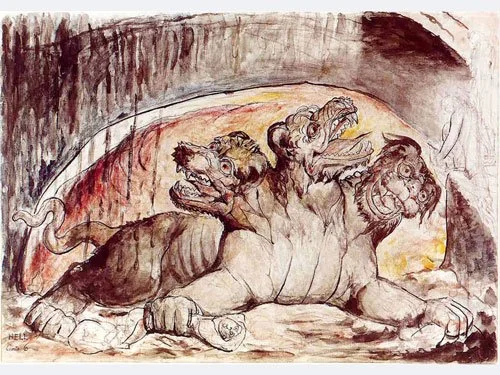
Blake puts him in the mud with the gluttons, blocking a road nobody was trying to leave by. From Illustrations to Dante’s Divine Comedy, 1824–27. Public domain via Wikimedia Commons.
Dante found him in the third circle of the Inferno, up to his elbows in freezing rain and filth, tormenting the gluttons. William Blake, illustrating the passage in the last years of his life, drew him sprawled over the mud with the damned laid out beneath him. It is a striking image and it is guard duty of a kind nobody needed: the souls in the third circle were not going anywhere, and Blake’s dog is blocking a road no one was trying to use.
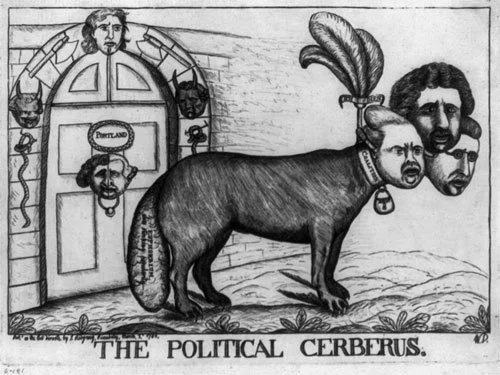
The heads are Lord North, Fox and Burke; the gate reads Portland. William Dent, “The Political Cerberus,” London, 3 March 1784. Public domain via Wikimedia Commons.
The political cartoonists finished the job. In London on 3 March 1784, the printmaker William Dent published The Political Cerberus, a three-headed dog wearing the heads of Lord North, Charles James Fox and Edmund Burke, in a collar marked Coalition fastened with a padlock marked Interest. The dog is planted in front of a gate inscribed Portland, keeping the public out of the Treasury. Dent needed one thing from the myth and took it: a dog that stops you getting in.
Two and a half thousand years after Hesiod, that is the version everyone recognizes, and it describes a shift that never happened in the sources. Cerberus did not change job. His readers did.
He Went Back Down
He was on the surface for a matter of hours.
Hercules brought him up through a cave mouth — Tainaron, in Laconia, was the site most often pointed at by later Greek writers, though Pausanias visited and noted with some irritation that there was no passage underground there at all. He showed the dog to Eurystheus, who took one look and got into a large storage jar, and who then declined the delivery. The labor was complete. Hercules walked the hound back to the entrance and returned him.
The only creature ever taken out of the underworld went back into it, having done nothing to earn removal in the first place, and resumed the post. Nothing in the record suggests he was consulted, and nothing suggests he had anywhere else to be.
That is the story Rubens chose out of a commission of more than sixty mythological scenes. Not the lion, not the hydra, not the labors with a corpse at the end. The one where a dog is briefly taken out of the only place he had ever worked, and then taken back.
Eleven Inches of Panel
The picture in Room 79 is eleven inches by twelve.
Hercules and Cerberus is oil on panel, twenty-eight by thirty-one and a half centimeters, catalogued by the Prado as a painted preparatory study. It is a working sketch. Philip IV commissioned more than sixty mythological scenes in 1636 for the Torre de la Parada, a hunting lodge in the woods outside Madrid, and Rubens — then close to sixty and short of time — designed nearly all of them at this scale and handed the enlargements to other painters. This particular design, the Prado records, was worked up onto full-size canvas on at least three separate occasions by his assistants.
The lodge did not last. Austrian troops took it in 1714, during the War of the Spanish Succession, and it burned; the ruins are still in the Monte de El Pardo, inside a reserve the public cannot enter. Forty of the finished paintings survive. So do more than fifty of the sketches.
So, the most convincing Cerberus in European painting is a thumbnail that was never meant to be looked at — a set of instructions for somebody else, made in an afternoon, for a building that no longer exists. Rubens got the direction of travel right, and the empty hands, and the turned-away heads, at a size where none of it was supposed to show. The finished versions his assistants made from it are scattered and mostly forgotten. The instructions are hanging in Madrid, under glass, with a dog in them going the wrong way.
Where to view this painting
Location: Museo Nacional del Prado, Madrid. Room 79.
Gallery notes: The museum describes the mythological hero fighting the three-headed dog while two figures — possibly the underworld’s own gods, Pluto and Proserpina — look on in terror. It names Ovid’s Metamorphoses as Rubens’s direct source, notes that the episode also appears in other classical texts and records the work as one of the most expressive of all the sketches made for the projected decoration of the Torre de la Parada. The design was worked up onto canvas on several occasions by at least three of Rubens’s assistants.
Journey Further Through Canine History…
Cerberus let every soul into the underworld and none back out. Other cultures posted their own dogs at that door — a jackal-headed god over Egyptian burials, the death god Frida Kahlo named her dog after, and the Welsh hounds that ran between worlds.