A Pompeii Pup: The Dog Beneath the Lovers
In Pompeii’s newly revealed “Black Room”, Helen meets Paris in bright, ominous paint—yet it’s the hefty spotted dog at his feet that arrests the modern eye. A small presence with big implications for Roman status, domestic life, and loyalty.
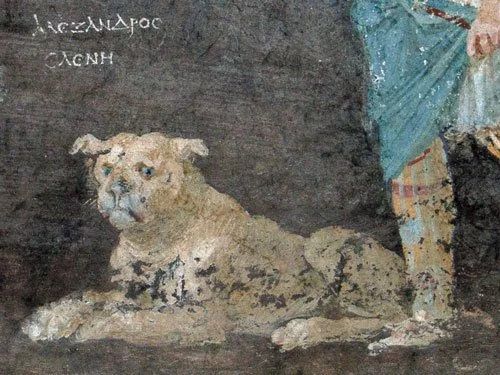
Fresco depicting the meeting of Helen and Alexandros (Paris), Black Room, Pompeii. Public domain via Wikipedia Commons
Pompeii 2025
In the shadowy stillness of the so-called "Black Room" of Pompeii, a new fresco has stepped into the spotlight. Its figures familiar, its colours vibrant and remarkably intact. Here, amidst the elegant swirl of drapery and myth, Helen of Sparta meets Paris (or Alexandros, as the Greek label insists), in a moment painted with delicate foreboding. Yet, for those with a keen appreciation for the canine kingdom, it is the substantial, spotted dog lounging at Paris’s feet that truly steals the show. The artist, with a few deft brushstrokes, has given us a creature of considerable character, its very presence adding a layer of grounded realism to the mythical narrative.
Lying obediently by Paris’ feet, the animal is unbothered by destiny. He does not know the Trojan War is about to begin. His job, it seems, is to observe. And perhaps that’s precisely what makes him so compelling. Who is this ancient dog, and what does he tell us about life, love, and loyalty in the Roman world?
A Dog’s Life in the Shadow of Myth
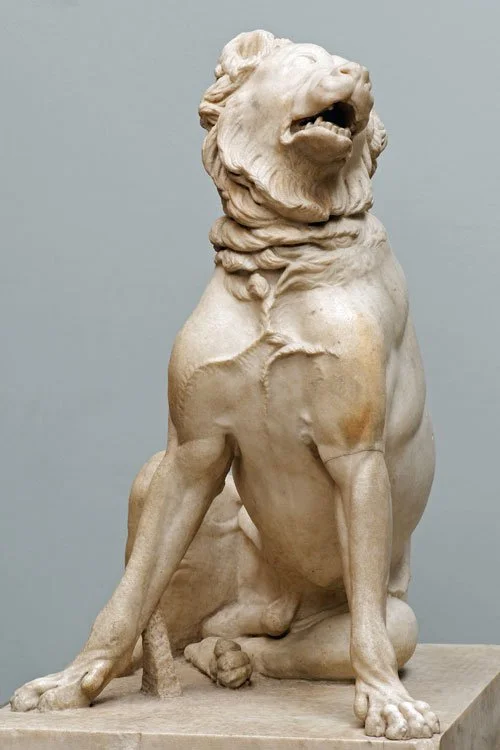
Molossian dog. The Jennings Dog on display in the British Museum. Photo by Marie-Lan Nguyen CC BY 2.5
The fresco, dated to the final decades before Vesuvius’ eruption in 79 CE, depicts the archetypal moment from Homeric lore when Helen meets her supposed abductor. It's been interpreted by scholars as a cautionary tableau or even a romantic prelude, but standing (or reclining) just beside the couple is the sort of companion rarely granted mythological billing.
This isn’t just any dog; its powerful build, muscular neck, and short, dense coat strongly suggest a Molossian hound. These formidable dogs, originating from Epirus in ancient Greece, were renowned for their bravery, strength, and protective instincts. Molossians, ancestors of today’s mastiffs, were employed as guard dogs, hunting companions, and even in warfare. They were a prestigious breed, favoured by royalty and revered for its loyalty.
Our frescoed friend, with its alert gaze and relaxed posture, seems to embody the very essence of this noble lineage. Its presence here, at the side of Paris – a figure soon to ignite a monumental conflict – is curious. Is it a faithful companion, a symbol of his status, or perhaps a subtle nod to the inevitable chaos that would follow?
Pompeii’s Silent Sentinels
The Pompeian pooch is far from an isolated incident. Throughout the Roman world, dogs were not merely pets but integral members of society, and their ubiquity is reflected vividly in the art of the period, particularly in the intricate mosaics that adorned the floors and walls of Roman villas.
Mosaics at Pompeii famously feature the warning “Cave Canem” (“Beware of the Dog”), found in the entrance hall of the House of the Tragic Poet. There, a black dog strains against its chain, teeth bared, an early form of the “beware of the dog” sign that still adorns British fences.
But not all Pompeian dogs were guard dogs. In the House of Orpheus, another mosaic shows a friendly, tail-wagging pup seated behind his musical master. Elsewhere, frescoes portray dogs as companions, hunters, and beloved pets. Some are shown wearing collars; others lounge freely, chasing hares or dozing near couches. Roman literature, too, is full of canine cameos—Virgil, Columella, and Varro each mention dogs with a tone of both utility and affection.
What these depictions reveal is a society that understood dogs not only as property, but as personalities.
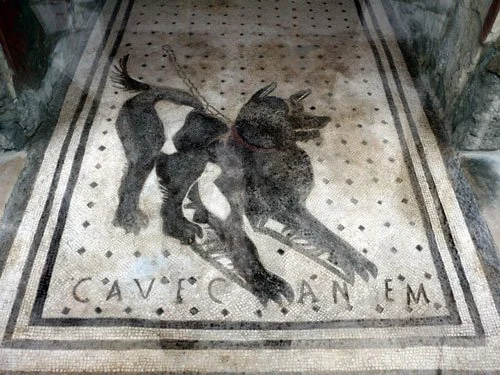
House of the tragic poet, mosaic of the cave canem, Pompeii. Sailko, CC BY-SA 4.0 Public domain via Wikipedia Commons
From Guardian to Companion
The dog of the “Black Room” may represent a domestic guardian, included to signify wealth or status, or even serve a more narrative function - foreshadowing the eventual violence unleashed by this fateful romance. After all, Molossians were also the dogs of war.
Yet it’s equally possible he was included simply because he was there. Perhaps the artist, or the patron commissioning the work, had such a dog at home, watching the household drama with the same silent attentiveness.
Unlike the stylised postures of Helen and Paris, the dog’s body is relaxed and naturalistic. His front paws are extended, tail curled gently around, gaze directed outward. One could almost believe he was painted from life.
Paw Prints Across the Empire
This dog is not alone in history. Roman mosaics across the empire, from Britain to North Africa, reveal a veritable gallery of ancient pups. In Antioch, one mosaic shows a dog chasing its tail—a universal gesture of canine joy. In Tunisia’s ancient city of Dougga, an intricate hunting scene features dogs bounding through marshland.
Meanwhile in Roman Britain, a mosaic from Lullingstone Villa (Kent) shows a spotted dog looking out with soulful eyes—clearly loved, perhaps even mourned. Some archaeologists suspect certain canine images served not just decorative, but commemorative functions: ancient pet portraits, if you will.
So the dog at Helen and Paris’ feet is not an anomaly. He is part of a lineage of dogs rendered in stone and paint, remembered across millennia not for heroic deeds, but for simply being present—for watching, waiting, and offering the quiet companionship that transcends time and tale.
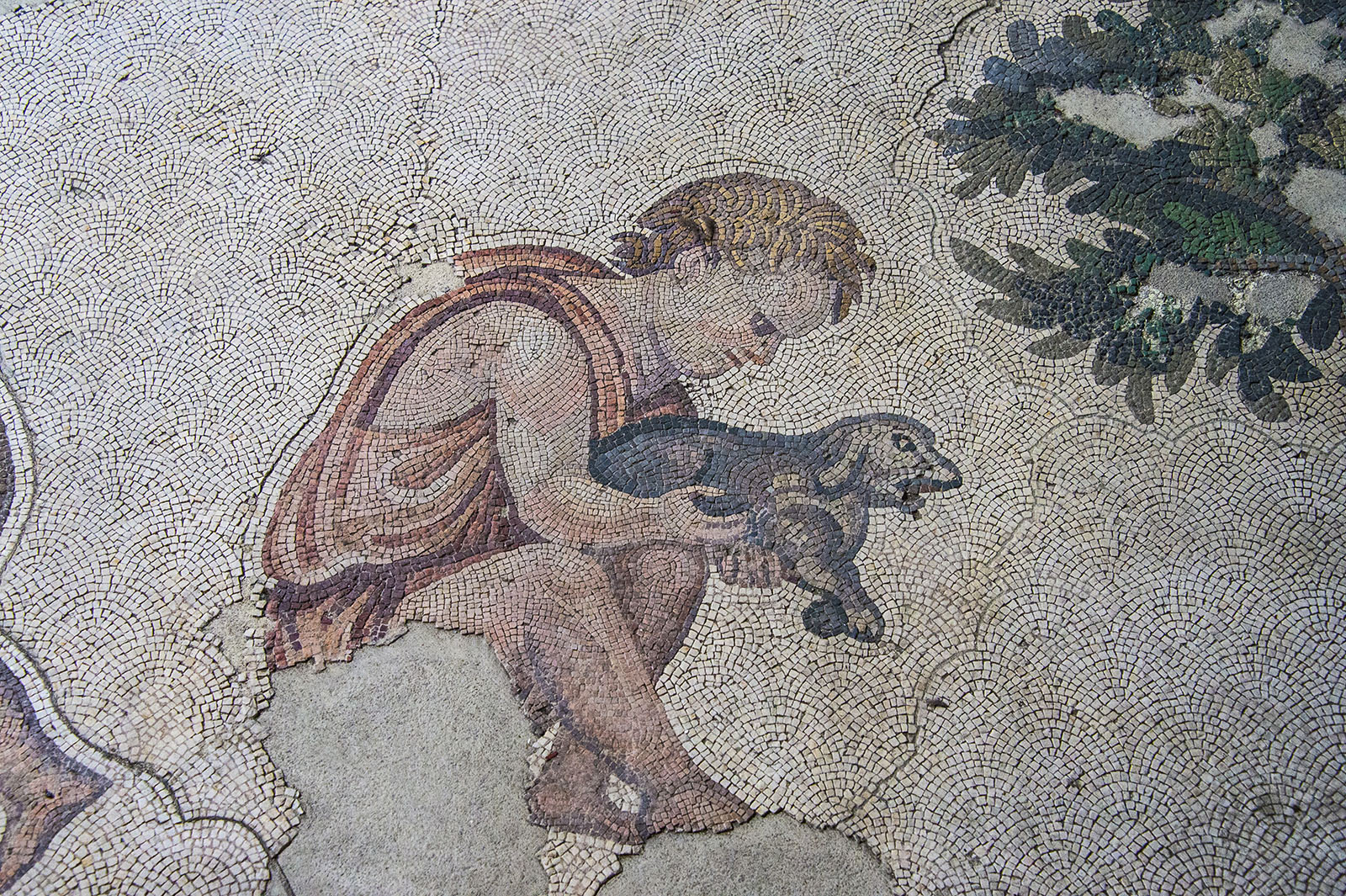
Child and dog, Istanbul Mosaic Museum. Dosseman, CC BY-SA 4.0
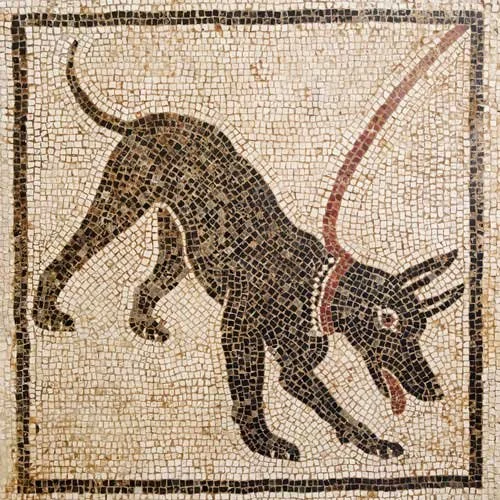
Mosaic fragment with a hunting scene, Sousse (modern Tunisia). Ad Meskens, CC BY-SA 3.0
Symbolic Function
Guardianship and Loyalty:The presence of a dog - especially a Molossian - was often symbolic of protection and vigilance. In this context, the dog may serve as a visual counterpart to Paris, whose role as both seducer and catalyst for war makes him a controversial "guardian" figure.
Domesticity and Contradiction: Helen, a royal woman, is being courted or abducted depending on the narrative lens. The dog lying calmly implies domestic peace and trust, which clashes with the impending violence of the Trojan War. This tension might be deliberately ironic.
Visual Anchoring: Artistically, the dog helps balance the composition, drawing the eye to the central space between Helen and Paris, where the moment of their meeting—and mutual decision—is taking place.
The Most Grounded Figure in the Room
As archaeologists brush away the ashes of antiquity, we are left with questions: Who loved this dog? Did he live in the house where the fresco was found? Was he real, or an artistic type?
We will likely never know. But it is a strangely touching thought, that amid the gods, lovers, and legends, someone in ancient Pompeii wanted to include a dog. And not just a guard dog to be feared, but a calm, companionable creature, present in the middle of myth.
He may not be part of the Homeric canon, but in the story of this fresco, and in the broader history of Roman life, he is, without doubt, the most grounded character of all.
Did You Know?
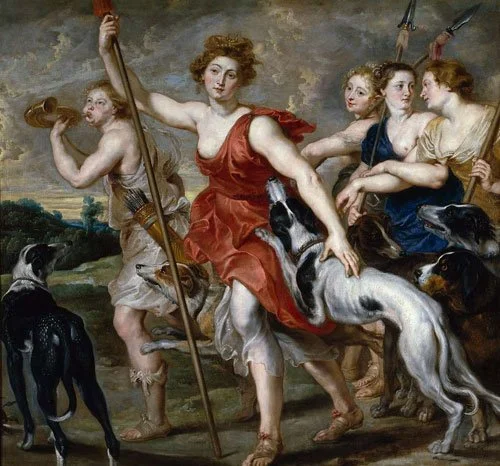
Painting depicting the Roman goddess Diana, the goddess of the hunt, with nymphs and hunting dogs by Peter Paul Rubens. Public domain via Wikipedia Commons
The Molossian hound is considered an ancestor of several modern breeds, including the Mastiff, Great Dane, and St. Bernard.
The “Cave Canem” mosaic in Pompeii is one of the earliest examples of a “beware of the dog” sign in the world.
Dogs were considered good omens in childbirth, and some Roman women kept lapdogs for this reason.
In literature, dogs often acted as metaphors for loyalty, or betrayal. They appear in the Aeneid, the Georgics, and many Roman fables.
The Roman goddess Diana, protector of the wild and huntress, was often depicted accompanied by dogs.
Where to view this object?
Location: Archaeological Park of Pompeii, Italy
You can see the Black Room fresco at the Archaeological Park of Pompeii in Italy. It is located at the threshold of the House of the Tragic Poet (Casa del Poeta Tragico).
The Archaeological Park of Pompeii is a UNESCO World Heritage Site preserving the ancient Roman city buried by Mount Vesuvius in 79 A.D. It features remarkably intact streets, villas, and temples across 44 hectares, it provides an unparalleled glimpse into Roman life.