Anubis Was Real: The Dogs Behind Egypt’s Most Famous God
Anubis wasn’t invented — he grew from real dogs haunting Egypt’s cemeteries. Discover the sighthound a pharaoh buried like royalty, and the eight million mummies that followed.
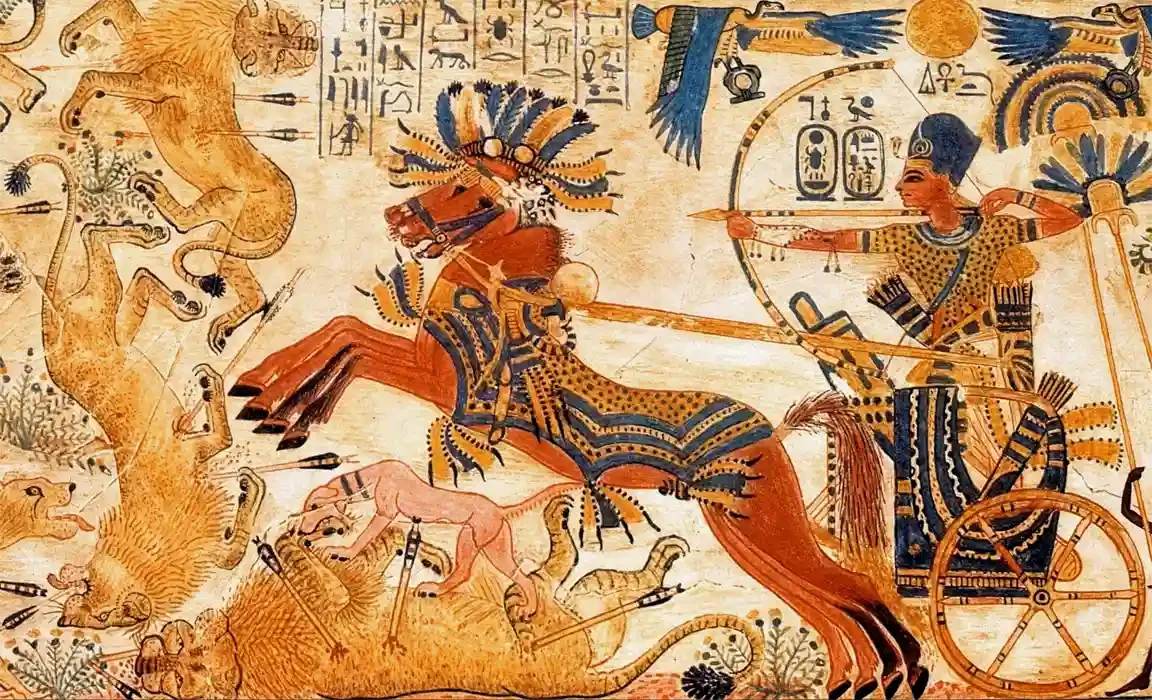
Tutankhamun hunting lions. This artwork is part of a scene decorated on one side of a chest found in the tomb of the Egyptian Pharaoh Tutankhamun. Photo: Davies, Ancient Egyptian Paintings, 1936.
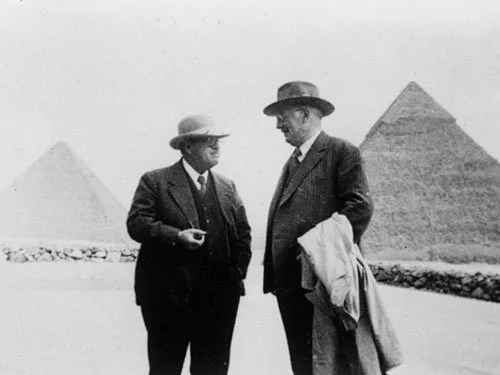
Georg Steindorff (right) with George A. Reisner (left) in Giza, Egypt (1935). Photo: Albert Morton Lythgoe, Public domain, via Wikimedia Commons
In October 1935, an Egyptologist named George A. Reisner pulled a small limestone tablet from the debris of a demolished funerary chapel in Giza West Field, in the long shadow of the Great Pyramid of Khufu. The stone was not large — roughly the size of a hardback book. Its ten columns of hieroglyphs recorded something that had not been seen before: a pharaoh ordering a state burial for a dog.
The dog’s name was Abuwtiyuw. The pharaoh’s name is gone.
The Stone in the Shadow of the Pyramid
Reisner was a Harvard archaeologist, meticulous and experienced, the kind of man who had spent decades cataloguing the tombs of the Old Kingdom with the same systematic patience he brought to everything. He had been excavating the Giza plateau since 1902. He was not easily surprised.
But the Abuwtiyuw tablet surprised him.
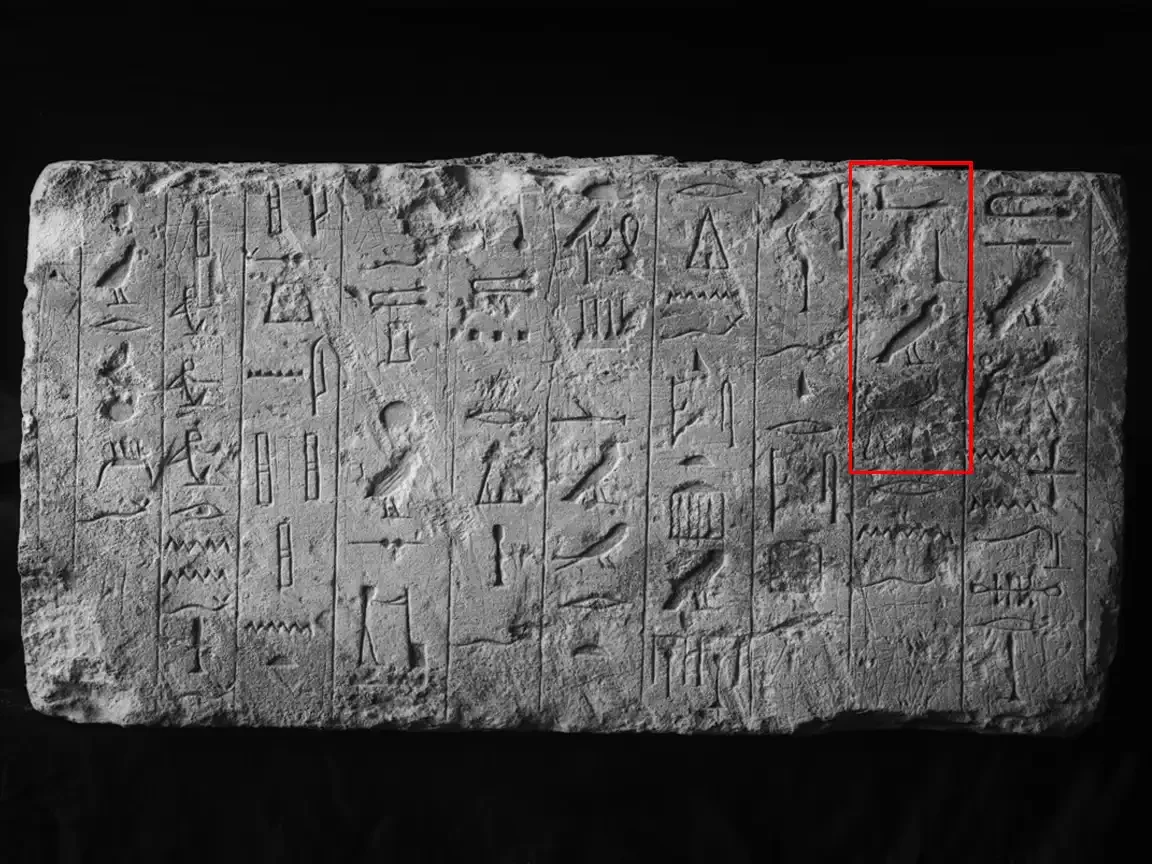
The inscribed limestone stele of Abuwtiyuw (also spelled Abutiu) represents a significant moment in history from approximately 2345–2181 BC. Photo: Egyptian Museum in Cairo, inventory number JE 67573.
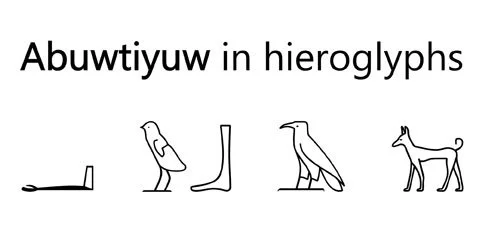
The inscription, translated in Reisner’s own words, reads: “The dog which was the guard of His Majesty. Abuwtiyuw is his name. His Majesty ordered that he be buried ceremonially, that he be given a coffin from the royal treasury, fine linen in great quantity, and incense. His Majesty also gave perfumed ointment, and ordered that a tomb be built for him by the gangs of masons. His Majesty did this for him in order that he might be honored before the great god, Anubis.”
A coffin from the royal treasury. Fine linen in great quantity. Incense and perfumed ointment. The same gangs of masons who built tombs for the human nobility of the Old Kingdom — redirected, by pharaonic decree, to honor a dog.
The tablet is now held in the Egyptian Museum in Cairo. Neither Abuwtiyuw’s mummy nor his tomb has ever been found. What we have is the inscription, and the name, and the knowledge that a ruler of one of the most powerful civilizations in human history chose to ensure that his dog would be remembered.
Abuwtiyuw appears to have been a Tesem — a lightly built sighthound, long-legged and swift, with erect ears and a curling tail, the kind of dog depicted at speed in the tomb paintings of the Old Kingdom. In the upper right corner of the tablet, a diagonal line in relief is thought to be part of a leash, suggesting the stone once bore an image of Abuwtiyuw with his owner — most likely the pharaoh or a royal official whose name did not survive.
It is one of the oldest named dogs in recorded history. Possibly the oldest.
How the God Was Made
To understand why a pharaoh would build a tomb for a dog, it helps to understand how Egypt came to have a dog god in the first place — and the answer is more literal, and stranger, than most people expect.
Anubis — the jackal-headed deity who guided souls to judgment, who presided over mummification, who weighed the human heart against the feather of truth — was not invented first and then associated with dogs. He grew out of them. From observation of real animals behaving in a real landscape.
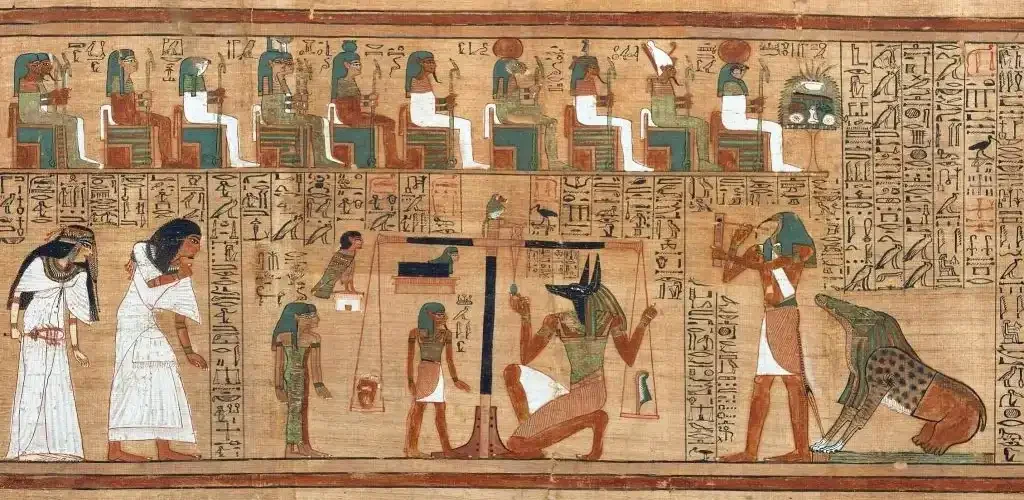
The Weighing of the Heart Ceremony, from the Book of the Dead, Papyrus of Ani (sheet 3). The god Anubis, here shown as a jackal-headed, human-bodied, kneeling deity, next to the balance which holds Ani’s heart (left) and a feather (right) representing Maat, the divine personification of truth and order. Photo: Egypt Museum.
In Predynastic Egypt, before the pyramids, before the dynasties, the dead were buried in shallow graves in the desert sand. And the desert, then as now, was full of dogs and jackals. They haunted the edges of settlements. They followed the smell of death. They dug up the shallow graves of the newly buried.
This was not a theological problem. It was a practical one. Families buried their dead and came back to find the graves disturbed, the bodies exposed. The solution Egypt eventually arrived at was architectural: deeper graves, sealed tombs, the mastaba. But the solution was also religious. If dogs and jackals were the creatures of the dead — if they appeared wherever bodies were laid — then perhaps the way to protect the dead was to place a canine god in charge of them. Fight like with like.
Anubis appears on royal tomb walls from the very first dynasty, around 3100 BCE. He predates almost every other figure in the Egyptian pantheon in this funerary role. His black color was not a representation of real jackals — those were grey and tan — but of the fertile black soil of the Nile Delta, which the Egyptians associated with rebirth and regeneration. He was not death. He was the one who protected you from it.
The same dogs that dug up the graves became the god who guarded them. That transformation — from threat to protector, from scavenger to deity — took thousands of years and left its mark everywhere in Egyptian life.
What the Tomb Paintings Tell Us
By the Old Kingdom, the period in which Abuwtiyuw lived, dogs were everywhere in Egyptian visual culture. They appear in tomb paintings alongside their owners, hunting gazelle and ibex in the desert. They sit beneath the chairs of nobles at banquets. They are shown on leashes, named in captions, painted with as much care and individuality as the humans beside them.
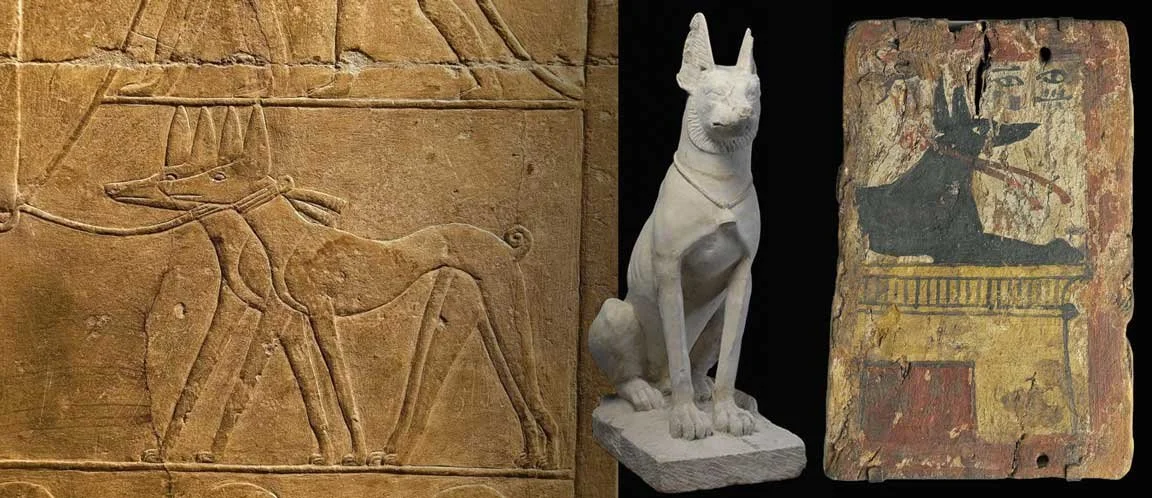
Left: The relief from the tomb of Mereruka, showing two Tesem led on a leash, ca. 2345–2333 BCE, Saqqara, Egypt. Egypt Museum. Middle: Right: Sculptures of dogs and jackals in Asyut, Middle Egypt, often placed in tombs. Egypt Museum. Coffin Fragment with Image of Anubis. Brooklyn Museum, via Wikimedia Commons.
Egyptian dogs had names. This matters more than it might seem. Naming an animal is a recognition of its individual existence, its particular self — a distinction from the anonymous mass of the natural world. More than seventy ancient Egyptian dog names have been translated from collars, stelae, and tomb reliefs. They include Brave One, Reliable, North-Wind, Good Herdsman, and — in one of the oldest recorded acts of canine affection — simply Useless. Four thousand years, and nothing has changed.
Pet dogs of nobles were sometimes buried with their owners in the early dynastic period, interred in the same tomb. The dog of King Khufu, the builder of the Great Pyramid, was reportedly buried within it. One noble at Giza had his dog depicted holding the leash in the rock-cut chapel: the dog shown not as subordinate but as companion, present in the visual record of the owner’s life.
What Abuwtiyuw’s inscription reveals is that this care extended to the highest level of the state. The pharaoh did not merely allow his dog to be buried. He directed it. He spent royal resources on it. He specified the quality of the linen. He invoked Anubis by name.
In a civilization that believed the soul required a properly prepared body to survive the afterlife, ordering a coffin from the royal treasury for your dog was not sentiment. It was theology. It was a statement that this particular animal deserved what humans received — that its Ka, its life force, was worth protecting.
A City of Dogs
By the first millennium BCE, more than two thousand years after Abuwtiyuw was buried in the shadow of the Great Pyramid, the relationship between Egyptians and dogs had taken on a new and spectacular dimension.
At Saqqara — the vast necropolis on the west bank of the Nile, burial ground of the ancient capital Memphis — a temple to Anubis had grown into something larger. A marketplace. A pilgrimage destination. A place where merchants sold bronze statues of deities, priests conducted ceremonies, and guides competed for business at the gates. Saqqara during the Late Period, roughly 750 to 330 BCE, was not a cemetery in any quiet sense. It was alive with commerce and devotion.
And pilgrims came to buy an offering.
The practice was simple. A worshipper who wanted to petition Anubis — for health, for a safe journey, for the soul of a dead relative — could purchase a mummified dog at the temple gates and dedicate it to the god. Egyptologist Salima Ikram of the American University in Cairo has described the logic: “In some churches people light a candle, and their prayer is taken directly up to God in that smoke. In the same way, a mummified dog’s spirit would carry a person’s prayer to the afterlife.”
Dogs were intermediaries. Messengers between the living and Anubis. The mummy was not a gift to a beloved animal. It was a vehicle for a request.
The catacombs beside the Anubis temple at Saqqara — a series of unadorned tunnels cut into the limestone, stretching deep into the rock with no natural light — were filled over the centuries with the results. When archaeologist Paul Nicholson of Cardiff University led a full survey of the site in the early 2010s, the estimate he arrived at was staggering: approximately eight million animals, the vast majority of them dogs.
Eight million.
The scale of that number requires a pause. The Great Pyramid of Khufu contains an estimated 2.3 million stone blocks. The Saqqara catacombs held more than three times that many mummified dogs.
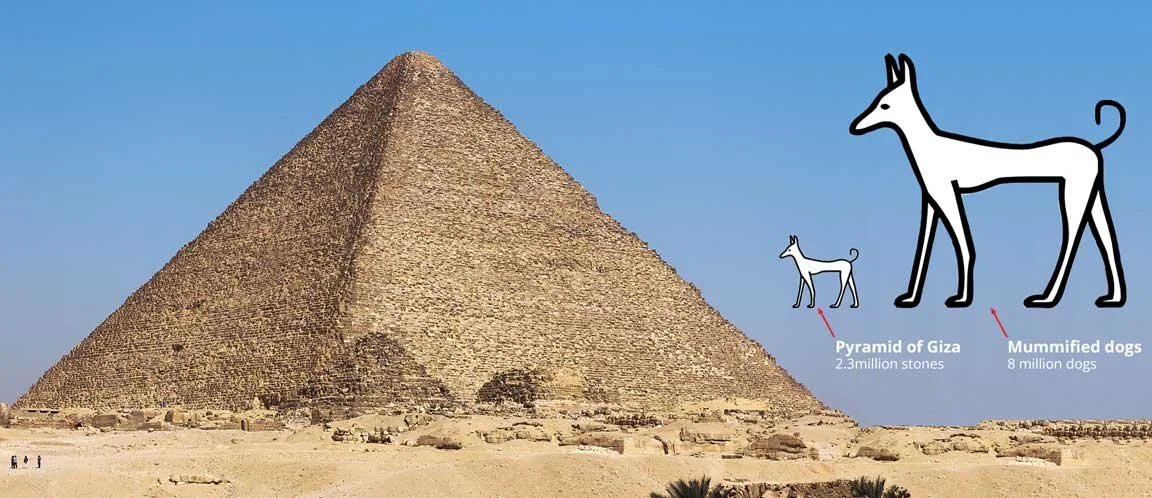
The Great Pyramid of Giza is the largest Egyptian pyramid. The people in the bottom left corner show you the scale of the structure. Photo: Douwe C. van der Zee, CC BY-SA 4.0, via Wikimedia Commons.
The Dark Arithmetic
Nicholson’s team found that many of the mummified animals were very young — hours or days old at the time of death. The sheer volume, and the evidence of age, pointed to a single explanation: breeding centers around Memphis, producing puppies at scale to supply the temple market.
The puppies were not killed by physical force, at least not in any way the bones recorded. They appear to have died from dehydration or starvation — separated from their mothers and left. The important thing, in the logic of the cult, was not the life of the individual animal. It was the mummy. The offering. The formal gesture of devotion.
This is the shadow that falls across the story. The same belief system that led a pharaoh to order fine linen and perfumed ointment for one particular dog he had loved also generated, centuries later, an industry that treated dogs as raw material for mass religious production. The theology was continuous. The application had changed completely.
Abuwtiyuw was mourned. He had a name, a history, a relationship with a specific person. The pharaoh’s inscription is an act of grief given public form — a statement made in stone that this dog, this individual, mattered enough to be honored before the gods.
The dogs of Saqqara were not mourned. They were manufactured. And yet the belief that motivated both acts was, at its root, the same: that dogs had a place in the afterlife, that their presence could reach the divine, that the boundary between the human world and whatever lay beyond it was something a dog could cross.
The Name That Survived
George Reisner published his account of the Abuwtiyuw tablet in the Bulletin of the Museum of Fine Arts, Boston in 1936, and again in the American Kennel Gazette two years later — a piece titled, with the directness of a man who knew his audience, “Ancient King Gives Dog A Royal Burial.”
The tablet is still in the Egyptian Museum in Cairo, inventory number JE 67573. The pharaoh who commissioned it remains unidentified. His name, which would once have been inscribed elsewhere in the chapel that housed Abuwtiyuw’s stone, was lost when the chapel was demolished and its materials reused in another tomb.
Abuwtiyuw outlasted him.
There is something in that reversal worth sitting with. The pharaoh who ordered the coffin, the fine linen, the perfumed ointment, the gangs of masons — who commanded the resources of a state and directed them toward the burial of his dog — did not survive in the record. The dog did. Abuwtiyuw is one of the earliest domestic animals whose name we can say with certainty has come down to us across four thousand years.
It is possible to read this as irony. It seems more accurate to read it as the pharaoh getting exactly what he intended: not his own commemoration, but the dog’s. The inscription says nothing about the pharaoh’s grief, his status, his piety. It records the dog’s name, the dog’s role, and the dog’s honors. Whatever else the Old Kingdom has given us, it has given us this: a name, carefully cut in limestone, waiting in the debris of Giza West Field for someone to come and read it.
Did You Know?
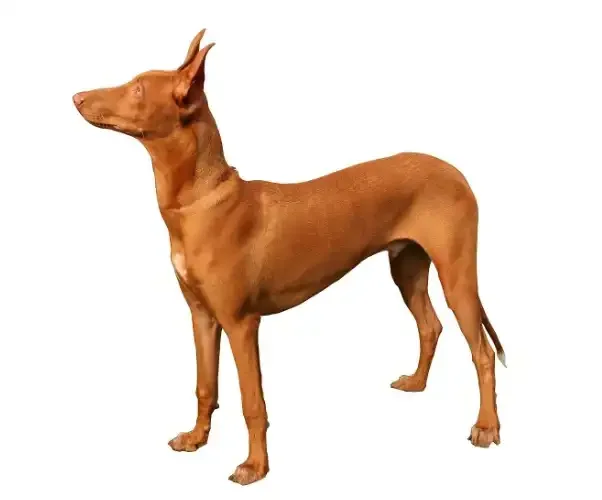
Pharaoh Hound. Photo: Pleple2000, CC BY-SA 3.0, via Wikimedia Commons
The living breed. The ancient Egyptians called their hunting sighthound the tesem — lean, erect-eared, built for speed. Its closest living relatives, the Pharaoh Hound of Malta and the Ibizan Hound, are largely unchanged in type from the dogs in Old Kingdom tomb paintings. The breed name, at least, acknowledges the debt.
The body-shaving rule. When a cat died, Egyptians shaved their eyebrows. When a dog died, they shaved their entire bodies — head, eyebrows, everything. The distinction, documented by Herodotus, is unambiguous: dogs ranked higher.
The death penalty for killing a dog. In ancient Egypt, killing a collared dog was a capital crime. A dog with a name on its collar was, legally, a member of the family.
The name "Abuwtiyuw" is thought by some Egyptologists to be onomatopoeic - roughly translating to "With the Bark of a Dog" (the ancient Egyptian equivalent of naming a dog "Woof" or "Barky").
The afterlife had dogs in it. Tomb paintings show Tutankhamun and Ramesses the Great hunting in the Field of Reeds — the Egyptian paradise — with their dogs alongside the chariot. The best of this life, continued.
The descendants are still there. The Baladi dog — lean, sandy-coloured, still roaming Egyptian streets today — is considered a living descendant of the ancient hunting dog, largely unchanged for thousands of years. Abuwtiyuw's cousins are still in Cairo.
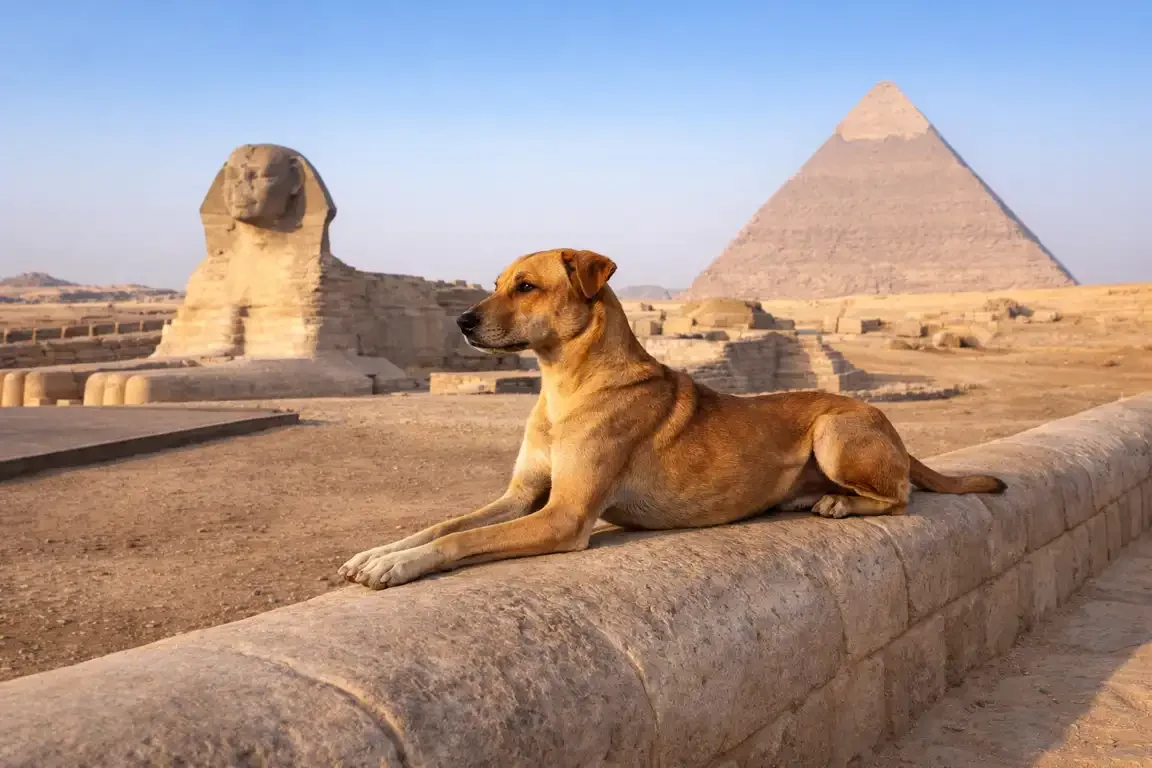
Baladi dog, Pyramids of GizaCaption title. Photo: Dogs in History