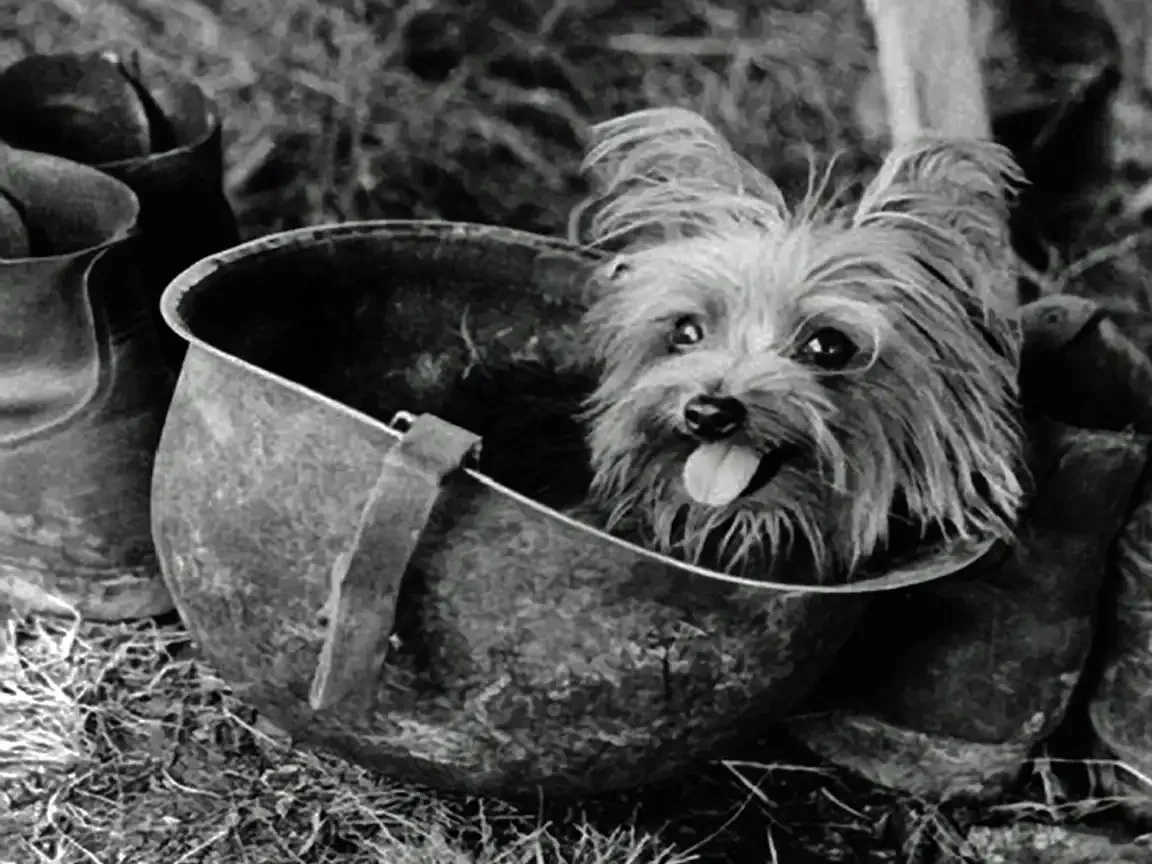
Rags: The Paris Stray Who Went to War
A Paris stray learned to carry messages through the trenches of World War I. The story most people know ends there. The story that matters begins after.
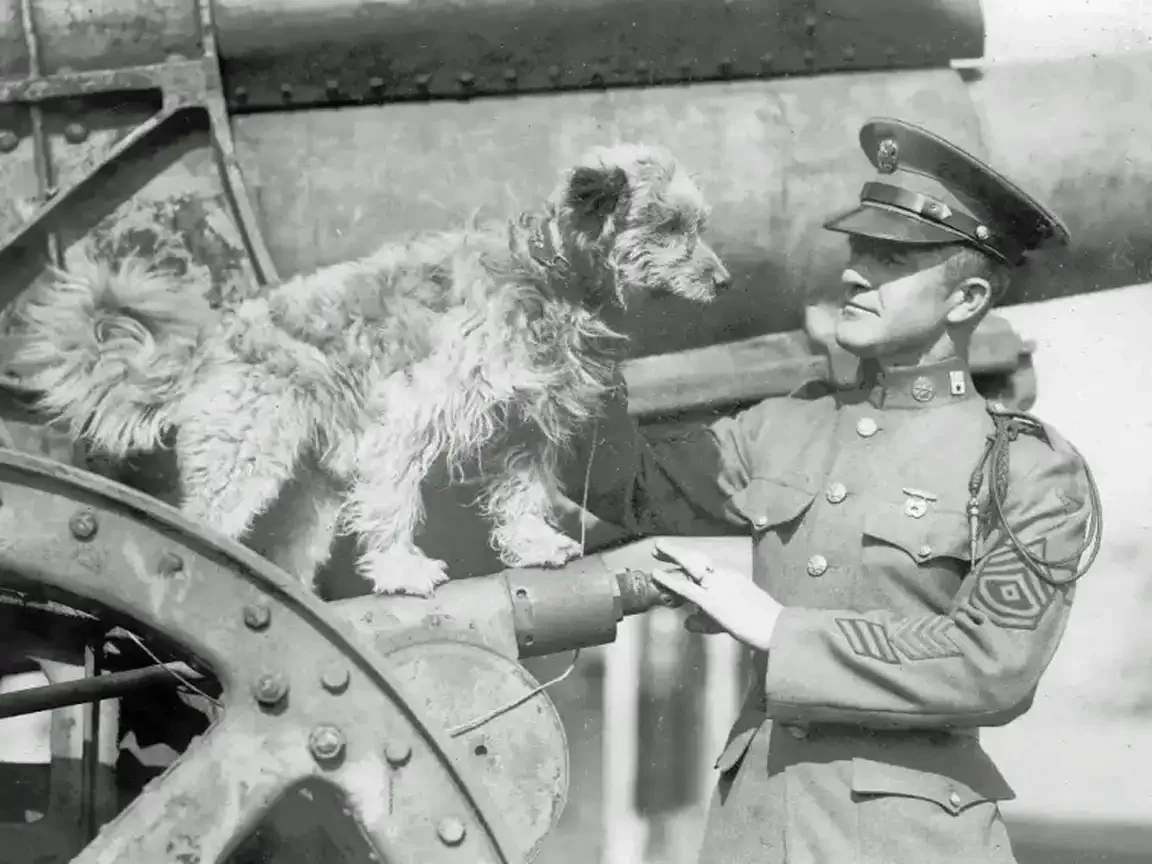
Rags perched on a field artillery piece alongside his postwar caretaker, Sergeant George Hickman, at Fort Hamilton, New York, c. 1920s. Public domain, via Wikimedia Commons.
The gas came in on the morning of October 9, 1918, somewhere in the Meuse-Argonne. The Germans had been shelling the sector for hours, and the small terrier who had been moving through these fields for three months had learned to read artillery the way other dogs read the wind. But this was gas, and there was no reading it. Private James Donovan went down. Rags went down beside him. When the stretcher teams reached them, both were still alive—Donovan badly gassed and bleeding, Rags with shrapnel in his right front paw, his right ear torn, and his right eye destroyed.
The commanding officer gave an order that would be recorded in the division’s informal history: treat Rags like a soldier. Man and dog were evacuated together.
A Bastille Day Miracle
The story begins four months earlier, on the night of July 14, 1918, in the Montmartre district of Paris. Private James Donovan, a Signal Corps specialist with the 1st Infantry Division, had marched in the city’s Bastille Day parade and stayed considerably longer than his leave permitted. He was also about to be arrested.
Donovan had been making his way through the narrow streets with a fellow soldier, George Hickman, when one of them kicked what appeared to be a bundle of rags lying in a doorway. The bundle whimpered. Then it barked.
Military police appeared almost immediately, and Donovan was clearly absent without leave. He did what Signal Corps men do under pressure: he improvised. This dog, he told the MPs with whatever composure he could muster, was the 1st Infantry Division’s missing mascot, and he had been sent to find it. The MPs were skeptical. The dog, for reasons that remain opaque to history, cooperated. They were both escorted back to base.
Donovan named the dog Rags and kept him. The MPs filed no charges. The lie became the truth. Within days, the 1st Division - the Big Red One, the oldest continuously serving division in the U.S. Army - had a new mascot, and Rags had, for the first time, a home.
The Education of a Signal Corps Dog
The 1st Division moved to the front four days after Bastille Day, and Rags went with it.
Donovan’s work was dangerous in the specific way that all communications work on the Western Front was dangerous: he spent his days on exposed ground, stringing telephone wire between advancing infantry and supporting field artillery. Human runners carried messages when the wire was not yet in place, but runners were slow, conspicuous, and frequently killed crossing open ground. Donovan saw possibilities in the twenty-five-pound terrier who followed him everywhere.
He taught Rags to carry messages. A piece of paper tucked under the collar, a command, and the dog would move - low and fast, through smoke and shell craters - toward a destination it couldn’t see. This is harder than it sounds. A dog trained to carry messages must be willing to leave the one person it trusts and run toward strangers, alone, through conditions that would send any sensible animal in the opposite direction. Rags did it.
He also developed skills nobody taught him. Along the wire routes, Rags began to stop at certain spots and mark them, places where the wire had broken or been cut by shellfire. Donovan would set up his repair equipment where the dog stopped. How Rags detected the breaks is uncertain; some observers noted that damaged wire carries a different smell, though no one could document exactly what he was reading. Whatever the mechanism, it worked.
The doughboys, a popular nickname for American infantrymen, watching him noticed something else. In the seconds before an artillery barrage, Rags would drop flat - paws splayed, body pressed to the ground. He had learned this by watching the men around him, and he had become faster than any human early-warning system. Soldiers who kept one eye on Rags during rest periods were, on several recorded occasions, already flat on the ground when the shells arrived.
In July 1918, at the Battle of Soissons, Rags and Donovan were among forty-two men of the 1st Division who found themselves cut off and surrounded by German forces. A message was attached to Rags’s collar. He was sent back through enemy lines alone. He arrived. The artillery barrage was called in. The men were rescued. News of what the dog had done spread through the division.
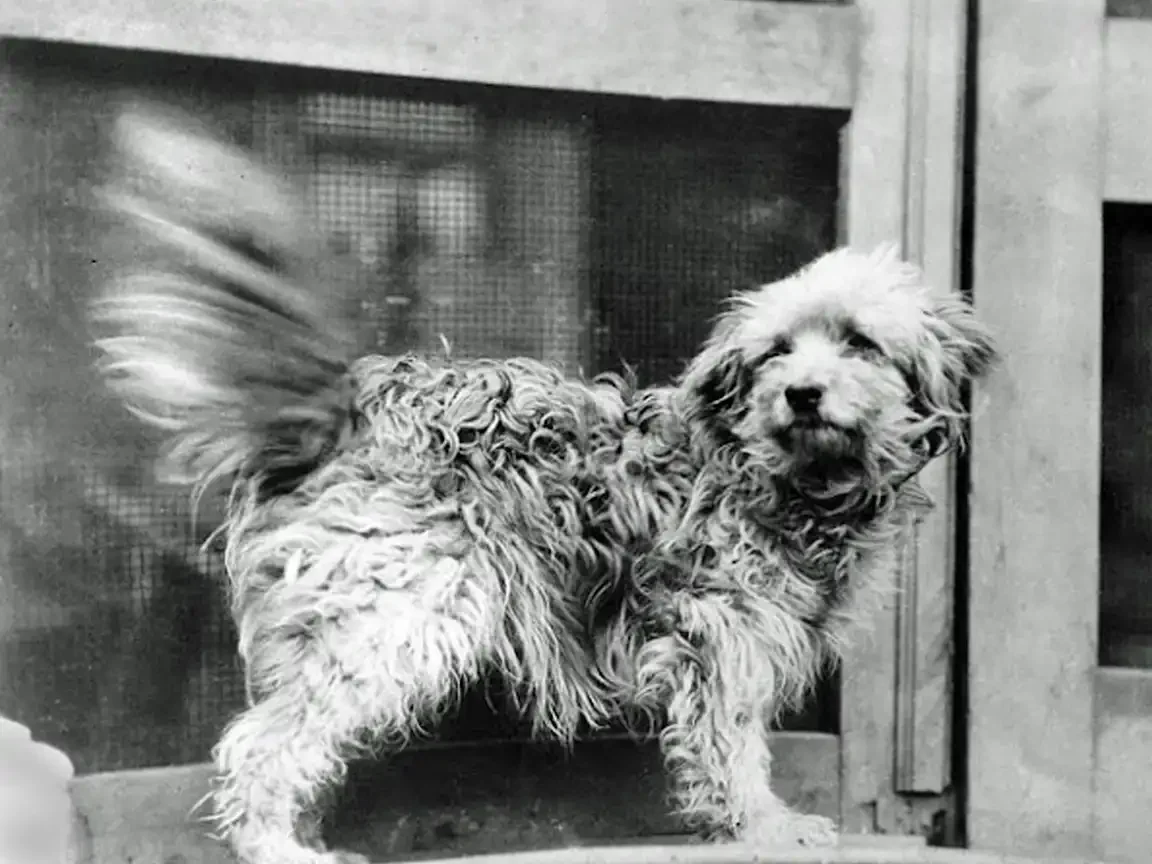
Rags, the 1st Infantry Division's mascot, photographed in the postwar years — tail mid-wag, one eye lost to shrapnel in the Argonne. Public domain.
The Meuse-Argonne
The largest American-run offensive of the war began on September 26, 1918, and for six weeks the 1st Division was at the center of some of the bloodiest fighting the American Expeditionary Forces would see. Rags ran messages through all of it.
On October 2, he carried a dispatch from the 1st Battalion of the 26th Infantry Regiment to the 7th Field Artillery. The resulting bombardment secured the Very-Epinonville Road. An important objective was taken with minimal American casualties.
A week later, on October 9, came the gas attack.
The Long Way Home
At the field hospital, the decision was made: Donovan and Rags would travel back to the United States together. Donovan needed specialist treatment - Fort Sheridan, outside Chicago, had become the Army’s primary facility for severe gas cases - and the 1st Division was not inclined to leave its mascot behind.
The commanding officer of the transport ship had different ideas. No dogs. Rags would be left behind.
What happened next was a small act of collective defiance, organized quietly by the men of the 1st Division. An officer wrapped the dog in his kit and carried him aboard. Others were aware and said nothing. Across the Atlantic, through the entire passage, Rags was kept hidden. He arrived at Fort Sheridan in early 1919, still officially contraband, reunited with the man whose collar tag now identified him as “1st Division Rags.”
For several weeks, the hospital staff kept the dog out of the wards. Then word of who Rags was got around, and the policy was quietly abandoned. Rags became a fixture on Donovan’s ward, sleeping at the foot of the bed, making rounds with the nurses, returning each evening to the firehouse where he had been given quarters.
Donovan did not improve. In early 1919, he died.
What the Soldiers Did
Some of the men who had served with Rags were still at Fort Sheridan. They worried about how to tell the dog that Donovan was gone. There was no protocol. They brought Rags to the ward. The body had been removed; the bed had not yet been stripped. What happened when Rags reached it—the waiting, the searching, the long stillness that followed—was observed by several men who were clear about what they had seen, even if they had no clinical vocabulary for it.
Rags did not return to the hospital. He took up residence in the firehouse and became, for the next year, simply the post dog—belonging to nobody and to everyone, making his daily rounds of the mess halls he preferred, appearing at the flagpole each evening when the bugle played and the flag came down. He raised his paw. It was a gesture Donovan had taught him.
The Hardenbergh Family
In 1920, Major Raymond W. Hardenbergh arrived at Fort Sheridan with his wife and two daughters. The daughters encountered a small, scarred terrier who seemed to be waiting for them when they came out for their bicycles each afternoon. Within weeks they were begging their father to let him sleep in the house. The post commander arranged the transfer of custody. Rags had a family.
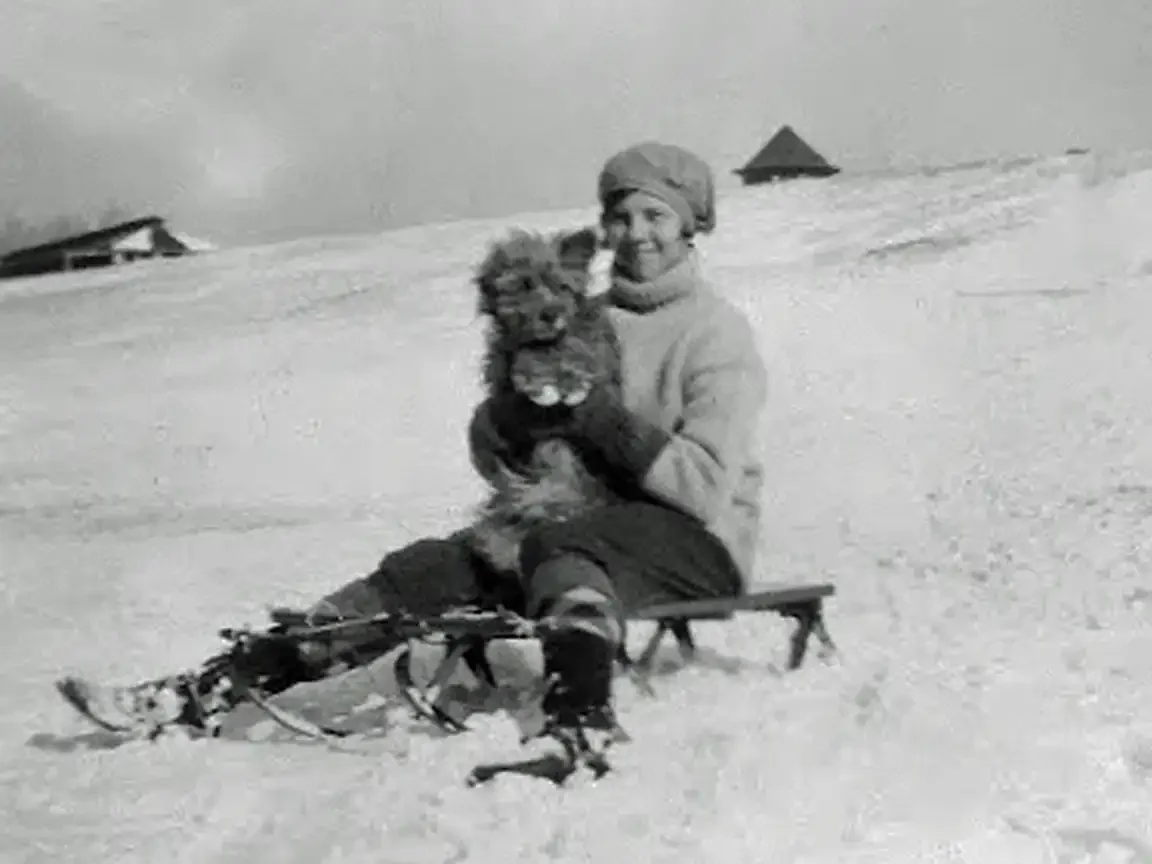
Rags sledding with Susan Hardenbergh at Governors Island, New York, c. 1926. Courtesy of Grant Hayter-Menzies. Public domain.
Over the next sixteen years, the Hardenberghs and Rags moved through the Army’s posting system: Fort Benning, Fort Knox, Plattsburgh Barracks, Governors Island in New York Harbor, eventually Washington, D.C. At each base, Rags continued his routines—the morning inspection tour, the mess hall visits, the evening retreat ceremony. At Governors Island in 1924, veterans of the 1st Division’s wartime service were stationed there; men who had been in the Argonne recognized the one-eyed terrier and introduced him to soldiers who had not yet been born when the gas came in.
The Dog the Division Did Not Forget
In 1928, the 1st Infantry Division marched down Broadway for the tenth anniversary of the armistice. Rags marched with them. The dog who had lost an eye in the Argonne was, by the account of the newspapers that week, the most photographed participant in the parade.
That same year, journalist Jack Rohan published the first biography of Rags, titled Rags: The Story of a Dog Who Went to War (Harper & Brothers, 1930). Letters arrived at various Army posts addressed simply to “Rags, 1st Division.” Generals had their photographs taken with him. He had become, in whatever way a dog can become such a thing, famous.
James Donovan’s name appeared in the biography’s early chapters. In the newspaper coverage and the parade photographs and the admiring correspondence, it appeared less and less. By the time Rags was a recognized figure—appearing at official ceremonies, greeting delegations, raising his paw at flag retreats from Virginia to New York—the man who had taught him that salute was largely absent from the story.
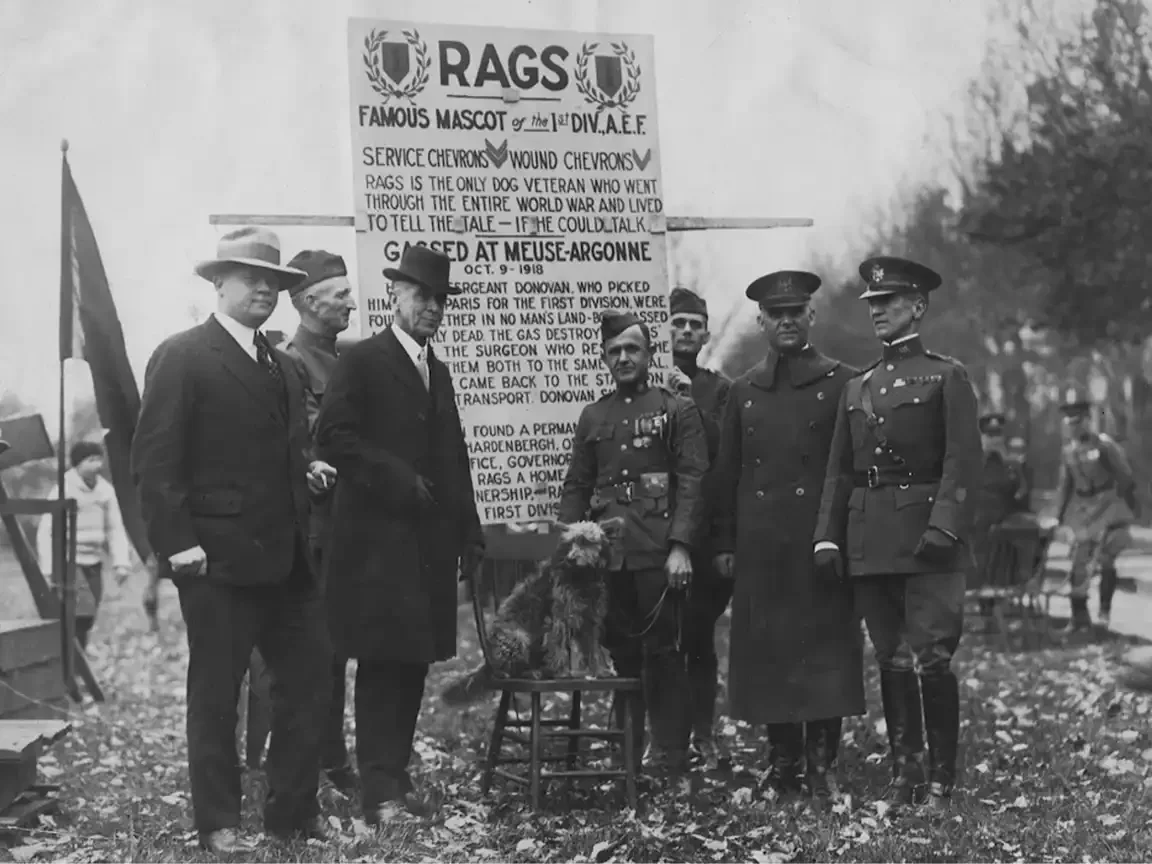
Rags (with Sgt., George Hickman) at a 1st Division ceremony celebrating the anniversary of the advance into Sommeviller Sector at Fort Hamilton, Brooklyn. Public domain.
The Evening Retreat
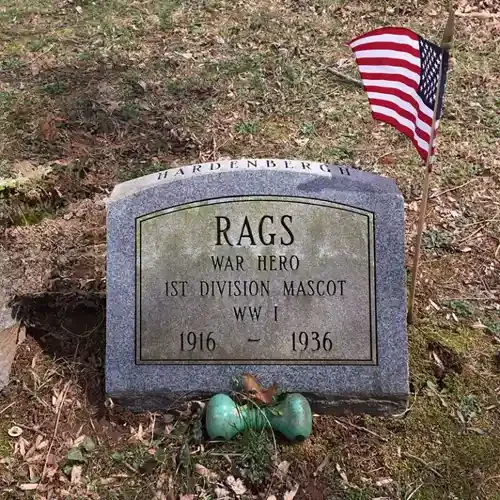
Rags grave, Aspin Hill Memorial Park in Silver Spring, Maryland near the Hardenbergh home. Public domain
Rags died in Washington, D.C., on March 22, 1936. He was approximately twenty years old, an extraordinary age for any dog, and a nearly implausible one for a dog who had been gassed and shrapnel-wounded on the Western Front eighteen years earlier. The New York Times ran an obituary. The New York Herald Tribune ran a story. The Army noted his death officially.
He was buried with military honors at the Aspen Hill Pet Cemetery in Silver Spring, Maryland. His headstone was placed by Lt. Col. Raymond Hardenbergh, the major’s son, who had grown up alongside him. The inscription reads: Rags War Hero 1st Division Mascot WW I, 1916–1936.
The stone does not mention Donovan. By 1936, almost nothing did. The war hero’s fame had long since detached from the man who found him in a Montmartre alley and bluffed his way out of arrest with an invented story that turned out to be true. Rags had been mascot to the 1st Division, companion to the Hardenbergh family, subject of books and broadcasts and parades.
He had also, for nearly two decades, been appearing each evening at the flagpole to raise his paw as the flag came down—performing a gesture a dead man had taught him, for crowds who mostly knew the dog and not the teacher.
Did You Know?
Public domain
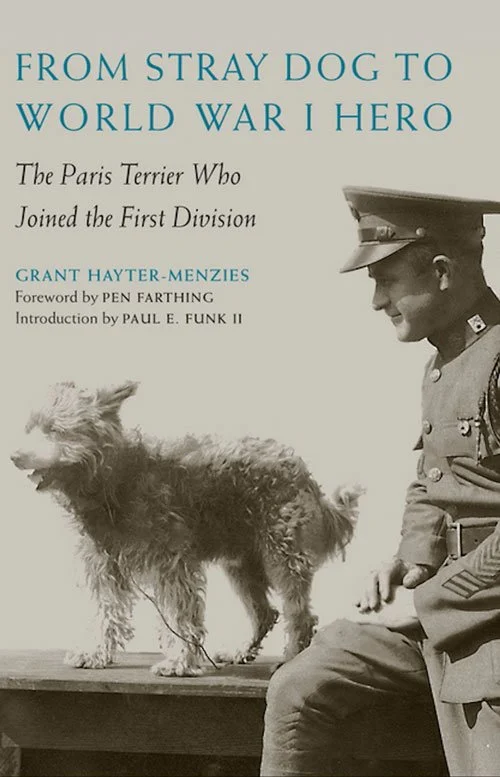
The first biography of Rags - Jack Rohan’s Rags: The Story of a Dog Who Went to War (Harper & Brothers, 1930) - was published six years before Rags died, meaning the dog outlived his own authorized biography and continued accumulating history for another half-decade that Rohan never recorded. The definitive account, by Canadian author Grant Hayter-Menzies, was not published until 2015.
The Aspen Hill Pet Cemetery in Silver Spring, Maryland, where Rags is buried, was added to the National Register of Historic Places in 2019. It has been in continuous operation since 1920 and is one of the oldest pet cemeteries in the United States. Rags is among its most historically significant residents.
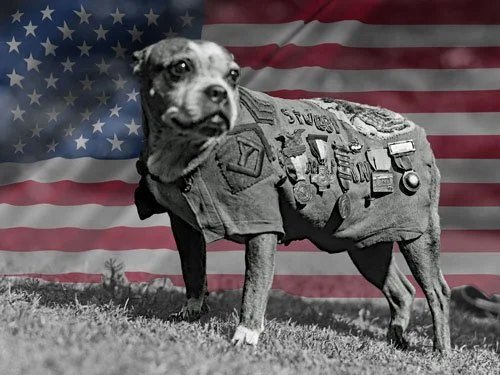
Rags is not the only dog associated with a famous World War I bluff. Sergeant Stubby, another wartime dog hero, was smuggled to France by his handler, Corporal Robert Conroy, in a nearly identical act of unauthorized transport. Both dogs were technically contraband for the entirety of their overseas service.
The 1st Infantry Division still exists. Based at Fort Riley, Kansas, it has served in every major U.S. conflict since World War I. Its soldiers still wear the Big Red One shoulder patch—the same design that was being worn by the doughboys in the Argonne when Rags ran his messages.