Dash: Queen Victoria’s Beloved Spaniel
In January 1833 a King Charles spaniel arrived at Kensington Palace, a gift from Sir John Conroy to the Duchess of Kent. History remembers Dash as Princess Victoria’s great childhood love. He became hers not by gift but by habit.
Inset: Dash, 1836, by Sir Edwin Landseer. Main: Portrait of Princess Victoria of Kent (later Queen Victoria, Empress of India) with her spaniel Dash, painted within weeks of his arrival. Victoria noted the sittings for the original portrait, between 29 January and 22 March 1833, in her diary. The original was exhibited at the Royal Academy, London, in 1833. Public domain, via Wikimedia Commons.
Dash Wants the Ball
Dash could not bear to see his ball held out of reach. When it was, the little spaniel leaped on all four feet and screamed for its return, and in January 1833 Princess Victoria wrote the performance into her journal. The dog was not hers.
He had arrived at Kensington Palace earlier that month as a present for her mother, in a household where very little was Victoria’s to choose. She was thirteen, and her days were arranged by adults. Her lessons, walks, meals and company followed a supervised routine, and her governess, Louise Lehzen, was a constant presence. A dog who shrieked for his ball understood none of the rules governing those rooms. Retellings often make him a present to the princess herself, the great comfort of a lonely childhood. Her own journal shows something stranger: a dog who became hers without anyone deciding it.
Mamma’s Little Dog
Victoria’s own journal is clear about who owned him. On January 15, 1833, she described “Mamma’s little dog,” a beautiful spaniel of King Charles’s breed that Sir John Conroy had presented to the Duchess of Kent the day before. He was already attached to his new owner and lay at her feet. Nobody had chosen a puppy for the princess. Nor was he a Cavalier King Charles Spaniel, as he is often called today; that separate breed was defined only in the twentieth century.
Who gave him matters too. Conroy ran the Duchess’s household, and with her he ran the strict regime known as the Kensington System, which kept her daughter closely supervised and dependent on them both. Relations between the princess and the adults who governed her life were fraught, and Victoria came to dislike him intensely. His present was for the mother, not the daughter.
Dash did not stay at the mother’s feet for long. Within days he was walking with Victoria and chasing her ball. By March 1833 she was calling him her “play-fellow” and noting the curls growing on his ears and the force of his enthusiasm. He still slept in her mother’s dressing room.
Upstairs With the Princess
Dash passed to Victoria by habit rather than by gift, and the habit formed at dinner parties. The Duchess entertained a wide circle of aristocratic and political guests. On one May evening in 1833 the company downstairs included the Duke of Wellington and the Lieven family. The rooms downstairs belonged to the adults, with their conversation, precedence and ceremony. While the victor of Waterloo dined with her mother, Victoria went upstairs with Lehzen. So did Dash.
Victoria wrote down why. He was with them, “as he always is, whenever Mamma gives a dinner or is out.” The sentence describes a household rule, not a single evening. Whenever the Duchess’s attention went elsewhere, her dog went to her daughter.
Dash could not change Victoria’s lessons or decide who came into her rooms. He could break up the timetable with a ball, settle beside her while visitors filled the rooms below, and turn up again the next time without being invited. In a childhood where company was chosen for her, here was company that kept arriving on its own.
By the spring of 1833, the dog at the Duchess’s feet had become the dog upstairs. The change was small enough for the household to absorb, and large enough for Victoria to notice when he was gone.
Jealous of a Parrot
Dash’s absences began to matter. When he came back from a spell away in May 1833, Victoria noted how glad she was to have him. Two years later it was Victoria who had been away, and on her return to Kensington she found “dearest Dash in high health and spirits.” That is not how a girl writes about her mother’s possessions. It is how she writes about someone waiting for her at home.
Then came a rival. In 1835 the Duchess acquired a tame parroquet that could laugh, cough and ride about on her hand. Victoria thought the bird a great acquisition. Dash was jealous. Victoria took his side and called him “poor darling.” The Duchess had a new pet of her own; her daughter stood by the old one.
The Duchess commissioned this portrait of her own dog and gave it to Victoria the day before her 17th birthday. Sir Edwin Landseer, Dash, 1836, oil on panel. Royal Collection Trust. Public domain, via Wikipedia Commons.
She drew him, too, and pictures of Dash became part of the visual record of her youth. Their inscriptions show how she thought of him. A study she made in January 1836 carries her inscription “our dog.” Three years after he first went upstairs with her, she still wrote of him as shared.
Later that year the Duchess gave her daughter Dash, in a manner of speaking. According to the Royal Collection, she commissioned Edwin Landseer’s portrait of the spaniel and gave it to Victoria on May 23, 1836, the day before her seventeenth birthday. The mother who had received the living dog gave the princess his likeness. Just over a year later, the princess would be queen, and the question of whose dog Dash was would no longer be her mother’s to answer.
The Post-Coronation Bath Legend
When Victoria became queen on June 20, 1837, almost everything around her changed. She had a household and ministers of her own, she moved from Kensington to Buckingham Palace, and Conroy did not get the position of influence he had hoped for. Dash went with her, and was one of the few parts of the old life that came with her into the new.
He had known her when a walk or a game could fill an afternoon, and he stayed familiar while almost everything else around her changed.
The best-known story about him belongs to the following summer. On June 28, 1838, the story goes, the nineteen-year-old queen came back to Buckingham Palace from her coronation at Westminster Abbey and hurried upstairs to give Dash his bath. It is easy to see why the scene lasts: a monarch, newly crowned, goes straight to her dog. But there is no mention of the bath in Victoria’s journals as they now exist. Her entry for coronation day survives in two later witnesses, Princess Beatrice’s handwritten copy and Lord Esher’s typescript, and neither is complete. Until a contemporary source turns up, the bath is best treated as legend rather than history. The princess whose afternoons Dash had once filled with walks and games now had ministers to see, papers to read and a court to run. He was still at her side, but no longer at the center of her days, and within two years he would be sharing her with a husband and five other dogs.
Room for Six Dogs
Even in his own portrait, Dash had company: a deerhound, a greyhound and a parrot. Sir Edwin Landseer, Hector, Nero, and Dash with the parrot, Lory, 1838. Royal Collection Trust. Edwin Landseer, Public domain, via Wikimedia Commons.
Marriage changed the shape of Victoria’s days again. Prince Albert arrived in 1840 with his own tastes, his own household connections and, before long, dogs from Germany. In June 1840 Victoria went out walking with six dogs, Dash among them, along with two dachshunds newly arrived from Germany. The spaniel once singled out for his high spirits had become one of a company, and the newcomers were interesting in their own right.
In November 1840 Victoria’s first child was born. The small upstairs world in which Dash had been the princess’s regular companion was becoming a family and a court, and he still held his place in it. He had outlasted the Kensington routine, the accession and the arrival of Albert. The next change was one he could not follow her through.
Dash’s Death, Grave and Epitaph
On Christmas Eve 1840, Albert told Victoria that Dash was dead. She called him “poor dear old Dash,” and wrote that she was fond of him and that he had been attached to her.
The rest of her day was crowded. She walked with Albert, saw her mother and received Lord Melbourne. Questions involving Spain and Portugal needed her attention. There was a sketch of the baby, and music after dinner. Dash received a few sentences among all of it.
Those few sentences are not a measure of her feeling. Victoria’s journal had changed since her girlhood, as her life had, and a married queen’s day held far more than a princess’s. The spaniel who had once filled the small upstairs world of Kensington was remembered in a house now full of people and obligations.
His grave said more than the journal did. Dash was buried at Adelaide Cottage in Windsor Home Park, under a marble effigy. Its inscription names him the favorite spaniel of Her Majesty, gives his age as “in his 10th year” and praises him in three balanced lines: “His attachment was without selfishness, His playfulness without malice, His fidelity without deceit.” It ends by urging the reader to profit by his example. The diary entry was private. The stone speaks to strangers, and addresses its reader directly.
Dash arrived as the Duchess of Kent’s property and became Victoria’s companion without ever being given to her. He survived her passage from princess to queen, and by the end he was the queen’s dog as surely as he had once been her mother’s. The nearest thing to a deed of gift is a sentence a thirteen-year-old wrote in May 1833: Dash was with them “as he always is, whenever Mamma gives a dinner or is out.”
Quotations from Queen Victoria’s journals are drawn from RA VIC/MAIN/QVJ (W), consulted in the versions available online: Queen Victoria’s handwriting, Lord Esher’s typescripts and Princess Beatrice’s copies. Royal Archives / © His Majesty King Charles III.
Did You Know?
The modern Cavalier began with a £25 prize. In 1926 the American Roswell Eldridge offered it at Crufts for “Blenheim Spaniels of the Old Type, as shown in pictures of Charles II’s time,” long-faced dogs that fashion had since bred away.
Dash was the first of a great many. The royal kennels Victoria built in Windsor Home Park in the early 1840s housed up to a hundred dogs, according to the Royal Collection.
Victoria banned tail docking and ear cropping in the royal kennels, according to the Royal Collection.
The princess who once had one borrowed spaniel became a dog-show exhibitor. In 1891 Queen Victoria entered six of her Pomeranians at Crufts.
In 1885 Queen Victoria became the first royal patron of Battersea Dogs Home, two years after her son rehomed a Battersea dog named Skippy.
Breed: King Charles Spaniel | Country of origin: England | First use: Companion dog of courtly and aristocratic households | Origins: 17th century
Discover More Dogs Living in Houses of Power…
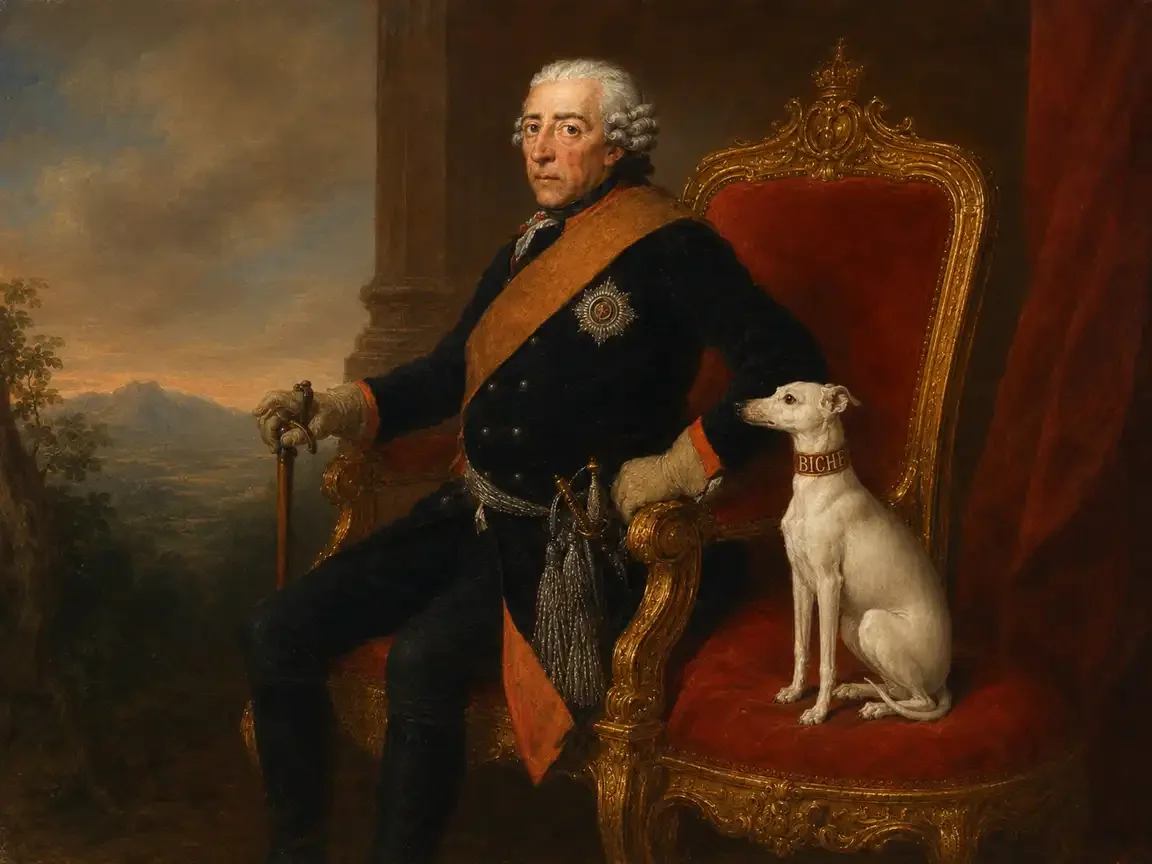
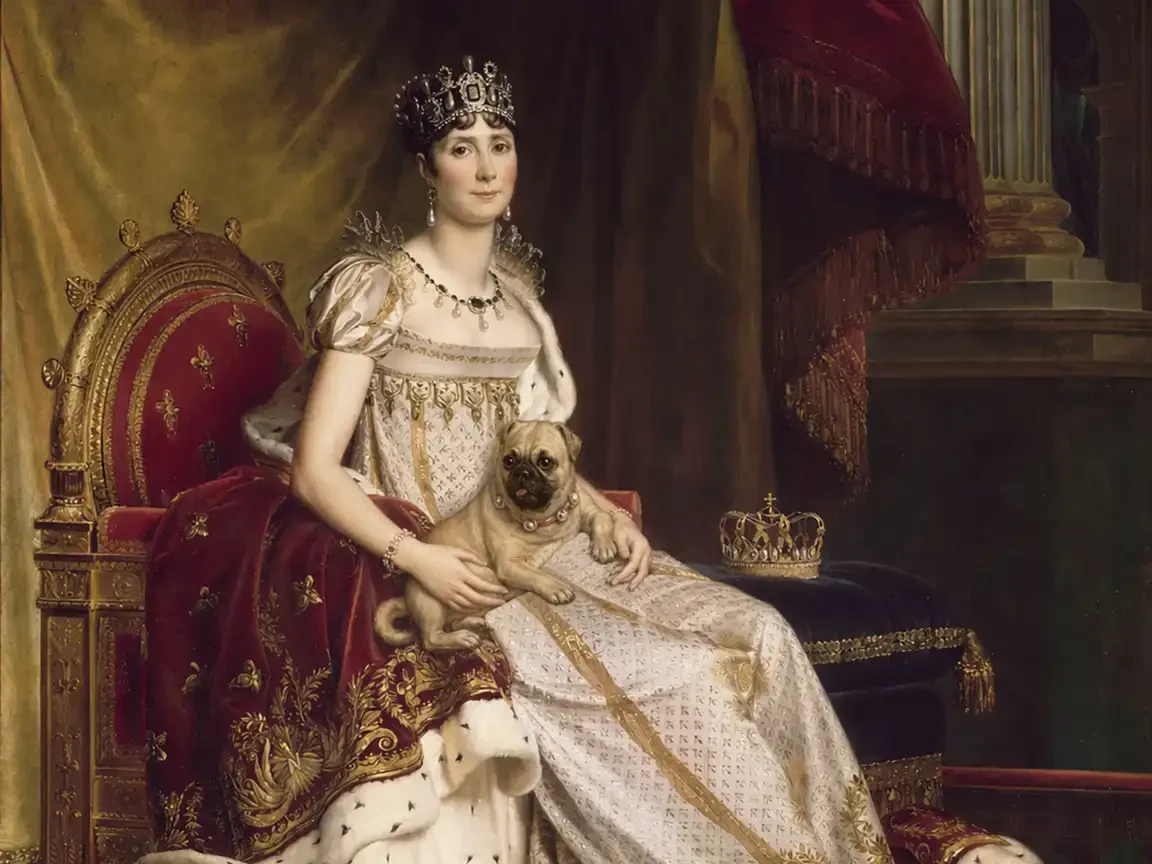
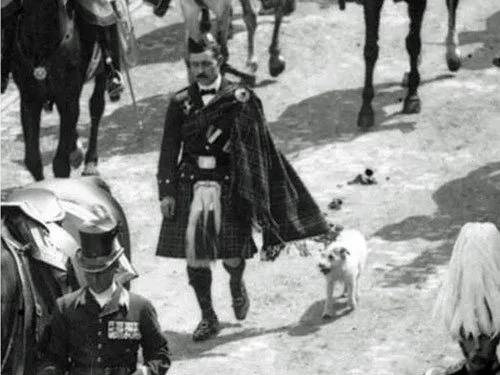
Dash became Victoria’s without anyone handing him over. In other royal households, something came between a dog and its person: a terrier who outlived his king, a pug already in Joséphine’s bed when Napoleon arrived, and a greyhound taken from Frederick the Great’s camp.