Fortuné: The Dog Who Bit Napoleon on His Wedding Night
He survived the Reign of Terror, upstaged a general on his wedding night, and traveled to Italy in the same carriage as his mistress's lover. Before Napoleon entered Joséphine's bed, Fortuné was already in it — and he never accepted the new arrangement.
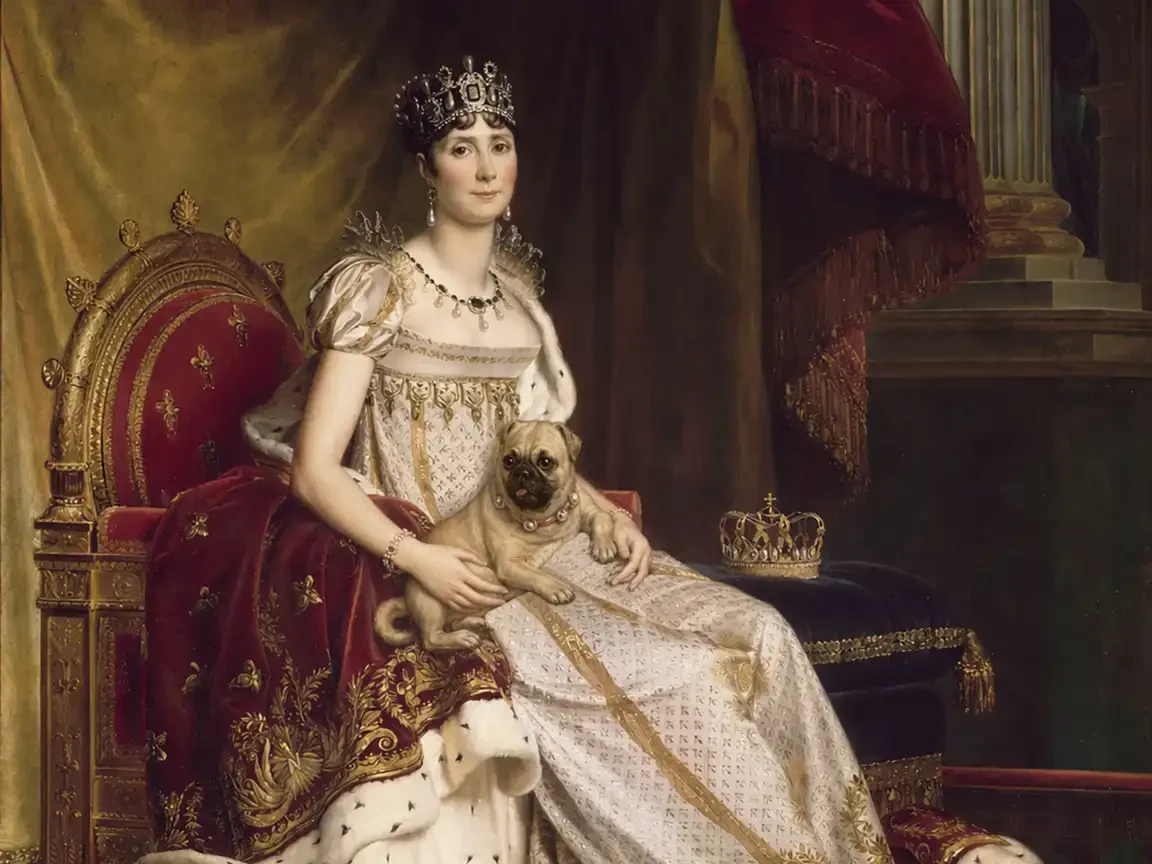
Empress Joséphine in coronation robes, 1808 — Fortuné added by AI. No portrait of him exists; this is the closest he came to sitting for one. AI-generated illustration after François Gérard.
The Bars of Les Carmes
On the morning of April 21, 1794, a woman named Rose de Beauharnais was arrested at her house on the rue Saint-Dominique and taken to the Convent of the Carmelites in the sixth arrondissement of Paris. The Carmes — as the prison was known — was a dank, verminous place where prisoners were sometimes confined eighteen to a cell. Beyond its walls, the guillotine worked steadily through the city's suspects. Rose de Beauharnais, who would later take the name Joséphine, was one of them.
She was thirty years old, the widow-in-waiting of a revolutionary general who was himself already imprisoned in the same building. She had two children: Eugène, thirteen, and Hortense, eleven. She had a pug.
The dog's name was Fortuné. He had been given to Joséphine as a puppy by her close friend Thérésa Cabarrus — a fawn-bodied, black-muzzled pug with a curly tail and, by all accounts, a temperament that fell some distance short of the breed's usual sociability. He was not a particularly distinguished specimen. None of that mattered. When Joséphine was taken to Les Carmes, Fortuné pined in the empty house. When her children came to visit — permitted to see their mother through iron bars, in the presence of the turnkey, with no private conversation possible — they brought the dog.
What the jailers did not prevent, and perhaps did not notice, was what happened next. Fortuné was small enough to slip through the bars and into Joséphine's cell. Under his collar, accounts of the time tell us, were letters — from her children, from her friends, passed into the one space no turnkey could easily search. Whether this was the deliberate plan of a thirteen-year-old trying to save his mother, or something that evolved by chance, is not recorded. What is recorded is that it worked, and that the letters were a lifeline.
Joséphine spent three months at Les Carmes. Her husband Alexandre was guillotined on July 23, 1794 — one of the final executions of the Terror, at the Place de la Révolution (now known as Place de la Concorde). She was freed five days later, on July 28, when Robespierre fell and the killing stopped. She stepped out of Les Carmes a widow. She still had Fortuné.
The Dog in the Bed
Less than two years later, Joséphine married again. The groom was Napoleon Bonaparte, a Corsican general six years her junior whose letters from the Italian campaign read more like dispatches from a man drowning than a soldier winning battles. The civil ceremony took place on March 9, 1796. The mayor's deputy conducted it; the mayor himself had already gone to bed. By all accounts, the event was somewhat improvised.
What was not improvised was Fortuné's position in the household. He had slept in Joséphine's bed for as long as she had owned him. He had survived the Terror in that bed. He was not about to leave it for a general.
Napoleon described what happened next to his friend, the playwright Antoine-Vincent Arnault, pointing to the pug on the sofa: "Do you see that gentleman? He is my rival. He was in possession of Madam's bed when I married her. I wished to remove him but it was quite useless to think of it. I was told that I must either sleep elsewhere or consent to share my bed. That annoyed me considerably, but I had to make up my mind. I gave way. The favorite was less accommodating."
What followed, Napoleon continued, was that Fortuné attacked him — not once, but repeatedly, in circumstances that precluded much possibility of dignity. "I bear proofs on my legs of what I say." He bore, by other accounts, a scar. He shared the bed. He had no alternative; Joséphine made clear that the arrangement was not negotiable. She had held her position through the guillotine and the Carmes. A general with ambitions was not going to dislodge a pug she had carried through the Terror.
Two days after the wedding, Napoleon left Paris for Italy. He had been appointed Commander of the Army of Italy the previous week — a promotion with the useful side effect of placing several hundred miles between him and Fortuné.
Fortune, Whom You Love More Than Your Husband
Napoleon wrote to Joséphine constantly from Italy. The letters are famous for their passion, their need, and their barely contained bewilderment that a woman in Paris could not find time to join her husband in the field. "I awake full of you," he wrote in one. Elsewhere: "I am going to bed with my heart full of your adorable image."
What is less often quoted is the letter in which Napoleon catalogued, with rising exasperation, the things Joséphine loved more than she loved him. Her friends. Her social engagements. The theater. And then: "Fortune, whom you love much more than your husband, for whom you have only a little of the esteem, and a share of that benevolence with which your heart abounds."
The future emperor of France had been reduced to listing a pug as a romantic rival, in writing, to his wife.
Joséphine finally joined him in Italy in July 1796, nearly four months after the wedding. The convoy was notable. Three carriages carried: her brother-in-law Joseph Bonaparte; Napoleon's aide-de-camp Colonel Junot; Hippolyte Charles, a lieutenant of the household guard with whom Joséphine was conducting an affair; and Fortuné. The dog arrived in Italy to considerable warmth from the staff. According to an 1842 account in the Court Magazine, he was "caressed and petted by all the officers on the staff" and soon regarded as "an important personage at headquarters." He had survived a Terror prison. A military encampment presented no difficulties.
The Cook's Dog
Fortuné died in Italy. Exactly when, and in precisely what circumstances, varies between accounts — but the outline is consistent. One day, the pug picked a fight with a dog belonging to Napoleon's cook. The cook's dog was considerably larger. The result, for Fortuné, was fatal.
Joséphine was devastated. Napoleon, who had some feeling on the subject, forbade her from acquiring another pug. The prohibition was short-lived. Hippolyte Charles — whose role in the convoy had not escaped Napoleon's notice, though the full scope of the affair remained, for the moment, unacknowledged — gave Joséphine a puppy to replace the one she had lost. Joséphine named the new dog Fortuné.
Sometime later, Napoleon encountered the cook in the courtyard. The man apologized for his dog's action and assured the general that the animal had been sent away. Napoleon's reply, as various accounts have it: "Bring him back. Perhaps he will rid me of the new one too."
The Letter from Cairo
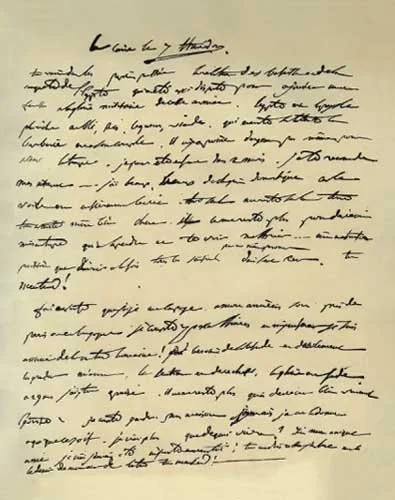
Napoleon's letter to his brother Joseph, written from Cairo, 1798, intercepted by the British Navy. Public domain.
Napoleon departed for Egypt in 1798. In his absence, the question of Joséphine's affair with Charles became harder to contain. A letter reached Napoleon in Cairo that made the situation plain: his wife had a lover, and the lover had given her a dog.
The letter he wrote to his brother Joseph was meant to be private. He instructed that divorce proceedings be initiated. The ship carrying his correspondence was intercepted by the British Navy. The letters were published in newspapers across Europe. Napoleon's personal humiliation — his wife's infidelity, his fury, his demand for divorce — became a matter of public record.
Joséphine, who had survived the Terror through circumstance and perhaps through a small dog whose collar carried letters, survived this too. By the time Napoleon returned from Egypt in October 1799, she had persuaded him to abandon the divorce. The marriage continued for another decade, until Napoleon required an heir that Joséphine could not provide. The final separation came in 1809.
After the divorce, Joséphine kept Malmaison — the château she had bought and loved. She planted its famous gardens, filled its rooms with art and botanical rarities, and kept dogs until the end. She died there in May 1814, at fifty years old. Napoleon, by then exiled to Elba, reportedly wept when the news reached him.
Did You Know?
In ancient China, the wrinkles on a Pug's forehead were highly prized, especially if they formed patterns that resembled the Chinese character for "Prince."
The pug had been fashionable among European aristocrats for over a century before Fortuné. William III of England arrived from the Netherlands in 1688 with pugs in his entourage, briefly making the breed a symbol of Williamite political sympathy.
Napoleon's aversion to household dogs did not extend to battlefield encounters. During one cavalry engagement he reportedly stopped to attend to a dog found beside its dead owner — an act of unexpected gentleness observed by several witnesses.
The intercepted Cairo letters, published by the British in 1798–99, included not only details of the affair but Napoleon's private assessments of senior French political figures — an intelligence windfall the British had done nothing to arrange and everything to exploit.
Joséphine's botanical garden at Malmaison introduced dozens of plant species to France and employed a team of illustrators whose engravings became scientific records. Her rose collection, in particular, laid the foundation for modern rose cultivation in Europe.
Breed: Pug | Country of origin: China | First use: Companion dog | Origins: 5th century BCE