Owney: The Postal Dog Nobody Could Keep
Owney was a stray who found a home among the railway mail clerks and then spent nine years refusing to stay anywhere for long. They fed him, tagged him and carried him across America, until the old dog finally became too difficult to travel with.
Owney in the doorway of Railway Post Office car 89. The men who fed him, tagged him and hired a lawyer to recover him stand where a dog's owner would. Restored photograph. Smithsonian Institution, CC0, via Wikimedia Commons.
Owney was the kind of dog who regarded a railway timetable as irrelevant. After wandering into the Albany post office, he began following the mail clerks onto their trains, turning up wherever he pleased and whenever he pleased. He belonged to nobody, yet before long thousands of railway men were calling him their dog.
They fed him, welcomed him aboard and fastened tags and medals to his collar wherever he went. Owney simply kept traveling, carrying the growing record of his journeys with him and becoming a familiar figure wherever the mail trains stopped.
Nobody Knows Where He Began
The beginning of Owney’s story is surprisingly difficult to establish. Contemporary newspapers offered different explanations for how he arrived at the Albany post office. One said he had been there since 1881 or 1882. Another put his arrival in 1886, describing a cold day when a stray dog entered the post office, found warm air and settled on a pile of mail sacks. Other accounts said he followed a mail wagon inside, or that he had belonged to a clerk who later moved away.
Even his name was disputed. One explanation linked it to a clerk named Owen. Another, found in later accounts, connected it with the idea of an ownerless dog. A contemporary newspaper said a clerk had simply declared, “He shall be our dog.”
There is no reason to choose one story over the others. Nobody thought the arrival of a stray dog at a post office was something that needed to be recorded. At the time, Owney was just another dog who had found somewhere warm to sleep.
Then he discovered the trains. By 1890, he had a collar tag identifying him as “Owney—Albany; owner, Postoffice employe. Be good to Owney.” It was an informal pass from one railway mail clerk to another. Owney could travel, and the men who found him would look after him. The arrangement suited him.
Six Thousand Owners
Owney did not have a master. He had a network. By 1893, the Cincinnati Enquirer reported that he knew no master but had something like 6,000 owners who took a lively interest in his welfare. Two years later, the Milwaukee Journal called him the property of 7,000 railway clerks. The numbers were estimates, but the idea was real. Owney moved through a workforce that regarded him as a shared responsibility.
By 1892 he carried four or five pounds of metal, and Postmaster General John Wanamaker had a harness made so the weight would sit across his back rather than his neck. Public domain, via Wikimedia Commons.
The tags on his collar made that relationship visible. They came from the places he visited and the people he met. By April 1892, after a six-week journey through Texas and along the Mexican border, Owney was reportedly carrying four or five pounds of metal and about 150 separate mementos. Postmaster General John Wanamaker had a harness made so the weight could be spread across his back. The tags continued to accumulate.
The railway clerks also defended Owney when somebody else tried to claim him. At one point, a dime-museum proprietor in Pittsburgh took the dog and exhibited him for two months. The clerks raised a purse, hired an attorney and recovered him.
Owney was not valuable because he was a rare breed or because anyone had paid for him. He was valuable because the men of the Railway Mail Service had made him one of their own.
The Men Who Rode With Him
The work Owney had joined was dangerous. Railway mail cars were positioned between the locomotive and the passenger coaches, putting postal clerks close to the point of impact in a collision. They sorted mail while trains were moving, working on their feet in wooden cars packed with paper.
The Railway Mail Service adopted him informally, then photographed him formally — a stray promoted to staff. Owney with RMS Clerk. Restored photograph. Smithsonian Institution, CC0, via Wikimedia Commons.
The accident figures from the period are stark, although different sources cover different periods. The National Postal Museum records more than 6,000 accidents involving trains carrying mail between 1890 and 1900, with more than 80 clerks killed and 2,072 injured. A National Archives tally for 1877 to 1896 records 94 deaths and 821 serious injuries. Owney was traveling with men who understood the risks.
Then, in 1891, something happened to him on the railway. On January 7, the New York Sun reported that Owney had arrived in Norwich, Connecticut, on a mail train. He jumped from the postal car after the first mail pouch and startled a veteran carrier named Henry Kelley. Another mail agent reassured Kelley: “Don’t get skeart, Henry; it’s only Owney, the postal dog.” Near the end of the article came a more serious detail. Owney had recently been in a bad railway smashup and had lost one of his eyes.
The location of the accident is uncertain. The Sun connected Owney’s absence with an inspection of Canadian postal routes. In 1893, the Morning Call reported that one of the medals on his collar represented an accident he had survived on a Canadian train. The medal has not been identified among the surviving collection. The newspaper account is nevertheless contemporary evidence that the accident was being remembered in connection with Owney.
A later Washington newspaper gave a different location, reporting that Owney and two railway clerks had survived a disastrous wreck near a place it called Bradfordsville, Indiana. No such Indiana location has been established, and the account appeared six years after the Sun report. The injury itself is much easier to establish than the location. Owney had lost an eye, and since the accident, it said, the sunny disposition that had surrounded him in previous years had been largely clouded.
The Lucky Dog
There was an odd contradiction in the way Owney was remembered. In 1893, the Big Stone Gap Post described him as blind in one eye. In the same article, it said that he had never been in a wreck and was regarded by the railway clerks as a mascot. When Owney was aboard, the paper reported, the men believed their trains were safe.
The two statements appeared in the same newspaper report. The accident had not stopped the legend. If anything, Owney’s reputation as a lucky dog had become part of the culture of the Railway Mail Service. His growing collection of tags and medals reflected that affection. The men who traveled with him gave him objects that recorded their encounters with him, sometimes practical, sometimes commemorative and sometimes simply playful.
One Seattle tag from 1893 carried a verse:
“I guess I am Innocence Abroad,
For I travel through thick and thin;
But I meet with kindly treatment,
And I like to be taken in.”
Owney’s reputation was spreading far beyond the mail cars.
Owney Goes Around
In 1895, he was given the chance to make his biggest journey. Owney arrived in Tacoma, Washington, after a trip to Alaska and visited Postmaster A. B. Case. When he went down to the wharf and showed such an obvious interest in the Asiatic steamer Victoria, Case decided to send him around the world and see whether he could beat the 60-day record set by eccentric businessman George Francis Train in 1892.
Owney left on August 19. He traveled with a bag containing his credentials, a blanket, brush and comb, his medal harness and letters of introduction to postal officials in other countries. At Yokohama, officials examined his baggage with curiosity. Owney was carrying so many decorations that some had to travel in a bag. An account of the American dog traveler was sent on for the information of the Emperor of Japan. He was subsequently given a passport bearing the Emperor’s seal. It extended his freedom to travel through the interior but came with instructions. Owney was told not to attend a fire on horseback, not to write on temples, shrines or walls, and not to drive too fast on narrow roads.
At Foochow, he was invited aboard the USS Detroit. He ate in the ship’s mess, where he was served plumduff and lobscouse, and left with a ship’s ribbon and a letter of introduction to other officers of the Asiatic Squadron.
At Singapore, he went ashore with an officer. His decorations attracted so much attention that onlookers apparently assumed he must be someone of considerable rank. A delay at Hong Kong cost Owney the record he was attempting to break. He reached New York on December 23, completing the journey in 132 days and bringing home more than 200 new tags, medals and certificates. Five days later, he boarded another train for Tacoma.
For a dog whose reputation rested on traveling wherever the railway took him, the next development was unexpected. Postmaster Case put Owney on exhibition in a public hall. Owney had become a celebrity.
One Man Takes Him Home
By 1897, the traveling life was becoming harder on him. Owney was old. He had suffered a severe attack of mange, and his temperament had changed. Contemporary reports described him as increasingly likely to bite people he did not know.
That year, newspapers announced his death twice. In March, a Scranton newspaper reported that Owney had been run over while trying to board a mail train somewhere between Syracuse and Albany. He was alive.
In April, another newspaper reported that a policeman in Cleveland had shot him. Again, the report was wrong. The story did, however, prompt Captain White, general superintendent of the Railway Mail Service, to contact the Cleveland superintendent. White asked for an official report and also asked whether the dog’s skin could be mounted for the postal museum. The reply established that the dead dog in Cleveland was an ordinary stray, not Owney. The real Owney was in St. Louis.
He had returned from the Postal Clerks’ Convention in San Francisco with a railway mail clerk named J. Melvin and gone to Melvin’s home. There, Melvin treated him for mange. Then Melvin asked to keep him. He wrote to Captain White, requesting permission to keep Owney for the rest of his days. On April 27, White granted the request. For perhaps the first time, Owney had something approaching a permanent home.
He was old, blind in one eye, recovering from mange and increasingly difficult with strangers. After years of belonging to thousands of railway clerks, he now had one man prepared to look after him. It did not last.
Chained for a Photograph
The record does not explain exactly how Owney left St. Louis. He was later reported in Cincinnati to meet the new superintendent and was then routed toward the exposition at Nashville. By June, he had reached Toledo.
There, a clerk summoned a newspaper reporter and photographer and chained Owney to keep him in place until they arrived. Accounts differ over whether this happened at Union Station or in the post office basement. They agree that Owney was restrained and that he bit the man handling him. Postmaster Rudolph Brand ordered that the dog be destroyed.
The details of what happened next vary between contemporary accounts. A Toledo Blade report, as later reported by the Toledo Gazette, said that the first officer ordered to shoot Owney refused. According to that account, Owney was left chained overnight. Shortly after four o’clock the following afternoon, June 11, 1897, a patrolman took him to an alley behind the police station and shot him.
Other newspapers gave different names for the officer and different accounts of the circumstances. The Chicago Tribune described the killing as an execution. Other reports said Owney had been running loose and had gone mad. The conflicting accounts cannot be reconciled.
One detail is clear from the reporting: Owney was no longer being treated simply as an old railway dog that had become difficult to handle. His death had become an event involving the postal service and the people who had followed his travels for years. The Toledo Blade also reported that arrangements had been made to have Owney stuffed and sent to Washington before he was killed. Six weeks earlier, Captain White had already asked whether Owney’s skin could be mounted after a false report of his death.
The railway clerks were about to lose their dog for good.
Owney’s Final Stop
Owney’s mounted body went on display in the Post Office Department museum in Washington in January 1898. Even then, the newspapers got the story wrong. A Washington report said that Owney had been shot in Minneapolis for biting a little girl. The claim appeared seven months after his actual death, while his mounted body was already on exhibition in Washington. Owney had acquired another life in print.
His remains were exhibited at the St. Louis World’s Fair in 1904 and transferred to the Smithsonian Institution in 1911. Since 1993, they have been displayed at the National Postal Museum in Washington, where Owney remains beside a reconstructed Railway Post Office car. The tags are among the surviving records of his travels. They show where Owney went and, in many cases, who wanted to mark the occasion.
The decision to preserve Owney’s remains was taken before he was shot. He has been on public display, in one building or another, almost continuously since January 1898. Smithsonian Institution, CC0, via Wikimedia Commons.
The harder thing to preserve is the relationship behind them. For nine years, the railway had been Owney’s home and the clerks his family. When he grew old, one of them tried to give him a different kind of home, but Owney was still traveling when his life ended.
The dog who had spent his days moving from train to train now remains in one place, surrounded by the marks of all the people who once welcomed him aboard.
Did You Know?
Two of Owney’s tags, a 1894 Davenport tag and a silver medal awarded to the famous postal dog in 1896. Smithsonian Institution, CC0, via Wikimedia Commons.
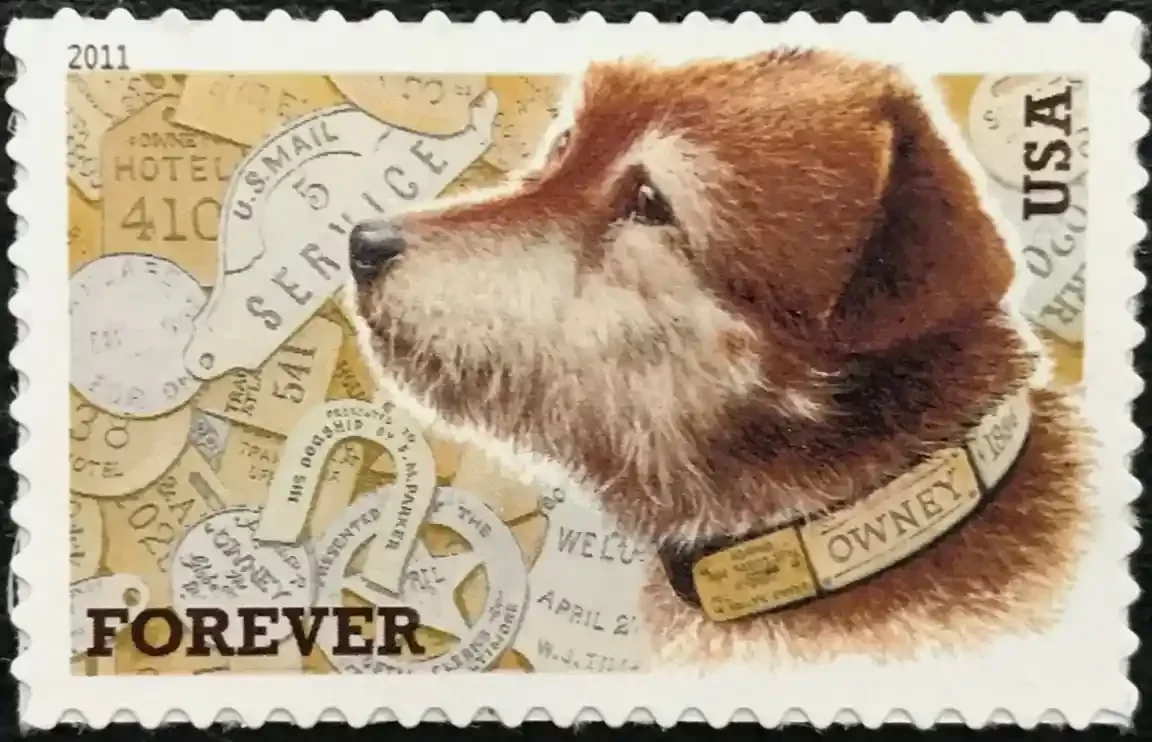
Honoring Owney, the legendary world-traveling postal dog, on a classic 2011 U.S. Forever stamp. Smithsonian Institution, CC0, via Wikimedia Commons
Owney collected more than 400 tags during his travels, and they are now preserved at the National Postal Museum. Made from silver, aluminum, nickel, chrome, brass and even leather. The collection reveals just how many people and places marked Owney’s journeys.
Owney was once impounded in Montreal, where the postmaster kept him in a kennel and refused to release him until his board of two dollars and fifty cents was paid. A collection was taken up among his friends in the service and the money forwarded.
Owney got his own postage stamp in 2011. The first-class Forever stamp featured an illustration of the Railway Mail Service mascot surrounded by his famous tags and medals.
The hazard that killed Owney has not gone away. The Postal Service recorded around 5,200 dog attacks on its employees in 2025, down from roughly 6,000 the year before. Los Angeles led the cities with 70; California led the states with 673.
Owney had an Australian contemporary. Bob the Railway Dog rode the South Australian Railways wherever he pleased through the 1880s and 1890s, changing trains on his own account, and was as well known to enginemen there as Owney was to mail clerks here.