Biche: The Greyhound Stolen from Frederick the Great
Frederick II of Prussia asked to be buried among his Italian greyhounds on the terrace at Sanssouci. The request is usually filed under royal eccentricity. It was a legal instruction, and one small dog is the reason he wrote it.
Frederick the Great seated with Biche. AI-generated illustration after Johann Christoph Frisch’s.
On the last day of September 1745, Austrian hussars rode around the back of the Prussian army at Soor and stripped the camp while the battle was still being fought. They took the war chest, the silver, the king’s flutes. They also took his dog.
A Gift from the Man Frederick Trusted Most
Biche arrived the year before, in 1744, a present from Count Friedrich Rudolf von Rothenburg — soldier, diplomat, and one of the very few people Frederick appears to have loved without reservation. Rothenburg had been badly wounded in the field and would not live long. What he handed the king was an Italian greyhound: a Windspiel, thin-skinned, light-boned, built for warmth and company rather than work.
Frederick had no use for hunting. In Antimachiavel, written before he came to the throne, he dismissed it as one of those pleasures that punish the body and do nothing for the mind — a judgment aimed squarely at his father, who had cleared a hundred square kilometers of Brandenburg for the chase. Rothenburg had given him a dog bred for none of it. Biche went with him to take the waters at Bad Pyrmont while he prepared for the next campaign, and when the campaign came, she went to that too.
The Dog Who Did Not Bark Under the Bridge
The most repeated story about Biche belongs to the autumn of 1745. Riding out to reconnoiter, Frederick pushed too far into ground the Austrians held. A troop of Pandours — irregular Croatian infantry, the most feared foragers in the theater — came down the road toward him. He dropped into a ditch and pressed himself under a bridge with the dog in his arms, and waited, expecting her to bark.
She made no sound.
The anecdote comes from Franz Kugler’s nineteenth-century biography, not from any contemporary record, and it should be read as tradition rather than testimony. What it proves is not what the dog did. It is that within two generations of his death, this was the kind of story Prussians told about the most feared commander in Europe, and expected to be believed.
The Austrians Take Everything, Including the Dog
At Soor the Prussians won the field and lost the camp. While the two armies fought over the high ground, Nádasdy’s hussars and Baron von der Trenck’s Pandours worked through the tents behind them, carrying off the payroll chest, the king’s dinner service, his papers, his flutes, and Biche.
Frederick assumed she had been killed. Accounts of how she came back differ, and they differ sharply. One tradition holds that she was returned months later under the terms of the peace signed at Dresden that December. Another, following the historian Rodenbeck, says the wife of the Austrian general took the dog in and gave her up only after repeated requests, within days. A third credits Prince Charles of Lorraine with sending her home along with an apology for the conduct of his irregulars.
The reunion is described by later biographers rather than eyewitnesses. Biche was let quietly into the room where the king was writing letters. She jumped onto the table, put her forepaws around his neck, and he wept.
Frederick in his study, the private hours at Sanssouci that he guarded more carefully than the Prussian border. AI-generated illustration after Johann Christoph Frisch’s.
Painted Into the Ceiling of the Room Where She Would Die
Frederick had his court painter put the dog in the goddess's lap; five years later Biche died in the room it hung in. The Bath of Diana, by Antoine Pesne, 1747, Sanssouci. Public domain, via Wikipedia Commons.
Sanssouci, a single-story summer palace, was finished in 1747. In the Concert Room, where Frederick played the flute before supper, Antoine Pesne painted a bathing Diana surrounded by her nymphs — and into the goddess’s lap he put Biche.
The rest of the household arranged itself around the dogs with the same seriousness. Leather balls were made for them and left where they fell. The favorite dog of the moment slept in the king’s bed and lay beside his chair by day on a seat of its own under cushions. Their servant was instructed to address them with the formal “Sie”, meaning “Milady” or “Madame”. When Frederick traveled to Berlin, the chosen dogs rode in a six-horse coach on the front seat, with the footman responsible for them sitting behind. A servant who stepped on a paw could expect the full weight of the royal temper.
Writing to his older sister and confidante Wilhelmine, Frederick complained that his veterinarian was a fool who had still not grasped that a Windspiel is not a dog at all but a four-legged bird. In May 1748 the two of them exchanged letters written in the voices of their dogs, Biche corresponding with Wilhelmine’s Folichon in the French they both preferred, using the animals to say things that were harder to say directly.
Rothenburg Dies, and Frederick Writes His Grave into His Will
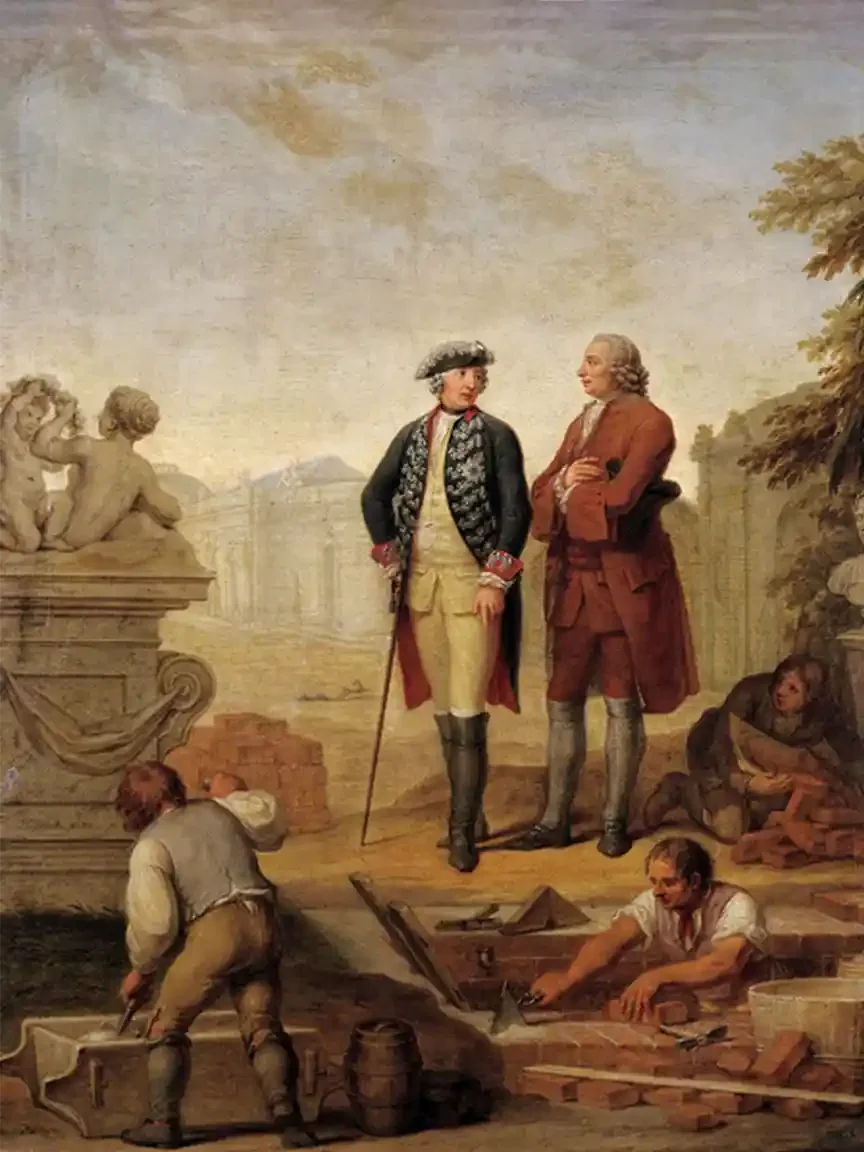
The king inspecting the burial chamber he had ordered dug for himself. Painting by Johann Christoph Frisch, Public domain, via Wikimedia Commons.
Rothenburg died in 1751, at forty-one, of old wounds and hard living. The loss affected Frederick badly.
He had already had a burial chamber dug into the uppermost vineyard terrace in 1744, before the palace above it was even complete. On 11 January 1752, in the winter following his friend’s death, he set down a personal testament describing exactly how he wanted to use it: not as a king, but as a philosopher. No pomp, no splendor, no ceremony of any kind. Carried up at night by the light of a lantern, with nobody following. Laid in the tomb he had prepared, on the height of the terrace. Among his dogs.
Biche Dies in the Room Where Her Portrait Hangs
Wherever he went, they went. Walking around Sanssouci palace grounds. AI-generated illustration after Johann Christoph Frisch’s.
Later that same year Biche died in the Concert Room, beneath the ceiling she had been painted into.
Frederick wrote to Wilhelmine that the loss had upset his philosophy entirely. He told her the death had reopened the loss of all his friends, and of one above the rest — the man who had given the dog to him. “I was ashamed that the death of a dog struck me so deeply,” he wrote, and then defended the shame: anyone capable of indifference toward a faithful animal will not be grateful to an equal, and if a man must choose, better too sensitive than too hard.
A coffin was made. She lay in the king’s library, as his dogs would afterward, and then she was carried out to the terrace and put into the ground beside the empty vault. Hers is the first stone.
The Instruction He Kept Repeating for Seventeen Years
He did not let the matter rest. Between 1752 and 1769 Frederick set the same burial instruction down four separate times.
Ten more greyhounds followed Biche onto the terrace. One of them, Alcmène, was granted something none of the others received: a coffin inside the vault built for the king himself. The accounts of her death are contradictory and the most quoted of them — the old king returning from a troop review to embrace a body already decomposing — traces back to a pamphlet written by an enemy and is best treated with caution.
On the night of 16 August 1786, Frederick sat in the chair built for him because his gout allowed neither sitting nor lying. A greyhound named Superbe was on a stool beside him. Around one in the morning he noticed she was gone and asked where she was and wanted her brought back. Then he saw that she was shivering, as he was, and gave an order that could barely be heard: cover the dog. He died at twenty past two.
Prussia Buries Him Beside His Father Instead
His nephew Frederick William II inspected the terrace vault, found it cramped and half-decayed and unworthy of the man, and ignored the will.
Frederick was placed in the crypt of the Potsdam Garrison Church, beside Frederick William I — the father who had beaten him, mocked him, and made him watch the execution of his closest friend. He stayed there for a hundred and fifty-nine years.
The rest is a strange military itinerary. In 1943 the coffin was moved out of the church for safekeeping, then to a bunker, then to a potassium mine at Bernterode in Thuringia, where American soldiers found it in 1945 and took it to Marburg. In 1952 it went to Burg Hohenzollern in the south, and there it stopped, because the terrace at Sanssouci was on the wrong side of a border.
August 1991: The King Comes to the Terrace
Prince Louis Ferdinand had said in 1952 that his ancestor would be returned to Sanssouci when Germany was reunited in freedom. On 17 August 1991, the two hundred and fifth anniversary of the death, he made good on it.
The day itself was a comprehensive violation of the will. The coffin lay in the courtyard in full public view with a guard of honor from the German armed forces — for a man who had asked for nobody to follow him. Only afterward, at night, was he taken up the terraces and lowered into the vault dug in 1744.
Set into the ground a few feet away are eleven small sandstone slabs, worn nearly smooth, cleaned and conserved in 2005. The first of them is dated 1752. The name on it is Biche.
Did You Know?
When Biche had her first litter, Frederick wrote to his younger brother August Wilhelm in the dog’s name, asking him to stand godfather to the puppies. The prince accepted, observing that loyalty and attachment are rare among people and nearly universal among dogs.
The court did not buy its greyhounds. A breeding establishment at the Potsdam Jägerhof kept between forty and eighty Italian Greyhounds, tended by two huntsmen, one of them responsible for the dogs’ health. The best of each generation were sent up to the king.
Frederick the Great gave most of his greyhounds elegant French names including Biche meaning "Doe" a nod to her graceful, deer-like appearance; Superbe meaning "Magnificent"; and Amouretto meaning “Little love” or “Cupid”.
Despite being a Prussian King, Frederick the Great named his favorite summer palace in French! Located in Potsdam, Germany (just southwest of Berlin), he called the estate Sanssouci, which translates to "without care" or "worry-free." It was designed as the ultimate escape from political drama - a peaceful sanctuary where he could focus on his poetry, play his flute, and relax on the vineyard terraces.
Frederick backed a 1768 proposal for a Prussian veterinary school and it collapsed on cost. The Berlin Tierarzneischule finally opened in 1790, four years after his death — commissioned by the nephew who had overruled his burial and built for the cavalry’s horses.
Breed: Italian Greyhound (Windspiel) | Country of Origin: Italy | First use: Companion and lapdog of the nobility | Origins: 16th century