Caesar: The Dog Who Walked Before Kings
Caesar of Notts attended the funeral of Edward VII in 1910. He did not attend it as a symbol. He attended it as the one creature the king had never had to perform for.
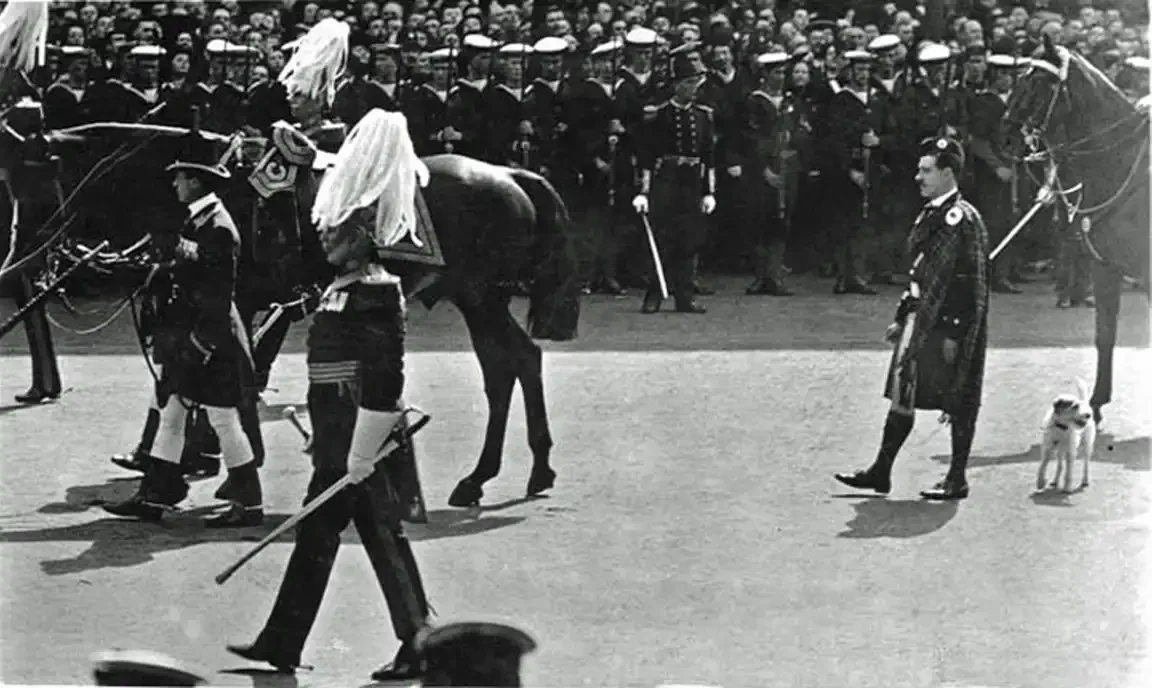
Caesar led by a Highland soldier in Edward VII's funeral procession, with the King’s favorite charger Kildare (horse) ahead of them. Huge crowds, estimated at between three and five million, gathered in London to watch this historic event. Public domain.
On the morning of May 20, 1910, the streets of London were lined six deep. Nine kings had gathered to walk behind a coffin. And ahead of all of them, led by a kilted Highland soldier, walked a small white terrier with a collar that read: I am Caesar. I belong to the King.
He did not belong to the King anymore. That was the point.
The image of Caesar of Notts walking in the funeral procession of Edward VII is one of the most photographed moments of the Edwardian era. The sight of the scruffy, unruly dog—placed ahead of Kaiser Wilhelm II, ahead of King George V, ahead of eight other sovereign heads of state—was reported in papers on both sides of the Atlantic. But the procession, remarkable as it was, was not the real story. It was the end of one.
A Replacement Dog
Caesar came to Edward as a replacement.
In 1902, the King lost his dog Jack—a terrier who had choked to death on food. Lord Dudley, seeking to mend the absence, arranged for a wire fox terrier from the kennels of Kathleen, Duchess of Newcastle, one of the most respected breeders in England. The dog was officially named Caesar of Notts, sired by Cackler of Notts, born in 1898. He was four years old when he arrived at the palace. He was not, by any conventional measure, an improvement.
Courtiers and hosts of royal visits soon settled on a nickname for him: “Stinky.” He had a footman assigned specifically to keep him clean, an arrangement that apparently achieved only partial results. He was high-strung, opinionated about the trousers of visiting dignitaries, and constitutionally incapable of observing any protocol he had not personally invented. He escaped in the spa town of Marienbad while chasing white peafowl. He killed rabbits belonging to Lord Redesdale’s daughters. The King, who seems to have regarded these incidents with something approaching pride, once suggested that Caesar was probably the reason certain diplomatic agreements could not be concluded.
The collar said I belong to the King. The behavior suggested the arrangement was open to interpretation.
The Performed Life
Edward VII—Albert Edward, known to his family as Bertie—had been performing for his entire life.
He was the eldest son of Victoria and Albert, which meant he was raised under the most exacting educational program the Victorian imagination could devise. His father designed a curriculum intended to produce a model prince; his tutors reported, uniformly, that the results were disappointing. What Edward actually possessed—charm, sociability, an instinct for warmth that no amount of formal education could manufacture—was not the kind of intelligence his parents valued. He spent nearly sixty years as Prince of Wales, largely excluded from political influence, filling his time with the pleasures his mother found unseemly: horse racing, gambling, travel, and a succession of mistresses so numerous that historians have catalogued at least fifty-five liaisons, acknowledging the figure is almost certainly incomplete.
When Victoria died in January 1901 and Edward ascended the throne at fifty-nine, he was a man who had spent his whole adult life in waiting. He proved to be a better king than anyone had expected. His diplomatic instincts, honed over decades of ceremonial visits, made him a skilled and genuinely liked figure across Europe. He transformed the monarchy from Victorian austerity to Edwardian openness. He was the public face of an era.
The public face was, of course, a face. Behind it was a man of enormous appetites and considerable loneliness, whose marriage to Alexandra of Denmark was a workable arrangement rather than a refuge. Alexandra knew of his affairs. She tolerated them with a grace that was either remarkable dignity or remarkable resignation, and perhaps both. His final mistress, Alice Keppel, was so thoroughly embedded in his life that she was allowed to be present at his deathbed—before Queen Alexandra, losing patience, had her removed.
It was into this exhausted, watchful, perpetually performing private life that Caesar arrived in 1902.
“Do You Like Your Old Master, Then?”
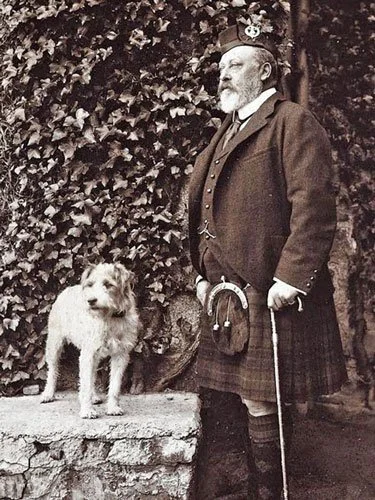
Edward VII with Caesar at Balmoral, c. 1905. The King wears Highland dress — a habit acquired from his mother Queen Victoria, who favored Balmoral above all her residences. Public domain.
The King took the dog everywhere.
Caesar accompanied Edward on long car journeys—and regularly wriggled free and leaped from the moving vehicle, ignoring commands from the King and footmen alike. He traveled aboard the royal yacht to Vienna, Paris, Biarritz, Marienbad, Pompeii, Athens, and Berlin. He slept in an easy chair placed beside the King’s bed. He had, by any assessment, a better arrangement than most of the King’s courtiers.
Charles Hardinge, 1st Baron Hardinge of Penshurst, recorded the dynamics aboard the royal yacht with some precision. “Whenever I went into the King’s cabin,” he wrote, “this dog always went for my trousers and worried them, much to the King’s delight. I used not to take the slightest notice and went on talking all the time to the King, which I think amused His Majesty still more.”
It is a small scene, but it reveals something. The King watching a diplomat maintain his composure while a terrier attacked his trousers, and finding the whole thing deeply funny—this was Edward off duty. No performance required. The dog was not diplomatic. He would not be managed. And Edward, who managed everything and everyone else, found that specifically delightful.
The King would greet Caesar by asking: “Do you like your old master, then?” Caesar would respond by jumping up and down in excitement. Edward would never strike the dog, but occasionally shook his walking stick at him, calling him a “naughty dog” in a tone of voice that appears, from all accounts, to have communicated the opposite. He also quietly arranged, through his personal attendant Lawrence Wrightson, that if the King died first, Caesar would be looked after. The dog would not be left to manage on his own.
This was Edward’s private life: small, specific, free from the weight of what he was supposed to be. In seven years of companionship, Caesar never once required the King to be a king.
May 6, 1910
Edward VII died on the evening of May 6, 1910, at Buckingham Palace. He had been ill for some weeks with bronchitis, and had refused to reduce the pace of his engagements. He had a brief, euphoric rally late in the afternoon—his horse Witch of the Air had won at Kempton Park, and he was told the news—and then lost consciousness and did not recover. He was sixty-eight.
Caesar refused to eat. He spent hours whining outside the King’s bedroom door. At some point he managed to slip past the household staff and was found by Queen Alexandra hiding under the King’s bed. She coaxed him out and persuaded him to eat. It is, by any account, the most uncomplicated grief in the palace that week.
Alexandra, who had spent decades sharing her husband with other women and enduring the humiliations that entailed, now found herself nursing a dog that had mourned more publicly than court protocol allowed most humans to. She did not, apparently, resent him for it.
Twenty Days
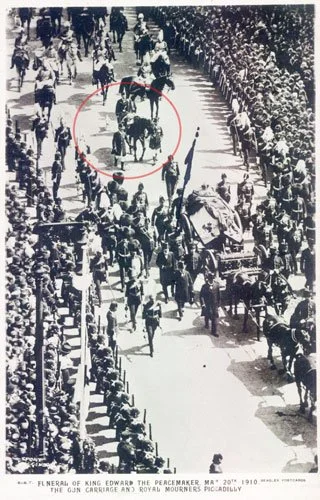
Edward VII's funeral procession, Piccadilly, May 20, 1910. Caesar — circled — walks ahead of the gun carriage and the kings behind it. Public domain.
The state funeral was held on May 20, 1910. The coffin was carried on a gun carriage through the streets of London, followed by the new King George V, Kaiser Wilhelm II, and seven other reigning monarchs—the largest gathering of European sovereigns at a single event in history, as it turned out, since the coming war would rearrange the map entirely.
Ahead of them walked Caesar. Alongside a Highland soldier who held his lead, the small white terrier preceded the procession—placed above the heads of state as a matter of deliberate arrangement. Who made that decision is not definitively recorded. What is recorded is Kaiser Wilhelm’s reaction: he was incensed at being placed behind a dog.
The photograph taken that morning—Caesar walking forlornly, the coffin in front, the line of kings behind—was reprinted across Europe and America. The British public, which had watched a reign of pleasurable excess with varying degrees of affection and judgment, saw something in that image that nine kings could not have provided. The dog did not know about the Entente Cordiale. He did not know about Marienbad, or Lillie Langtry, or Alice Keppel. He knew that his master was in the box, and he walked behind it.
The Book That Made Alexandra Furious
Within four weeks of the funeral, a book appeared in London bookshops.
It was titled Where’s Master? and purported to be written from Caesar’s point of view—a first-person account of the King’s final days and the funeral, told by the dog himself. The author, listed on the title page as Caesar the King’s Dog, was in fact a journalist and writer who had assembled the account with considerable speed and no authorization from the Royal Family whatsoever.
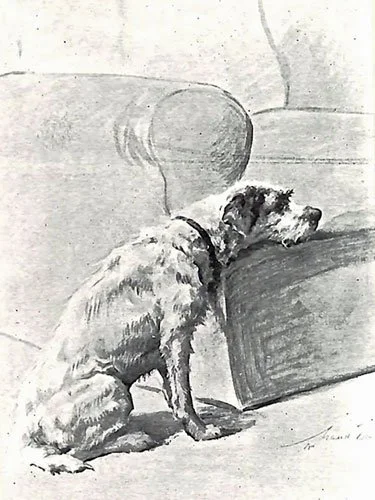
Silent Sorrow by Maud Earl, 1910. Caesar rests his head on the King's empty chair. The painting was commissioned in the weeks following Edward VII's death. Public domain.
Queen Alexandra was furious. She had spent decades managing what was and was not said about her husband’s private life; now a ghost-written terrier was telling the nation about the King’s last days, in the first person, for commercial profit. The book ran to nine reprints in its first year. The public could not get enough of it.
The Steiff toy company produced stuffed wire fox terriers modeled on Caesar around the same time. The image of the dog appeared on postcards, in portraits, in newspapers. Maud Earl, a celebrated animal painter, was commissioned to capture Caesar in his grief: the resulting painting, titled Silent Sorrow, shows the dog resting his head on the King’s favorite chair, staring at nothing. It is a portrait of bereavement with no human in it.
The nation had found, in Caesar, a way to mourn an Edwardian king without having to assess one.
What Alexandra Kept
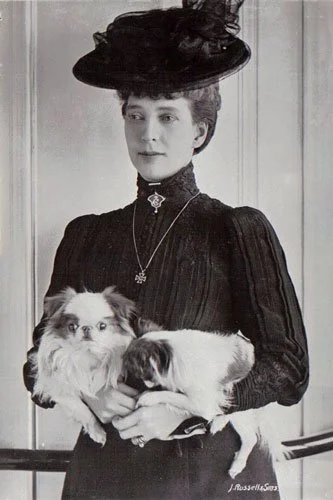
Queen Alexandra with her Japanese Chin dogs, c. 1900. After Edward's death, she took in Caesar and, by her own account, spoiled him thoroughly. Photo: Russell & Sons, Public domain.
Alice Keppel, the King’s final mistress, had inquired of Queen Alexandra about what was to become of Caesar. It was not an unreasonable question; she had been closer to the King in his last years than most of his household.
Alexandra kept him.
Despite her previous distaste for the dog—and she had genuinely disliked Caesar during the King’s lifetime, finding his behavior tiresome—she took him to Marlborough House and began, by her own account, to spoil him rather thoroughly. She confided to a friend that the King had been too strict with the dog and that she was making up for it. There is something in that admission worth sitting with: a widow compensating a terrier for her dead husband’s discipline, four years after the marriage that required the most compensation had ended.
Caesar died in April 1914, following a surgical operation. He was approximately sixteen years old. He was buried in the grounds of Marlborough House with a marble headstone bearing his image. The Fabergé model of Caesar—commissioned by the King from white chalcedony, with ruby eyes and an enamel-and-gold collar bearing his inscription—was purchased after the King’s death by Dame Margaret Greville for £35 and given to Alexandra as a gift.
It now forms part of the Royal Collection.
In St George’s Chapel, Windsor Castle, Edward VII lies in effigy alongside his Queen. At his feet, carved in stone, curled as if sleeping, is Caesar. He is the only creature in the monument who required nothing from the man beside him. The sculptor gave him that position. It is the most honest thing in the tomb.
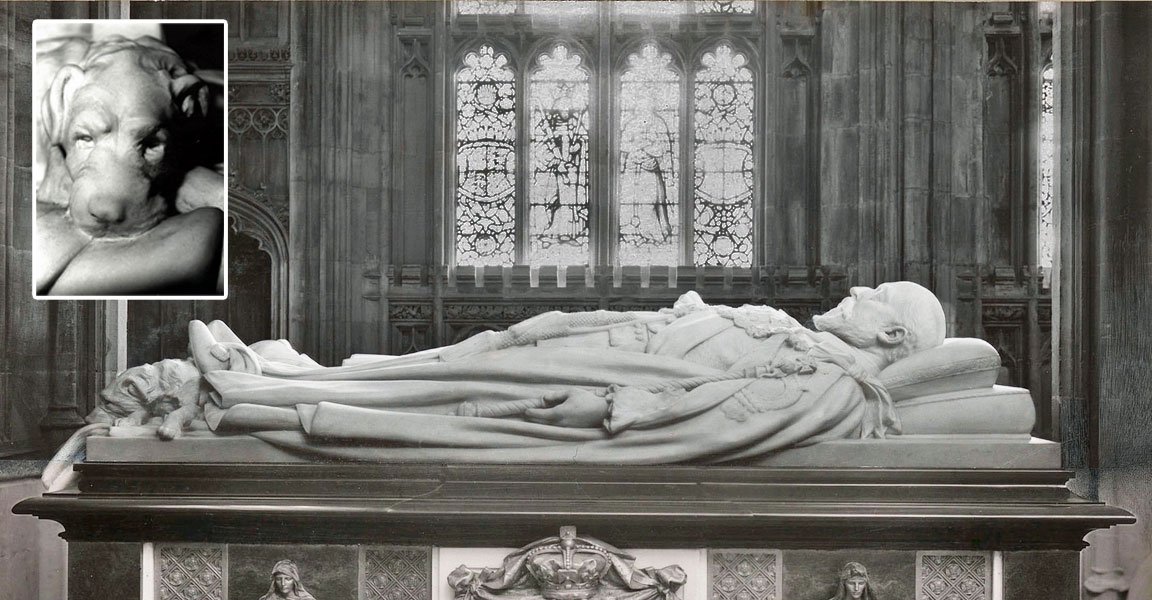
The tomb effigy of Edward VII, located in St George's Chapel at Windsor Castle, was sculpted by Bertram Mackennal. Caesar is carved at the King's feet — inset. Public domain.
Did You Know?
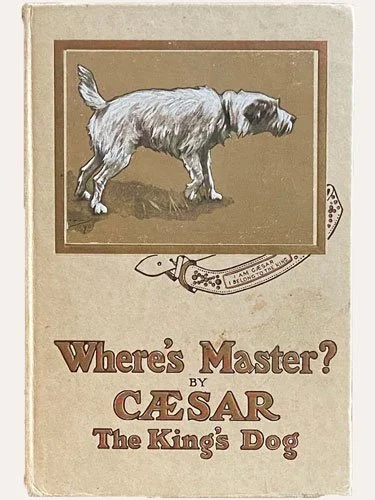
Where's Master? by Caesar the King's Dog, 1910. The unauthorized account of Edward VII's death ran to nine reprints in its first year. Public domain.
Where’s Master? was so commercially successful that Queen Alexandra eventually authorized her own response: a short account of Caesar’s life at Marlborough House after the King’s death, written with her blessing and intended to correct the unofficial version. It sold considerably fewer copies.
The wire fox terrier’s popularity surged dramatically in the years following Caesar’s fame, with registrations at the Kennel Club rising sharply through the 1910s and 1920s. Breed historians credit Caesar specifically with establishing the wire fox terrier as a fashionable companion breed beyond its working origins.
Caesar’s father, Cackler of Notts, is one of the foundational sires of the modern wire fox terrier breed. According to the Wire Fox Terrier Club of Canada, it is unlikely that any wire fox terrier alive today cannot trace its ancestry back to Cackler of Notts—making Caesar’s lineage a permanent fixture in the breed’s genetic history.
Alice Keppel’s great-granddaughter is Queen Camilla, consort of King Charles III—giving the story of Edward’s last years an unexpected royal continuation. When Edward VIII abdicated in 1936, Alice Keppel, then dining at the Ritz, was heard to remark: “Things were done much better in my day.”
Breed: Wire Fox Terrier | Country of origin: England | First use: Fox hunting | Origins: 18th century