The Hunting Dog Who Saved a Saint
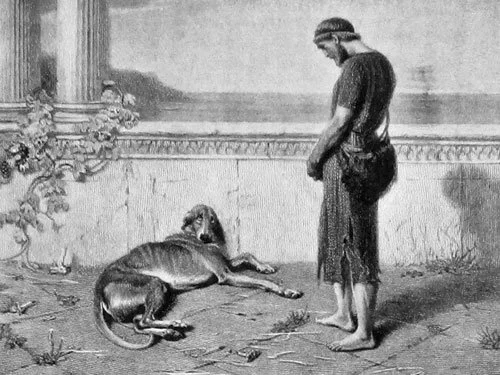
In every church, altarpiece, and woodcut that depicts St. Roch, a dog sits at the pilgrim’s feet with a loaf of bread in its mouth. For six centuries, viewers have read the animal as religious symbol — a sign of divine providence, loyalty, celestial care. It was a hunting dog that belonged to a count named Gottardo Pallastrelli, and the story of how it got there, and what happened when its owner followed it into the forest, has been almost entirely forgotten.
Gottardo's hunting party arrives in the background — but his dog had already found Roch first. AI image based on the Livre de la Chasse by Gaston Phoebus, 14th century. © Dogs in History
In the summer of 1371, a man lay sick in a forest shelter outside the city of Piacenza. He had retreated there from the hospital where he had been nursing plague victims — because the disease had caught up with him, and because he didn’t want to infect anyone else. His name was Roch. He had no food, no medicine, and every reason to believe he was going to die there.
What saved him was a dog.
A Pilgrim Heading South
Roch was born in Montpellier around 1348 — the year the Black Death reached its first devastating peak — into a family with social standing and civic office. By one account he was born with a red cross-shaped birthmark on his chest, a detail that hagiographers (biographies of saints) later read as divine election and that would, eventually, serve a more practical purpose. When his parents died, Roch was twenty years old. He gave away his inheritance, put on the plain garb of a mendicant pilgrim, and walked south toward Italy. The plague was still moving through the peninsula in waves. He was not fleeing it. He was heading toward it.
Through the early 1370s he worked in plague hospitals across northern and central Italy — Acquapendente, Cesena, Rimini, Novara, Rome — tending the sick in wards where most healthy people would not enter. A French diplomat passing through Piacenza recorded what is among the most reliable contemporary references to Roch: “A compatriot called Roch is held in high regard in these parts. He has the reputation of being a healer, performs miracles on people given up for dead, and has great piety.” At some point during his time in Piacenza, the plague caught up with him. His leg began to swell. He had spent years among people dying of exactly this. He knew what it meant.
Accounts differ on whether he was expelled from the hospital by frightened townspeople or left of his own accord. On the central fact they agree: rather than risk infecting others, Roch left the city. He made his way to the woods beyond a settlement called Sarmato, built himself a shelter from branches and leaves, and lay down to wait. He had no food, no companions, and no one who knew him well enough to come looking. He had done the responsible thing. The responsible thing had left him dying alone in the woods.
This is where the dog enters.
The Dog That Found Him
Dog giving Roch bread - the animal that kept him alive when no one else knew he was there. AI image based on the Livre de la Chasse by Gaston Phoebus, 14th century. © Dogs in History
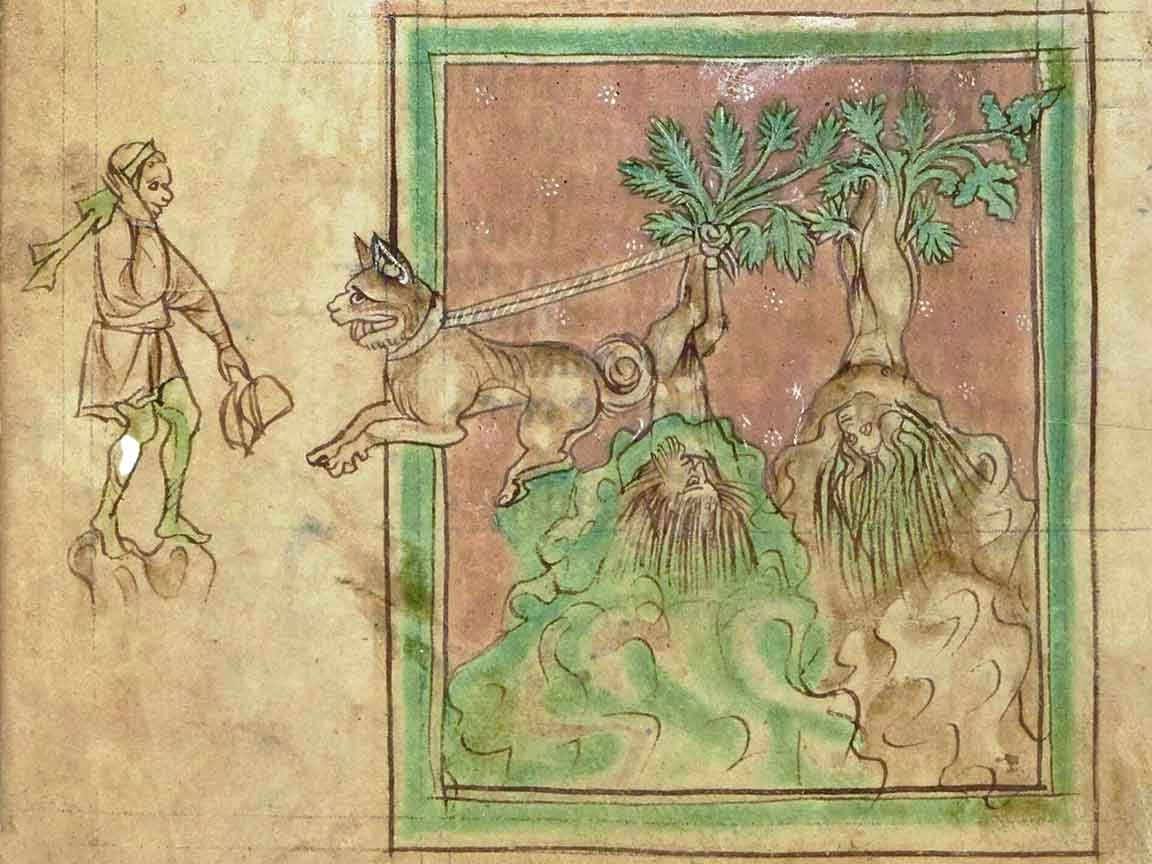
Near the forest where Roch had made his shelter, there was an estate belonging to a nobleman named Count Gottardo Pallastrelli. He kept hunting dogs — as men of his rank did — and one of them had begun behaving strangely. It was disappearing at mealtimes. It was taking bread from the table and not returning with it. Gottardo followed the dog.
He found Roch in his shelter: sick, barely alive, the plague sore open on his leg. The dog had been making regular journeys to the hut, carrying bread. In the accounts, it had also been licking the wound. Roch’s condition, by the time Gottardo found him, was beginning to turn. The healing is described in terms that belong to hagiography rather than medicine — miraculous, sudden, attributed to divine intercession and the dog’s attentions in roughly equal measure. What the accounts all agree on is that Roch did not die in that forest.
Gottardo’s first instinct, on finding a plague-infected stranger in the woods, was not to flee. He came back. He followed the dog again, and again, until Roch was well enough to speak with him. When Roch eventually warned him away — the disease was still there, the risk was real — Gottardo refused to leave permanently. The man in the hut was, by this point, less a stranger than someone his dog had singled out as worth returning to. That was enough.
The Count Who Followed His Dog
What Gottardo Pallastrelli did next is the part of the story that the paintings never show.
He gave up his estate. His title. His standing in Piacenza, a city where he was known as a man of consequence. He became a wandering beggar in the streets where he had once commanded deference, asking for alms from neighbors who, according to several accounts, refused him. He had become Roch’s first disciple — a voluntary conversion that had begun not with a vision or a sermon, but with a hunting dog carrying bread through the trees.
When plague broke out again in Piacenza, it was Gottardo who went back into the forest to tell Roch about it. And it was Roch who, still not fully recovered, went back into the city to help — because Gottardo had come to tell him. The two men moved in and out of danger together, tethered by the original encounter in the woods. Gottardo was the witness to all of it: the sickness, the dog, the recovery, the return.
The story ends badly for Roch. Traveling home toward Montpellier in the mid-1370s, he was arrested at Voghera on suspicion of being a spy. The official who imprisoned him was, in some accounts, his own uncle, who did not recognize him. Roch spent five years in that prison and died there, in 1376 or 1379 — sources differ — without ever giving his captors his name. He was identified after death by the red cross birthmark on his chest.
Gottardo, by then a wandering figure in Piacenza for years, was not present at the death. But the account of what happened in the forest — the dog, the bread, the wound, the recovery — comes, ultimately, from him. He was the only witness. Without Gottardo, there is no surviving record of any of it.
The Dog in the Painting
Within a century of Roch’s death, his cult had spread from Piacenza through Venice, into Spain, France, Germany, and eventually across the Catholic world. In 1485 his body was moved to Venice, where the Scuola Grande di San Rocco — one of the city’s great charitable confraternities — built a church in his honor and commissioned a sequence of paintings from Tintoretto spanning several decades.
The dog delivers bread to a stricken Roch — the moment the whole legend turns on. Peter Paul Rubens, Saint Roch Fed by a Dog, c. 1623. St. Martin's Church, Aalst, Belgium. Public domain.
Rubens painted him in the 1620s for an altarpiece in Aalst. Tiepolo, Ribalta, Giorgione, Carlo Crivelli: the iconographic tradition is long, varied, and remarkably consistent.
In almost every depiction, the dog is present. It sits at Roch’s feet, carries the bread, looks up at the saint with an expression that artists have rendered as devotion, loyalty, or patient waiting, depending on the era. The dog became one of the most recognizable attributes in all of Counter-Reformation devotional art — as reliable an identifying detail as Sebastian’s arrows or Catherine’s wheel. Show the plague sore. Show the pilgrim staff. Show the dog. Every viewer would know who it was.
What the iconographic tradition never preserved was Gottardo. He appears in written hagiographies — the Acta, the Golden Legend, the careful reconstructions of modern historians. But in six centuries of paintings, altarpieces, and stone carvings, the Count of Piacenza who followed his hunting dog into the forest and became Roch’s witness, disciple, and sole surviving source has disappeared. The dog became sacred; the man who owned the dog became a footnote.
There is something quietly accurate about this, and something that distorts. It is accurate because the dog’s role was real and specific: it found the man, it fed him, it led Gottardo to him. The dog did the essential thing. The distortion is in the flattening. The dog in the paintings is eternal, loyal, symbolic. It is always arriving with the bread, always present, never arriving from anywhere in particular — its owner, the chain of events that put it in the forest, the human story running parallel to Roch’s, all gone.
Gottardo Pallastrelli gave away his estate because a hunting dog led him to a stranger in the woods. That is the part the paintings leave out.
Roch in the wilderness while plague victims pray from the wings — the dog is visible by the stream, doing its quiet work. Probably only the compositional arrangement and the figure of the saint are from the brush of Tintoretto himself (c. 1580), while the landscape has been attributed to Paolo Fiammingo. The two lateral groupings were added by Santo Piatti in 1729. Scuola Grande di San Rocco, Venice. Public domain.
Did You Know?
Six centuries of the same image: pilgrim staff, plague wound, dog at his feet. Polychrome statue of St. Roch, Basilique Saint-Sernin, Toulouse. © Dogs in History
St. Roch is patron saint not only of dogs and dog lovers, but also of falsely accused people and bachelors — the latter a probable reflection of his solitary pilgrim’s life, which he never abandoned.
The bread-bearing-animal motif in Roch’s story has older roots in hagiography: a raven brings daily bread to the hermit Saint Paul the Anchorite in his desert cave. Scholars have noted that this conventional detail may have shaped how Roch’s story was written down, raising questions about how much of the dog’s role is documented history and how much is hagiographic inheritance.
Roch’s dog is sometimes identified in later, popular accounts as ‘Guinefort’ — but Guinefort was a separate folk saint, a greyhound venerated in the Ain region of France whose cult the Church condemned in 1231. The conflation reflects how thoroughly medieval religious culture organized itself around dog stories.
Tintoretto’s first painting for the church of San Rocco in Venice — Saint Roch Healing Plague Victims, completed in 1549 — is considered one of the earliest representations of the plague in Venetian art. Tintoretto secured the commission by painting the ceiling canvas without permission and presenting it as a gift the Brotherhood could not refuse.
Roch’s body was taken to Venice in 1485 from Voghera, in Lombardy — not from Montpellier, as had long been assumed and as Venetian authorities claimed. The translation was described by the city as a ‘discovery.’ The people of Voghera used a different word.