How America’s First Guide Dog Changed the World for the Blind
In 1927, a blind twenty-year-old from Nashville spent five cents on a magazine. What he read sent him across the Atlantic, to a dog-breeding estate in the Swiss Alps run by a Philadelphia socialite. The dog she trained for him had a different name. This is the story of how the American guide dog movement nearly didn’t happen—and why it did.
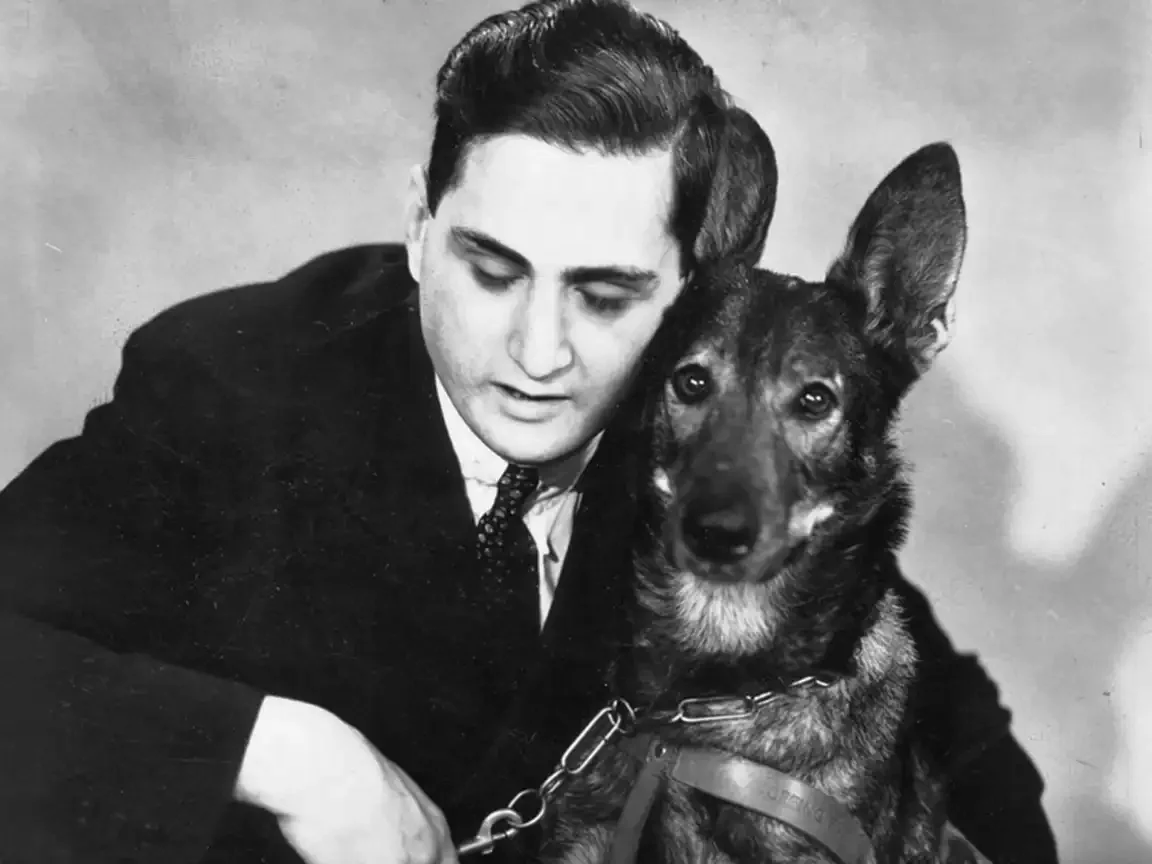
Morris Frank and Buddy in a studio portrait — the partnership that changed how millions of blind people live. Public domain.
Morris Frank had already lost two eyes. The first went at age six, when a tree branch caught him while riding a horse. The second, a decade later, in a boxing match with a friend. In a biographical coincidence so improbable it sounds invented, his mother had lost her sight in exactly the same fashion: two unrelated accidents, two eyes, total darkness. Frank grew up understanding blindness from the inside of a family, and then from the inside of his own skull.
By 1927 he was nineteen years old, living in Nashville, and working as an insurance salesman. He hired young men to guide him on his rounds, but found them unreliable—prone to oversleeping, to quitting without notice, to steering him wrong. He was dependent on strangers in a way that chafed constantly. On November 5, 1927, his father read aloud to him an article in The Saturday Evening Post.
The Woman at Fortunate Fields
The Saturday Evening Post, November 5, 1927 — Dorothy Eustis's article "The Seeing Eye" was the five-cent magazine piece that changed Morris Frank's life. © The Saturday Evening Post, Public domain.
The article was titled “The Seeing Eye.” Its author was Dorothy Harrison Eustis—born in Philadelphia in 1886, the daughter of the provost of the University of Pennsylvania, educated at private schools in England, widowed at twenty-nine with two young children. She had remarried in 1923, to George Morris Eustis, a polo player who shared her enthusiasm for dogs, and the two had moved to Vevey, in the Swiss canton of Vaud, where they established a kennel on their estate. They named it Fortunate Fields.
What Eustis did at Fortunate Fields was scientific in its approach. She and her head trainer, Jack Humphrey—a self-taught American horse breeder turned dog trainer—were selectively breeding German Shepherds for intelligence, loyalty, and steadiness of temperament. The dogs were supplied to the Swiss Army, to customs officers, to city police forces across Europe. In 1927, during a visit to Potsdam, Germany, Eustis had seen something else: a program where dogs were being trained specifically to guide veterans blinded in the First World War. She watched them navigate streets, halt at curbs, thread between obstacles. She came home and wrote about it.
The Saturday Evening Post published her account to an audience of millions. Eustis was not, at that point, a guide dog trainer. The program she described was German, and her article was an account of what she’d witnessed—not an offer of what she could provide.
Morris Frank didn’t read it that way.
Five Cents and a Letter
Frank later said the five cents the magazine cost him had bought an article worth more than a million dollars. He wrote to Eustis immediately, and his letter didn’t ask where to find such a dog. It asked Eustis herself to provide one—and made a promise in exchange. “Help me and I will help them,” he wrote, referring to the thousands of blind Americans without independence. “Train me and I will bring back my dog and show people here how a blind man can be absolutely on his own.”
Dorothy Eustis at Fortunate Fields, Vevey, Switzerland, with three of the German Shepherds she bred and trained for police and guide work. Public domain.
Eustis called him on February 9, 1928, and put a direct question: would he come to Switzerland? Frank’s answer has been quoted ever since. “Mrs. Eustis, to get my independence back, I’d go to hell.”
He arrived at Fortunate Fields in April 1928. Eustis and Humphrey had spent the intervening months adapting techniques from the Potsdam program to two of their own dogs. When Frank arrived, he was given a choice between them. The one he worked with best was a young female German Shepherd. Her name, assigned by the kennel, was Kiss.
Frank renamed her Buddy.
What Buddy Did
Training lasted several weeks, on the streets of Vevey and across the grounds of the estate. Frank later described learning to read Buddy through the harness—the small tensing before a stop, the subtle shift of direction when something lay in the path. He stepped on her paws. He missed her signals. He walked into a gatepost. Buddy waited beside him and tried again.
By June, Humphrey judged the pair ready. On June 11, 1928, Frank and Buddy disembarked in New York City into a crowd of reporters. They expected a charming demonstration of something experimental. What they got was different.
One of the journalists issued a dare: take the dog across West Street.
Morris Frank and Buddy crossing West Street in Manhattan, 1928, watched by a crowd who had come to see whether a dog could really guide a blind man. © The Seeing Eye archives, Public domain.
West Street ran along the Hudson waterfront and was widely regarded as one of the most dangerous thoroughfares in the city—choked with trucks, taxis, and delivery vehicles moving in all directions. Frank accepted the dare. He later described what followed: ten-ton trucks thundering past, horns in his ears, drivers shouting. He had surrendered navigation entirely to Buddy. She moved into the noise, stopped, backed up, started again, found the gap, and brought him through.
When they reached the other side, Frank leaned down and told her she was a good girl. Then he went to find a telegraph office. His message to Dorothy Eustis at Fortunate Fields was a single word: “Success.”
He called Buddy his “declaration of independence.”
The School, the Laws, the Road
The Seeing Eye was incorporated in Nashville, Tennessee, on January 29, 1929. Eustis served as its first president; Frank as managing director. The school took its name from the Old Testament, Proverbs 20:12: “The hearing ear and the seeing eye—the Lord hath made them both.” It moved to Whippany, New Jersey in 1931, and settled permanently in Morris Township in 1965.
Frank and Buddy stepping off a Newark bus — a routine journey that, in 1928, required a fight to make legal. Public domain.
Frank spent the next three decades on the road with Buddy, quite literally. He traveled by train and bus across the United States and Canada, appearing at hospitals and civic events, demonstrating what a guide dog partnership looked like in practice. The work was practical as much as inspirational: in 1928, Buddy was routinely refused access to the passenger compartments of trains. By 1935, every railroad in America had adopted policies specifically permitting guide dogs. By 1956, every state in the country had passed a law guaranteeing blind people with guide dogs access to public spaces.
Buddy—the original, the one who had been named Kiss—died on May 23, 1938. Frank named every subsequent dog Buddy in her honor. The obituary for Buddy II, published in The New York Times in 1948, noted that she had guided her master on travels of over 49,000 miles during the Second World War alone, when Frank lectured at Army and Navy hospitals on the subject of guide dogs for the blind.
What Followed
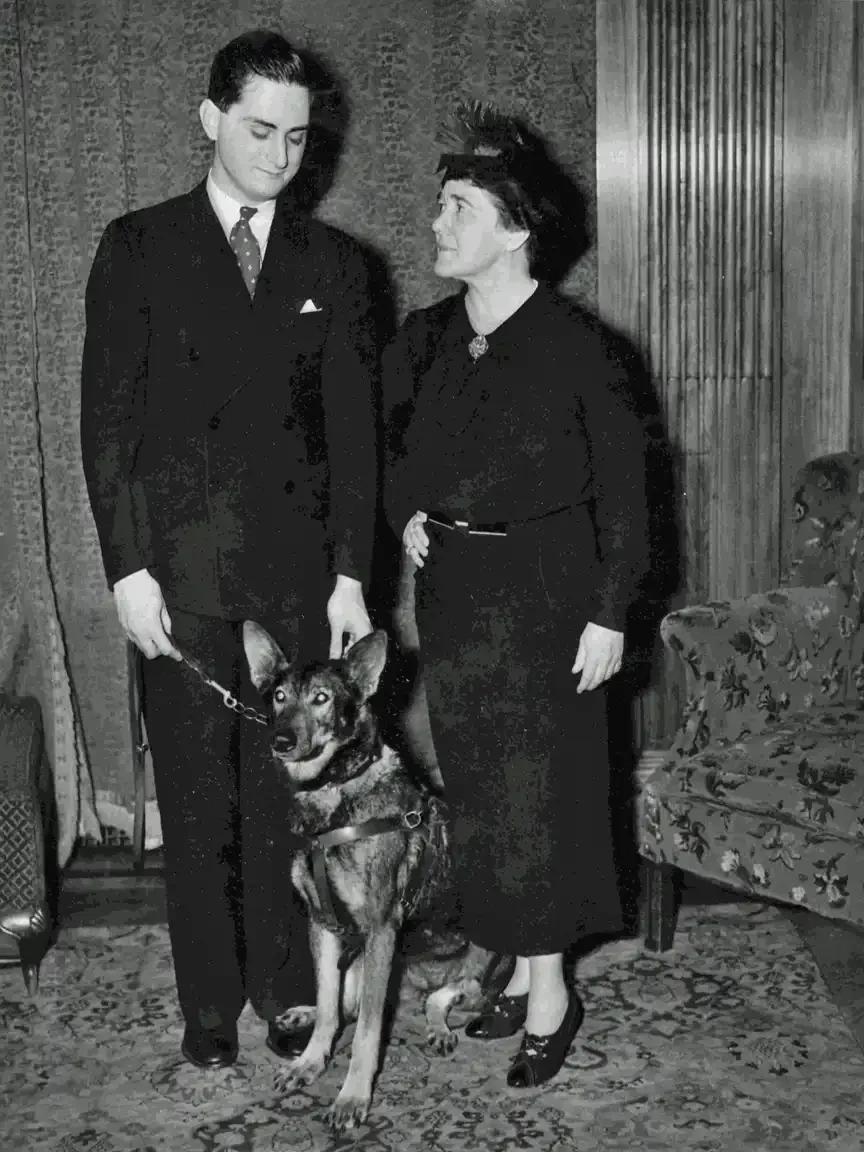
Morris Frank and Dorothy Eustis with Buddy — the blind insurance salesman, the Swiss-based dog breeder, and the German Shepherd who brought them together. © The Seeing Eye archives, Public domain.
The movement that Frank and Eustis launched from a kennel in the Swiss Alps did not stay American for long. In 1930, two British women read about The Seeing Eye and contacted Eustis. She sent training expertise to Britain, and by 1934 the Guide Dogs for the Blind Association had been established there. In 1931 alone, Eustis supplied dogs and qualified instructors to Italy, France, and Britain simultaneously, seeding three national guide dog programs from Vevey in a single year.
Today, the International Guide Dog Federation counts member organizations across six continents. The Seeing Eye alone - the school founded on Frank’s promise, in a letter written in Nashville in November 1927 - has created 18,500 partnerships between individuals and dogs since 1929.
Worldwide, an estimated 10,000 new guide dog partnerships are formed each year.
Morris Frank died in 1980, at the age of seventy-two. He had used guide dogs for the last fifty-two years of his life. On Morristown Green, near The Seeing Eye’s New Jersey headquarters, there is a bronze sculpture of a man and a German Shepherd walking together. It is titled The Way to Independence.
The first Buddy is buried on the grounds of the school she helped to found.
Did You Know?
The Seeing Eye's archives contain rare footage of Morris Frank describing his partnership with Buddy in his own words — a firsthand account from the man who crossed the Atlantic to collect a dog and came home with a movement. Watch the film here
Dorothy Harrison Eustis poured so much of her personal fortune into The Seeing Eye that by 1958, the school’s endowment had grown sufficient to end all outside fundraising. No public appeal has been required since.
The German guide dog program at Potsdam that Eustis visited had been running since the First World War, training dogs to assist soldiers blinded by mustard gas on the Western Front—more than a decade before the movement reached America.
Frank's memoir, First Lady of the Seeing Eye, was published in 1957 — but the title belongs to Buddy, not Dorothy Eustis, who appears in it as the architect rather than the subject. Frank named every guide dog he ever owned Buddy, in the original's honor.
Britain's shift from German Shepherds to Labradors as guide dogs was an accident of quarantine law: when regulations blocked importing trained dogs from Europe in the 1930s, British trainers sourced Labradors locally instead — and the breed became the global standard.
In 2020, New Jersey officially named the Seeing Eye dog its state dog—nearly a century after the school that coined the name was incorporated in Nashville, Tennessee.
Breed – German Shepherd Dog | Country of Origin – Germany | First Use – Military and police work | Origins – 19th century