Seaman: The Dog Who Crossed a Continent
Meriwether Lewis bought a Newfoundland in 1803 for practical reasons. What he couldn't have known was that the dog would become the one consistent presence across eight thousand miles — and that when the journals finally went quiet, it would be the dog's silence that felt loudest of all.
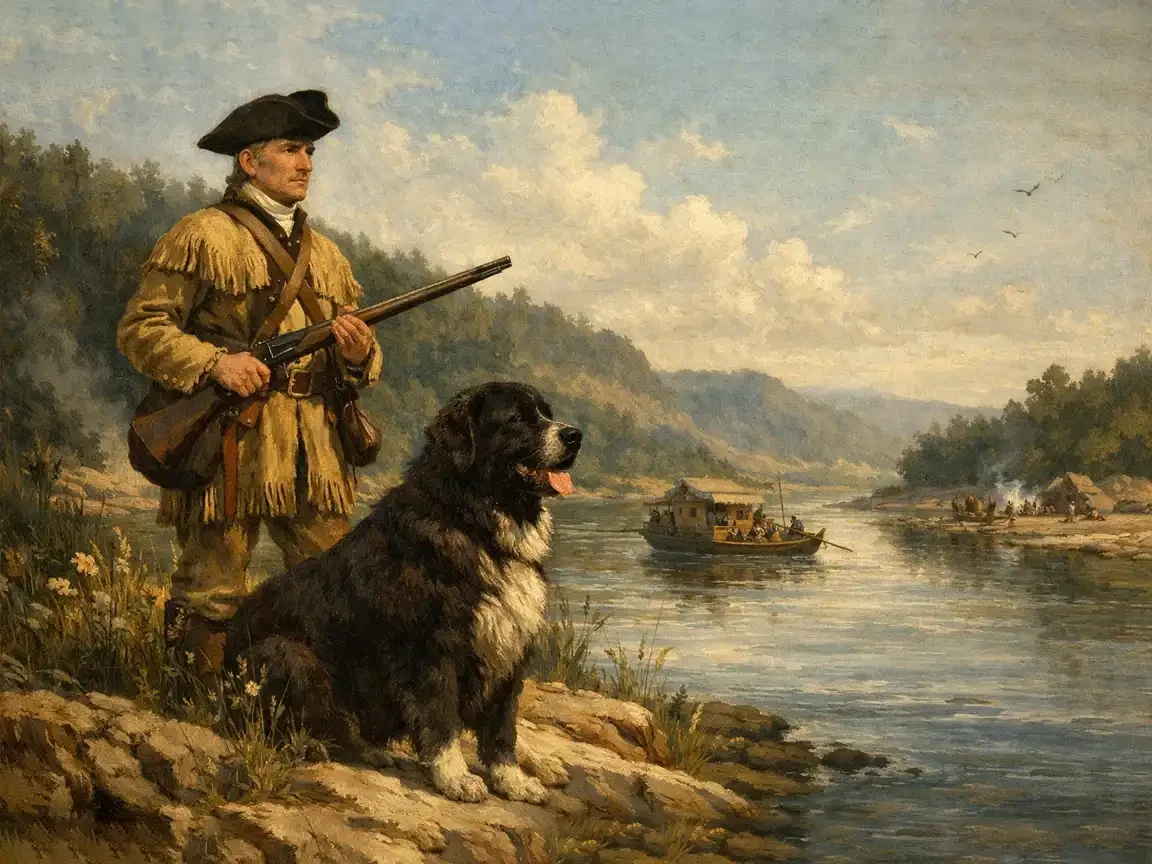
Meriwether Lewis and Seaman at the Missouri River. Interpretation. © Dogs in History.
In the late summer of 1803, a man preparing to walk into an unmapped continent bought a dog.
The man was Meriwether Lewis. He was twenty-nine years old, a captain in the United States Army, and he had been tasked by President Thomas Jefferson with crossing the Louisiana Territory — a vast expanse of land that America had just acquired from France and knew almost nothing about. Lewis spent months assembling what the expedition would need: instruments, weapons, medicines, men. Then, in Pittsburgh, he paid $20 for a large Newfoundland.
The dog's name was Seaman. He was not a sentimental afterthought. He was a tool.
A Dog Bought for Water and Wilderness
A Newfoundland made strategic sense for a mission that would live on rivers. The breed had been developed in the cold waters off the Canadian coast: powerful swimmers, calm under pressure, built for hauling and cold. On a journey of capsizing canoes and slippery banks, a dog like Seaman was closer to equipment than companion — chosen, as Lewis might have phrased it, for his utility.
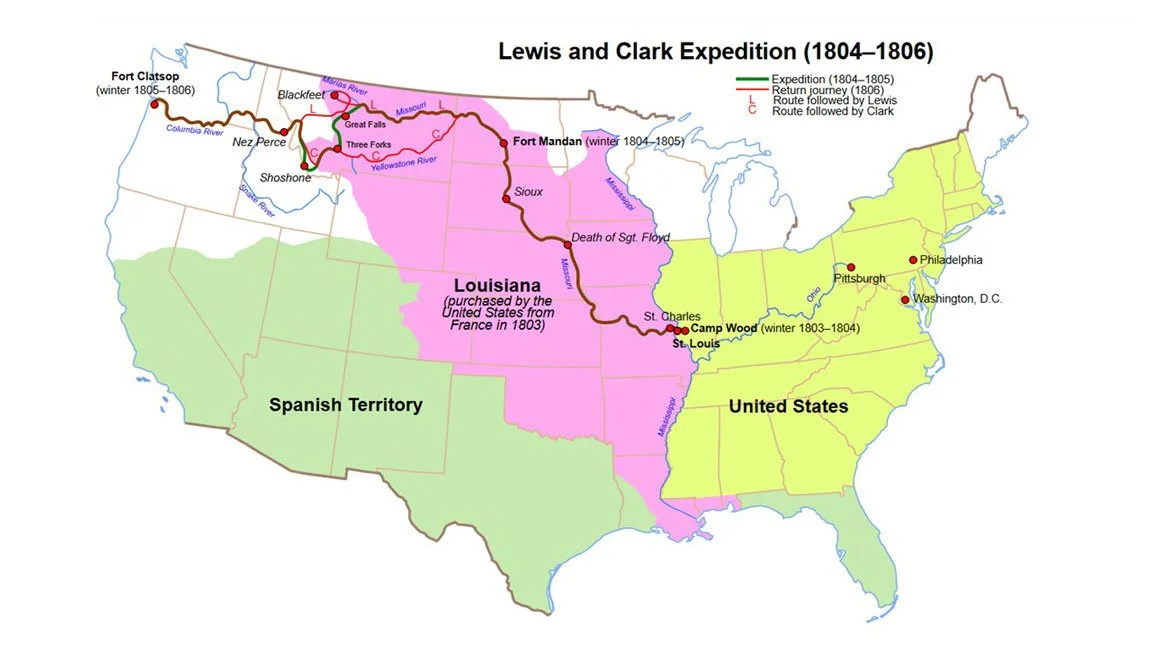
Route of the Lewis and Clark Expedition, 1804–1806. Public domain, via Wikimedia Commons.
That practical origin matters because it clarifies what happened afterward. Lewis was not a man who named his tools. He was precise in his journals — systematic, scientific, exact — and a dog who was merely useful might have appeared as inventory. Seaman did not. He appears by name, with attention, with something that reads unmistakably as care.
Lewis demonstrated him to strangers along the route the way he demonstrated his air gun: as proof of preparation, an emblem of competence. But even in those early months on the Ohio River, something more than utility was already evident. Lewis watched the dog work — noticed him, wrote him down — with a particularity that says more about the watcher than the watched.
“...I made my dog take as many each day as I had occation for, they wer fat and I thought them when fryed a pleasent food— many of these squirrils wer black, they swim very light on the water and make pretty good speed— my dog was of the newfoundland breed very active strong and docile, he would take the squirel in the water kill them and swiming bring them in his mouth to the boat.”
The expedition that would come to be known as the Corps of Discovery set out in the spring of 1804. Forty-odd men in a keelboat and two smaller pirogues, moving up the Missouri River into territory that American maps left blank. Jefferson had asked Lewis for rivers, landscapes, plants, animals, and the Native nations who inhabited the land. He had asked for a possible water route to the Pacific. He had not asked for a dog. But the dog came anyway.
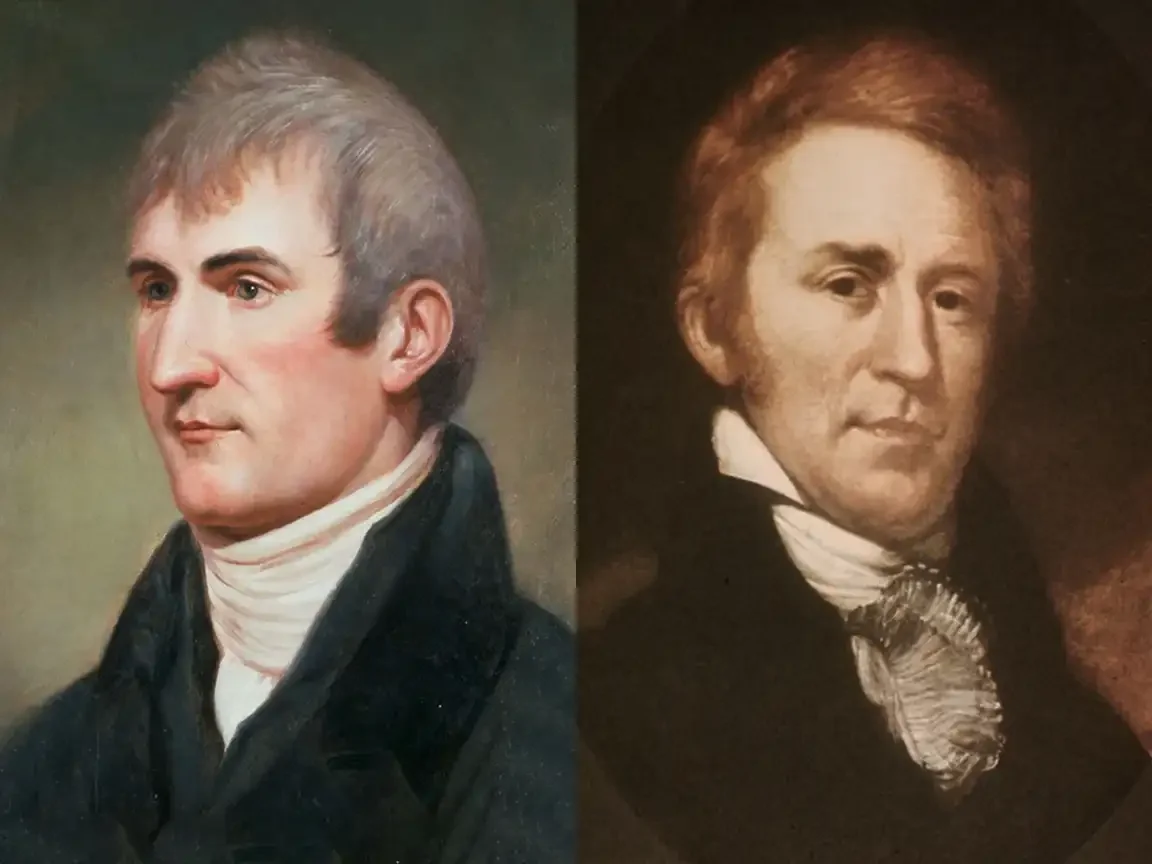
Meriwether Lewis (left) and William Clark (right). Public domain, via Wikimedia Commons.
If Seaman had a job description across the two years and four months of the expedition, it would read like a frontier generalist with a specialty in water. He hunted and retrieved. He helped bring back game — squirrels on the Ohio, waterfowl on the Missouri. Accounts describe him as especially adept at squirrels, which is hardly heroic prey, until you imagine the hunger that makes small meat matter.
He also served as an alarm system in a landscape where the most ordinary sound could be a warning. The National Park Service records episodes in which Seaman alerted the party to bears and put himself between the men and charging bison. Whether he was fearless or simply doing what large dogs do — placing himself between his people and trouble — the effect was the same: the camp slept a little easier.
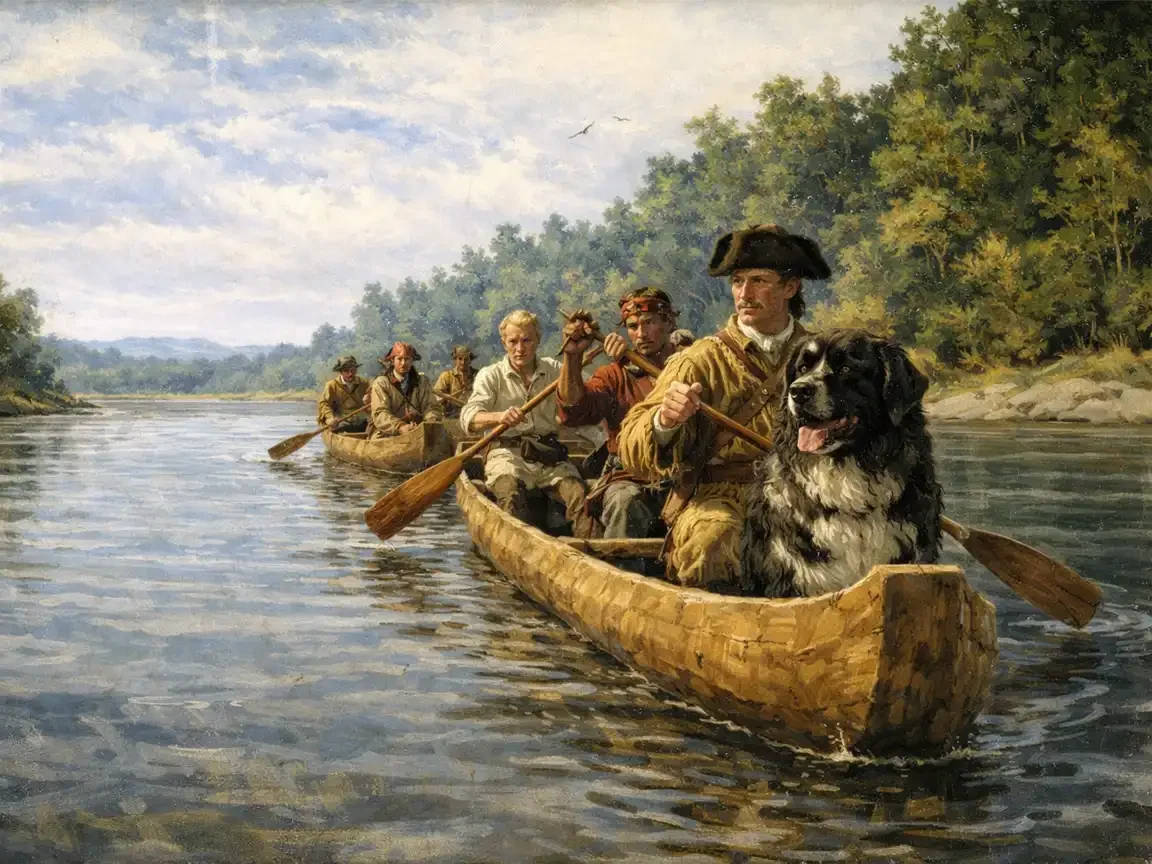
The Corps of Discovery on the Missouri River. Interpretation. © Dogs in History.
The dog also played an unexpected role in the expedition's encounters with Indigenous nations along the route. Lewis recorded how communities reacted to Seaman with curiosity and admiration. A Newfoundland was an imposing sight on the early nineteenth-century frontier — the breed was largely unknown this far inland — and in places where language was limited and trust still forming, the dog sometimes opened conversations that other approaches could not. An offer was made, at one point, to purchase Seaman for beaver pelts. Lewis declined.
Then, in April 1806, on the return journey, Seaman was taken.
The account is brief. Some members of a local group had led the dog away from camp, nearly half a mile. Clark's journal records what happened next:
“we were informed of it by a man who Spoke the Clatsop language and imediately Sent three men with their guns who over took the Indians, who on their approach ran off and lift the dog— we informed the nativ’s by Signs that if the indians insulted our men or Stold our property we Should Certainly put them to death”
Three armed men. For a dog. In a world where animals were routinely traded, where dogs were sometimes purchased for food along the route, this particular dog was not negotiable. The response was not that of a man retrieving equipment. It was the response of a man retrieving something he could not afford to lose.
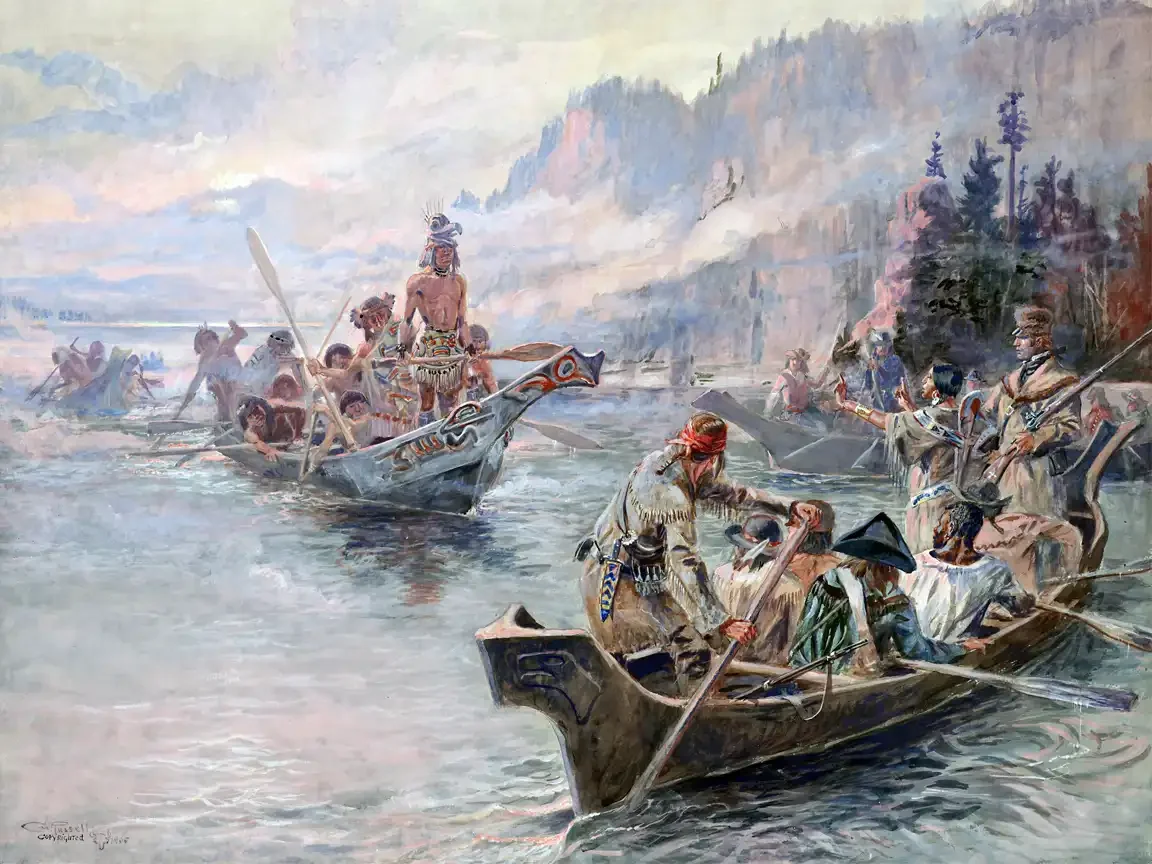
Lewis and Clark Expedition by Charles Marion Russell. Public domain, via Wikimedia Commons
The Feeling of Being Somewhere Very Far From Home
It is tempting, reading the journals, to imagine Seaman as the expedition's four-legged hero. The better story is steadier: a working dog performing practical tasks across an immense distance, staying close to the man who had chosen him, registered in the record not because he was spectacular but because he was constant.
Lewis was, by most accounts, a complicated man — precise and disciplined in the field, prone to dark periods when the field was behind him. The expedition years appear to have been the peak of his life: purposeful, forward-moving, filled with the kind of practical observation he was built for. In the journals he is most alive when he is noting something specific — a new plant, a river's character, the behavior of an animal. Seaman gave him something to note almost every day.
There is a version of Meriwether Lewis that history tends to emphasize: the leader, the scientist, the disciplined classifier. The journals, read closely, also show a man who liked to walk a shoreline with his gun and his notebook and his dog, happiest when the world narrowed to the next practical task. Seaman makes that version of Lewis legible. Not romance. Temperament.
The final mention of Seaman in the journals comes in July 1806, on the return journey, somewhere in present-day Montana. The corps has been traveling for months. The men are exhausted. And the insects have become intolerable.
“the musquetoes continue to infest us in such manner that we can scarcely exist; for my own part I am confined by them to my bier at least ¾ths of my time. my dog even howls with the torture he experiences from them, they are always most insupportable, they are so numerous that we frequently get them in our thrats as we breath”
A continent crossed. Mountains measured. Rivers named. And a Newfoundland, howling at mosquitoes in the summer dark. It is, somehow, the most human image in the entire record.
The Silence After
The expedition returned to St. Louis in September 1806. Lewis was celebrated. Clark was celebrated. The journals were taken apart for publication, reassembled, argued over. The continent had been documented.
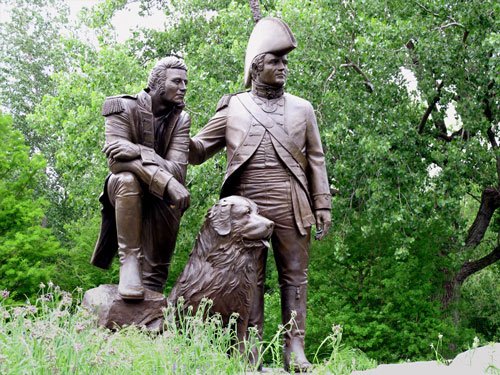
Lewis and Clark with Seaman, Frontier Park in St. Charles, Missouri. Public domain, via Wikimedia Commons.
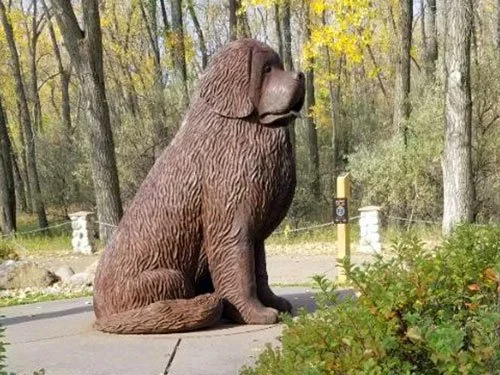
Statue of Seaman at Fort Mandan. Public domain, via Wikimedia Commons.
By October 1809 Meriwether Lewis was dead, at a roadside inn in Tennessee. He was thirty-five. The circumstances were disputed at the time and remain so; the most considered reading of the evidence is that he took his own life. The great expedition was three years behind him, and he had not managed to find what came after it.
Seaman vanishes from the record in July 1806. What happened to him after the expedition ended — whether he lived out his years in St. Louis, whether Lewis kept him, whether he outlasted the man who had bought him — nobody wrote down.
Did You Know?
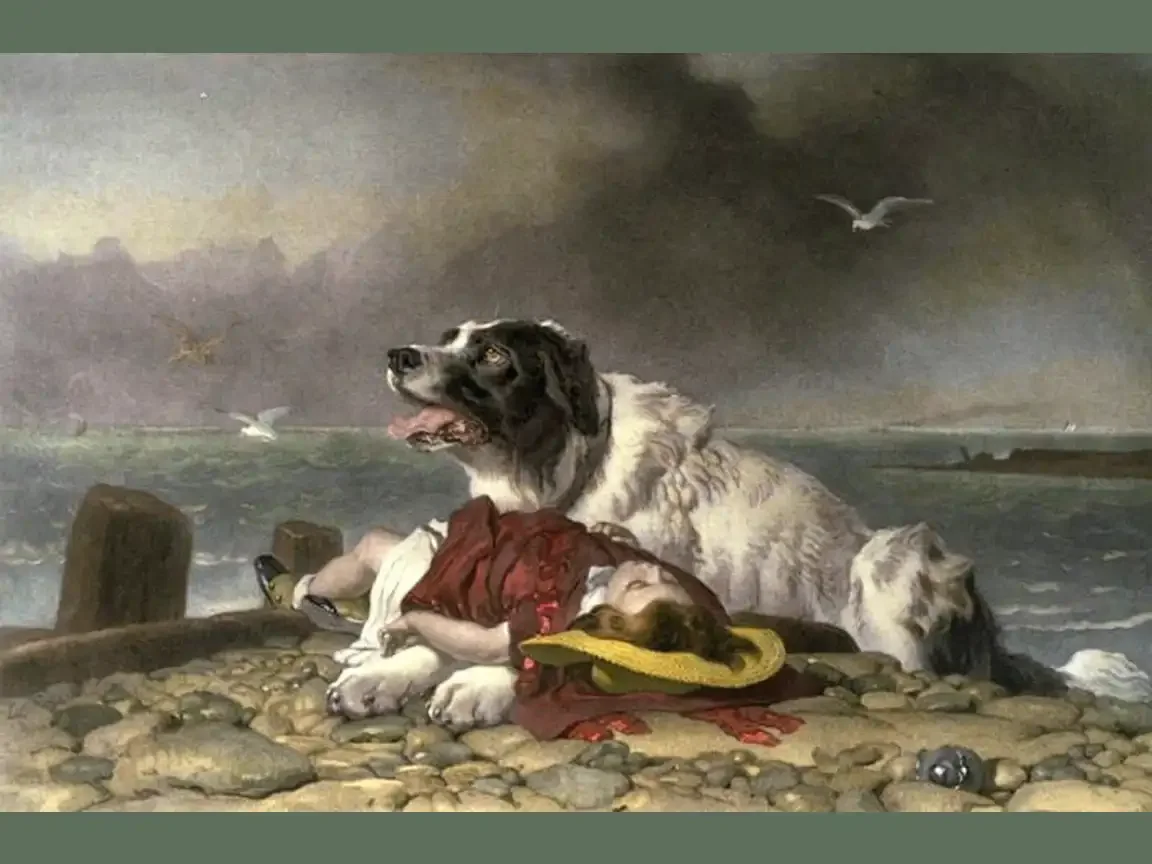
Saved, by Sir Edwin Landseer, 1856. Public domain, via Wikimedia Commons.
Seaman's name was misread for decades. Early transcriptions of Lewis's journals rendered it as "Scannon," and for much of the twentieth century that was the name used in histories and atlases. A Montana creek was recorded as "Scannon's Creek" — now Monture Creek — before the error was corrected by scholars in the 1980s.
Nobody knows what Seaman looked like. There is no description of his color or markings in the journals. Today he is almost universally depicted as black, but nineteenth-century Newfoundlands were commonly black-and-white. Every portrait of Seaman is, in that sense, a reconstruction.
Lewis paid $20 for Seaman in Pittsburgh in 1803 — roughly half a month's pay for an Army captain. The seller is not named in the journals.
The Edwin Landseer painting Saved (1856), which depicts a Newfoundland guarding an unconscious child on a rocky shore, helped cement the breed's reputation for heroism and loyalty in the Victorian era. Landseer painted Newfoundlands so frequently that the black-and-white variety of the breed is still called the Landseer today.
Breed: Newfoundland | Country of origin: Canada | First use: Working water dog for coastal fishing and lifesaving | Origins: 17th century