First Dogs of U.S. Presidents
From Washington’s foxhounds to FDR’s election-saving terrier, America’s First Dogs have trotted through the White House as comforters, comedians, and quiet PR geniuses. In pawprints and photo ops, they reveal the human side of power.
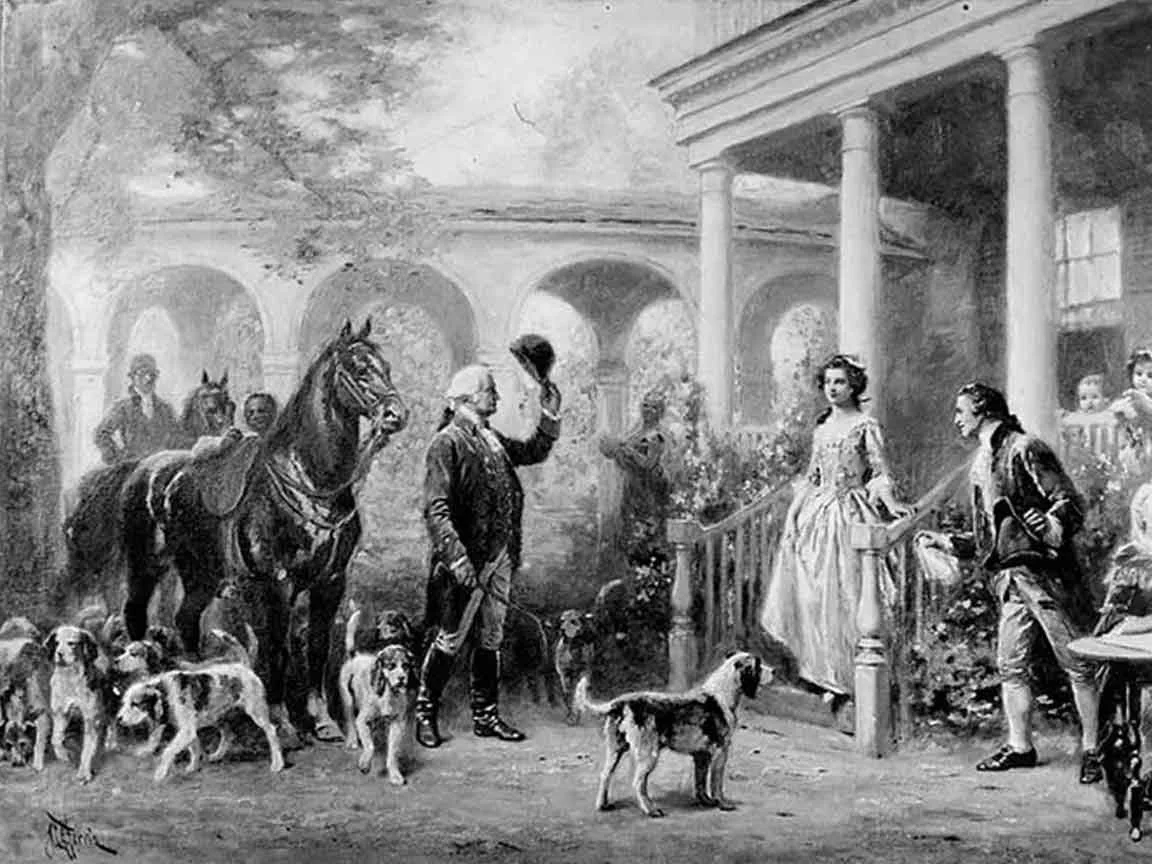
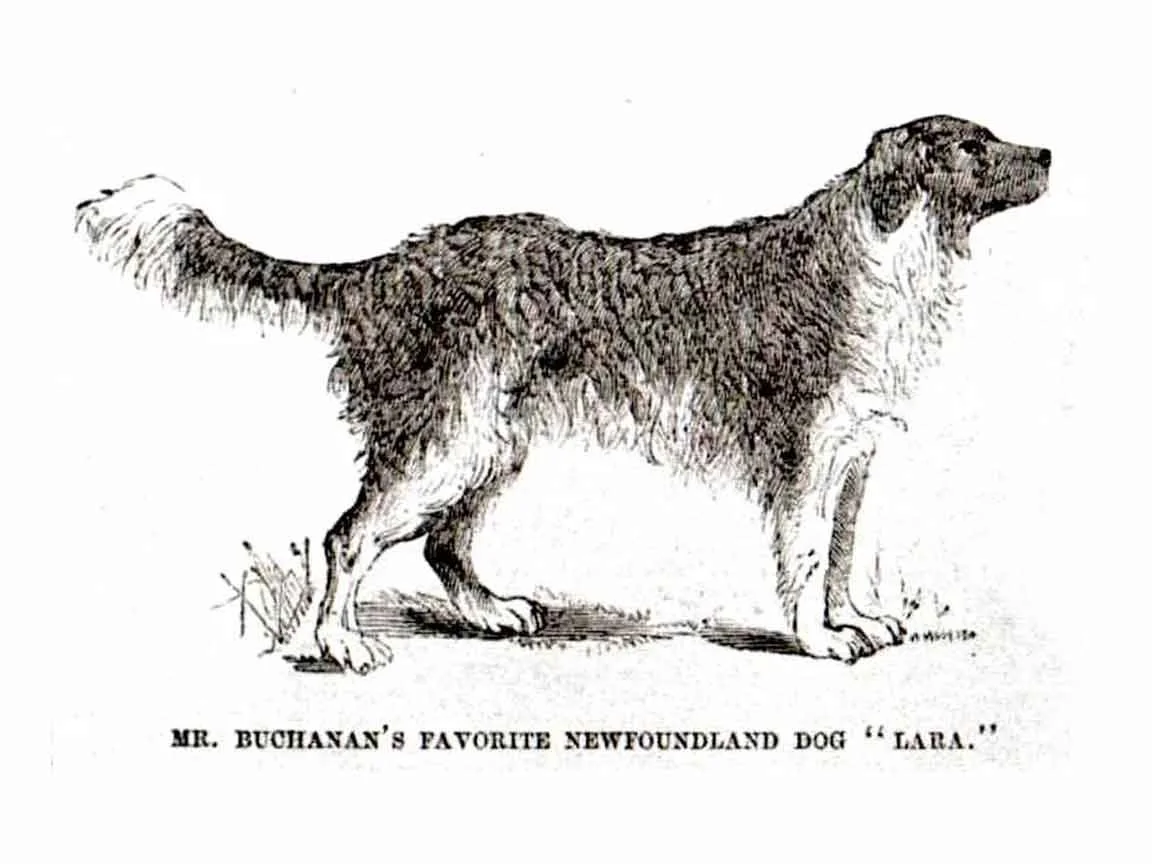

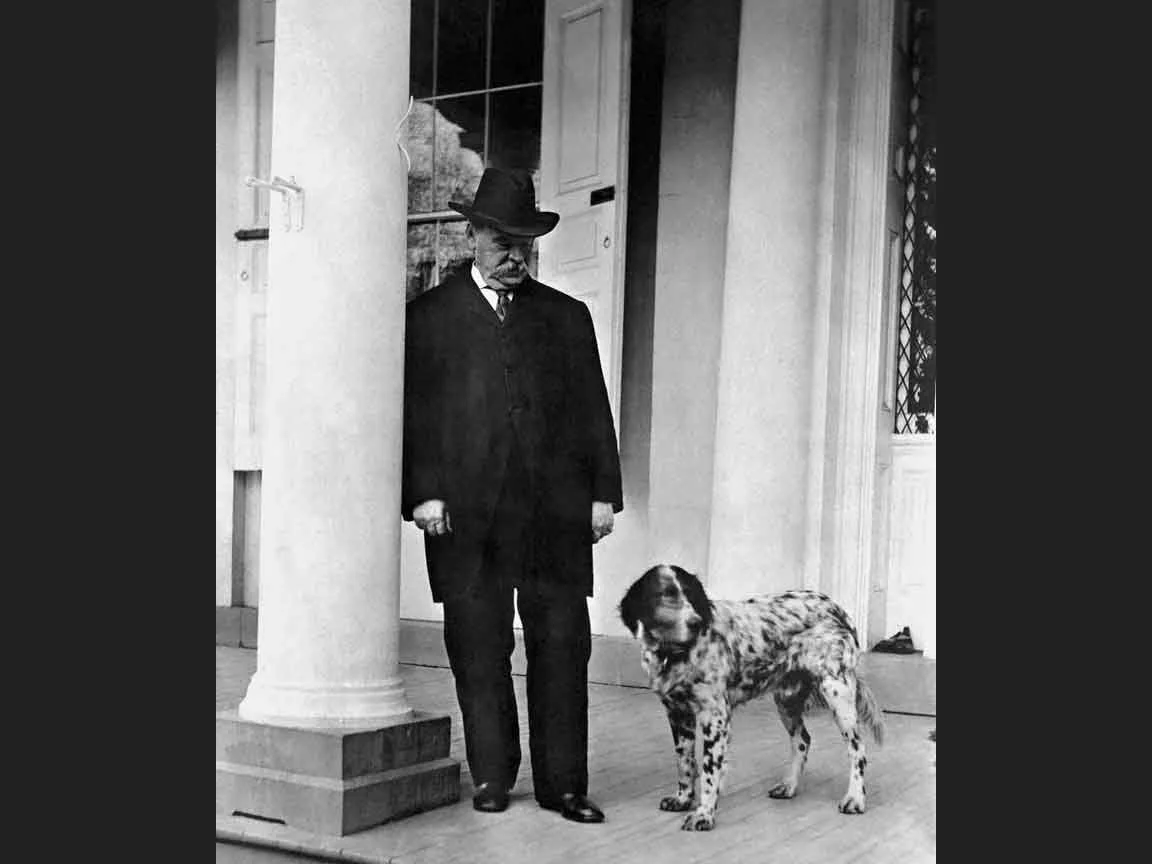
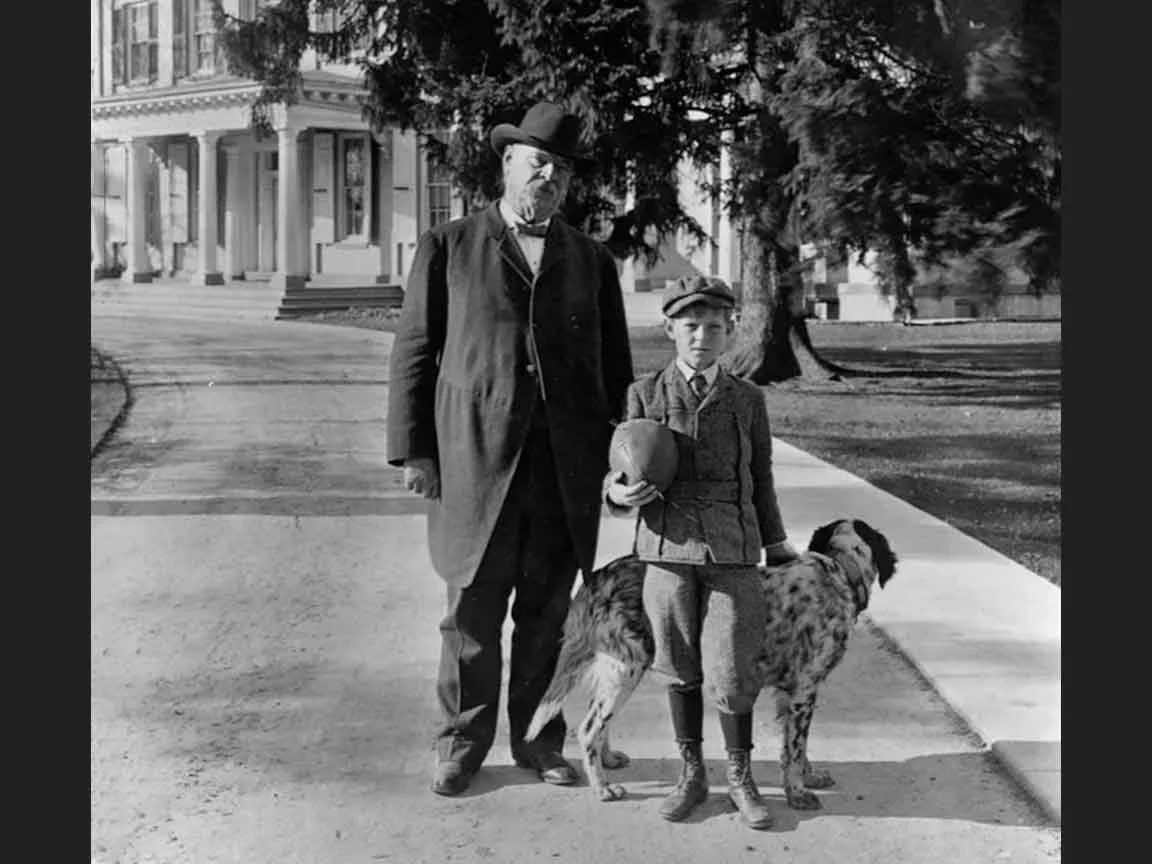
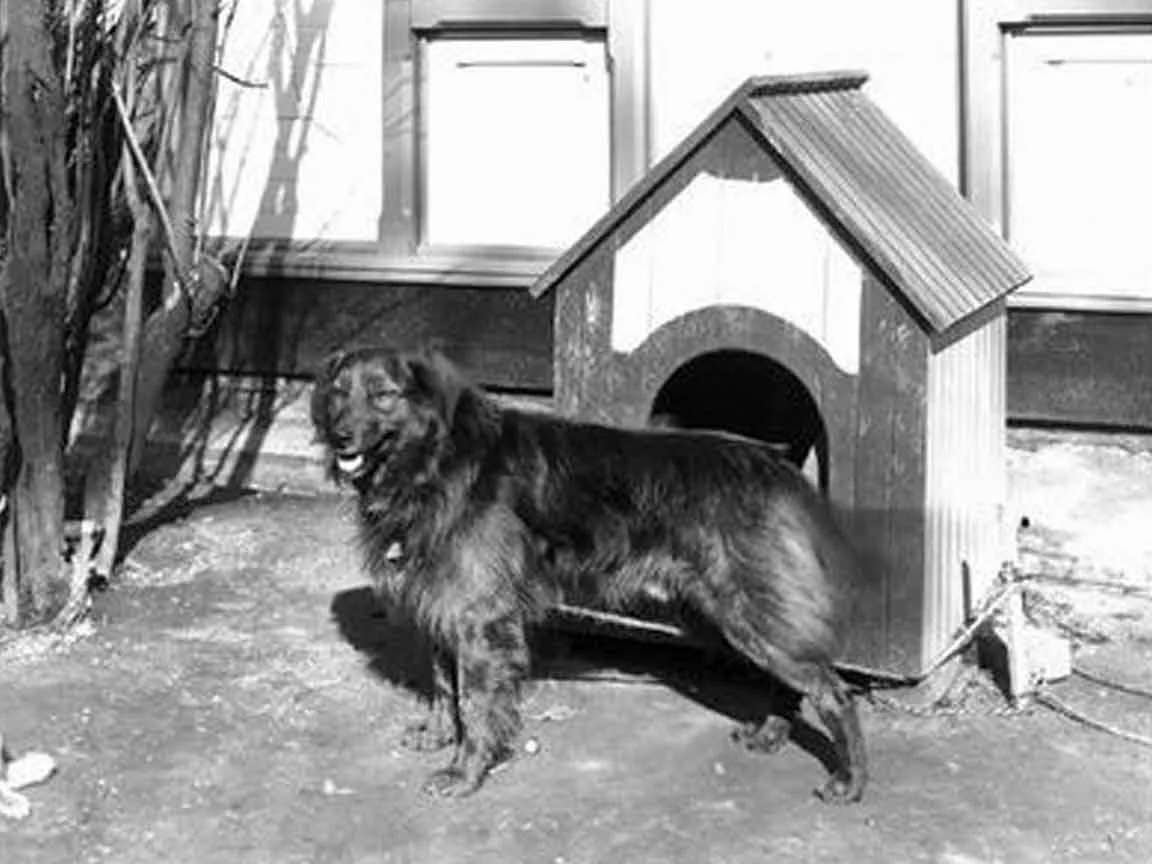
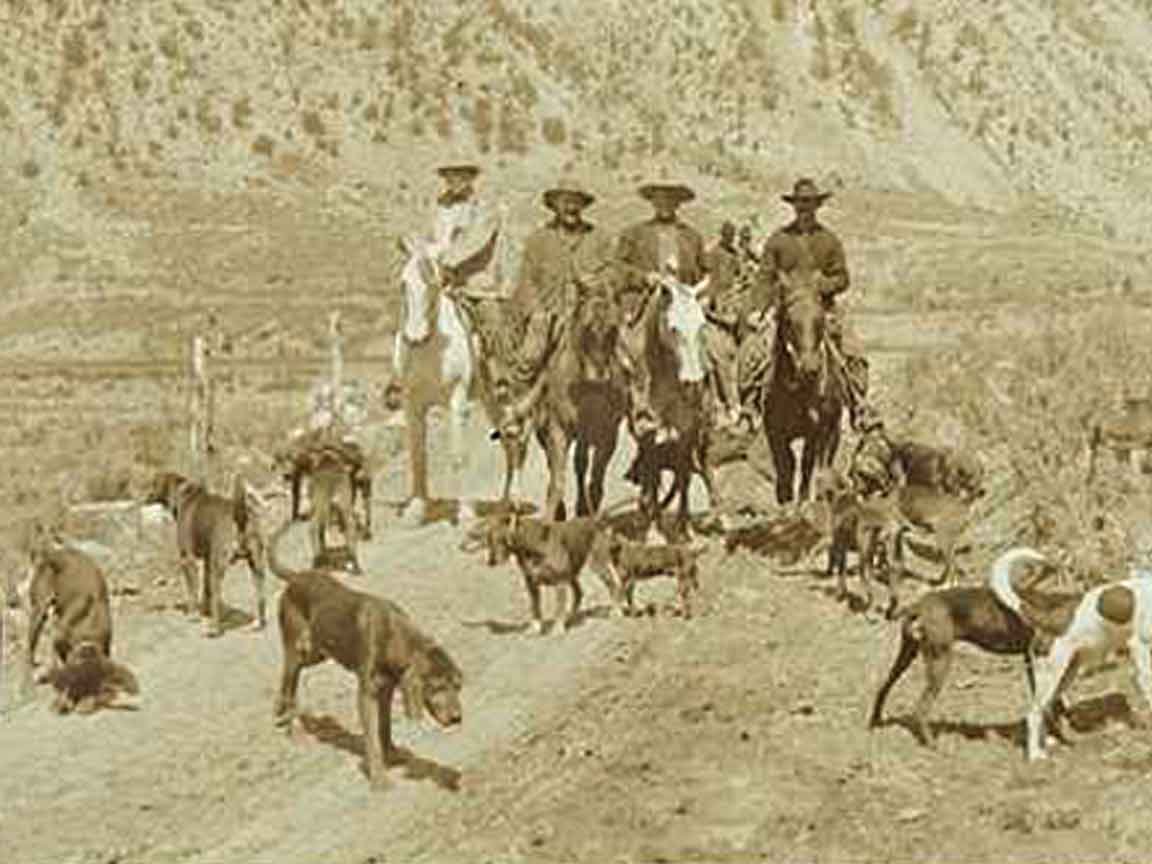
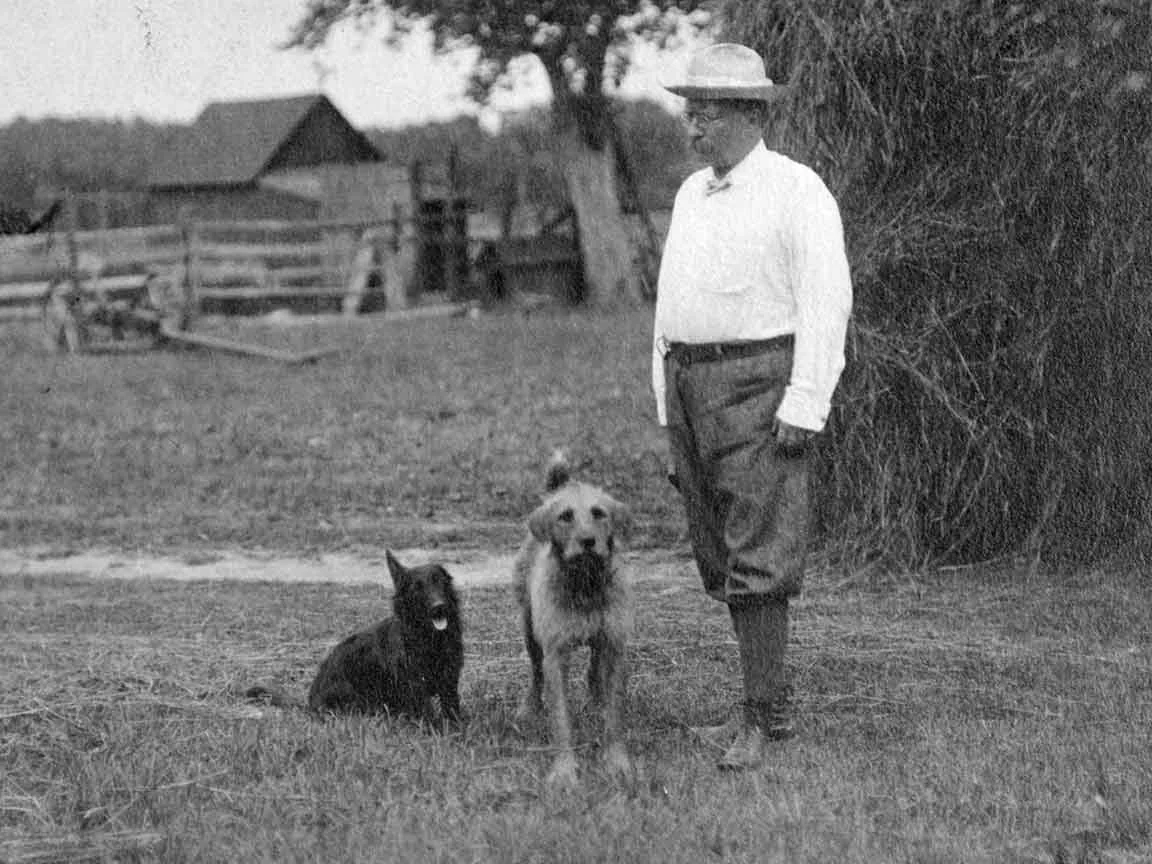
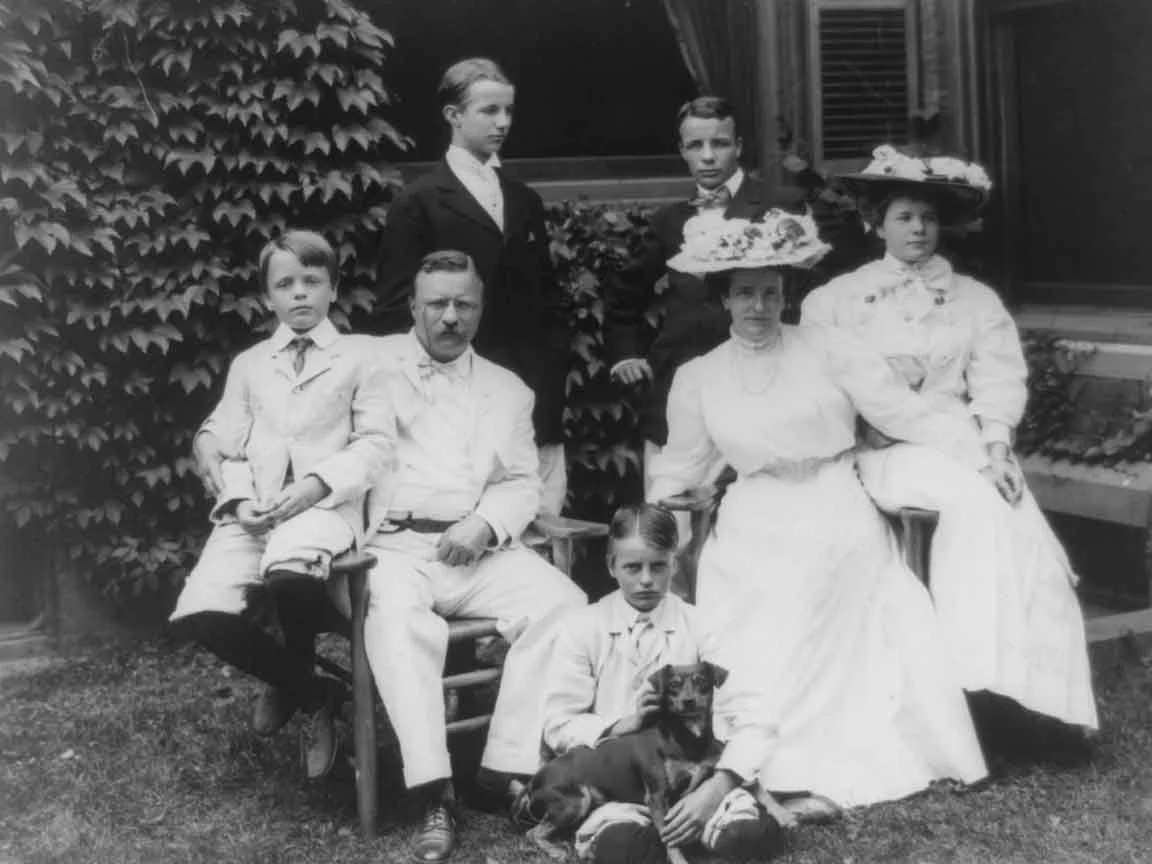
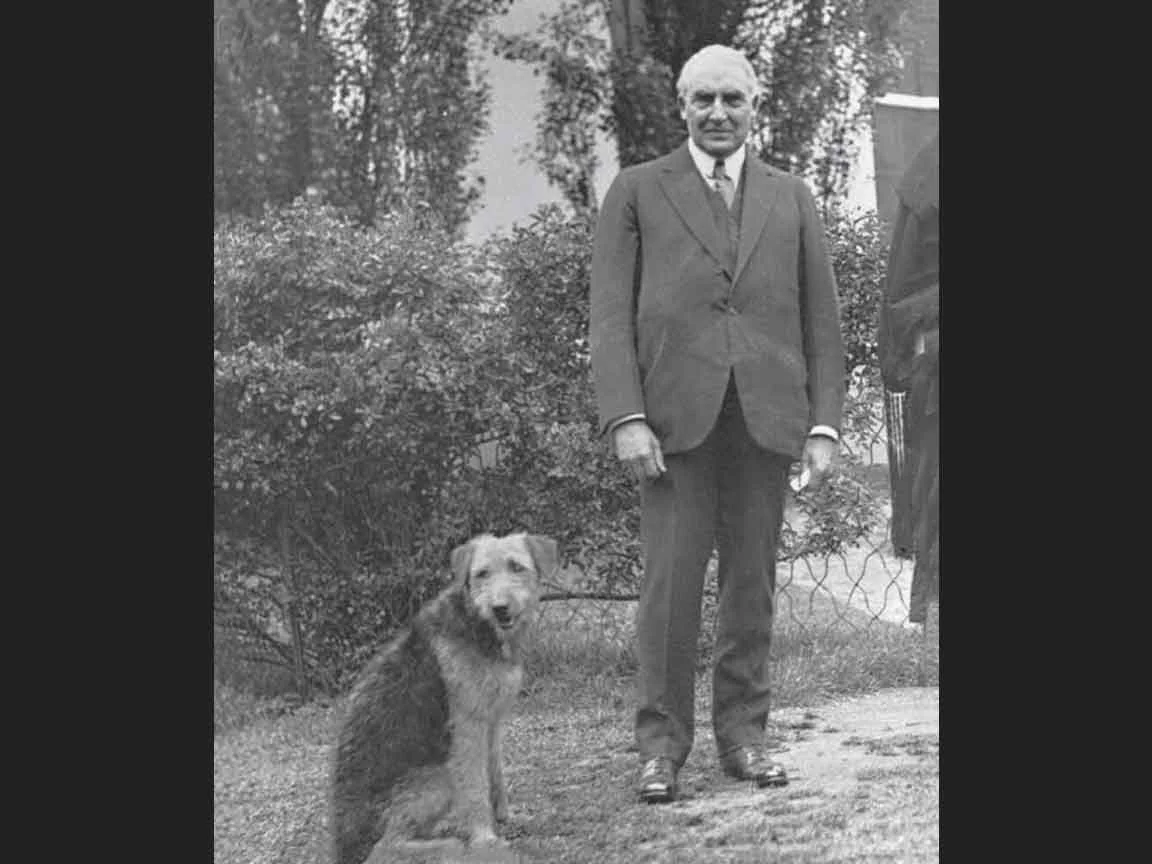
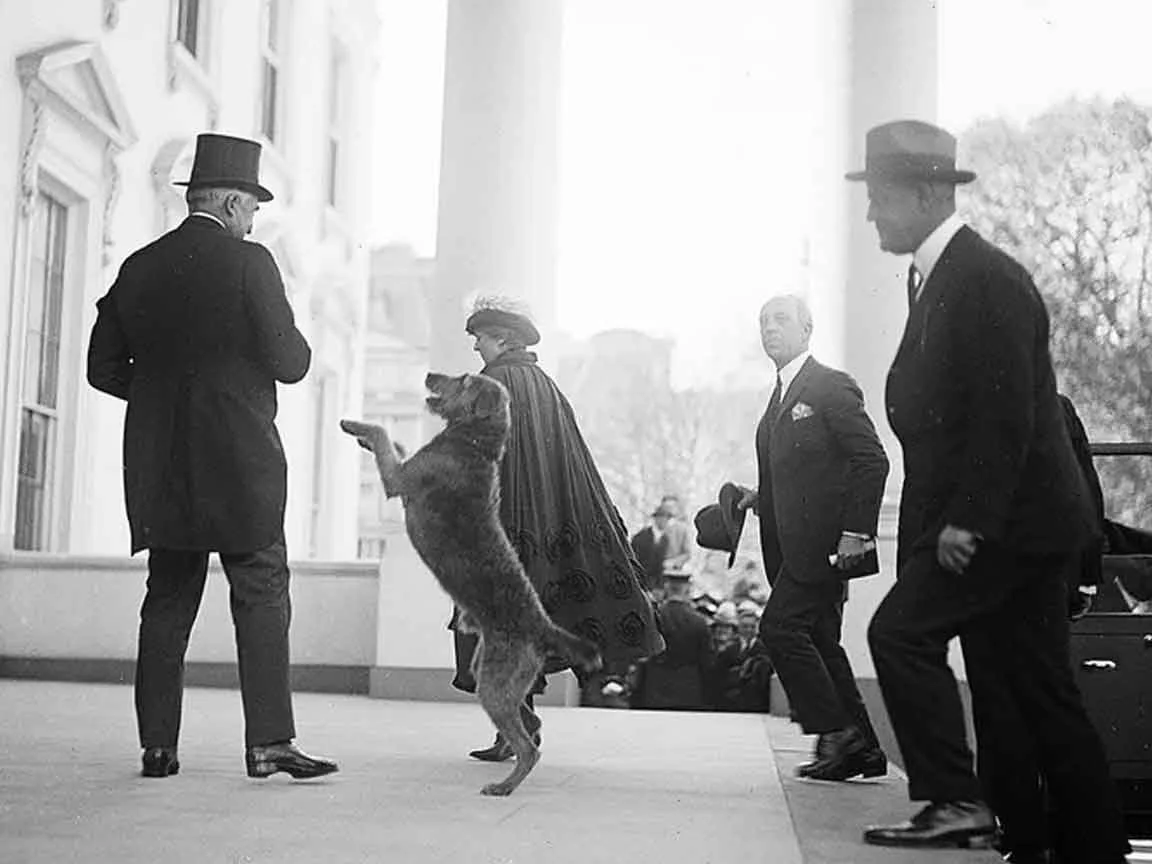
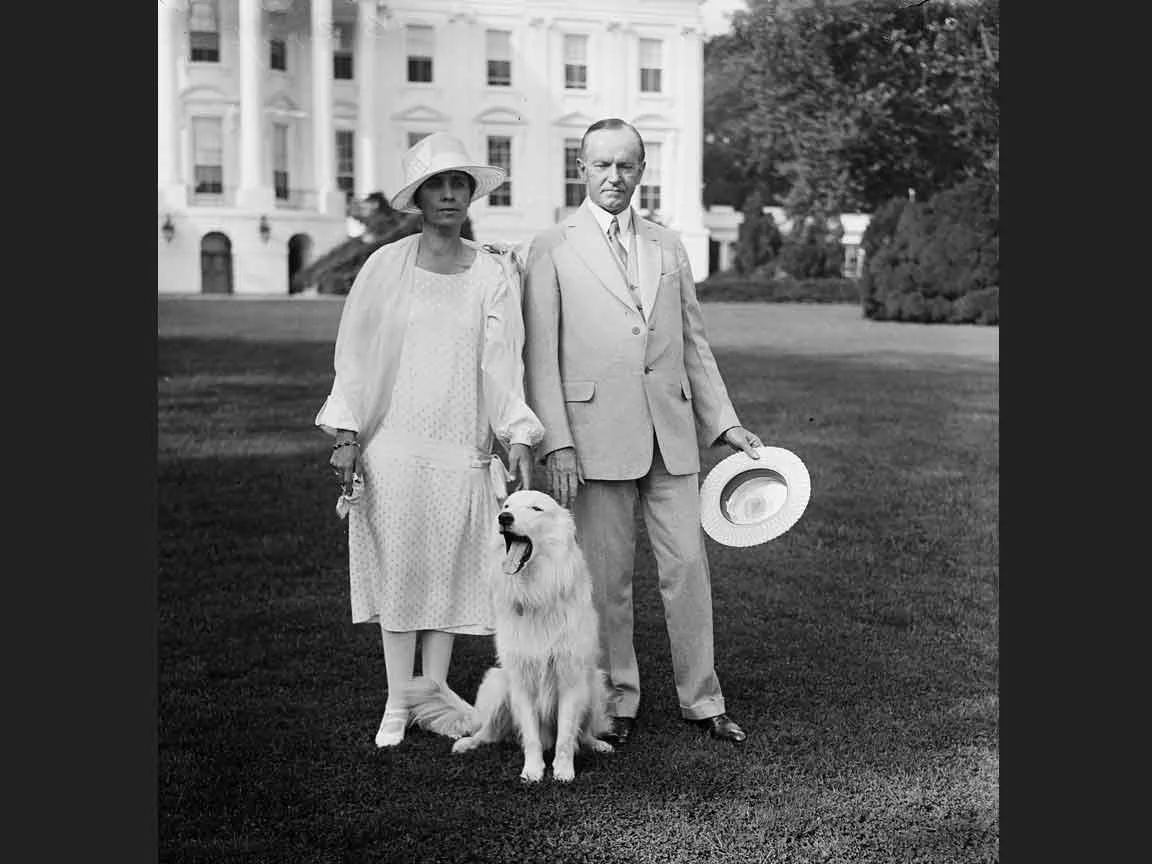
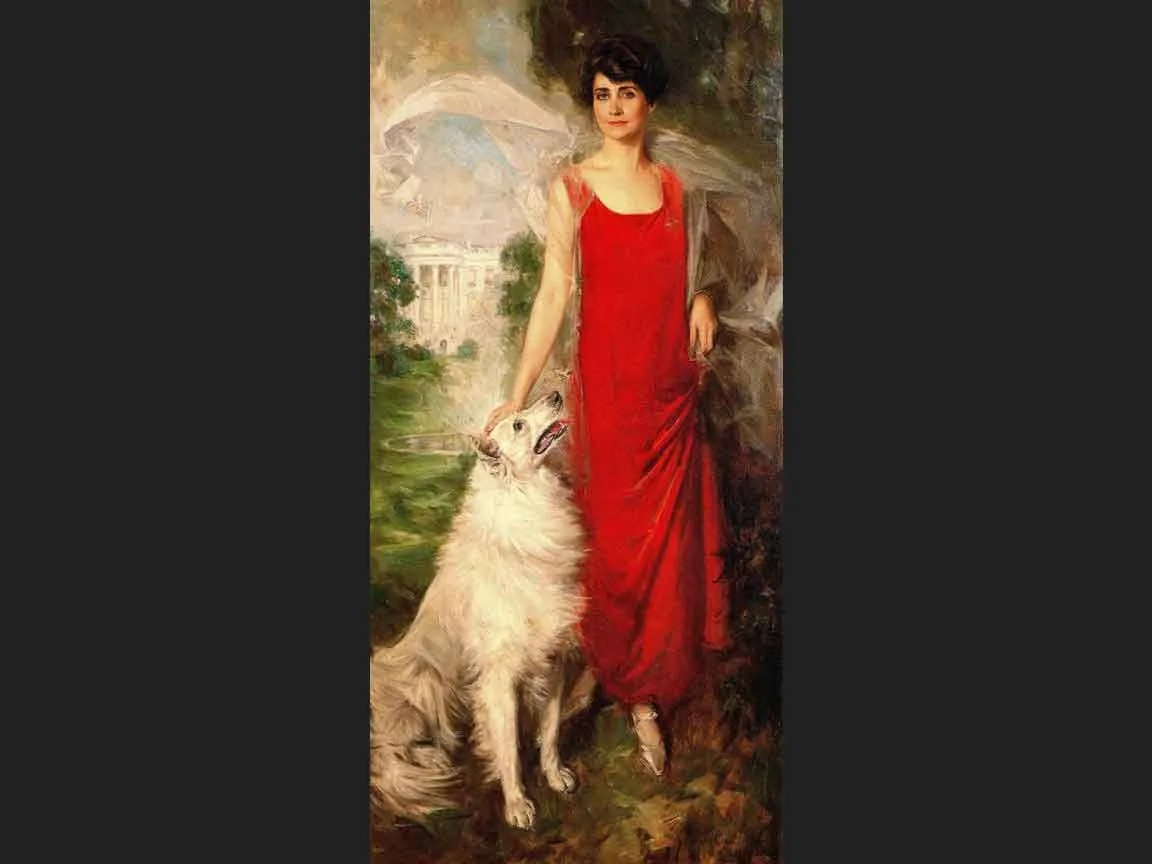
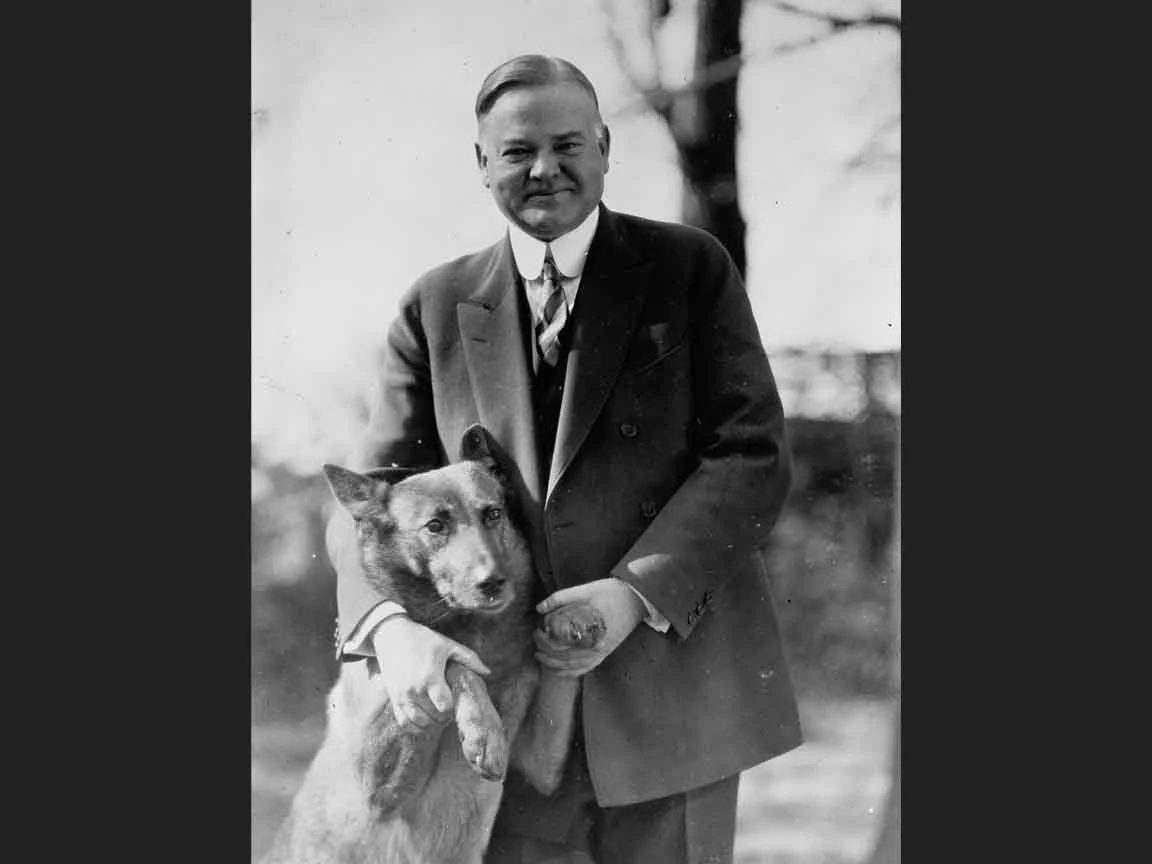
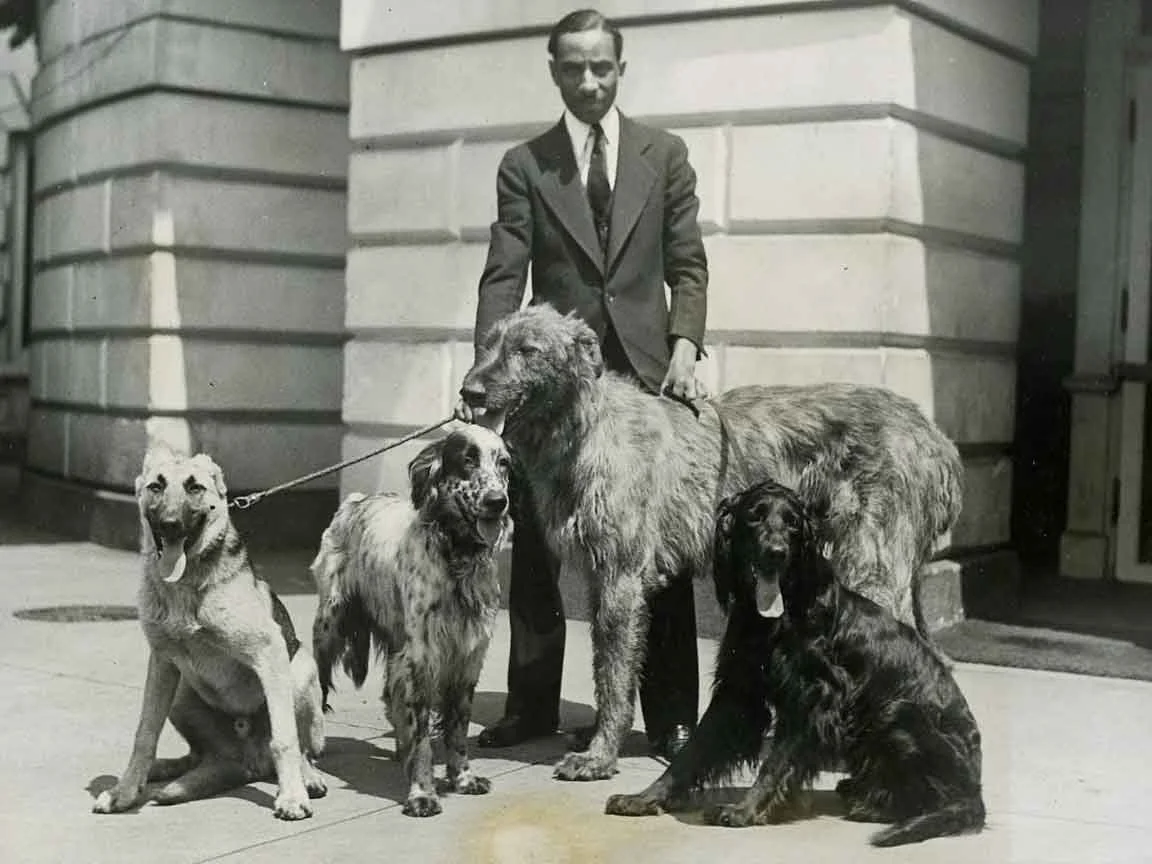
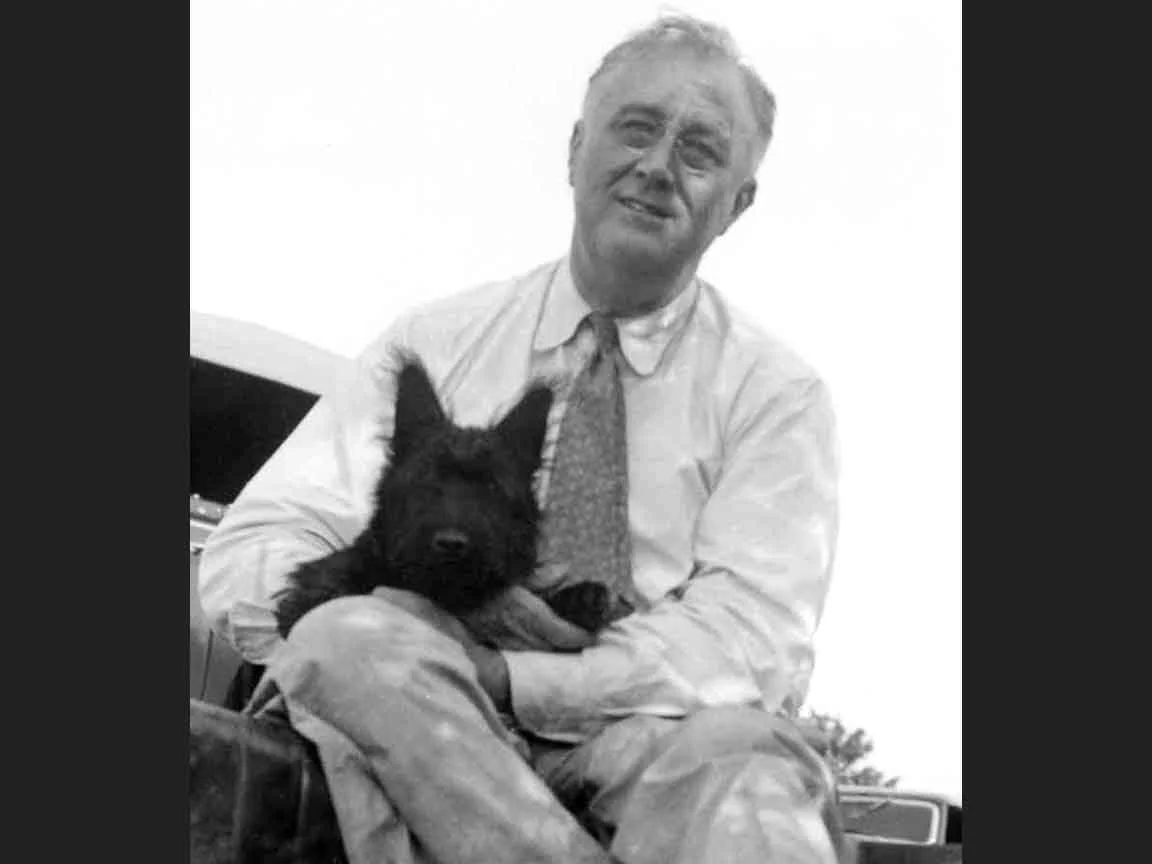
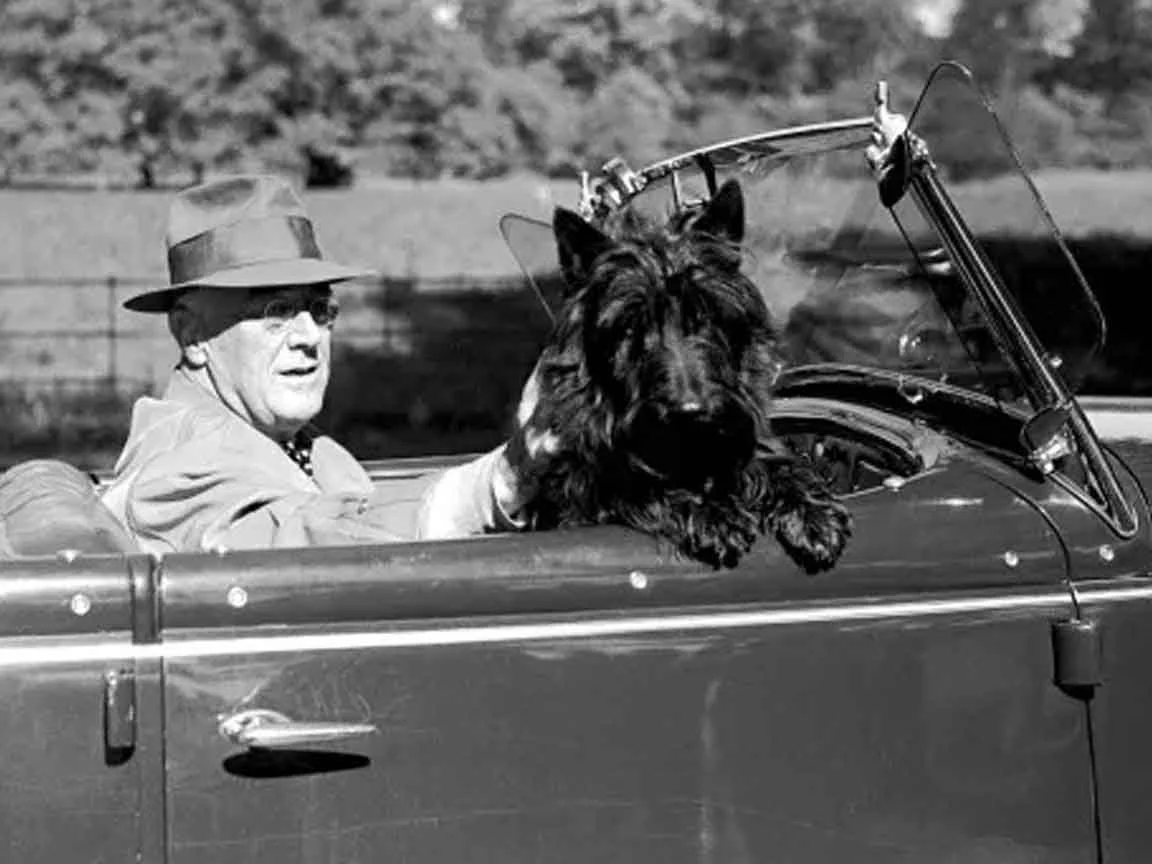
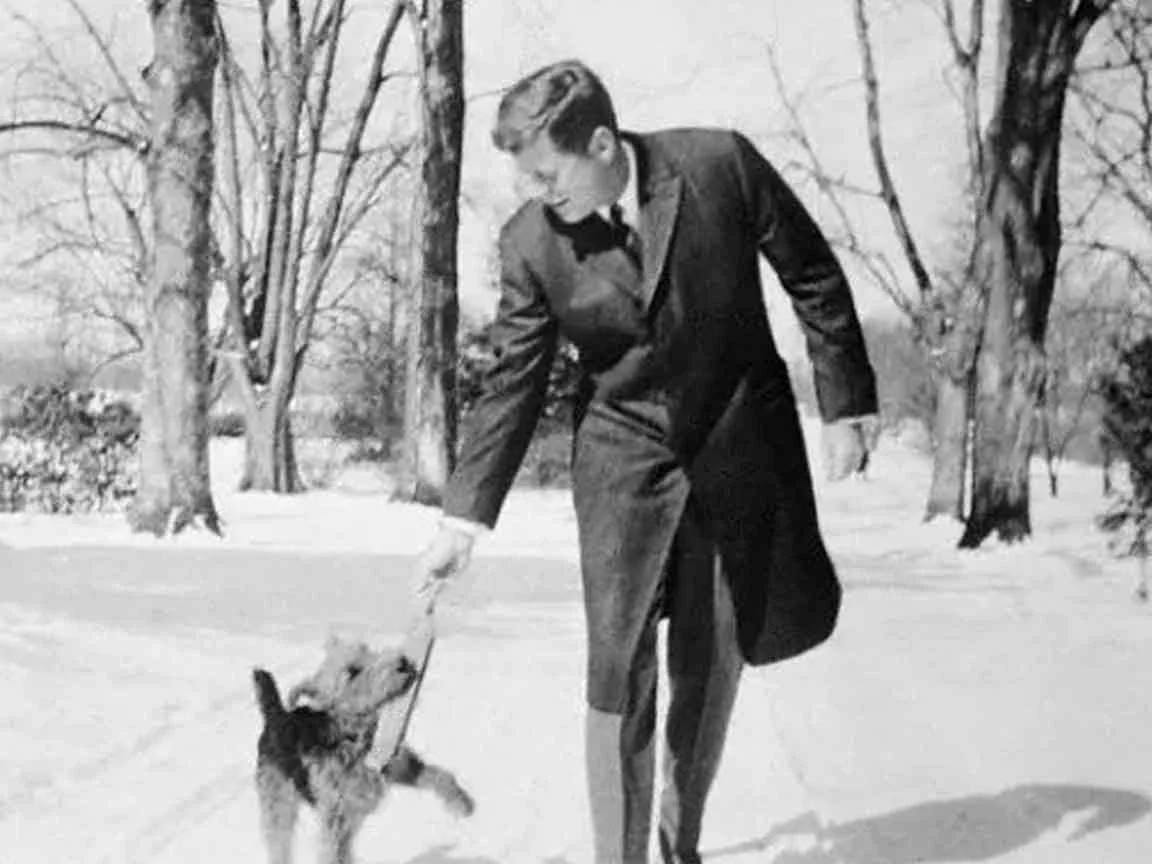


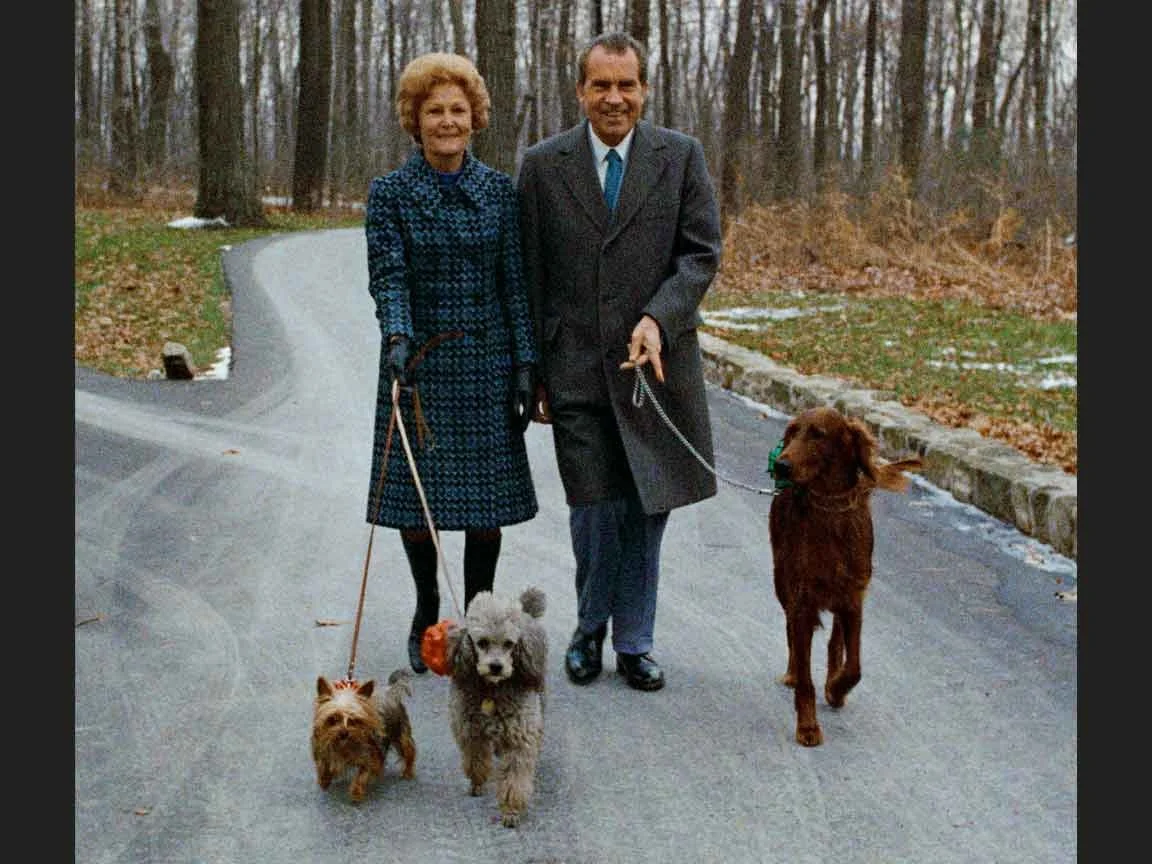
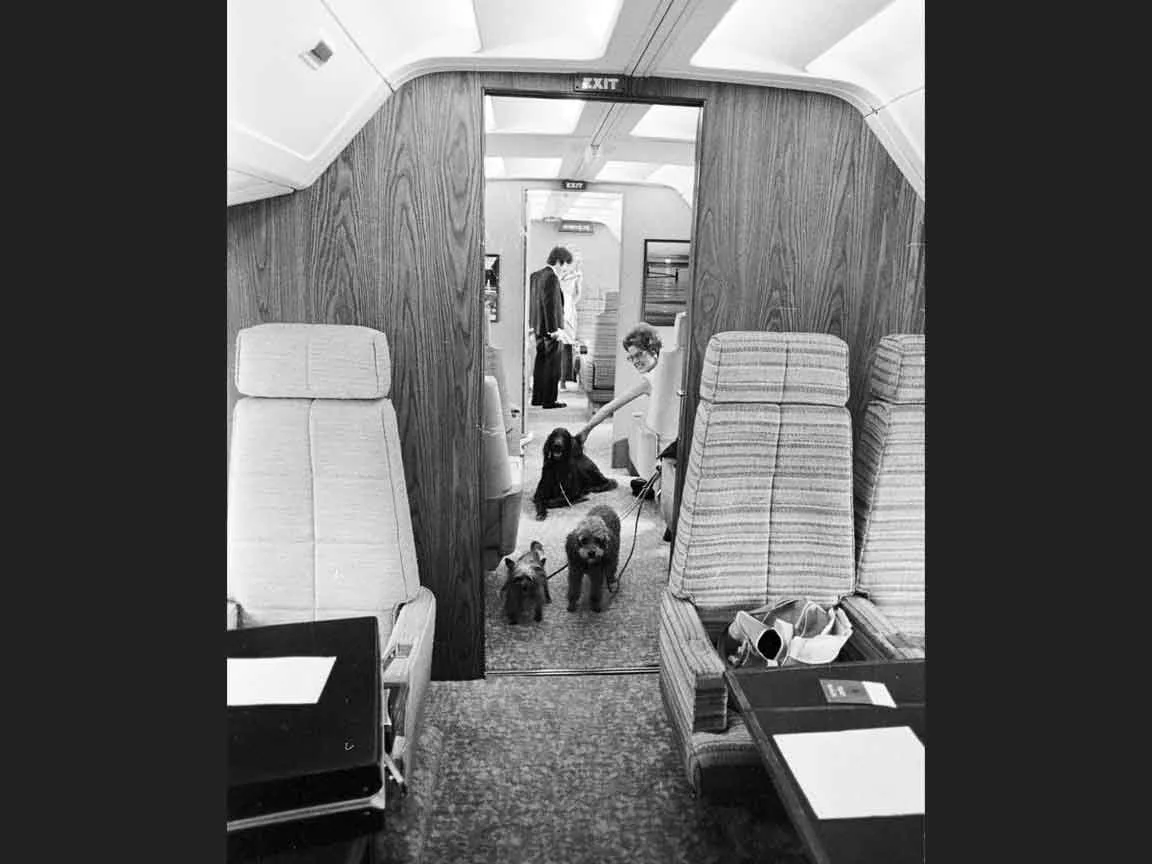
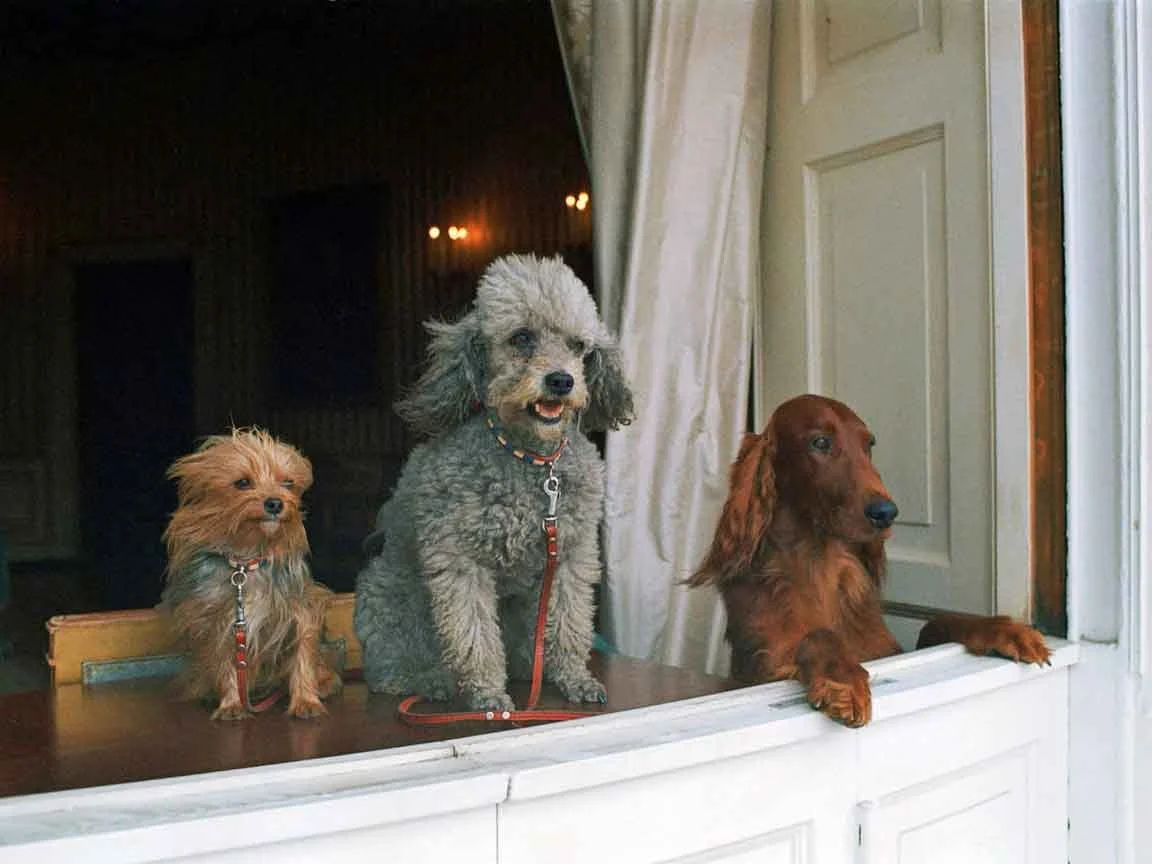
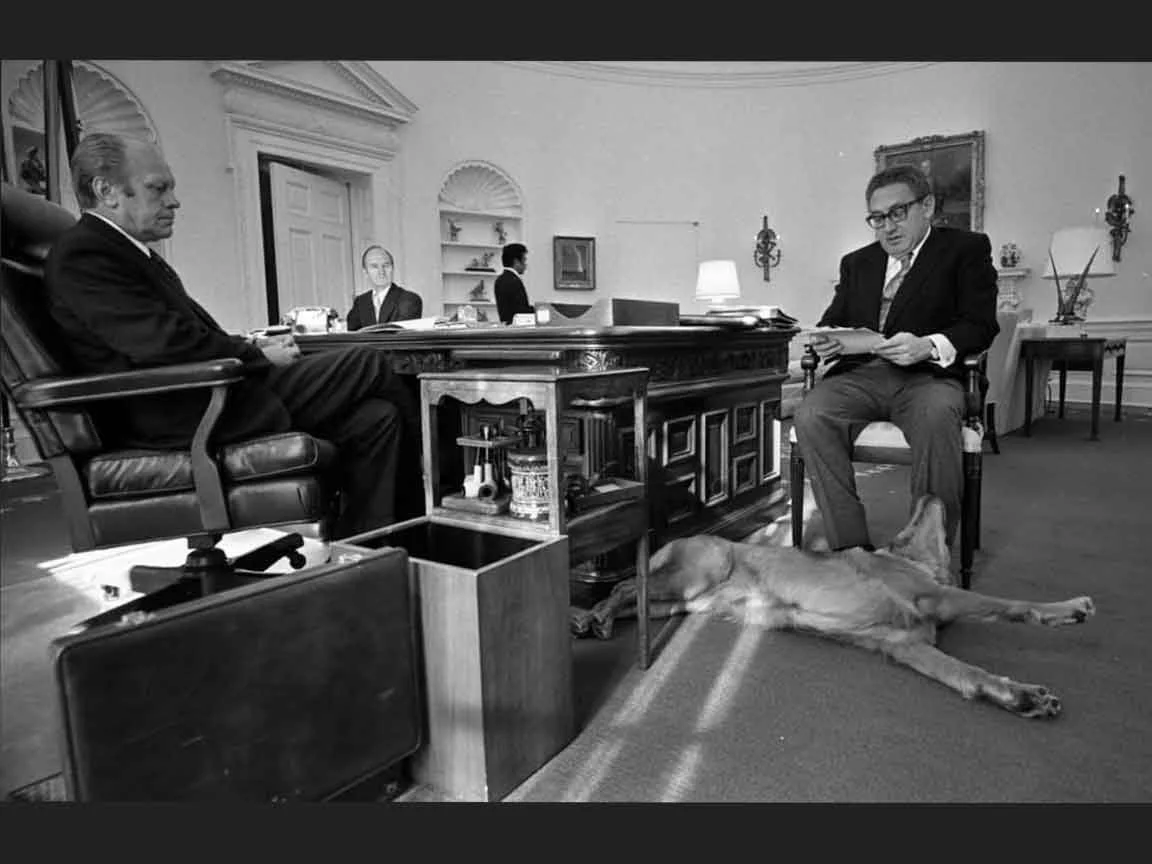
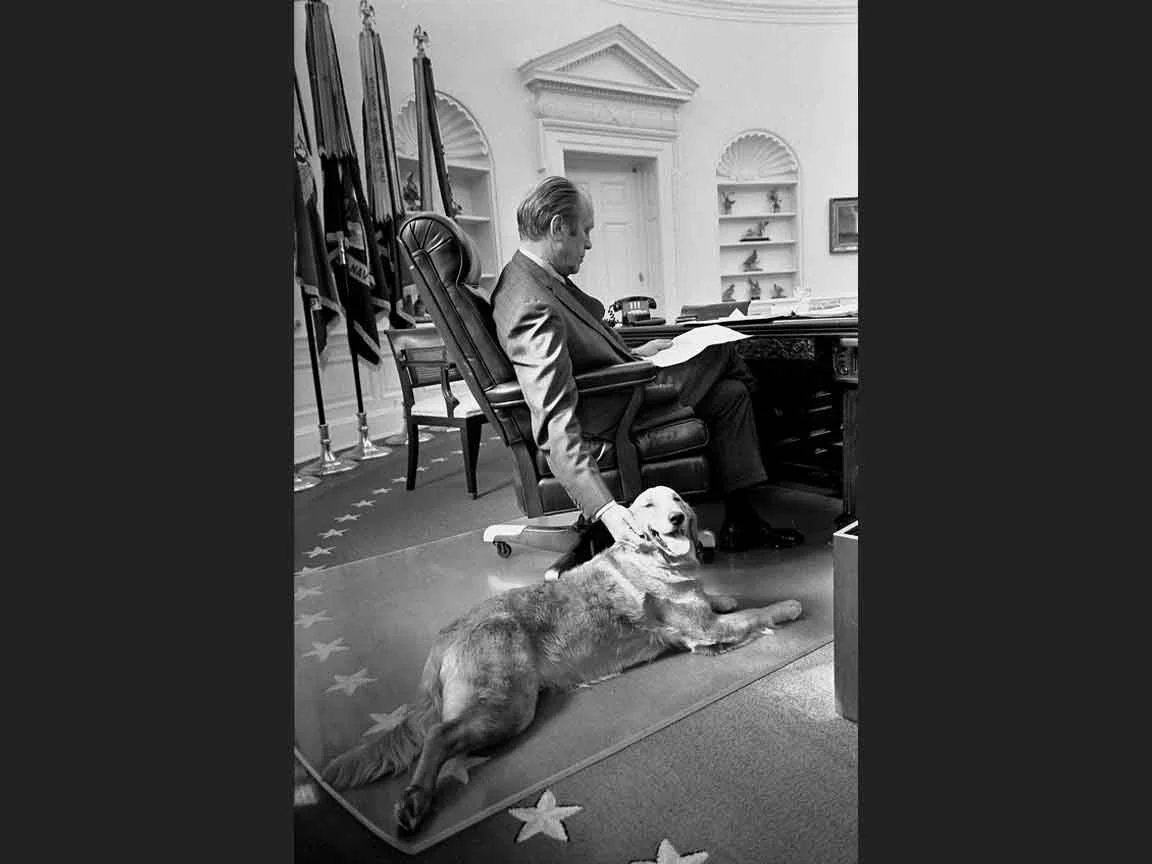
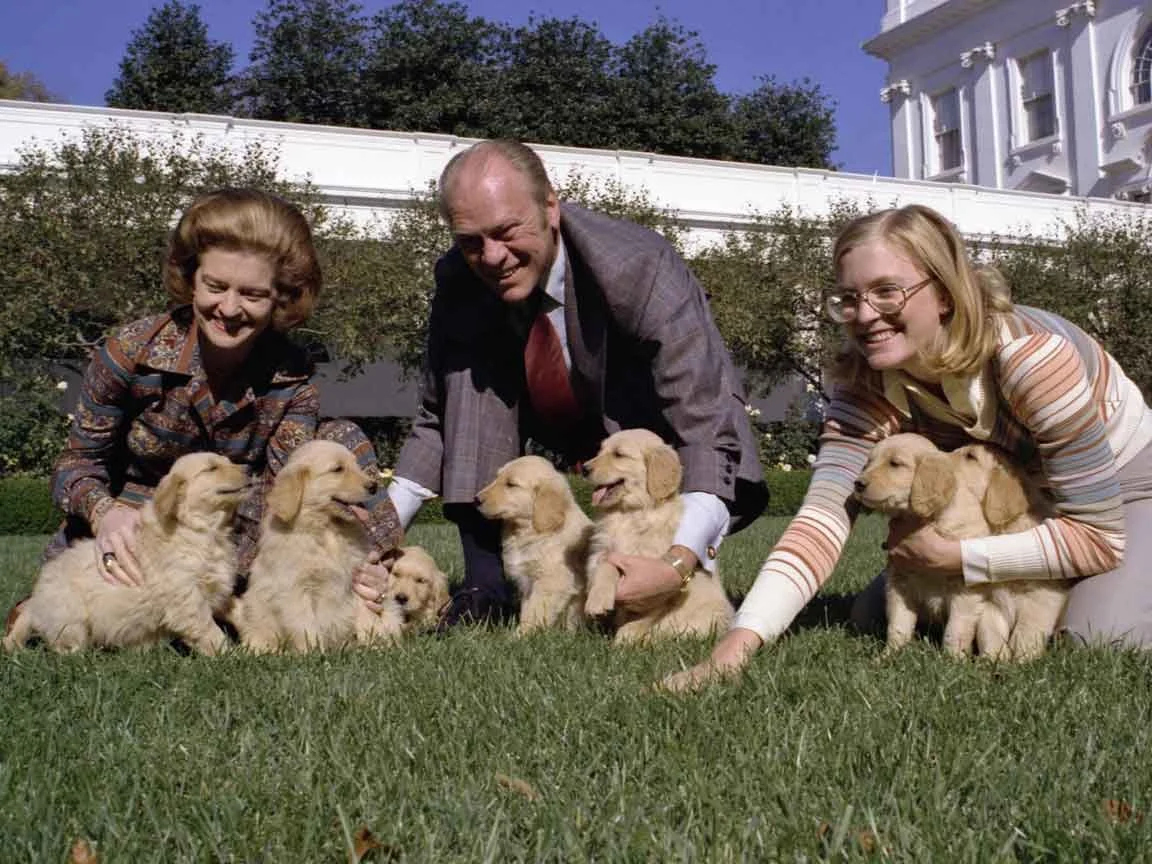
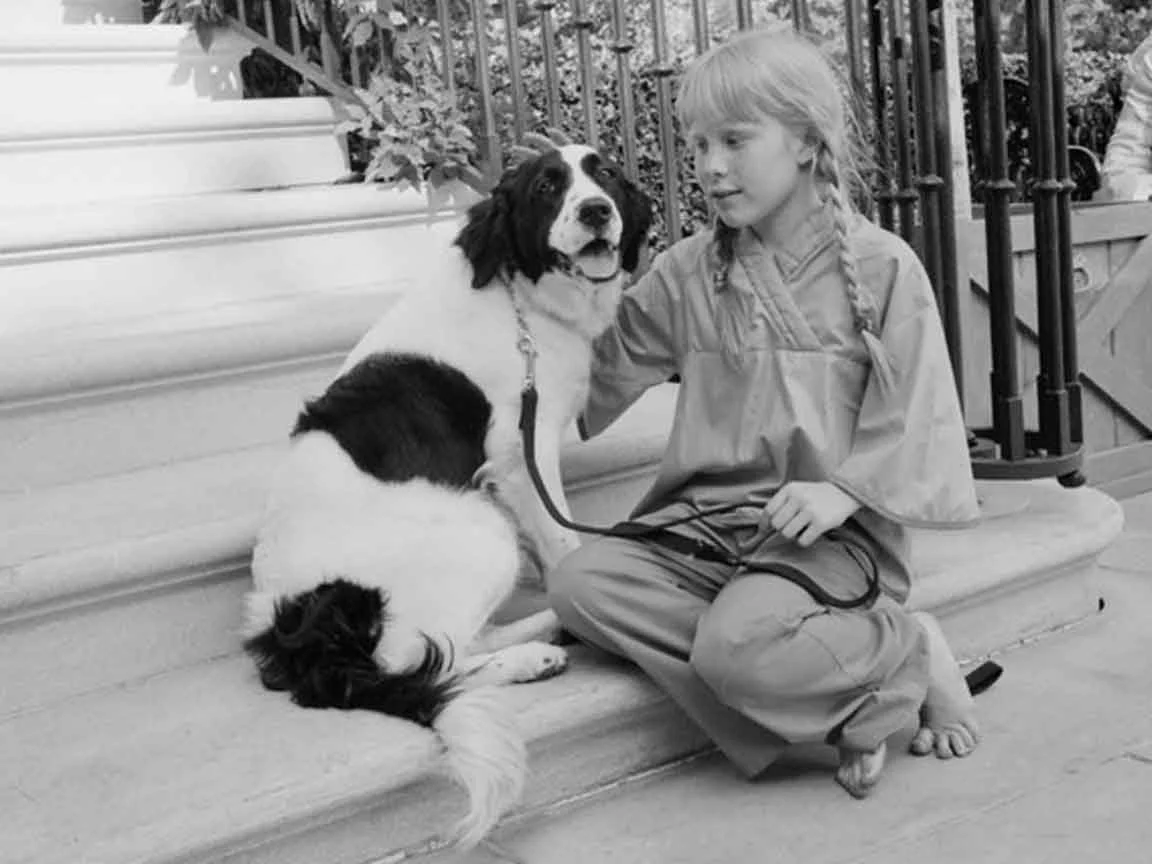
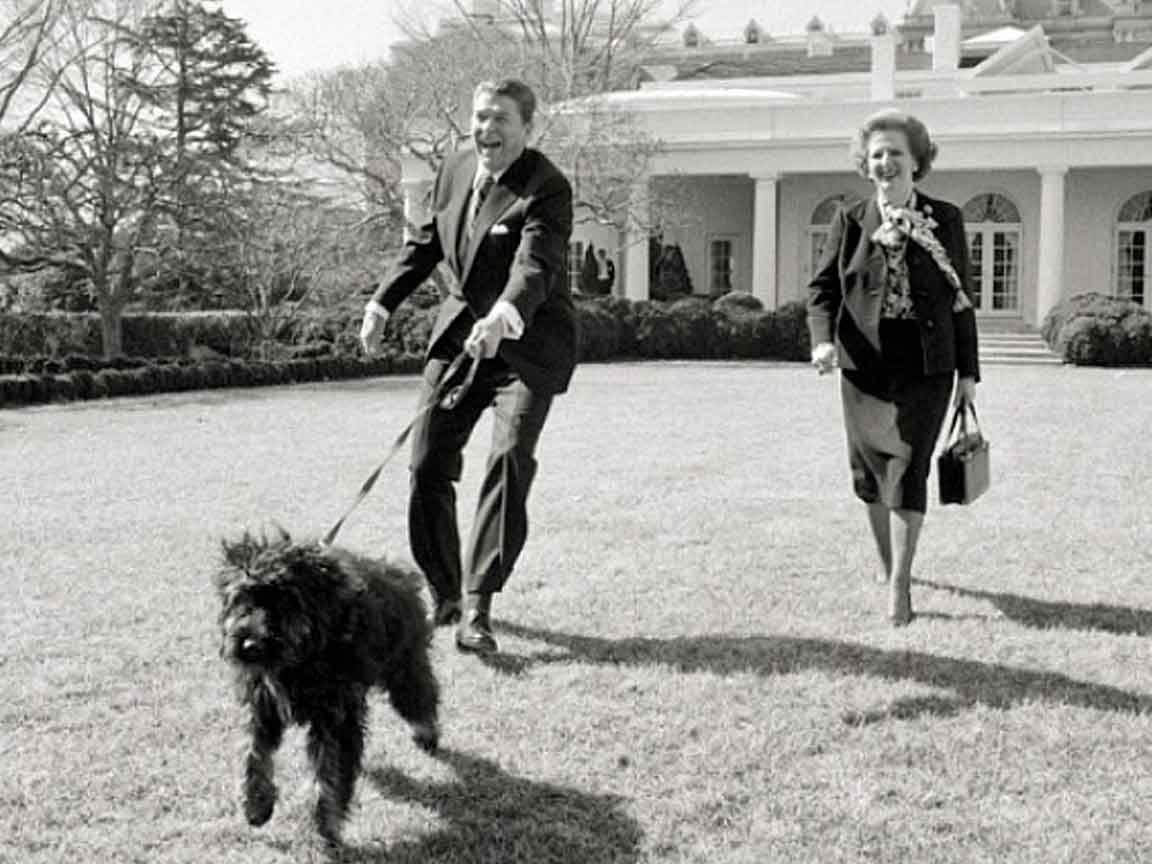
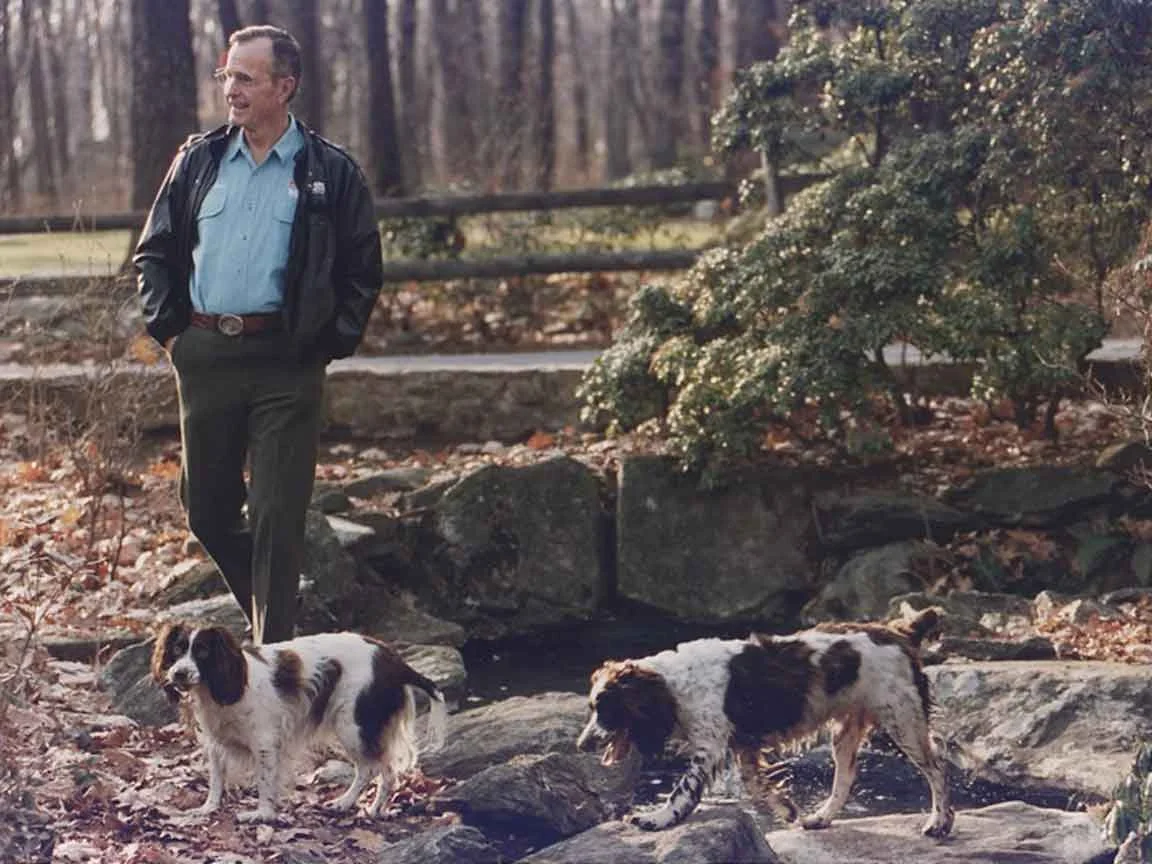
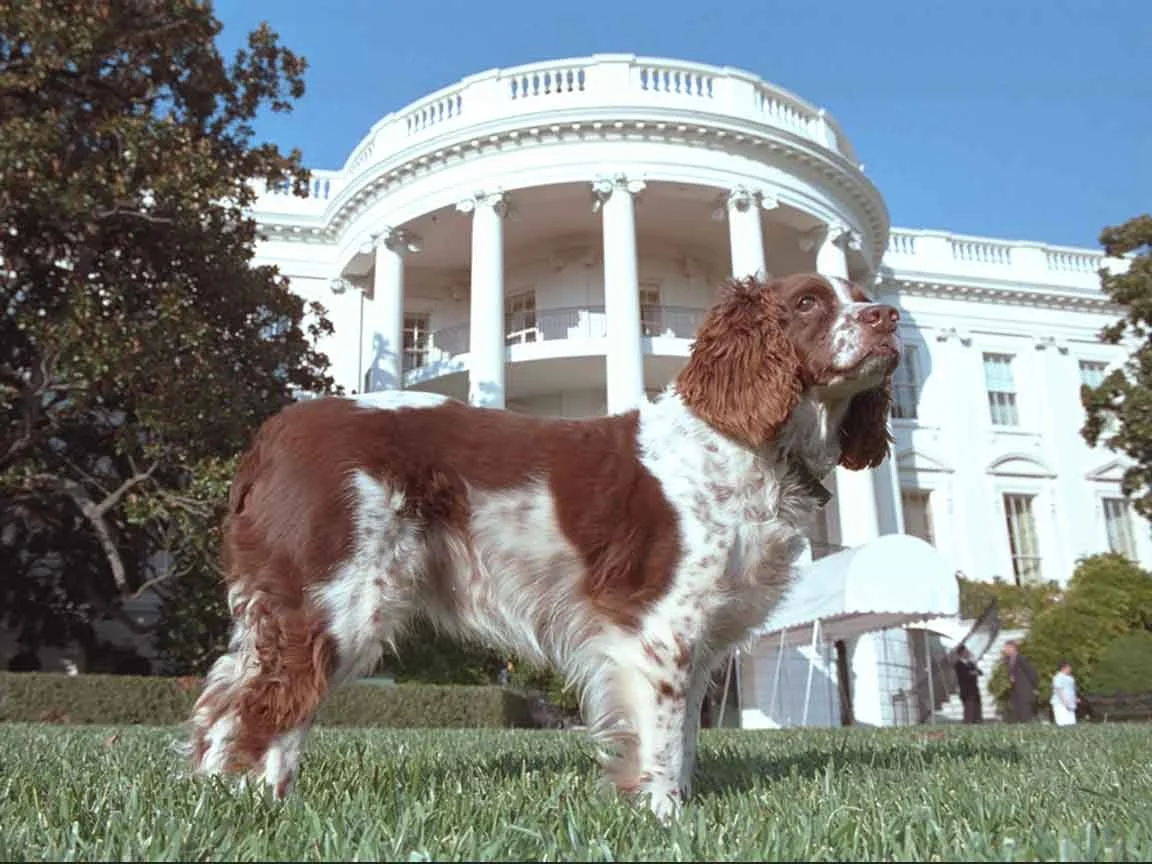
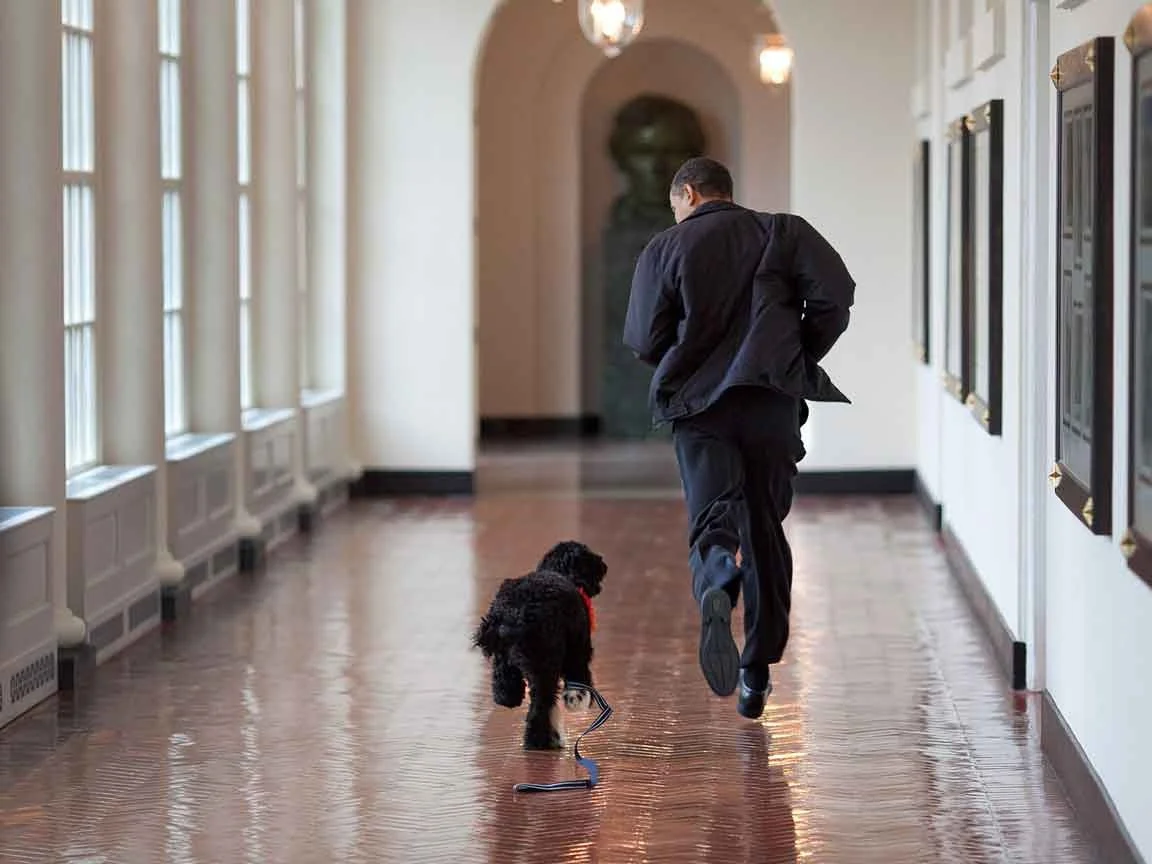
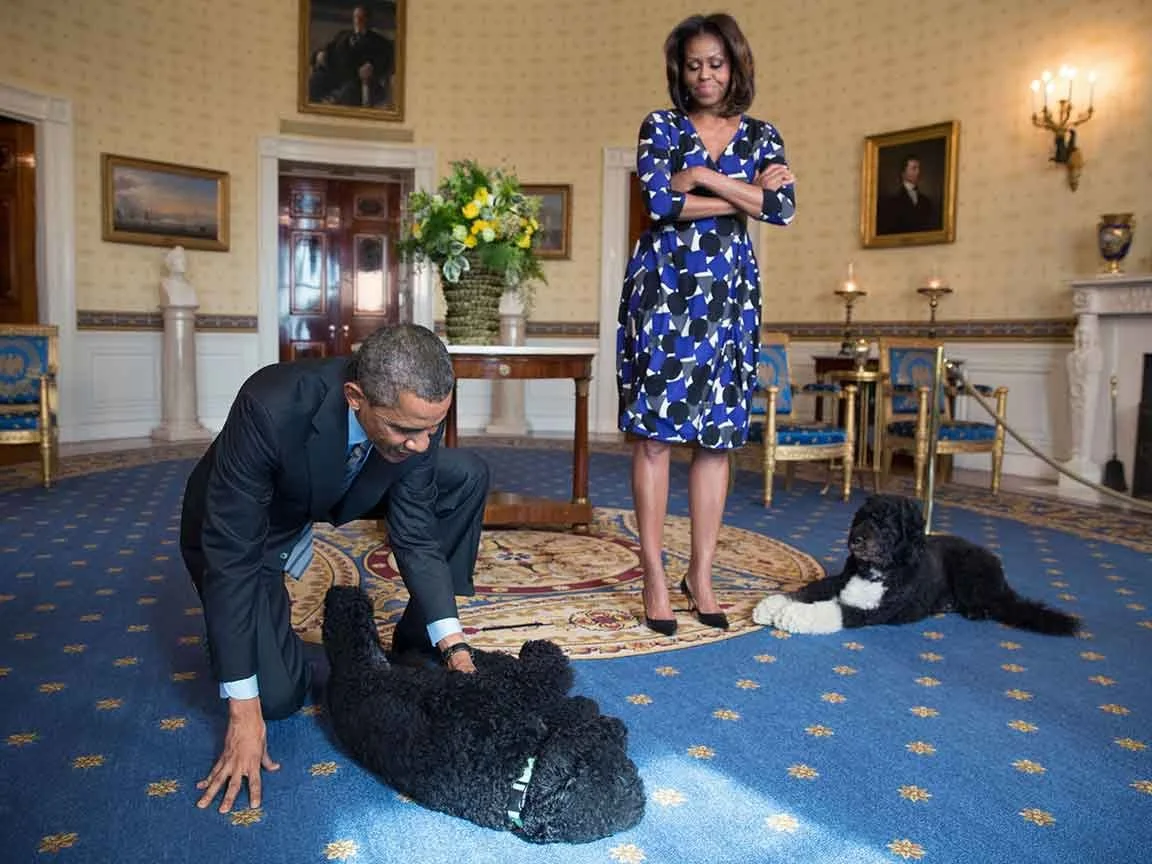

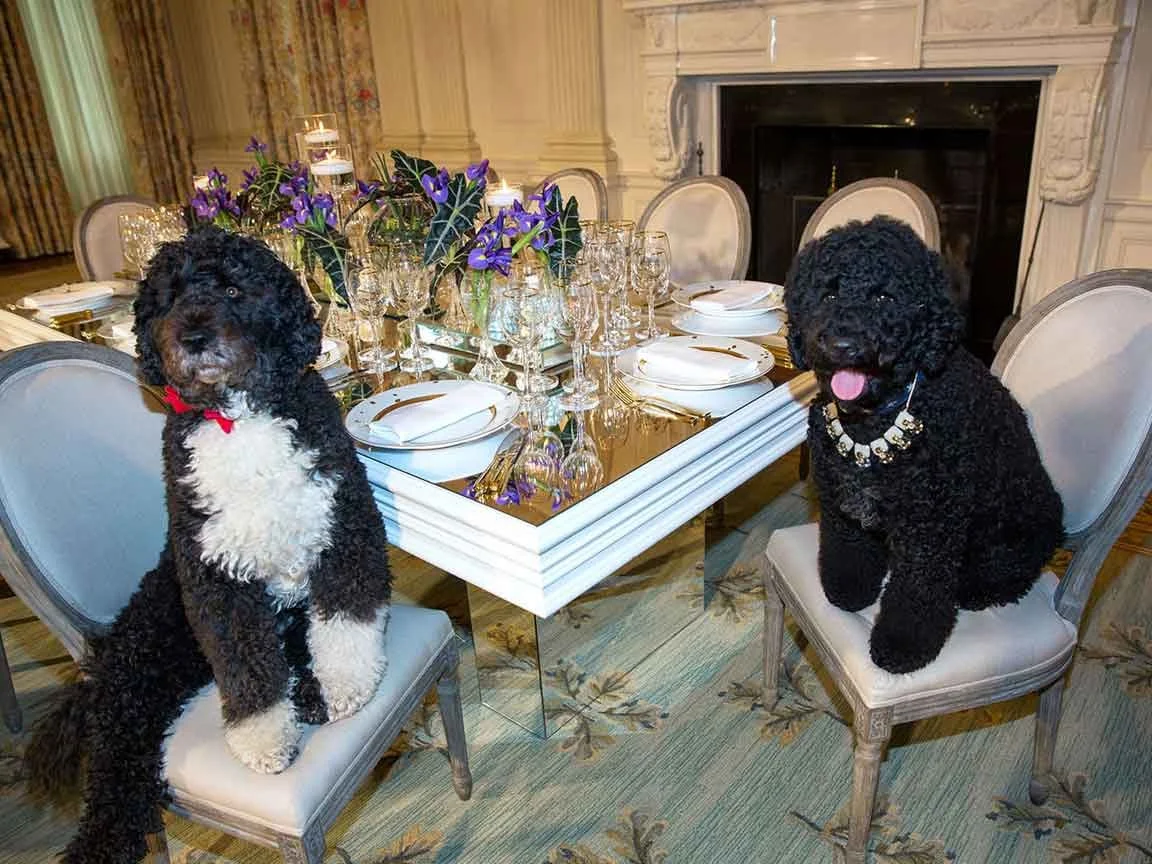
Gallery: A visual history of U.S. Presidents and their canine companions, from Washington’s American Foxhounds to Biden’s German shepherds. While not every president is pictured, this gallery of 50+ images offer a glimpse into the long tradition of dogs at the heart of American power.
Tails of Loyalty: Dogs at the Heart of American Power
If the American presidency is the world’s most scrutinised job, it follows that its pets live under a microscope too. For more than two centuries, dogs have padded alongside presidents, graced Christmas cards, crashed press briefings, and posed solemnly for portraits as if privy to state secrets. More than mascots, these “First Dogs” often played a role in shaping public perception, soothing weary statesmen, and offering a surprising form of diplomatic fur power. Their stories trace an alternative history of the White House. One told in muddy pawprints, slobbery tennis balls, and the occasional chewed piece of antique furniture.
President Franklin D. Roosevelt (FDR) with his 4 month old dog Fala at a picnic on Sunset Hill near Pine Plains, NY. FDR Presidential Library. Public domain
Papal Blessings: President Obama and First Lady Michelle Obama introduce Pope Francis to their dogs Bo and Sunny in the Blue Room of the White House, 2015. Photo by Pete Souza. Public domain
The Canine Companions of the Early Republic
While George Washington never lived in the White House, he set a precedent as a devoted dog owner. A breeder of foxhounds, he gave them genteel names like Sweet Lips and Drunkard, as if to reassure guests that his dogs, like his politics, balanced charm with disorder.
John Adams and Thomas Jefferson followed suit, but it was Abraham Lincoln whose dog Fido truly captured the public imagination. A mixed-breed with a sunny disposition, Fido was known around Springfield, Illinois, for trailing the future president to barbershops and general stores. Fido never made it to Washington, as Lincoln feared he wouldn’t survive the journey, but his story is symbolic of the president’s humanity. A photograph of Fido, lying on a blanket, was later distributed at Lincoln’s funeral in lieu of a formal mourning card (this photo can be seen in the gallery above).
In these early administrations, dogs were not yet publicised assets. They lived in the background, occasionally appearing in diary entries or letters. But even then, their presence humanised powerful men otherwise cast in marble.
Dogs in the Spotlight of a Growing Nation
As mass media evolved, so too did the public appetite for presidential pets. Theodore Roosevelt turned the White House into a veritable ark. His menagerie included guinea pigs, a badger, and numerous dogs. Among them was Pete, a feisty bull terrier who once tore the trousers off a French ambassador. Pete's bad behaviour was eventually too much for diplomacy; he was exiled from the grounds.
Yet Roosevelt’s dogs reinforced his image: vigorous, untameable, and quintessentially American. They embodied his Rough Rider persona in fur.
First film footage taken of Theodore Roosevelt at Sagamore Hill, in 1912. Seen riding his horse Sidar and playing with three of his dogs.
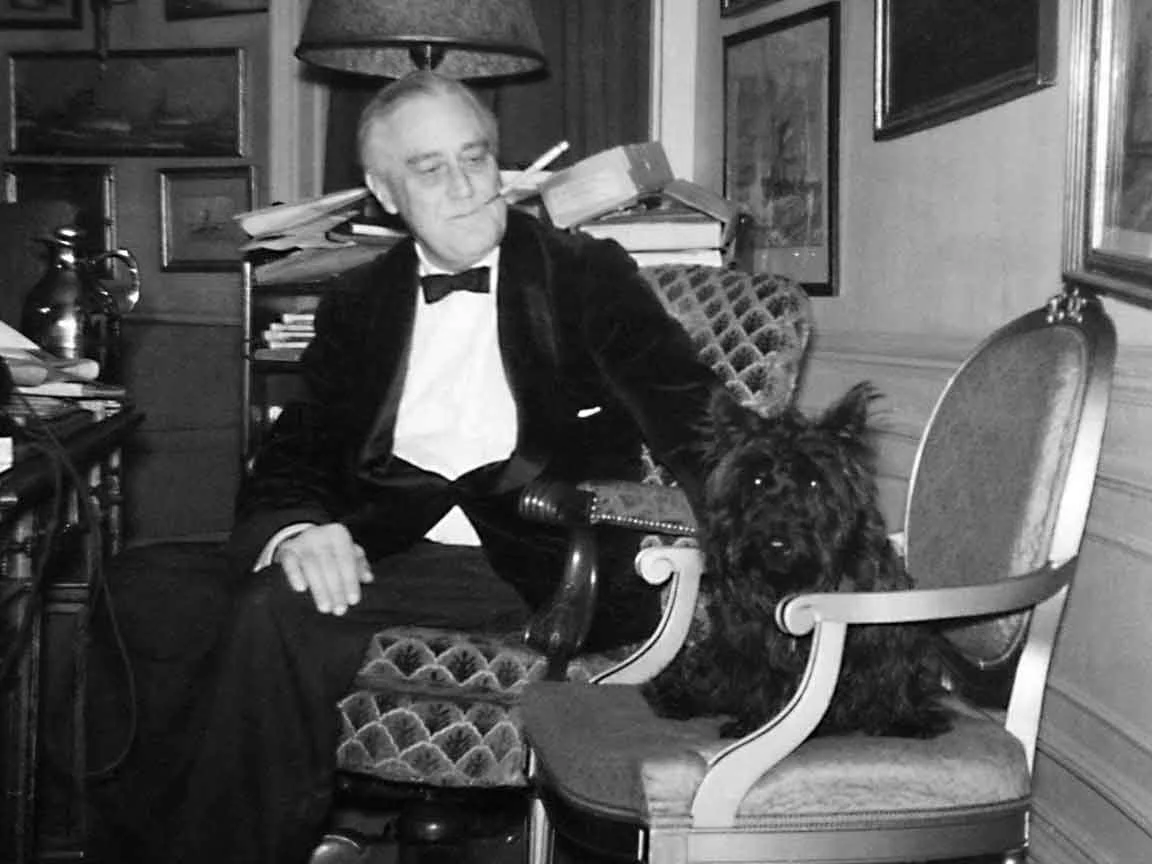
Fast forward to Franklin D. Roosevelt and the most politically significant dog in American history: Fala. A Scottish terrier with glossy black fur and keen eyes, Fala accompanied FDR on train journeys, sat in Cabinet meetings, and featured in wartime propaganda. When Republicans accused the president of using taxpayer money to retrieve Fala from the Aleutian Islands, Roosevelt struck back with the now-famous “Fala Speech”, delivered with the flourish of a showman:
"You can criticise me, my wife, and my family, but you can’t criticise my little dog. He’s Scottish, and all these allegations about spending all this money have just made his little soul furious."
The speech, delivered with perfect timing during the 1944 campaign, delighted audiences and defused criticism. It was perhaps the only time a dog helped win a presidential election.
President Franklin D. Roosevelt shares a quiet moment with his Scottish Terrier, Fala, in the White House Study. FDR Library. Public domain
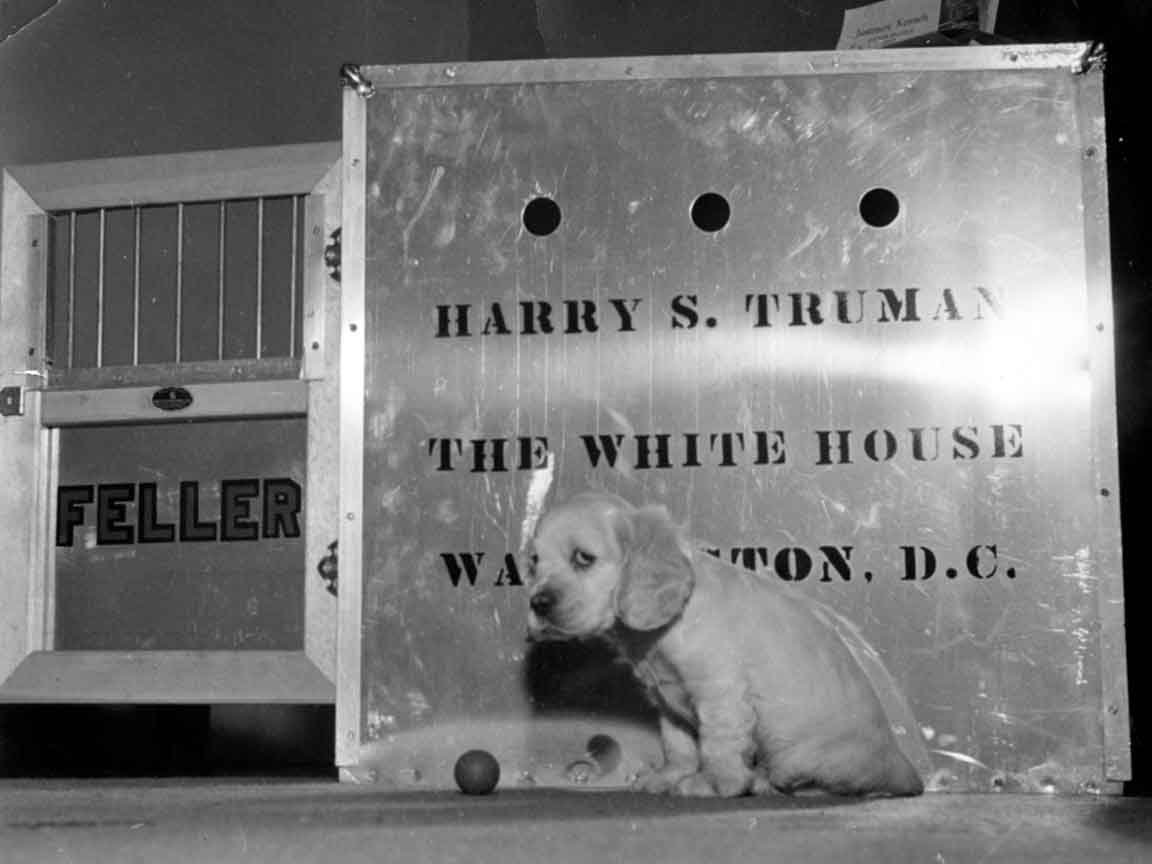
Feller, a cocker spaniel gifted to President Harry S. Truman. Who declined to keep him. The U.S. National Archives. Public domain
Harry S. Truman, famously less sentimental, once remarked, “If you want a friend in Washington, get a dog”. Ironically, he did have dogs, though they were mostly gifts, returned or rehomed. The quote stuck, and Truman became an unwitting advocate for canine companionship.
First Dogs in the Age of Broadcast
With the arrival of television and 24-hour news cycles, First Dogs became visible actors in political theatre.
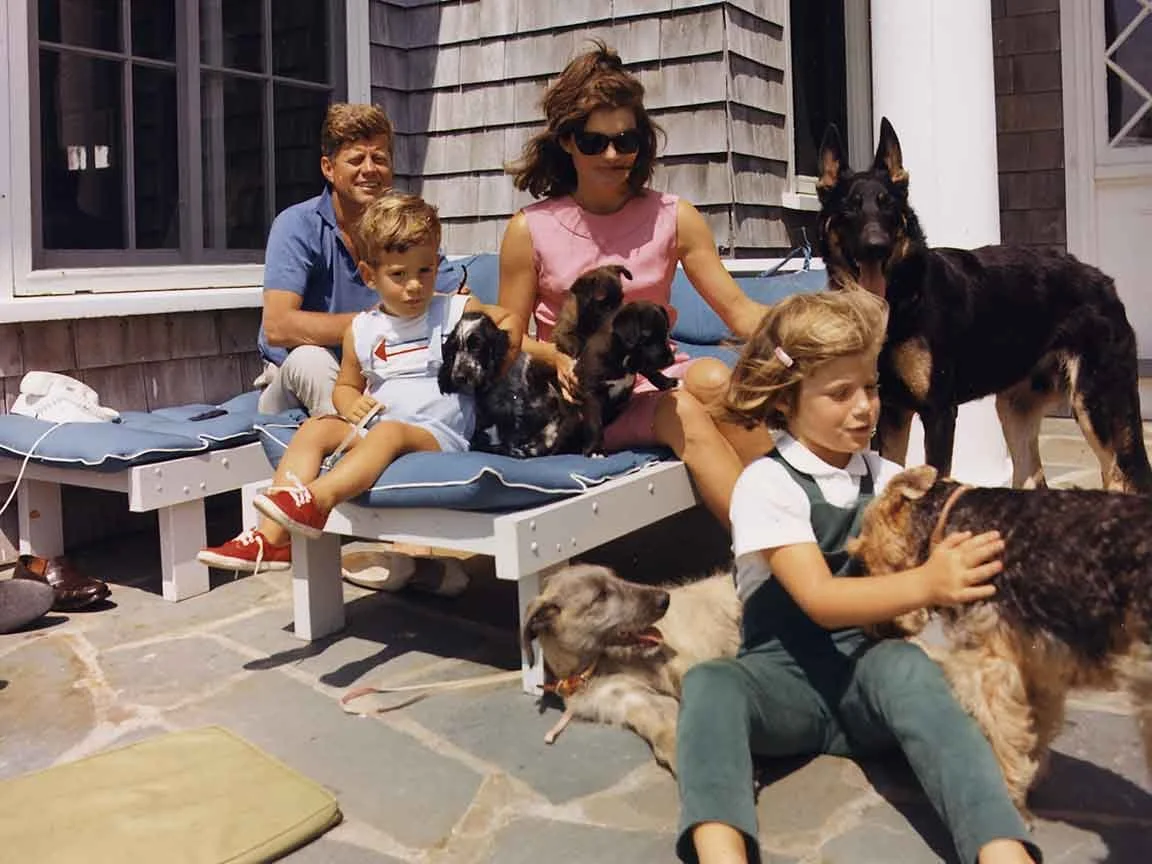
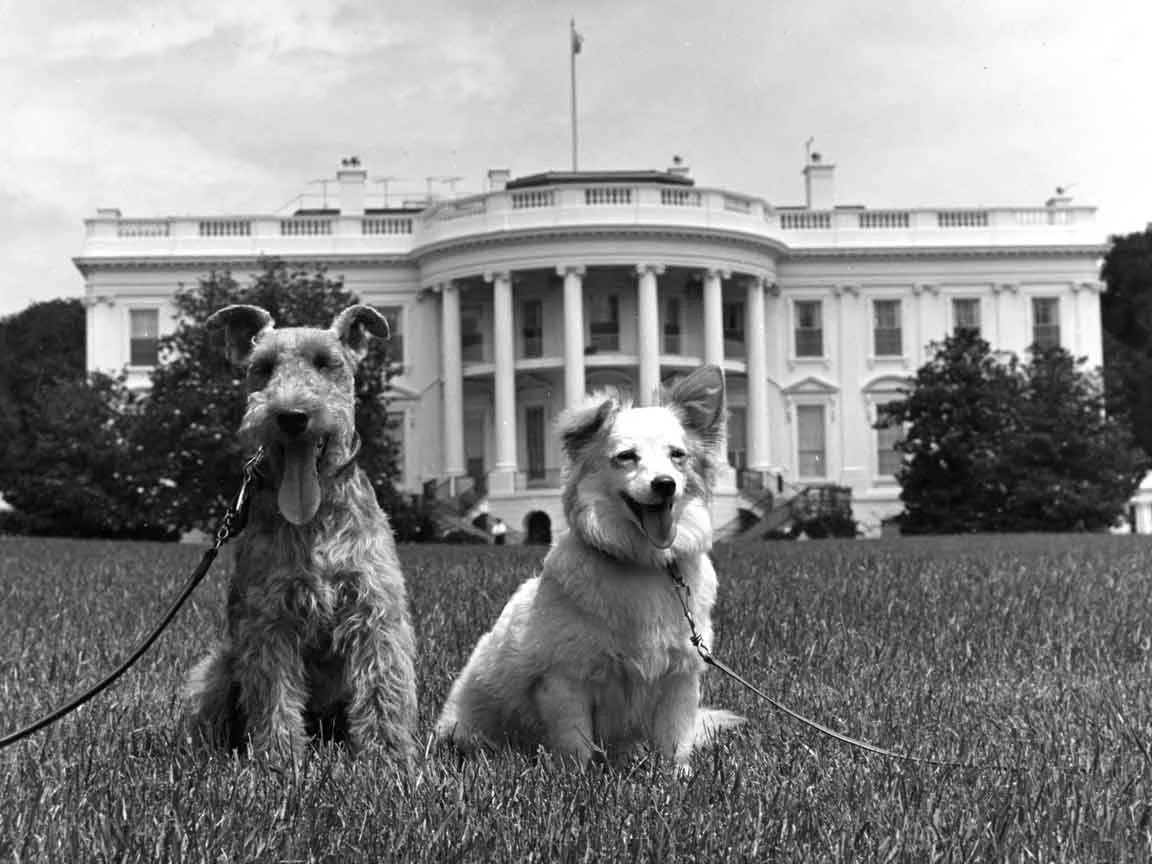
John F. Kennedy’s White House was a canine cacophony. The Kennedys owned a Welsh terrier named Charlie, a German shepherd, and famously, Pushinka, a small white mutt given to them by Soviet Premier Nikita Khrushchev. Pushinka was the daughter of Strelka, one of the first dogs sent into space. Her arrival at the height of the Cold War was laden with symbolic charm. She later mated with Charlie, producing what the press dubbed “pupniks.”
President John F. Kennedy’s dogs Charlie a Welsh terrier (left) and Pushinka a mixed breed on the White House's south lawn, 1961. U.S. National Archives. Public domain
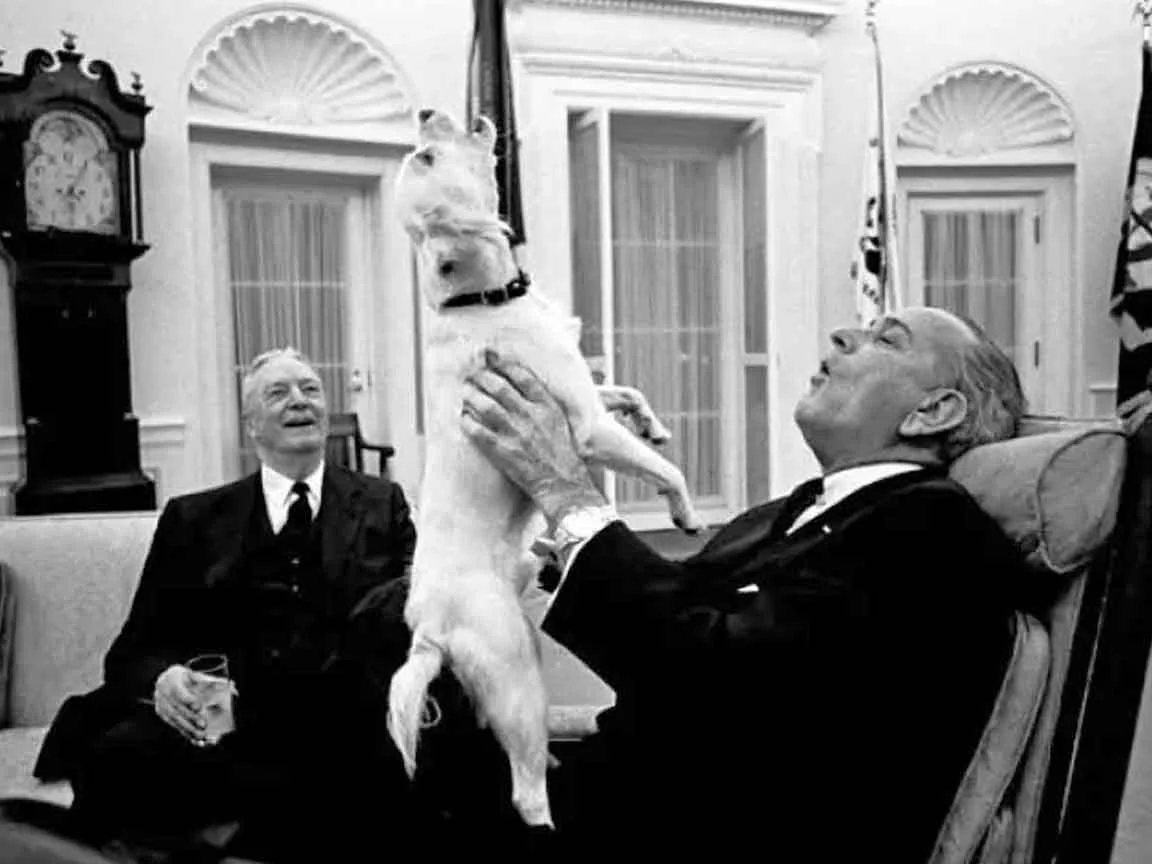
Lyndon B. Johnson, in contrast, found himself in the doghouse, publicly, when he was photographed lifting one of his beagles, Him, by the ears. He insisted the dog liked it. The public disagreed. Still, Johnson was fond of his dogs, and named them Him and Her, a reflection, perhaps, of his uniquely blunt style.
Richard Nixon, ever image-conscious, used his cocker spaniel Checkers to emotional effect in a televised address that came to define a political archetype. Accused of misusing campaign funds, Nixon spoke directly to the camera in what became known as the “Checkers Speech”. He swore he wouldn’t give back one gift, his daughters dog, Checkers.
“I don’t care what they say about it,” he declared. “We’re going to keep it.”
Checkers became the patron saint of embattled political pets, illustrating once again how dogs could soften even the stiffest reputations.
President Johnson lifting his beagle Him by his ears, 1964. Photo by Yoichi Okamoto. Public domain
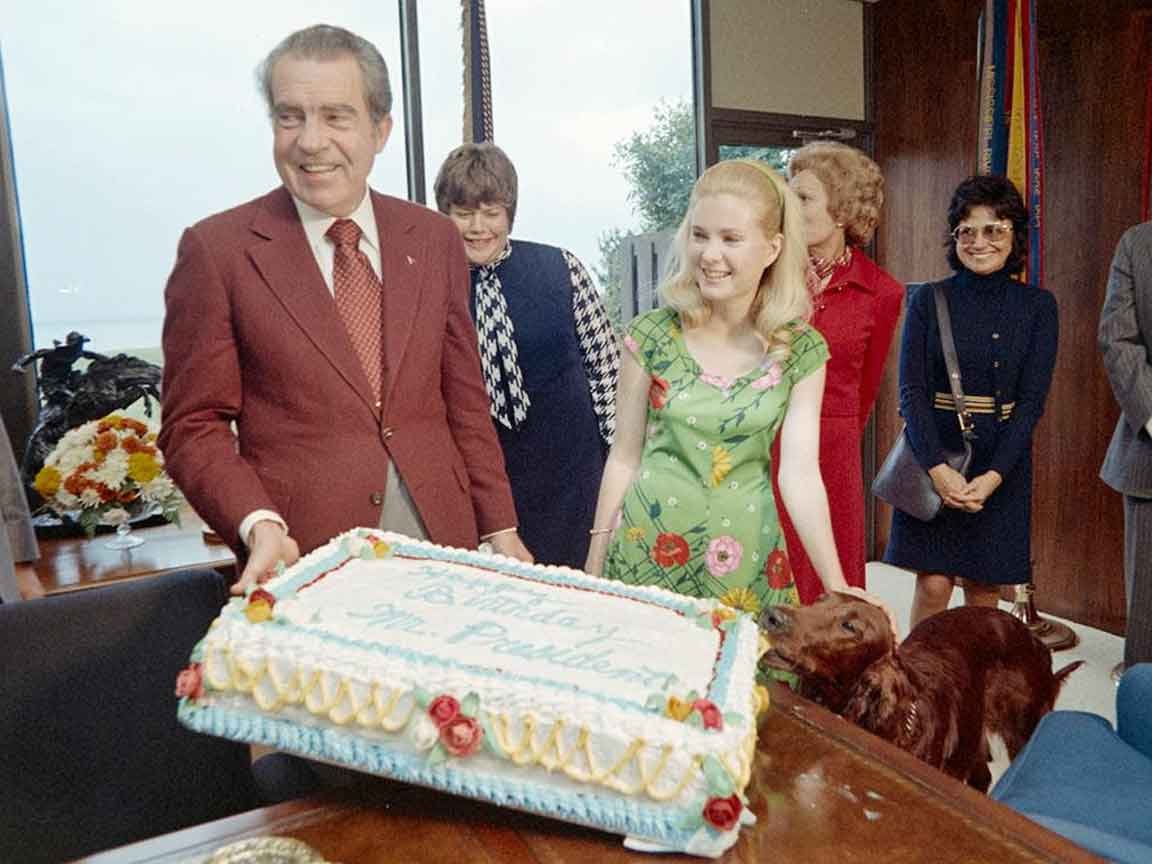
President Nixon admires his 61st birthday cake at the Western White House as does his dog King Timahoe who eats a piece. Public domain. Watch the video
Dogs as Presidential Brand Ambassadors
By the 1980s and 1990s, dogs had become extensions of presidential branding. Ronald Reagan’s Cavalier King Charles spaniel, Rex, was well-groomed and media-ready, just like his owner. The Reagans even built a small replica of the White House for Rex to play in on the South Lawn.
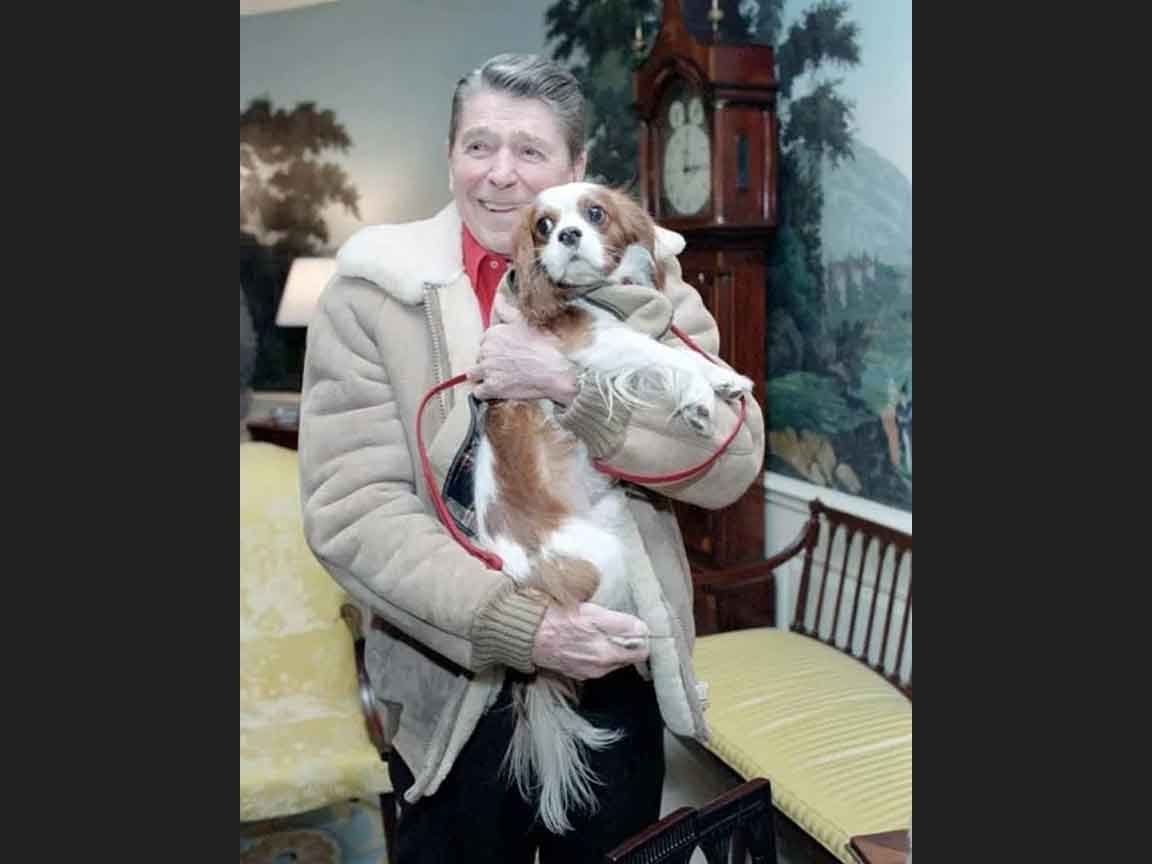
President Ronald Reagan holds his Cavalier King Charles Spaniel, Rex, in his arms in the White House. Public domain
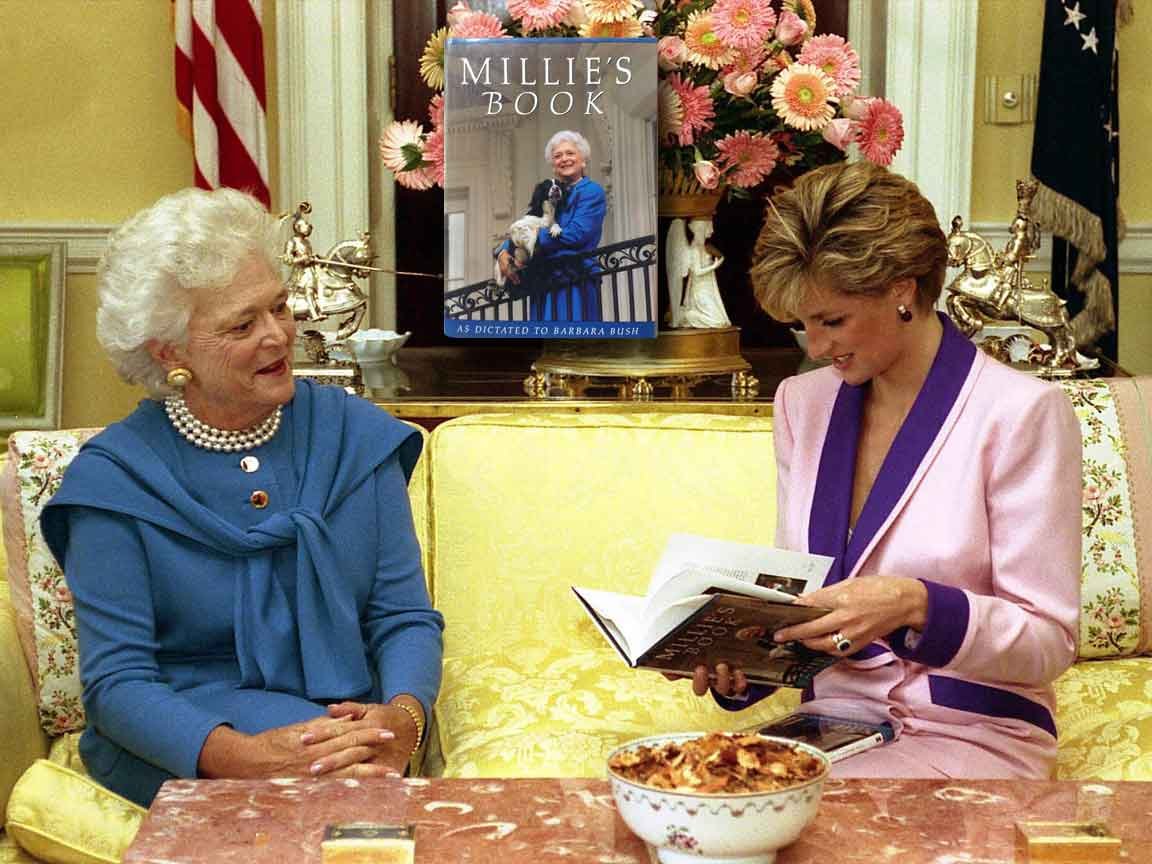
First Lady Barbara Bush presents Millie’s Book, her dog’s best-selling tale, to Princess Diana in the Yellow Oval Room. George Bush Presidential Library. Public domain
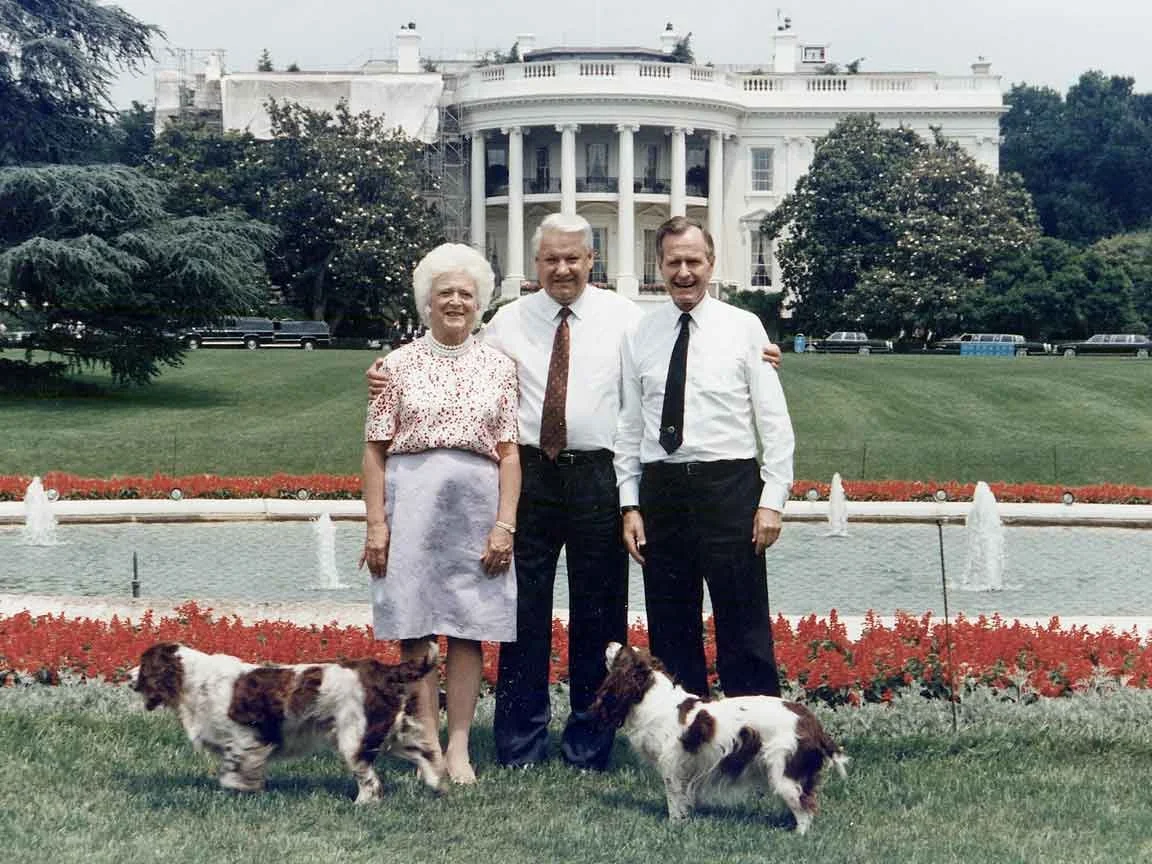
George H. W. Bush’s English springer spaniel, Millie, had a literary career. Her 1990 book Millie’s Book (ghostwritten by First Lady Barbara Bush) became a New York Times bestseller. In it, Millie narrated the goings-on at 1600 Pennsylvania Avenue with gentle wit and bipartisan grace.
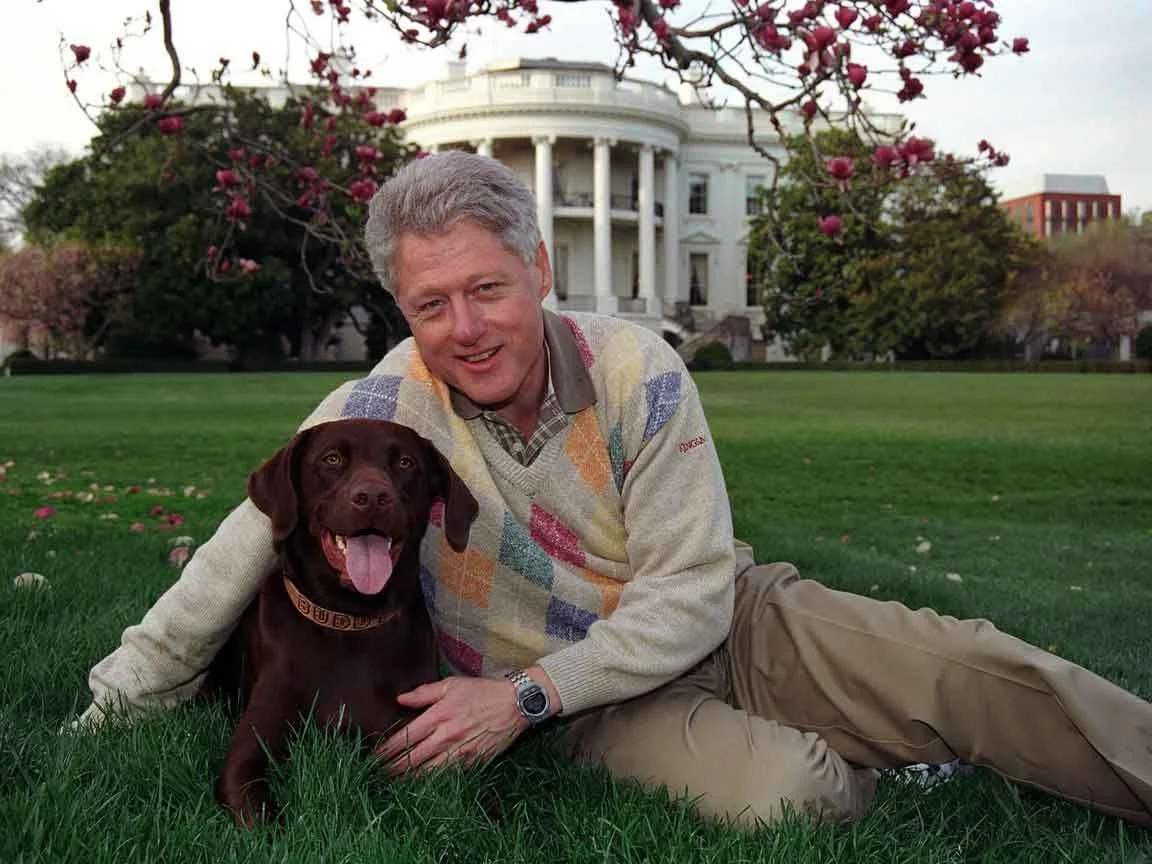
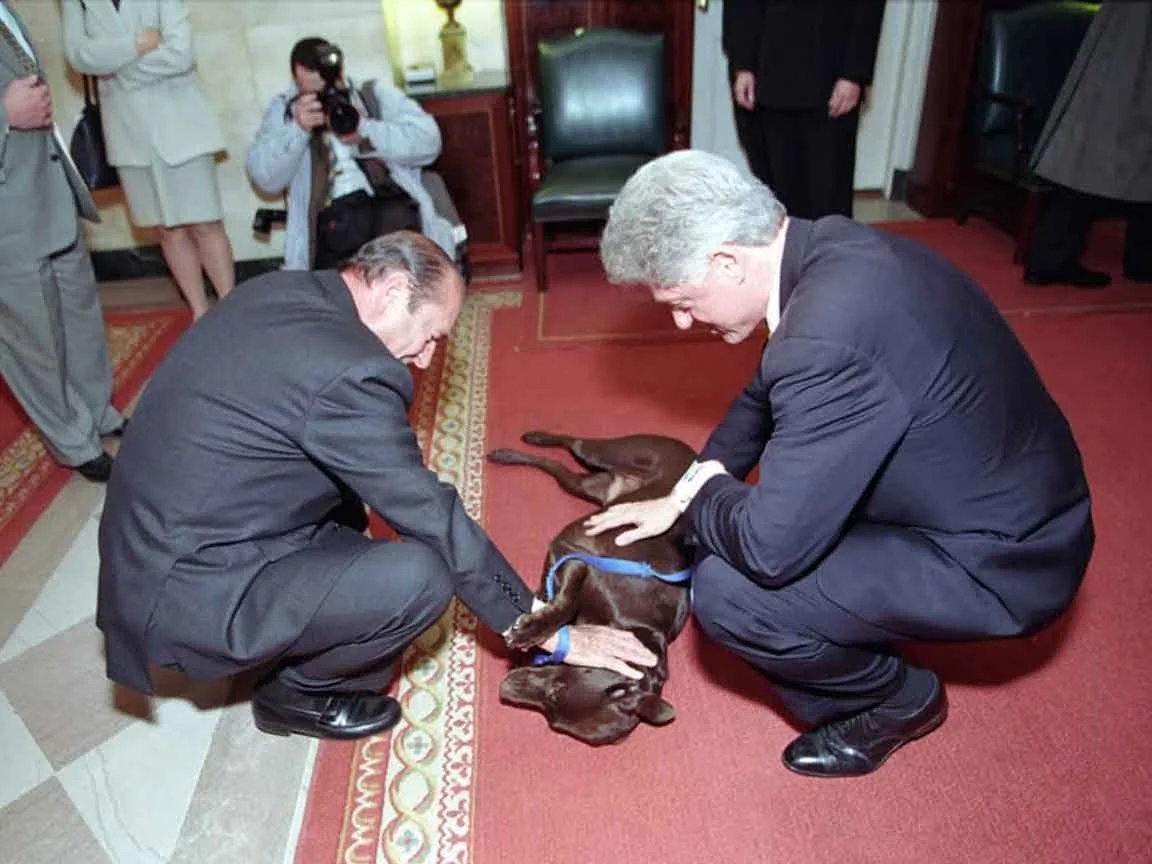
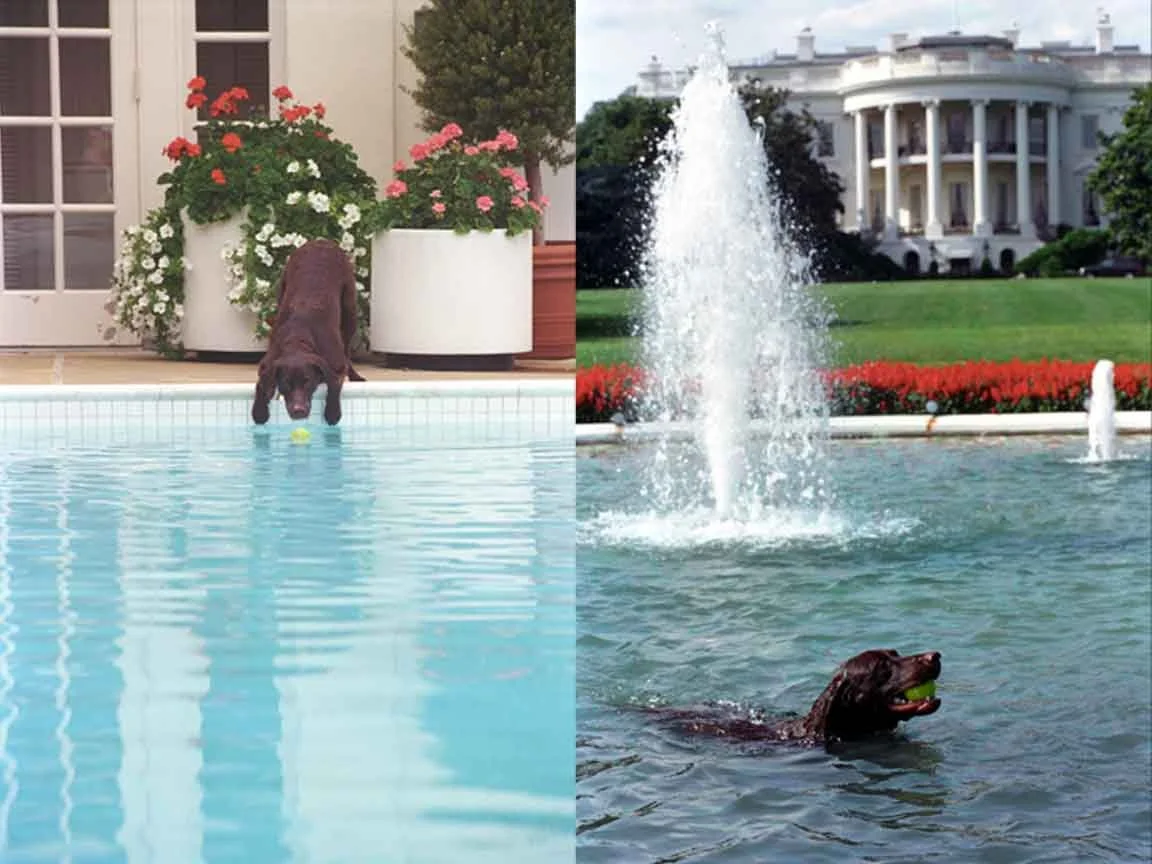
Bill Clinton’s labrador retriever, Buddy, offered a cuddly contrast to the political storms of the late 1990s. Although he famously didn’t get along with the Clintons’ cat, Socks, Buddy became a comforting image amid impeachment headlines.
President Bill Clinton poses with Buddy for a portrait on the White House South Lawn. Photo by Barbara Kinney, U.S. National Archives. Public domain.
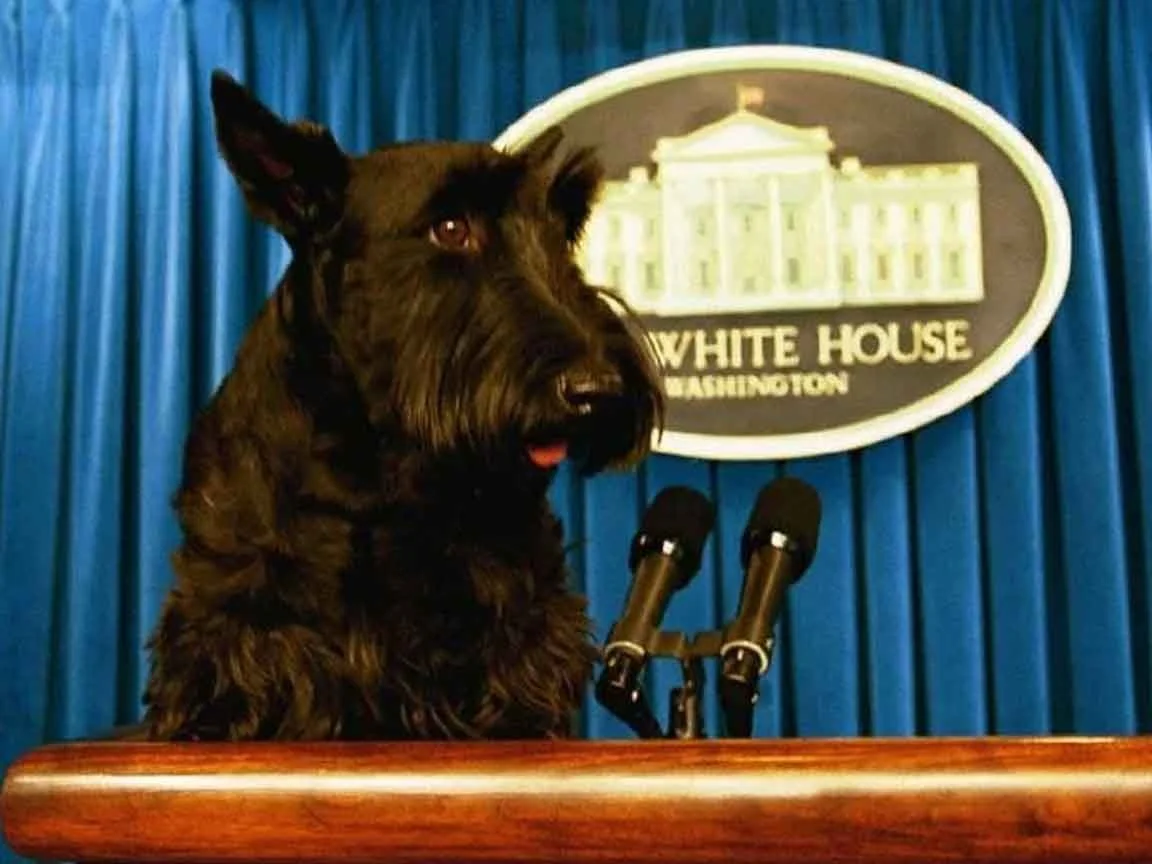
BarneyCam: With the White House Press Secretary traveling with the President (George W. Bush) Barney holds his first Press Briefing. Photo by Alex Cooney. Public domain
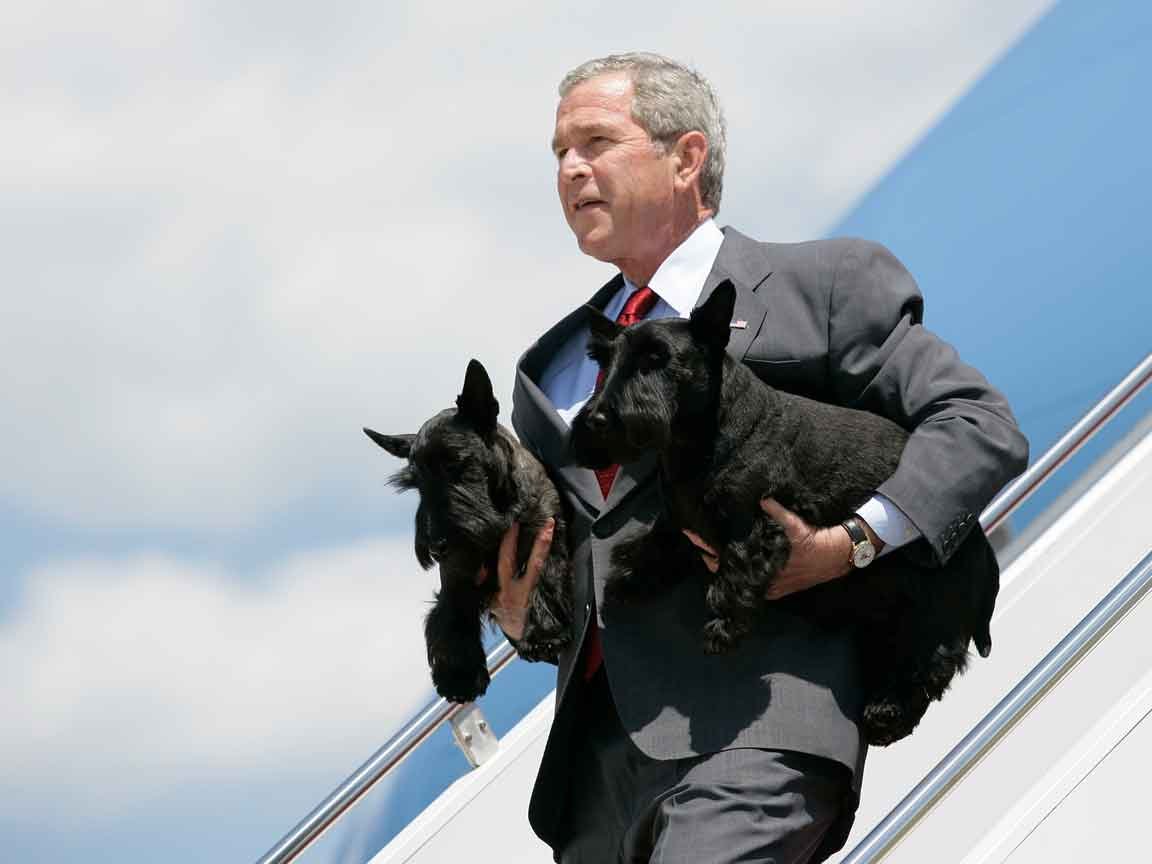
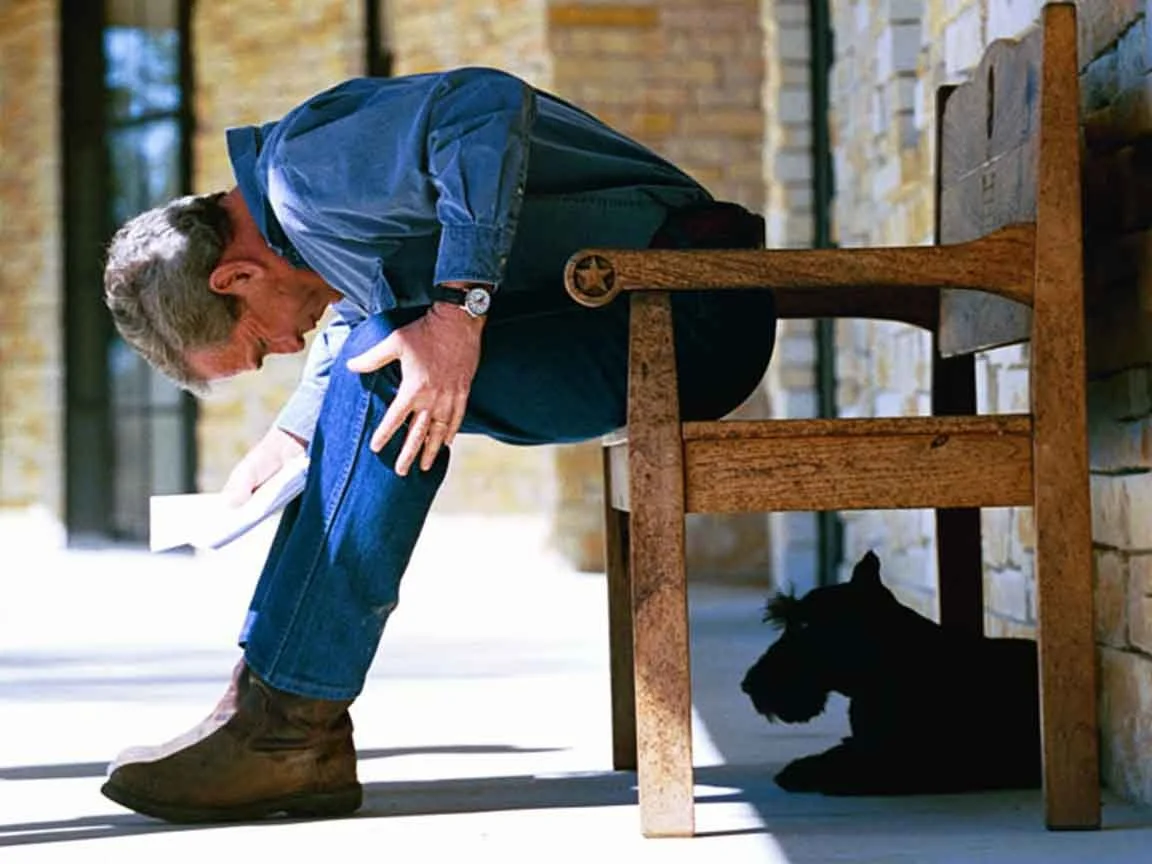
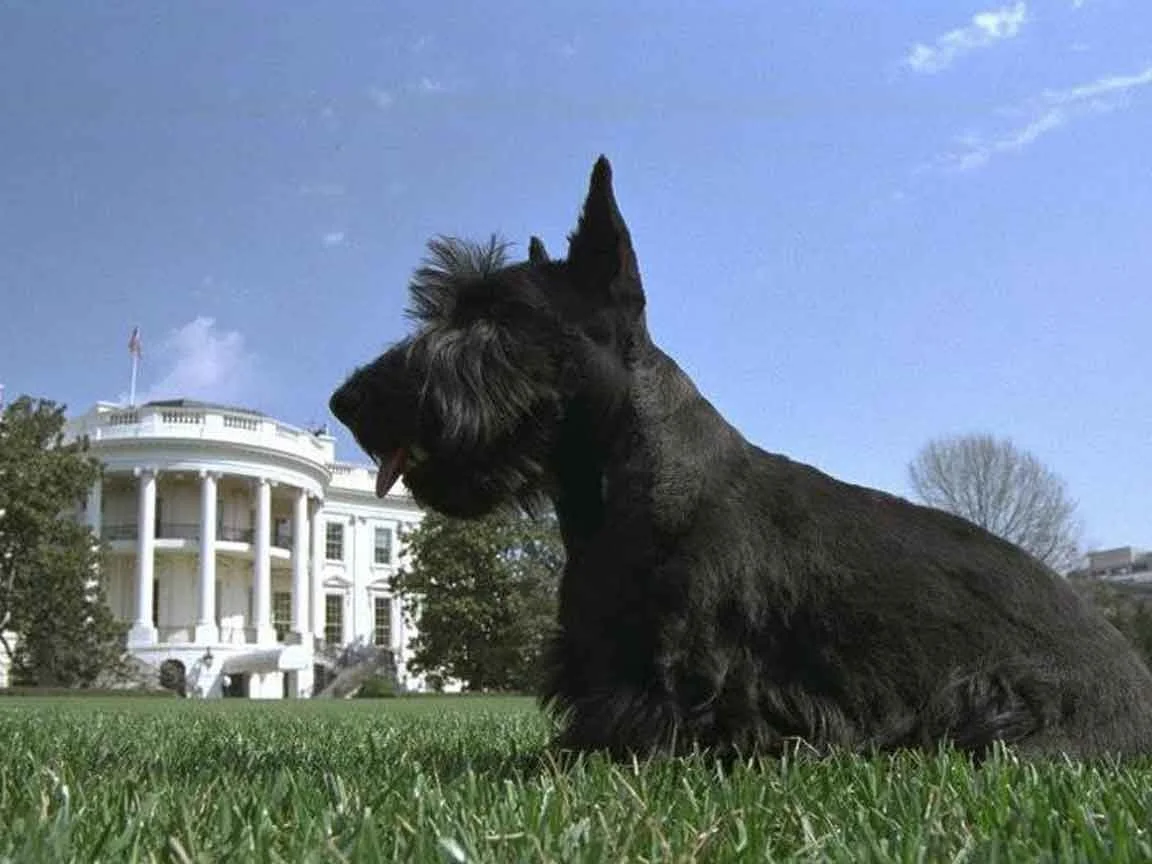
George W. Bush brought Spot, a dog who had lived in the White House under his father’s tenure, back to the executive residence. Later, he welcomed Barney, a Scottish terrier who starred in BarneyCam, a series of White House holiday videos from the dog’s point of view. Barney’s peppy performances added a touch of surreal charm to the Bush presidency and showed that First Dogs had made the leap into digital media.
The Dogs of the Digital Presidency
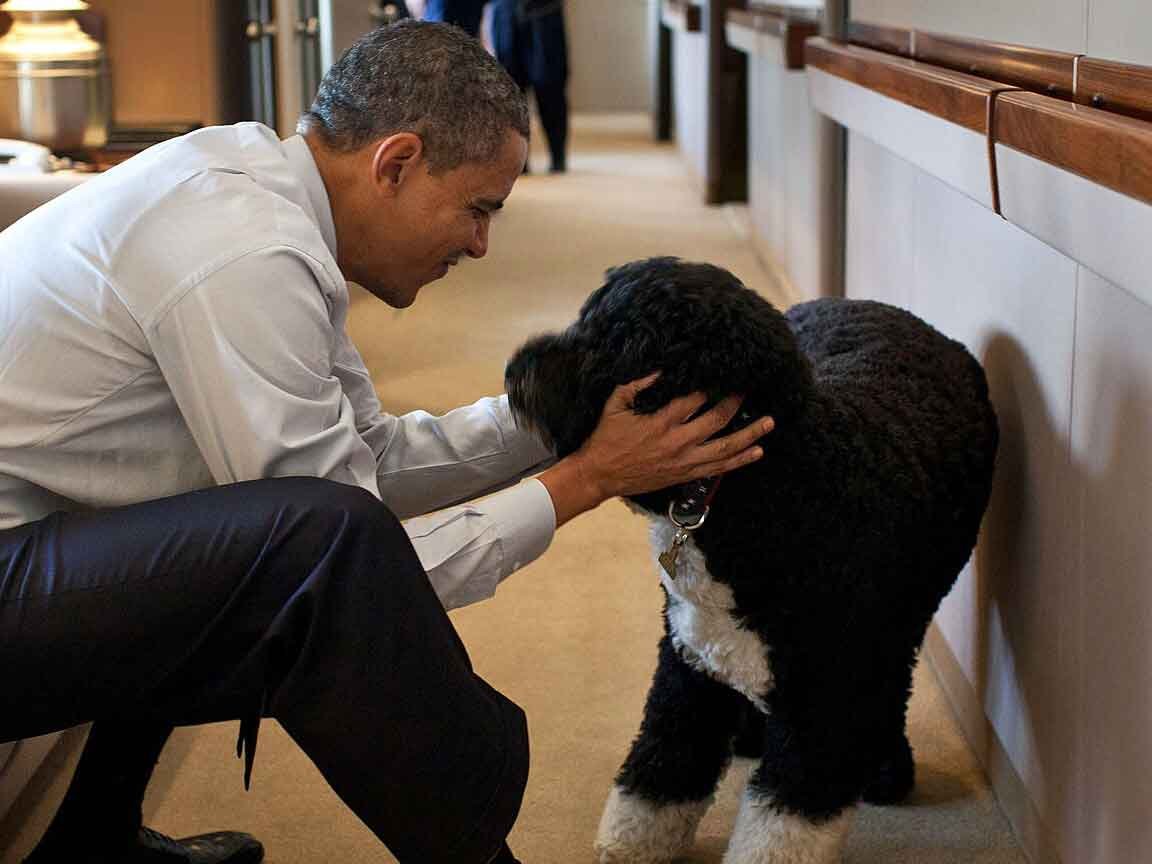
Barack Obama, initially petless, pledged to adopt a dog as a promise to his daughters Malia and Sasha. The result was Bo, a Portuguese water dog selected for his hypoallergenic coat. Later joined by Sunny, Bo became a media darling. Bo appeared in official photos, White House tours, and countless memes. The Obamas’ dogs embodied a modern, polished yet playful image, consistent with the family’s brand of accessible elegance.
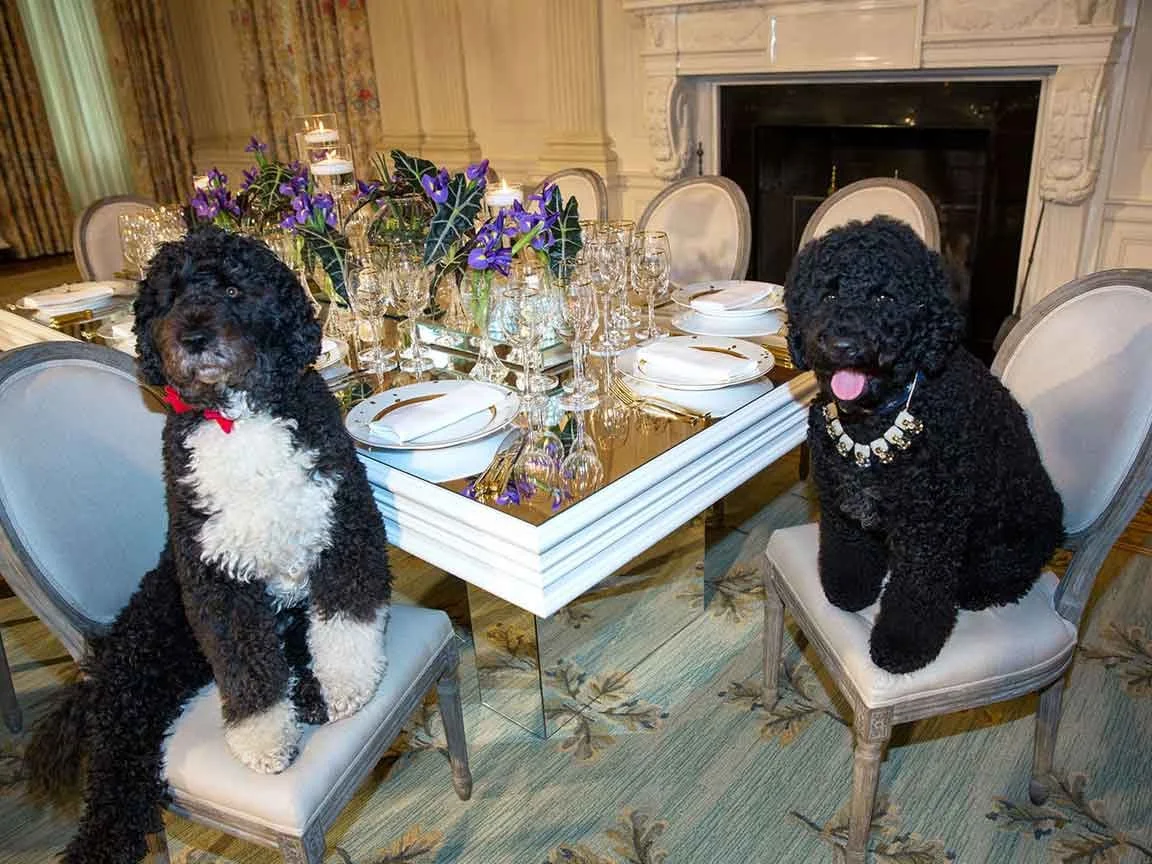
President Obama’s dogs Bo (left) and Sunny take their seats at the table in the State Dining Room of the White House. Photo by Lawrence Jackson. Public domain
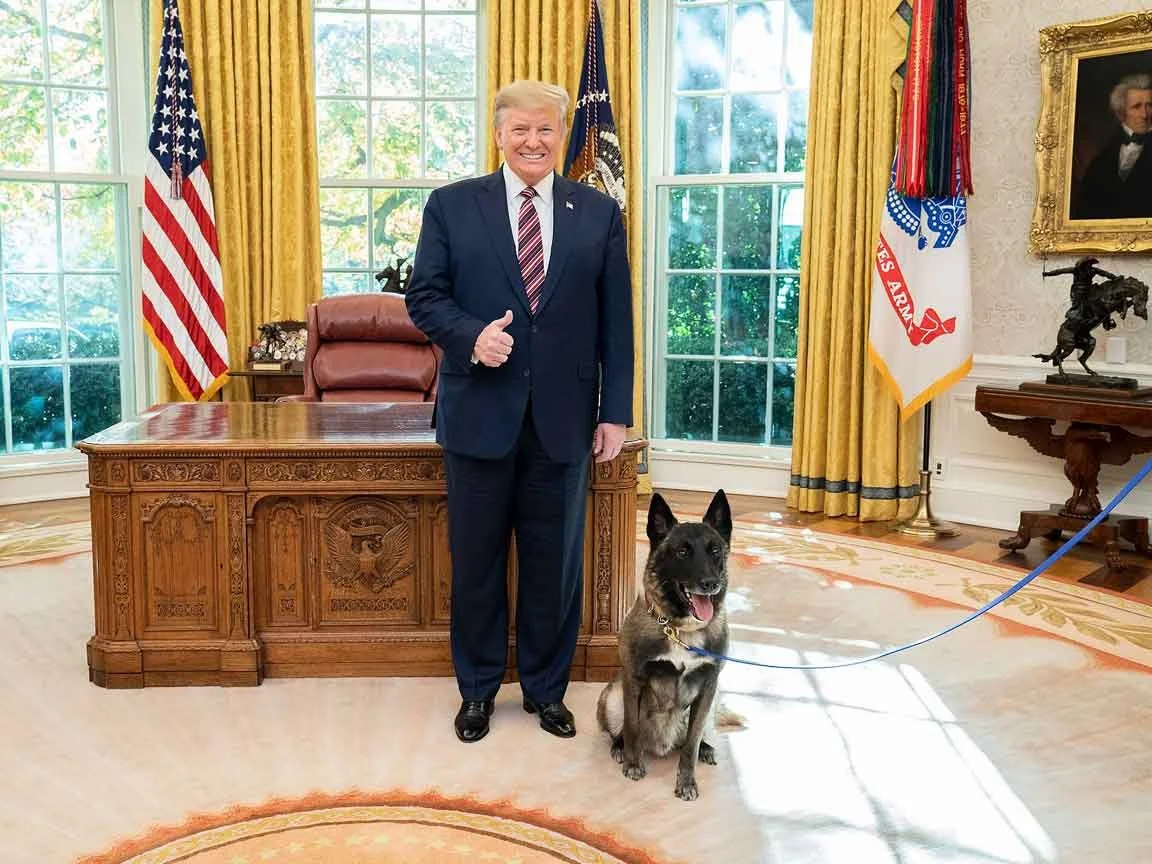
President Trump poses with Conan, the military dog honored for his role in a raid against ISIS leader Abu Bakr al-Baghdadi, during a ceremony in the Oval Office.
Donald Trump notably broke the tradition, becoming the first president in more than a century not to have a dog. He explained that it didn’t fit his image and that he’d feel “a little phoney” walking one on the South Lawn. Some critics noted the absence, others admired the honesty. Yet even in his absence, the First Dog remained a cultural benchmark. Its very omission seen as symbolically meaningful.
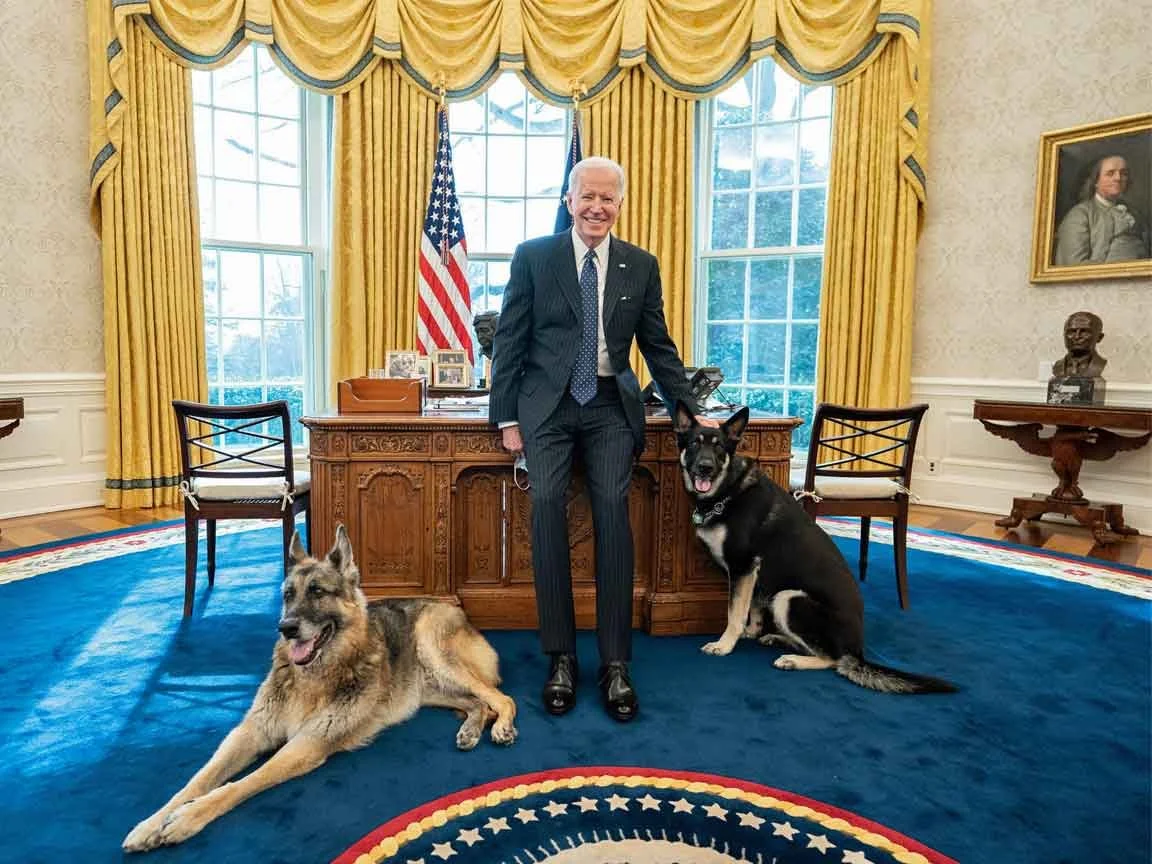
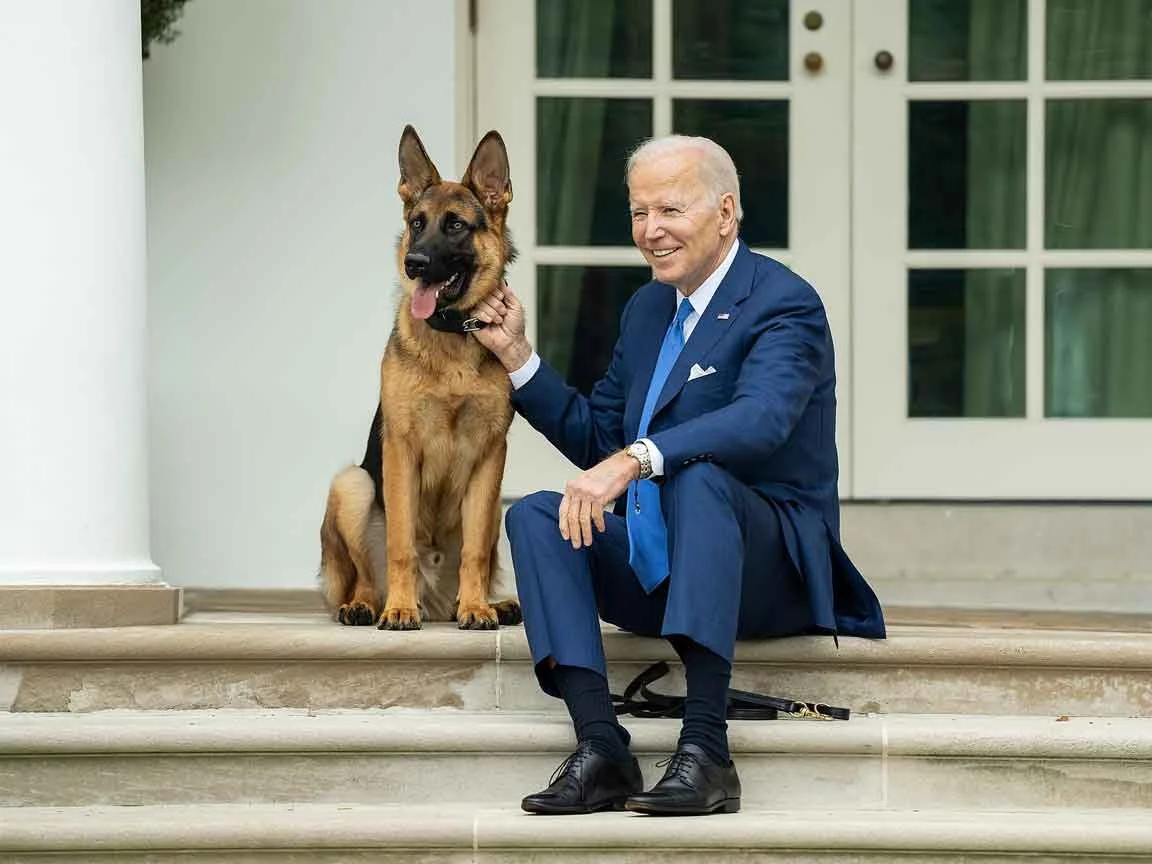
Joe Biden restored the tradition with his German shepherds, Champ and Major. Major, a rescue dog, made headlines both for being the first shelter dog in the White House and for an unfortunate biting incident involving a security guard. Though briefly relocated, Major still made history. Champ, an older and more sedate dog, passed away in 2021, prompting an outpouring of public condolence. The Bidens have since welcomed Commander, another German shepherd.
President Joe Biden in the Oval Office with his German shepherds, Champ and Major, on February 9, 2021. Official White House photo by Adam Schultz. Public domain
Loyal Companions in the Corridors of Power
Across centuries and cameras, from battlefields to briefing rooms, dogs have stood as companions to the American presidency. They have comforted grieving leaders, charmed wary voters, inspired political speeches, and helped define the public personas of their humans. In moments of scandal, they’ve offered warmth. In times of joy, they’ve bounded through the gardens with an irrepressible zest. Through sniffs, barks, and chewed cables, they’ve reminded us that even presidents need someone who wags their tail just because they came into the room.
If the presidency is a performance, then the First Dog is the trusted sidekick. One who asks for nothing more than a belly rub, a biscuit, and perhaps, now and then, a seat on Air Force One. Or Marine One!
President Barack Obama runs down the East Colonnade with dog Bo, on his first visit to the White House. Photo by Pete Souza. Public domain
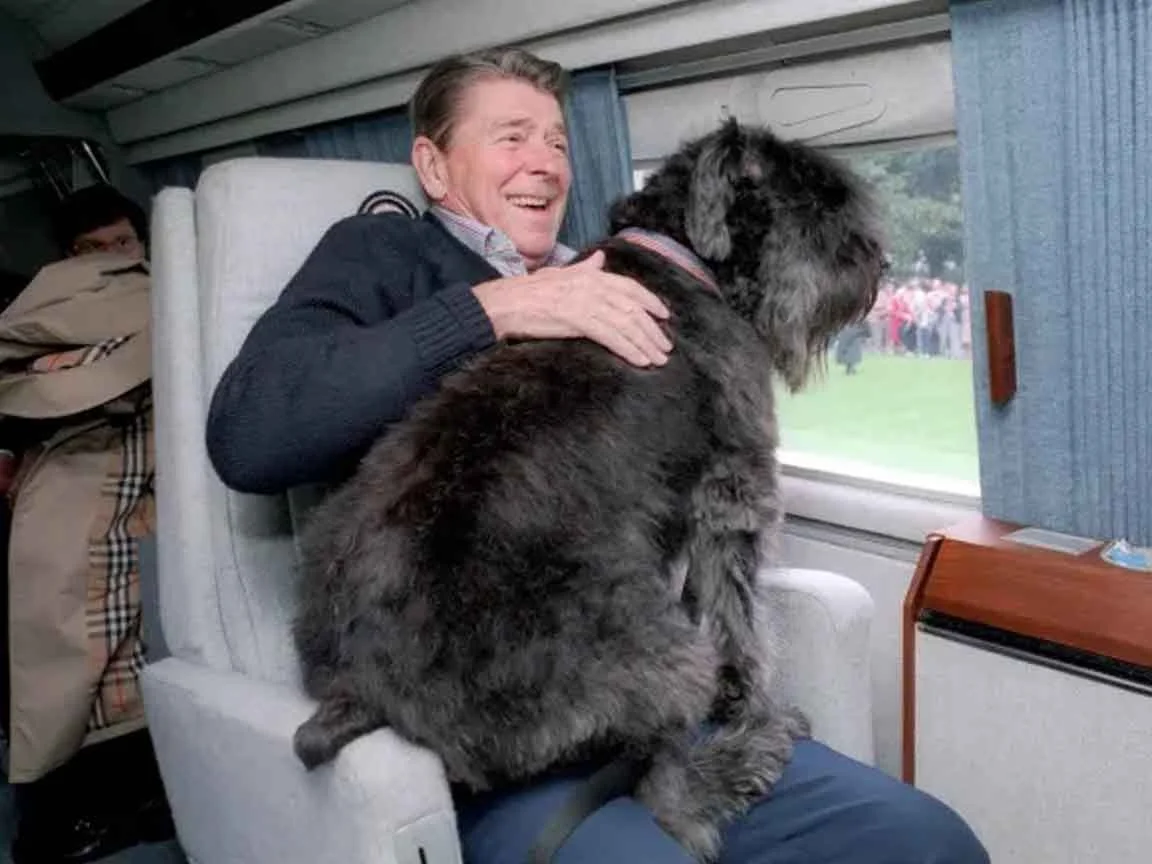
Aboard Marine One, President Ronald Reagan laughs as his large Bouvier des Flandres, Lucky, climbs into his lap to enjoy the view. The U.S. National Archives. Public domain
A Complete List of Presidential Dogs in the White House
Explore the full list of dogs owned by U.S. Presidents focusing on their time in office.
-
Sweet Lips, Scentwell, Vulcan – American Foxhounds
Washington, known as the "Father of the American Foxhound," had a favorite pack of hounds, and Sweet Lips was considered a perfect foxhound. Vulcan was known for his mischief, once boldly entering the Mount Vernon kitchen to steal a ham intended for dinner.Drunkard, Taster, Tipler, and Tipsy – Black and Tan Coonhounds
Part of his extensive hunting pack, showing his devotion to the sport and to American breeds.Cornwallis – Greyhound
Named for General Cornwallis (who may or may not have existed).Legend has it that Lafayette also sent Washington a French basset hound, who probably was the first basset hound to come to America.
-
Juno and Satan – Mixed breeds
These were the first dogs to live in the White House. The Adams family may have had several mixed-breed dogs, including Satan and Juno. Juno especially captured the heart of the first lady. In a letter to her granddaughter, Caroline Smith, Abigail wrote: “If you love me … you must love my dog.”. The letter continued: The dog “appears to enjoy life and be grateful for the attention paid her. She wags her tail and announces a visitor whenever one appears”. -
Bergère and Grizzle – shepherd dogs from France, possibly Briards
These two shepherd dogs were a gift from the Marquis de Lafayette and were used for herding sheep on his estate. -
Unnamed – Spaniel
The spaniel belonged to Monroe's youngest daughter, Maria Hester Monroe.Unnamed – Sheepdogs
Provided by Marquis de Lafayette as working dogs on Monroe's farm. -
Le Beau – Italian Greyhound
A gift to his wife Juila, who commented on the greyhound puppy’s rough treatment of furniture and rugs in the White House and his need for “attention and discipline,” she claimed, “Le Beau is perfectly well and hearty and has the most unfailing attention”. -
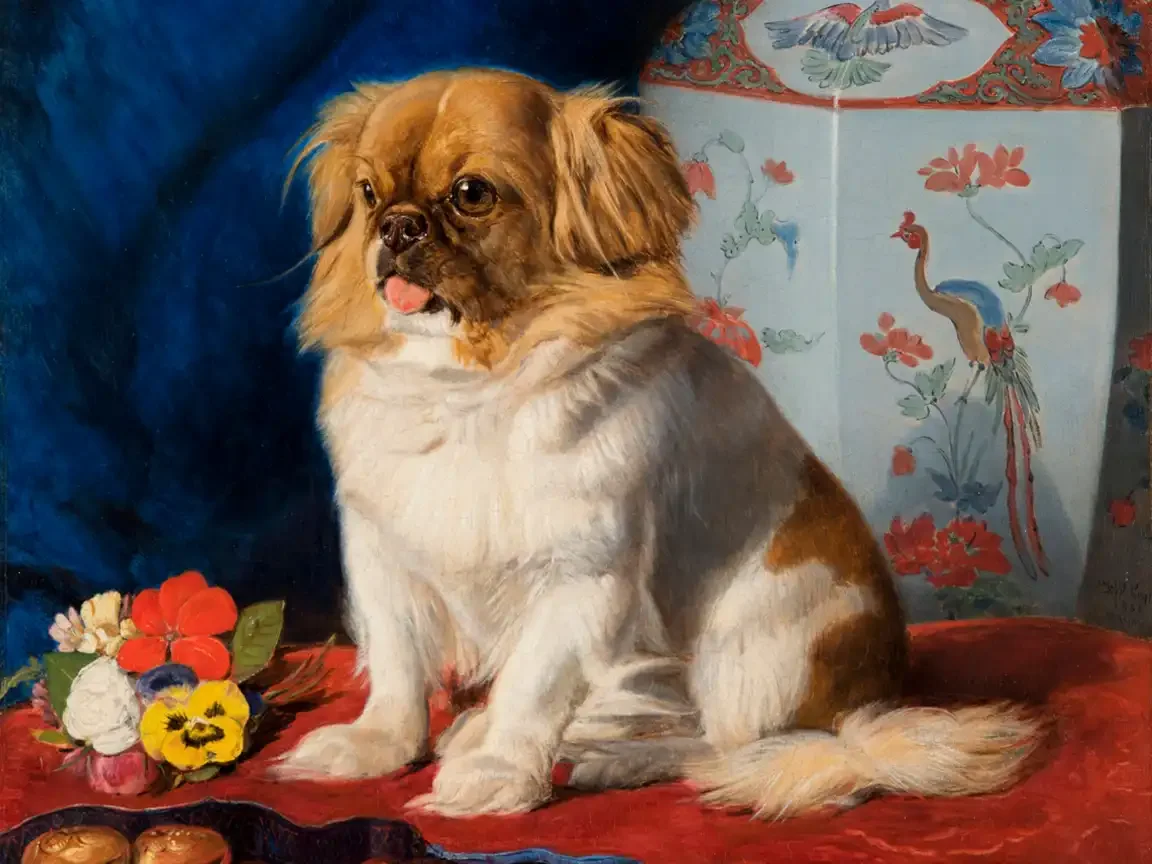
Unnamed – Miniature (teacup) Japanese Chin
When U.S. Representative Commodore Matthew Perry returned to the states after the successful signing of the treaty, he brought gifts to Pierce from the Japanese. Among these gifts were 7 teacup sized dogs. These dogs were possibly the breed known as the Japanese Chin. They were toy-sized dogs, although in the 1800s this size dog was called a “sleeve” dog – so named because they could fit into the sleeve of a kimono. -
Lara – Newfoundland
A large dog, known for her size, with some accounts claiming she weighed 170 pounds, and her unusual habit of sleeping with one eye open.Punch – Toy Terrier
Punch was a small terrier that also resided in the White House with Buchanan. It certainly must have been entertaining to see Punch with Lara, due to their difference in size. -
Fido – Mixed breed
Fido was a yellowish, mixed-breed dog with floppy ears and a stubby tail. He may have been a pet of the President, but he wasn’t actually a “Presidential Pet”. Lincoln did not bring Fido to the White House because he was afraid of the train and the crowds, so he left him with a family friend. Sadly, he was assassinated by a drunk with a knife, a few months after Lincoln's assassination. Fido's story is credited with popularizing the name "Fido" for dogs.Jip – Small dog (possibly terrier)
Sat on Lincoln’s lap during Cabinet meetings and mealtimes. According to Nurse Rebecca Pomeroy, Jip “helped relieve Lincoln of ‘some portion of the burden, for the little fellow was never absent from the Presidential lunch. He was always in Mr. Lincoln’s lap to claim his portion first, and was caressed and petted by him through the whole meal”. -
Faithful – Newfoundland
Belonged to Grant’s youngest son, Jesse. Apparently, he had suffered the heartbreak of the early death of several other dogs. So, when his father became president he gave his staff this message: “If this dog dies, every employee in the White House will be at once discharged”.Rosie – Unknown breed
According to Seymour Reit in Growing Up in the White House, Grant would often take dinner in the stables and talk to both the horses and to Rosie while he ate. -
The family, the first to be called the “first family”, made their pets part of everyday life in the White House.
Hector - Newfoundland
He must have been a relatively well-behaved animal because there is little history recorded about him.Duke - English Mastiff
Known for his large size and gentle nature.Grim – Greyhound
In his journal, Hayes wrote of, “He is good-natured and neat in his habits…and took all our hearts at once”. The first lady Lucy Hayes and Grim apparently enjoyed “singing” together. Nan Card, the Rutherford B. Hayes Presidential Center’s manuscripts curator, says: “One day, as Lucy sang the Star Spangled Banner, Grim lifted up his head and howled in a most pitiful manner. And ever after, when his mistress sang the national anthem, Grim began to howl”. Sadly, he tragically died after being hit by a train.Juno and Shep - Hunting dogs
Their exact breeds are unknown, but they were likely used for hunting with the President.Jet - Terrier
Not much is known about Jet. -
Veto – Newfoundland
From a 1954 article in the Lewiston Evening Journal, we learn he was “… a true protector. Once Veto held the reins of a valuable horse on a rampage in the barn, and Veto kept on holding the stamping horse until help arrived”. And, “On another occasion, when the barn caught fire, it was Veto’s barking that sounded the alarm”. President Garfield was shot in July 1881 and died from complications related to the wound in September. His death deeply impacted Veto, who reportedly showed clear signs of mourning. -
Kay – Saint Bernard
She was a prize-winning St. Bernard, but not much is known about her.Hector – French Poodle
The well-known black French poodle of Mrs Cleveland.Gallagher – Cocker Spaniel
Not much is known about Gallagher.Unnamed - Collie
Although listed in several sources as belonging to the Clevelands, no more information can be found.Unnamed - Three Dachshunds
Little is known about these dogs other than they were an import from Germany.Unnamed - Foxhounds
Grover was an avid outdoorsman and hunter. While the foxhounds’ names have been lost to history, doubtless Cleveland enjoyed hunting with them when he could. -
It is tricky to identify whether the dogs who lived in the White House actually belonged to the President himself or to the various family members that moved in with him.
Dash – Collie
Harrison gave Dash to his grandchildren as a gift, but Dash seemed to prefer the President’s company.He had other dogs, including one rumored to be named Jack, and a Siberian Bloodhound, whose name is lost to history.
-
Pete - Bull Terrier (possibly Bulldog, Boston Terrier)
Known for killing squirrels and his nippy behavior, which ultimately led to his exile from the White House.Rollo – Saint Bernard
Not much is known about Rollo, other than there is a phot of him with Theodore Roosevelt.Sailor Boy – Chesapeake Bay Retriever
In his autobiography, Roosevelt says of Sailor Boy: “Much the most individual of the dogs and the one with the strongest character was Sailor Boy; a Chesapeake Bay dog. He had a masterful temper and a strong sense of both dignity and duty. He would never let the other dogs fight, and he himself never fought unless the circumstances imperatively demanded it; but he was a murderous animal when he did fight.”.Blackjack (Jack) – Manchester Terrier
Belonged to the President’s son Kermit and known for being afraid of catsSkip – Mix Breed
Possibly the inspiration for the Teddy Roosevelt Terrier breed. In 1905, President Roosevelt went on a hunting trip, where he was first acquainted with Skip, who quickly won the President’s admiration.Manchu – Pekingese
Manchu was a gift given to Alice by Chinese Empress Dowager Cixi in 1905, making him a rather unorthodox but well-loved gift. -
Caruso – Unknown Breed
A gift for Taft's daughter Helen from opera singer Enrico Caruso, after a White House performance. According to a reporter Caruso had a bark that was “like a high pitch tenor” and “howled La Traviata,” so it seems this dog was aptly named. -
Davie – Airedale Terrier
Apparently a very well behaved pet as he made little press during his time with the family. There is a photo of him in 1916.Mountain Boy - Greyhound
He was a childhood pet of the President so never lived at the White House. Among Wilson’s private papers was found an old childhood sketch he had made of Mountain Boy.Bruce – Bull Terrier
Known for his plucky, but sweet, gentle disposition. He was meant to be a gentle and well-trained companion to the President as his health declined. -
Laddie Boy – Airedale Terrier
The first presidential pet to become a celebrity, Laddie Boy had his own chair at cabinet meetings, attended the White House Easter Egg Roll, and even had a statue made in his honor from melted-down pennies.Old Boy – Bulldog
Old Boy was not as prominent in the public eye as Laddie Boy. When the two dogs first meet, Old Boy was happy to take a second in command position and the two dogs could thereafter be seen playing together in the halls of the White House. -
Rob Roy – White Collie
Rob Roy posed in a famous portrait with Grace Coolidge that hangs in the China Room of the White House.Prudence Prim – White Collie
The First Lady had calling cards designed that featured Prudence Prim. When she made a visit, she would leave her own card and the dog’s card behind.Peter Pan – Wirehair Fox Terrier
Unfortunately, the White House was too busy a place for Peter Pan’s poor nerves. He seemed to enjoy the company of Coolidge’s secretary, Edward T. Clark, and so Coolidge gave Peter Pan to ClarkPaul Pry – Airedale Terrier
Half-brother of Warren Harding's Laddy Boy. Paul’s bad manners eventually led to him leaving the White House. He lived happily in a Navy Yard and became attached to many of the children there and this is where he spent the rest of his days.Calamity Jane – Shetland Sheepdog
The lively young Sheltie would rummage into things and get herself dirty in and around the White House. So much so that the first lady renamed her Calamity Jane in honor of the American frontierswoman.Tiny Tim – Chow Chows
A birthday gift for the president. Apparently, the dog and President Coolidge shared the same birthday, the Fourth of July. Some accounts report that Tiny Tim earned the nickname “Terrible Tim” for his household antics.Blackberry – Chow Chows
One of Blackberry’s claims to fame was his tendency to howl at everything. After enduring this for some time, the President finally gifted Blackberry to son John Coolidge’s fiancée.Ruby Rouch – Collie
By the time the Coolidges’ term of office ended, Ruby was one of only three dogs left in the White House, the others all having passed away or been given to friends.Bessie – Collie
Little is known about Bessie.Boston Beans – Boston bulldog
Upon his arrival, he immediately attempted to take the spot of top dog in the White House. This led to him being given to Mrs. Coolidge’s mother. Although one newspaper reported seeing Mrs. Coolidge with Beans in their hometown post-presidency, so perhaps she reacquired him.King Cole – Belgian Sheepdog (Groenendael)
Was reportedly a very nervous dog. According to a newspaper report the sound shots frightened King Cole causing him to break his leash and escape into some nearby woods.
White House staff and Secret service eventually retrieved the frightened sheepdog. Upon leaving the White House he was given to a teacher in Kentucky.Palo Alto ("Palo") – English Setter
A bird dog who briefly belonged to President Calvin Coolidge. Coolidge soon gave away the gift as he had little time for actual hunting, and knew that the White House was no place for a hunting dog. He went to live in Kentucky. -
Bellhaven Behoover (Glen) - Collie
Given to Lou Hoover. Apparently, Glen did not get along with other dogs at the White House and was given to Mrs. Cora Newton, the wife of Herbert Hoover's secretary, Walter Newton.Big Boy - Wirehaired Fox Terrier
Arrived as a Christmas present from someone in Virginia, Christmas, 1929 and was given to the sons of George Akerson, one of Hoover’s secretaries.Buckeye - Belgian Police Dog (or Malinois)
A gift to the Hoovers in 1928, just after Mr. Hoover was nominated for President. Buckeye moved to the White House with the Hoovers in 1929. Shortly after, for unknown reasons, he was given to James Y. Rippin and his wife, Jane.Cragwood Padraic (Patrick I) - Wirehaired Irish Wolfhound
Presented to Lou Hoover in 1929 by Mrs. Norwood B. Smith, a former schoolmate. Patrick passed away shortly after arrival at the White House of an infection.Cragwood Padraic II (Patrick II) - Wirehaired Irish Wolfhound
From Mrs. Norwood B. Smith to replace the deceased Patrick I. Patrick arrived at the White House in August, 1929. A newspaper report in June 1930 described Patrick as “sensitive, shy and shaggy, claims Mrs. Hoover as his closest friend". Apparently, he proved too shy and Mrs. Hoover traded him back to Mrs. Smith for ShamrockCragwood Seamrog (Shamrock) - Wirehaired Irish Wolfhound
Given to Lou Hoover in 1930 by Mrs. Norwood B. Smith, apparently because Patrick II was too shy. In 1931 Shamrock became aggressive around strangers and bit one of the Marine guards at Camp Rapidan. Mrs. Hoover gave him to a soldier at Ft. Myer who volunteered to take him, who later gave him to Col. Wrisley Brown.Ch. Inglehurst Gillette (Gillette) - Gordon Setter
A prizewinner at the Madison Square Garden show. Presented to President Hoover by Colonel William J. Donovan on Inauguration Day. Shortly afterward, he was given into the custody of a Dr. Mann, Superintendent at a nearby zoo, apparently because the dog barked too much. Gillette was photographed with the other White House dogs and received tags in the summer of 1930. Subsequent fate unknown.King Tut - Belgian Police Dog (or Malinois)
Herbert Hoover’s favorite. He was a visible companion for Hoover, often featured in his campaign photos and even helping to patrol the White House grounds.The Hoovers acquired Tut from a friend around 1922, when he was probably one or two years old. Tut moved with them to the White House but was unhappy, so the Hoovers sent him back to their former S Street house, which had been rented by Connecticut Congressman Frederic Walcott and his family. Tut died in October 1929, though the Hoovers did not make the fact public for several months in order to avoid a deluge of donated dogs.Ole and Olay - Norwegian Elkhound
Listed in news articles with White House dogs receiving dog tags in 1932. No other information.Pat - German Shepherd or Belgian Malinois
Was a gift to the Hoovers from Captain Charles J. Mabbutt of Fort Benning, GA. Given to Hoover in 1930 as a replacement for King Tut, Pat liked to patrol the White House grounds. While he was there, he enjoyed the title of “#1 Dog” wearing the ceremonial number one on his collar. He went to Palo Alto with the family after Hoover's presidency.Ronnie Av Glitre (Weegie) - Norwegian Elkhound
Was a gift from the American Elkhound Association in 1931 to replace King Tut. Originally named “Norway” or “Norrie” for short, the Hoovers' granddaughter, Peggy Ann, called him "Weegie" and it stuck. Weegie went to Palo Alto with the Hoovers after the Presidency.Ch. Southboro Markham (Mark) - English Setter
Presented to Hoover in 1929 by Mr. D. C. Kok of Palo Alto, CA, a family friend. The dog was a national and international champion. No further information.Whoopie – Schnauzer
Given to the Hoovers by Frances Dillmann of Chicago in 1929. Because Whoopie seemed discontented with life in the White House, Lou Hoover gave the dog to Mrs. Norwood Smith when she brought Padraic I to the White House.Northern Light Yukon (Yukie) - Siberian Husky. A 1929 gift from Fairbanks, Alaska. He didn’t adjust well to the warm Washington climate and was sent to Canada during the summer months. He was later given to an unidentified friend living in a cooler climate.
-
Fala – Scottish Terrier
This highly intelligent terrier was FDR's inseparable and famously mischievous companion, renowned for his playful antics and loyal presence even at high-level wartime meetings. He was so popular that he received thousands of letters from people. He even needed to have a secretary appointed to him to answer his mail. He is probably the only president pet to be memorialized in statuary. One of Fala’s most famous news moments was in 1944. Fala accompanied FDR on a trip to the Aleutian Islands, and all went well – or so he and the President thought. Somehow a rumor got started that the President had forgotten Fala, and then sent back a Navy destroyer to pick him up at the taxpayers’ expense. FDR vehemently denied this, and even made it the subject of a campaign speech on September 23rd in Washington – known a “The Fala Speech”. A statue of Fala stands next to one of FDR at the Franklin Delano Roosevelt Memorial in Washington D.C.Major – German Shepherd
Major was a former police dog that had been donated by the New York State Police when FDR was a governor. He would take exception to people who gathered around the White House property. He once nipped the hand of someone who stuck his hand through the fence in an effort to pet him. In a more high-profile incident, Major took a particular dislike to visiting British Prime Minister Ramsay MacDonald – ripping his trousers.Meggie –Scottish Terrier
Before Fala, there was Meggie. Shared many of Fala's spirited traits, adding to the bustling canine presence in the Roosevelt household. The Associated Press reported that she was “very fat,” hated baths, liked to sleep in fireplaces, and made a big stink any time Eleanor Roosevelt was around. Meggie was said to go everywhere with the First Lady, even press conferences — where she would bark to announce her presence.Winks – Llewellyn Setter
Like many of the Roosevelt dogs Winks had a bit of a mischievous streak. He discovered an unattended table in the White House that was filled with breakfast food. He went from plate to plate, gobbling up the breakfast of bacon and eggs that had been prepared for 18 people! Sadly, he ran into an iron fence and died of a concussion.Tiny –Old English Sheepdog
Not much is known about Tiny, apart from he was large as males of this breed can reach 100 pounds or more. One source says Tiny was gifted to Adm. Cary Grayson, a friend of FDR’s and a physicianPresident – Great Dane
Franklin Jr. left President, at the White House during the holiday season of 1937. The dog acted with appropriate behavior and wagged his tail vigorously at the visiting monarchs.Blaze – Bullmastiff
A 135-pound, floppy-eared English bullmastiff who belonged to the President’s son, Elliott Roosevelt, who had a brief stay at the White House. -
Feller – Cocker Spaniel
An unwanted gift that Truman gave away, sparking public criticism.Mike - Irish Setter
A gift to daughter Margaret Truman was again given away due to health issues, reportedly caused by overindulgence in treats from staff.The Truman family preferred to be pet-free. However, some research says Truman flat-out didn’t like dogs, and that the president called Mike “a damn nuisance” and Feller “a dumb dog”.
-
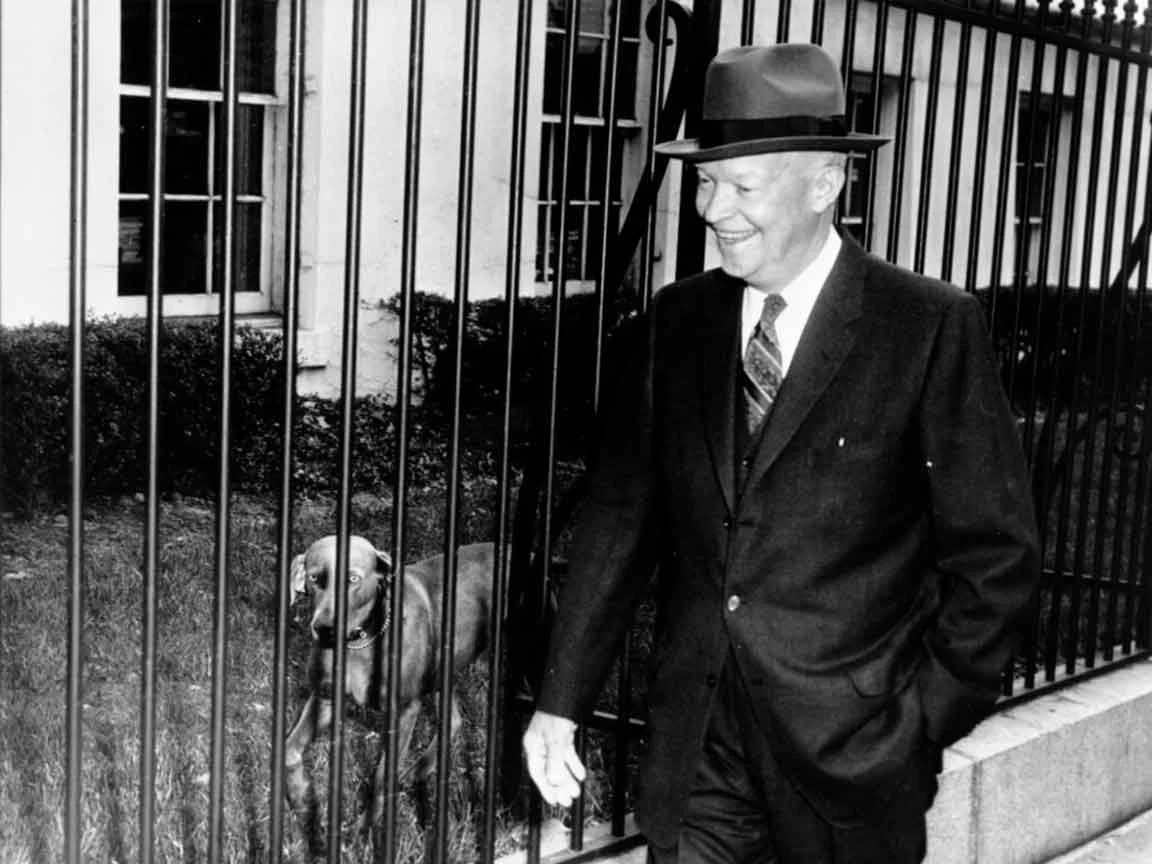
Heidi – Weimaraner
Has the dubious distinction of being possibly the only presidential dog banned from the White House. Removed after accidents on an expensive White House rug. And by expensive we don’t mean by late-1950s standards. The rug was worth $20,000 at the time, that’s over $250K today. -
Charlie - Welsh Terrier
He who would often swim laps in the pool with the president. Charlie was known to be protective of his human, growling when any other dog came near him.Gaullie - French Poodle
He belonged to First Lady Jacqueline Kennedy. She named her poodle De Gaulle — shortened to Gaullie — “because he was straight and proud and had a prominent nose”.Pushinka - Mixed Breed
A gift from Soviet Premier Nikita Khruschev. Pushinka, Russian for “Fluffy,” was a puppy of Strelka, a Soviet space dog that orbited the planet aboard Sputnik 2 in 1960. The Secret Service had to make sure she wasn’t bugged!Shannon - Cocker Spaniel
A gift to the First Family from Ireland’s President Éamon de Valera. The dog wore a gold shamrock–decorated collar.Wolf - Irish Wolfhound
He was very fond of children and humans, but he does not like other dogs. It is said that because of this difficulty he was placed with another family.Clipper - German Shepherd
He belonged to First Lady Jacqueline Kennedy. He was unique among the Kennedy family’s many dogs, got formal training through an obedience school. When a reporter asked Mrs. Kennedy what Clipper liked to eat, the First Lady showed a bit of the humor by replying, “Reporters”.Butterfly, White Tips, Blackie, Streaker — Mixed Breed
Pushinka and Charlie’s had a litter of puppies together and JFK called them the “pupniks”.When living at the White House, on many nights, the First Couple would take one or two of their dogs for a walk outside the White House gates, unbeknownst to people on the street.
-
Him and Her – Beagles
Who were frequent sights in the White House, riding along in the president’s car, snoozing in the Oval Office, and swimming in the White House pool. An unfortunate ear-pulling photograph featured in Life magazine made Him and Her national celebrities. Although LBJ was amazed at how big the controversy became, he eventually issued a public apology. The often outspoken president however, made this aside to reporters after his apology: “I’ve been pulling Him’s ears since he was a pup, and he seemed to like it.”Freckles – Beagle
Freckles was the offspring of Him. Sheand her littermate Kim were officially given to Johnson daughter Luci. Kim went to live in Texas with Luci, and Freckles stayed at the White House. When the Johnsons left the White House at the end of their term, Freckles was adopted by a White House staff member.Edgar – Beagle
A gift from J. Edgar Hoover when Him suddenly died. Apparently, once when Johnson and Hoover were strolling across the White House lawn, Johnson called out, “Edgar, come here!”. The confused Director Hoover replied, “I am here, Mr. President”.Blanco – Collie
LBJ reportedly enjoyed shaking hands with Blanco when he returned to the White House, but Blanco tended to be nervous and was prone to biting other dogs. LBJ had a photo of himself standing next to Blanco and Him made into a White House Christmas card. Each card was signed with Johnson’s signature as well as the paw prints of the two dogs. Before leaving the White House, the Johnsons gave Blanco to a Kentucky doctor and his wife.Yuki - Mixed Breed
Luci (LBJ’s daughter) found Yuki at a gas station in Texas. Yuki, which means “snow “in Japanese was given to LBJ for his birthday. LBJ danced with Yuki at his daughter Lynda’s wedding. Yuki flew with him on Air Force One to the LBJ Ranch, and the little dog was reportedly his side when the former president died. After Johnson’s death, Yuki went to live with Luci and her family. -
Checkers – Cocker Spaniel
Famous from the "Checkers Speech" but never lived in the White House. He used the new medium of TV to take his case to the people to deny any alleged misuse of $18,000 in campaign contributions. He explained that no matter what happened as a result of the controversy, his young daughters were keeping one campaign gift: Checkers from a supporter in Texas.King Timahoe – Irish Setter
He was named after King Timahoe a hamlet in County Kildare, Ireland, where Nixon’s ancestors were from. He had a bit of a sweet tooth. A NBC newsreel filmed the dog sneaking a large piece of cake during a small surprise party for Nixon’s 61st birthday. The dog’s sneaky move in front of the camera apparently befuddled the president, because the footage next shows him with frosting all over his jacket. Watch the videoVicky – Poodle
Was technically Nixon’s daughters dog Julie, she enjoyed being with all members of the First Family. The night before Nixon resigned from office, Vicky curled up on an ottoman beside him, perhaps bringing a certainly troubled man some comfort.Pasha –Yorkshire Terrier
He spent most of his time with Nixon’s daughter Tricia, but was spotted with Nixon or his wife on several occasions. Julie Nixon Eisenhower published a children’s story about Pasha titled “Pasha Passes By,” and it imagined “a brief and unsatisfying exploration of the White House” after Pasha escapes from his kennel. -
Grits – Border Collie (Mix)
Given to his daughter Amy by her teacher but later returned it. Some sources report that Grits had a few behavior problems and didn't get along with the Carters’ cat. But it may be that Amy parted with Grits to help ease her teacher’s sadness over the loss of her own dog.Lewis Brown – Afghan Hound
Not much is known about Lewis Brown other than he was a family pet. -
Lucky – Bouvier des Flandres
Who grew from a “ball of fluff” to “be the size of a pony,” according to First Lady Nancy Reagan. Lucky especially enjoyed visiting Camp David, and would get very excited when she saw Marine One because she knew it meant a trip to the presidential retreat. Ultimately, the Reagans determined that Lucky was not a good fit for the White House, so they sent her to their ranch in California.Rex – Cavalier King Charles Spaniel
He had a determined nature and would pull on his leash. Sometimes Reagan appeared to use Rex’s pulling as a good way of dodging reporters’ questions. One of Rex’s first official duties was to throw the power switch to light the national Christmas tree in 1985.Victory – Golden Retriever
Unfortunately for Victory there was no big move to the White House. He and several other dogs were left behind at their ranch, Rancho del Cielo, in California, where they had free run of the property and plenty of sunshine to bask in.Peggy – Irish Setter
Not much is known Peggy other than she lived at the Reagan’s ranch in California.Taca – Siberian Husky
Not much is known Taca other than she lived at the Reagan’s ranch in California.Fuzzy – Belgian Sheepdog
Not much is known Peggy other than she lived at the Reagan’s ranch in California. -
Millie – English Springer Spaniel
Wrote a #1 best-selling book, as interpreted by, and dictated to First Lady Barbara Bush, with proceeds donated to the nonprofitRanger – English Springer Spaniel
Millie’s pup. At Camp David, when he wasn’t chasing deer or following his mom Millie around, Ranger was at the president’s side. Barbara Bush described Ranger as a “big, bouncy, puppy. He could leap straight up into the air and his handsome face made us laugh…. He loved to curl up by George’s side and was everything in a dog George wanted”. -
Buddy – Labrador Retriever
When Buddy arrived at the White House, Clinton’s spokesman Mike McCurry told reporters that Clinton got the dog because “It’s the President’s desire to have one loyal friend in Washington”. He was well-known for his feud with Socks, the family’s feisty cat, and he was often featured in press. He became a bit of a ham for the camera, and fan clubs and websites sprang up in his honor. He accompanied the president in the Oval Office, on walks on the White House grounds, and on trips to Camp David. -
Barney – Scottish Terrier
Famous for starring in “BarneyCam”. He was a fierce armadillo hunter at the Bush ranch is Texas, and at Camp David his favorite activity was chasing golf balls on the chipping green”. President Bush described him as “Barney was by my side during our eight years in the White House. He never discussed politics and was always a faithful friend”.Miss Beazley – Scottish Terrier
Barney’s neice, nicknamed "Beazley Weazley" was a birthday from George to his wife. The two became good friends, and entertained their fans with videos of them playing ball on the White House lawn.Spot (Spot Fetcher) – English Springer Spaniel
Daughter of Millie (see George H. W. Bush). The only dog to have lived in the White House under two presidencies. He was friendly, affectionate, obedient, and eager to please his humans in whatever way he could. Bush, who felt a certain standard of formality was required in the office, said in an address to a Wisconsin high school: “Spot understands the decorum of the Oval Office, so she gets to go in”. -
Bo – Portuguese Water Dog
When President Obama was running for office, he promised his daughters, Sasha and Malia, a puppy if he won. When he did Senator Ted Kennedy and his wife gifted the dog to the Obama girls. The country took to Bo right away, with his photo going viral within days, and he became a national sweetheart.Sunny – Portuguese Water Dog
Younger companion to Bo, known for knocking over a toddler during a holiday event. She was full of energy, very affectionate, and the First Family picked her name because it fitted with her cheerful personality.Both dogs met Pope Francis during a private meeting in the Oval Office.
-
Trump was the first president in over a century not to have a dog. At a rally in Texas in 2019, he said he would "feel a little phony" about walking one on the White House lawn, plus he didn't have the time.
-
Champ – German Shepherd
Long-time family dog who moved into the White House before passing in 2021. Biden granddaughters Finnegan and Maisy chose the name Champ in honor of one of their “Pop’s” favorite sayings, one he often heard from his own father: “Any time you get knocked down, champ, get back up!”.Major – German Shepherd
The first-ever rescue dog to take up residence in the White House. He burst onto the national scene after Biden, when president-elect, broke his right foot while playing with him at their home in Wilmington, Delaware. He was removed from the White House following several biting incidents.Commander – German Shepherd
Given to the Bidens as a puppy by the president's brother. He was removed from the White House due to the numerous biting incidents. CNN reported that there were at least 24 such events.
Did You Know?
Herbert Hoover posed with his Belgian shepherd, King Tut, in campaign photos to soften his stiff image.
Calvin Coolidge had a white collie named Rob Roy who slept by his bed and once attended Cabinet meetings.
Franklin D. Roosevelt’s dog Fala, a Scottish terrier, had a press secretary and received thousands of fan letters.
Lyndon B. Johnson’s beagles, Him and Her, were both born in the White House.
Pushinka, JFK’s Cold War puppy, underwent a full FBI inspection before being allowed into the White House.