Queen Elizabeth II and Corgis: A Lifelong Love Affair
From Dookie in the 1930s to Muick and Sandy in 2022, Queen Elizabeth II’s corgis padded through palace life as confidants, comedians, and constants. Behind the crown’s formality was a monarch happiest amid short legs and royal mischief.
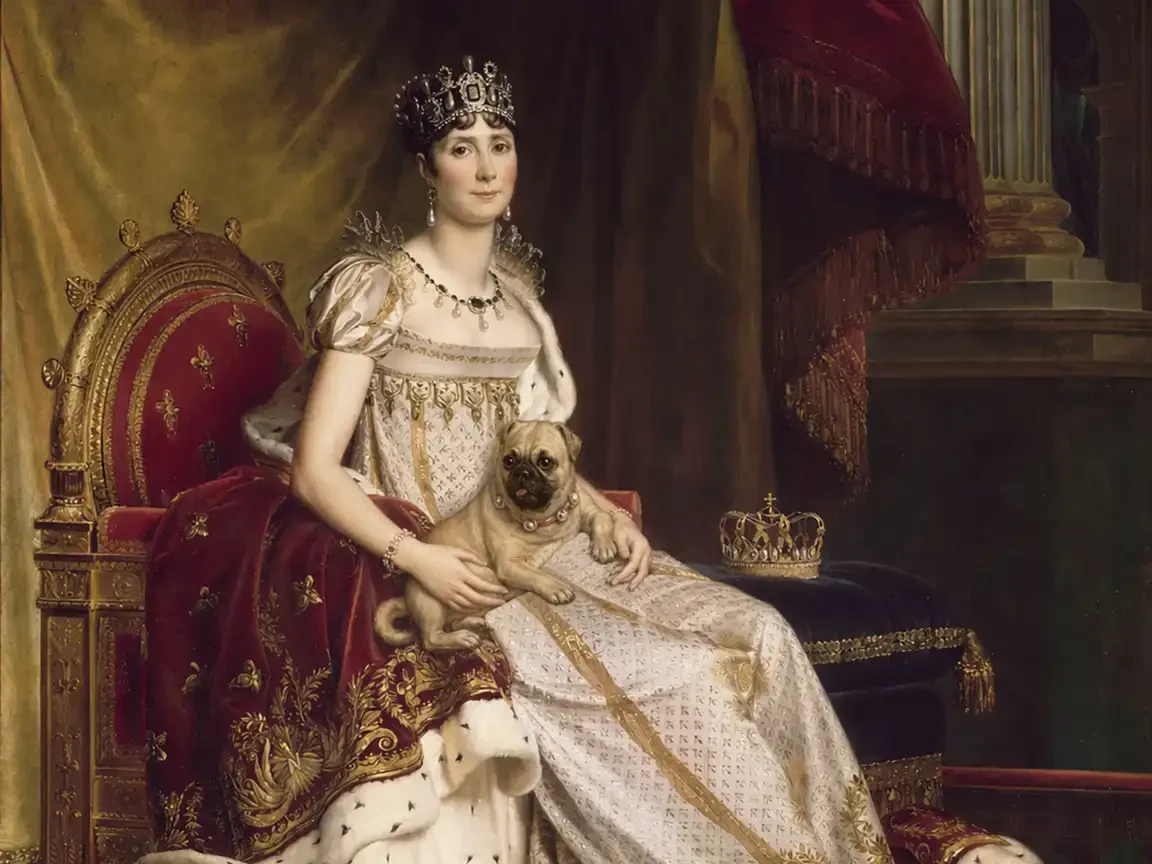
A royal seat for a royal pup - celebrating Queen Elizabeth II’s lifelong love of her beloved corgis. AI photo by Dogs in History.
A Life with Corgis
For nearly 90 years, Queen Elizabeth II was accompanied not just by heads of state and household staff, but by a lively pack of Pembroke Welsh Corgis. The dogs weren’t just symbols of monarchy or subjects of memorabilia. They were a source of comfort, joy, and continuity. Paws padding through palace corridors, tails wagging at Windsor, always somewhere near the throne.
Few images are as enduringly charming as that of Queen Elizabeth II surrounded by her beloved Pembroke Welsh Corgis.
From a childhood curiosity sparked in the 1930s to a final farewell in 2022, the Queen's devotion to her corgis spanned nine decades. Over 30 corgis accompanied her through wars, weddings, jubilees, and constitutional crises. They were her constants. Short-legged sentinels who followed her from throne room to moor.
A Childhood Introduction
The Queen's corgi journey began in the early 1930s, long before she wore a crown. A young Princess Elizabeth and her sister Princess Margaret were first introduced to the breed through family friends. What began as casual exposure quickly bloomed into genuine affection.
The breed’s endearing mix of intelligence, loyalty, and mischief made corgis irresistible companions for two lively princesses. Small enough for a child to manage but spirited enough to hold their own in royal games, these little dogs were the perfect blend of fun and fortitude.
The First Royal Corgi
The Queen’s first proper corgi experience came with Dookie, a gift to the family in 1933 from their father, the Duke of York (later King George VI). Named affectionately after the Duke, Dookie lived with the family at their London residence before the war. He quickly established himself as a fixture, known for his boisterous antics and his aversion to baths. He was soon joined by Jane, another corgi who added to the mischief.
Princess Elizabeth with corgis Dookie and Jane, 1 July 1936. Public domain Mark 1.0 Universal
These early experiences with Dookie and Jane left a mark on the young Elizabeth. More than pets, they were companions during a turbulent time, providing joy as the shadow of war loomed over Europe. The corgis were allowed to roam the house freely, their little legs pattering down grand staircases, occasionally knocking over the odd vase or dignitary.
The Birthday Gift That Started a Dynasty
If Dookie was the prototype, Susan was the blueprint. Presented to Princess Elizabeth for her 18th birthday in 1944, Susan was a companion through war, romance, and coronation. She even (allegedly) accompanied Elizabeth on her honeymoon with Prince Philip in 1947, tucked away in the royal carriage.
Susan's legacy endured for generations. Almost every corgi the Queen owned descended from her, over 50 are recorded in her family tree. Through meticulous breeding, the Queen oversaw a canine lineage as carefully managed as any royal family tree. Names like Whisky, Candy, and Sugar followed, each one distinctive in personality yet bearing a trace of Susan’s spirit.
The Queen wasn’t merely a passive pet owner. She took personal interest in the dogs' breeding, welfare, and training. Deciding pairings, overseeing births, and knowing every dog’s quirks and traits. Each pup was more than a pet; they were family.
The Dorgis An Accidental Delight
Accidents happen, even in royal households. One of the more serendipitous results of palace dog-wrangling was the creation of the "dorgi". A cross between a corgi and a dachshund. The first dorgi was the result of a romantic entanglement between one of the Queen’s corgis and Pipkin, Princess Margaret’s dachshund.
A Corgi crossed with a Dachshund produces a Dorgi. AI photo by Dogs in History
Rather than being scandalized, the Queen welcomed the hybrid breed. Dorgis like Cider, Brandy, and Tinker soon joined the royal pack, displaying the lively nature of corgis with the elongated charm of dachshunds. The Queen embraced them fully, proving that her love of dogs wasn't limited to pedigree. Charm, after all, knows no bloodline.
A Broader Canine Family
Though corgis were her signature breed, the Queen’s broader canine family included Labradors and Cocker Spaniels, especially at her country estates. These dogs weren’t lap warmers but working animals, joining her on shoots and countryside walks.
Where corgis brought indoor chaos and cuddles, the gundogs brought discipline and tradition. Their presence at Sandringham and Balmoral reflected another side of Elizabeth. The countrywoman who rose early, donned her boots, and took joy in rural routine.
The Queen took a personal interest in their training, often visiting the kennels, watching trials, and discussing breeding decisions. Her spaniels accompanied her on shoots and long walks in the Scottish Highlands, representing a quieter, countrywoman side of the monarch often hidden from the public eye.
A Constant Presence
Royal life was no obstacle to canine comfort. The Queen's corgis enjoyed the run of the palace, literally. They had their own room, complete with wicker baskets lined with clean sheets changed daily. Their meals were prepared by palace chefs and might include fillet of beef, chicken, or rabbit, with gravy. A footman delivered their food in porcelain dishes.
Though indulged, the dogs were far from idle. They were active participants in the Queen’s daily routine, trotting beside her through corridors and gardens, often attending official functions in the background. Staff recalled the dogs waiting patiently outside closed doors during audiences, tails thumping with anticipation.
Each dog had its own personality. Some were affectionate and gregarious, others shy or territorial. The Queen knew them all by name, spoke to them as individuals, and even reprimanded them gently when required. Once, after a corgi nipped a footman, she reportedly quipped, "They are a bit like children. If you don't keep them in hand, they run riot."
A Poignant Decision
Around 2003, the Queen made a decision that surprised many: she stopped breeding corgis. It wasn’t about slowing down or moving on. It was a thoughtful choice, grounded in care.
She didn’t want to leave behind young dogs who would outlive her. The decision marked a tender awareness of time’s passage and the deep bond she shared with her dogs. For a woman so often defined by duty, this personal gesture revealed the immense responsibility she felt toward even her smallest companions.
An Enduring Global Symbol
The Queen's corgis were far more than just pets; they evolved into a cherished global symbols inextricably linked to Her Majesty and the British monarchy. Their image permeated popular culture, becoming a cheerful and instantly recognizable shorthand for British royalty, tradition, and even the Queen's personal warmth.
Royal corgi souvenirs - Christmas Ornament.
Royal corgi souvenirs - Plush.
If there was a moment the world truly saw just how fond the Queen was of her dogs, it was the 2012 London Olympics. In the famous opening sketch, the Queen starred alongside Daniel Craig’s James Bond in a playful film set in Buckingham Palace.
And who stole the show? Monty, Holly, and Willow, three of her beloved corgis, trotting alongside Bond, wagging their tails as the cameras rolled. It was a wink to the world, a moment of humor and humanity from a monarch more often cloaked in formality.
Muick and Sandy
In her final years, the Queen welcomed two last corgis: Muick and Sandy. Gifts from Prince Andrew and Sarah Ferguson, these dogs arrived in 2021, bringing youthful chaos and comfort during a period marked by sorrow and solitude.
Prince Philip had died in April of that year, and the Queen, more isolated due to the pandemic, found solace once more in the company of dogs. Muick and Sandy filled Windsor Castle with lively energy, another generation of short legs, eager eyes, and boundless devotion.
After her death in September 2022, they stood quietly at Windsor, held by staff as her funeral cortege passed by. It was a moment that touched millions: a final farewell from two of her truest companions.
They now live with Prince Andrew and Sarah Ferguson, continuing their lives in a familiar, loving environment. A fitting postscript to a canine story that spanned generations.
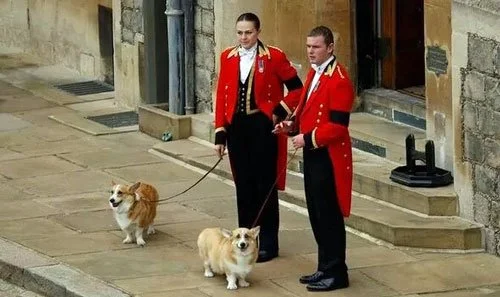
Muick and Sandy awaiting their late owner's coffin in the grounds of Windsor Castle.
The Crown and the Corgis
The Queen’s corgis became much more than palace pets. They turned into emblems: of her private warmth, her sense of humor, her love of routine, and her rootedness in ordinary joys.
They showed us that behind the crown and constitutional responsibilities stood a woman who found deep comfort in the shuffle of paws on polished floors, the nudge of a wet nose, the wag of a tail.
They appeared in official portraits, tea towels, cartoons, commemorative coins, and even viral animations. And yet, their legacy isn’t in their fame—it’s in the sense of grounded affection they brought to a figure often viewed as distant.
For nearly nine decades, they were with her: on laps and lawns, through wars, weddings, jubilees, and farewells.
Not a bad innings for a bunch of little dogs from Wales.
Queen Elizabeth’s Corgi Family Tree
The Queen’s corgi Susan’s Family Tree. Source: Penny Junor. Corgi images by I Setiawan from Pixabay.
Did You Know?
The corgis had their own Christmas stockings at the palace.
In 1954, the palace clock winder, Leonard Hubbard, was bitten by Susan upon entering the nursery at the Royal Lodge, Windsor.
In 1968, Labour MP Peter Doig called for the royal staff to put up a "Beware of the dog" sign at Balmoral after one of the corgis bit a postman.
Queen Elizabeth II once demoted a footman for giving the corgis whisky.
The Queen's Corgi is a 2019 English-language Belgian animated comedy film produced by nWave Pictures.
Breed: Pembroke Welsh Corgi | Country of origin: Great Britain | First use: Droving cattle | Origins: 11th century