Black Dog: The Dartmoor Terror Behind The Hound of the Baskervilles
Before Conan Doyle invented the Hound of the Baskervilles, Dartmoor’s phantom dogs had been killing travelers for centuries. The man who borrowed them wasn’t entirely sure they didn’t exist.
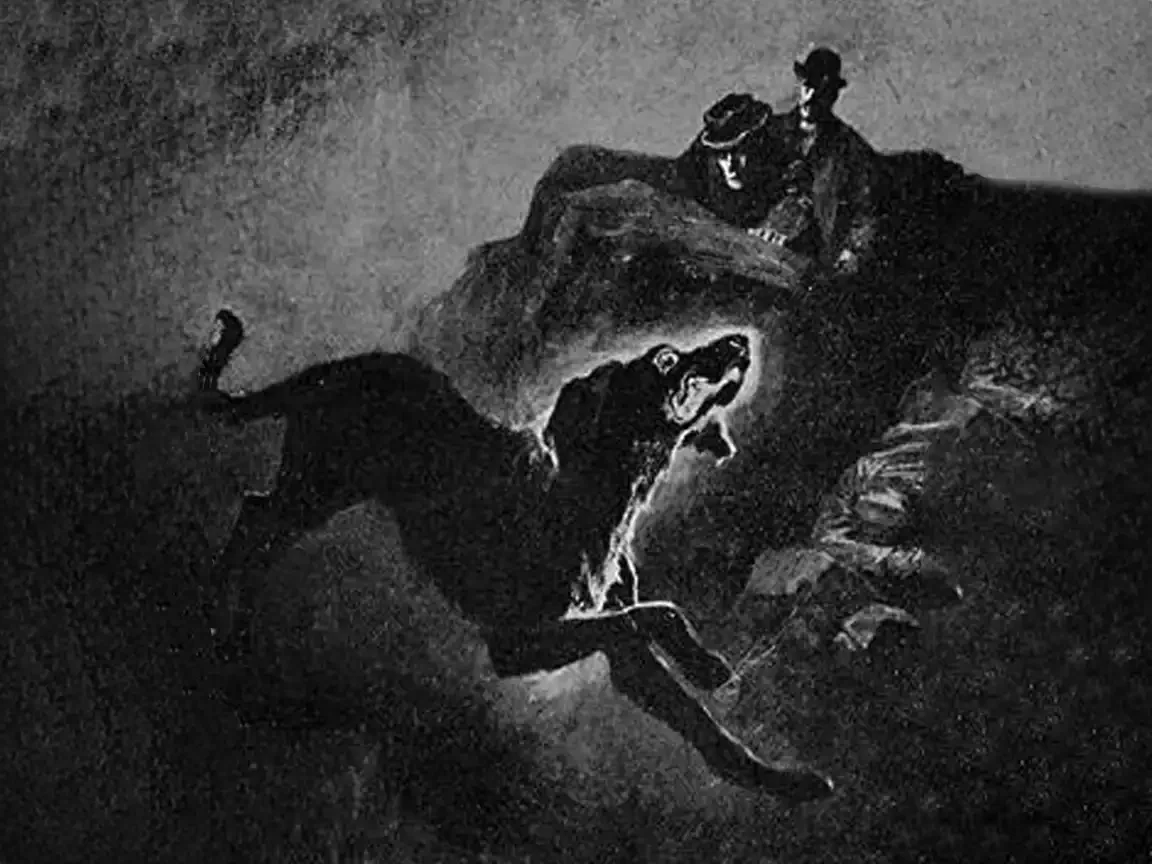
The phosphorescent hound bears down on its quarry — Sidney Paget's illustration for The Strand Magazine captured a fear that Dartmoor communities had lived with for centuries. Public domain, via Wikipedia Commons.
The Sepulchre
The tomb at Buckfastleigh is not built to honor the dead. It is built to contain them.
Richard Cabell of Brook Hall died in July 1677 — accounts vary on the precise year, with some sources giving 1672 — with a reputation so dark that his neighbors constructed what amounted to a stone cage over his grave. The mausoleum, known locally as The Sepulchre, stands in the churchyard of Holy Trinity Church on a rocky outcrop above the Devon town: three windowless walls, a pyramidal slate roof, and an iron-barred fourth wall through which visitors can see the chest tomb within. It was designed not so that visitors could look in, but so that Cabell could not get out.
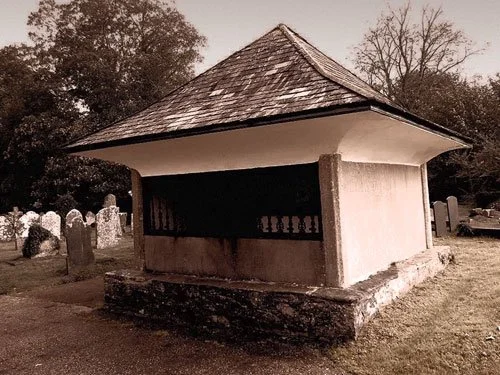
The Sepulchre at Buckfastleigh churchyard — Richard Cabell's iron-barred tomb, built to keep him in rather than keep visitors out. Public domain.
The story told about him is consistent across three centuries. He was a huntsman. He was wicked. He was rumored to have murdered his wife, though Elizabeth Fowell is believed to have outlived him by fourteen years. He was described as morally degenerate, deeply disliked throughout Buckfastleigh, and widely suspected of having sold his soul to the devil. On the night of his burial, the legend holds that fire-breathing black dogs raced across Dartmoor, surrounding Brook Manor, howling at the walls.
The village, taking no chances, put him under a heavy stone and a sort of pent-house was built over that with iron gratings to prevent his coming up and haunting the neighbourhood.
Children were still daring each other, well into living memory, to place their fingers through the keyhole. The belief was that Cabell would gnaw them off.
Before the Novel
The hound of the Baskervilles did not begin with Conan Doyle. It had been on Dartmoor for centuries.
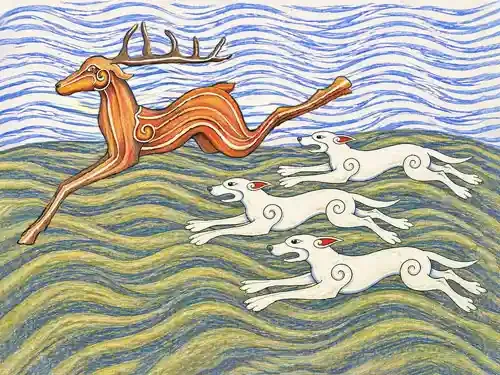
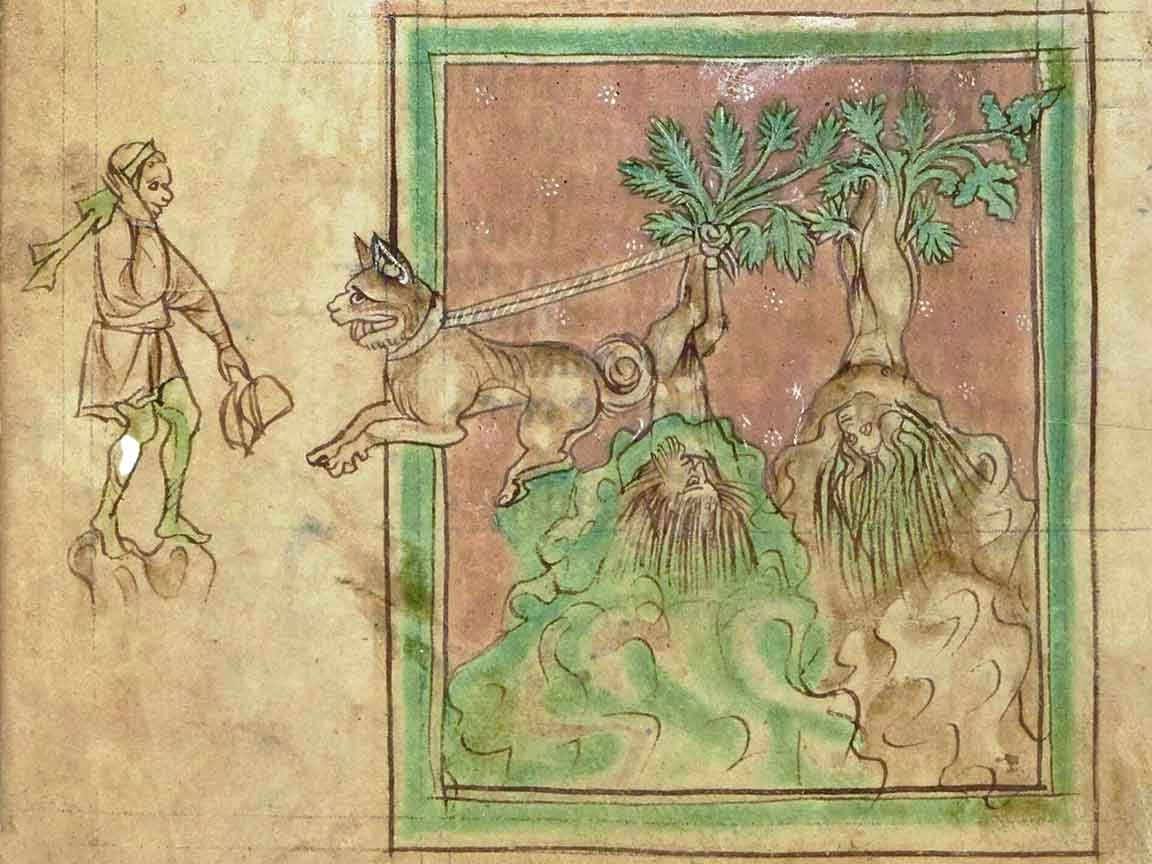
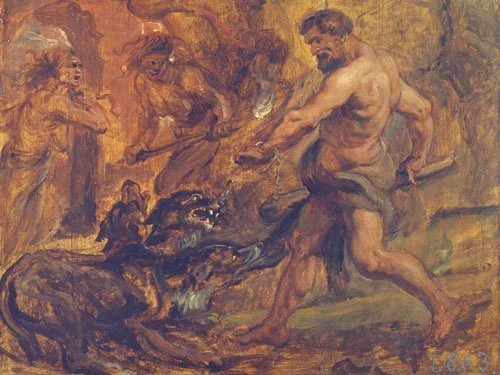
Dartmoor’s spectral dogs go by several names depending on which parish you ask and which century you’re consulting. The Wisht Hounds — “wisht” being a Devon dialect word for “ghostly” or “eerie,” possibly derived from an ancient name for Woden — appear in print from at least 1832, when the Quarterly Review described them: jet-black, breathing flames, followed by a swarthy figure with a hunting pole, visible on Sundays, audible in the loneliest recesses of the hills. The Yeth Hounds — from “yeath,” a Devon pronunciation of “heath” — are headless, and are said to be the souls of unbaptized children condemned to hunt the moors in spectral form.
The folklore writer William Crossing described them in his Folklore and Legends of Dartmoor with the kind of specificity that suggests he was recording something widely believed rather than inventing local color: what they hunted, nobody could say with certainty, but their quarry could have stood little chance, since their eyes glowed like balls of fire and were as big as saucers. Their home was Wistman’s Wood, an ancient gnarled oakwood on the high moor, some of whose individual trees may be five hundred years old. Their preferred hunting ground was the old road called the Abbot’s Way. Their huntsman, depending on the account, was the Devil, was Woden, was Sir Francis Drake, or was Richard Cabell himself — risen from his stone cage and leading the pack across the moor on the anniversary of his death.
Unbaptized infants were their particular quarry. So fervent was this belief that parents in remote Dartmoor farmhouses would place a piece of consecrated bread under a newborn’s pillow — a ward against the hounds — whenever bad weather prevented them from reaching a church before the child could be baptized. The fear was not symbolic. It was practical.
By the time Conan Doyle visited Dartmoor in 1901, this tradition had been documented in print for nearly seventy years and practiced in Devon communities for far longer. It was not legend in the antiquarian sense. It was living fear.
The Man from Ipplepen
The specific chain of events that produced The Hound of the Baskervilles began not on Dartmoor but on a ship from South Africa.
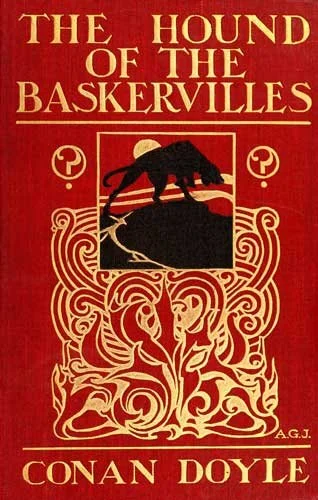
The first edition cover of The Hound of the Baskervilles, designed by Alfred Garth Jones, George Newnes Ltd., 1902. Public domain, via Wikimedia Commons.
Bertram Fletcher Robinson was a journalist — he would become editor of the Daily Express — who had grown up in Ipplepen, a village a few miles from Buckfastleigh. He was returning from South Africa on the same vessel as Conan Doyle in the summer of 1900, and he spent the voyage telling Doyle the dark stories of his Devon childhood: the Cabell legend, the Wisht Hounds, the hellhound tales of the moor. The following spring, Doyle came to Dartmoor to see the landscape himself. Robinson accompanied him as guide. Together they explored the bogs and tors of the high moor — the isolation, the prison at Princetown, the prehistoric ruins, the particular quality of the mist that fills the valleys and erases landmarks in the time it takes to turn around.
Robinson received a one-third royalty on the finished novel. By the end of 1901, that had amounted to more than five hundred pounds — a substantial sum that indicates how seriously Doyle valued what Robinson had brought him. The acknowledgment in the first edition is brief: “This story owes its inception to my friend Fletcher Robinson who has helped me.” What Robinson had actually provided was something older than either of them: a tradition that stretched back centuries and was still, in Devon farmhouses and on dark moorland roads, genuinely believed.
When asked in 1907 to identify the source of the story, Doyle replied that it was based on nothing save a remark of Robinson’s about a legend of a dog on the moor connected with some old family. It was a modest account of what had in fact been a thorough immersion in Devon’s darkest folklore.
The Spiritualist Writes a Rationalist
Here is the tension at the heart of the novel, and it is one that Conan Doyle carried in himself.
By 1901, the year he walked the Dartmoor bogs with Robinson, Doyle was already deeply committed to spiritualism. He believed in communication with the dead, attended séances, took mediums seriously, and would spend the last decades of his life as one of the most prominent public advocates for the supernatural in England. He believed that his own house was haunted. He would later defend, with complete conviction, photographs of fairies taken by two Yorkshire girls that have since been shown to be fabrications. Over the course of his life, he wrote more than a hundred articles and essays on spiritualism and delivered over fifty public lectures on the subject. His belief in the spirit world was not a passing interest. It was the organizing principle of his later years.
The detective he had made famous was Sherlock Holmes: the embodiment of pure rationalism, a man who operated entirely on evidence, logic, and the systematic elimination of the impossible. Holmes was, in many ways, everything Doyle’s medical training had produced and everything his deepest convictions had since overruled.
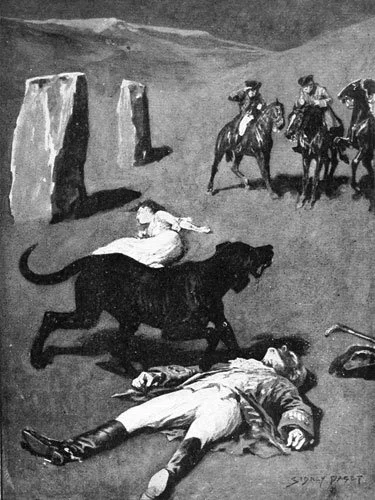
The hound strikes on the moor — Sidney Paget's illustration for The Strand Magazine. Public domain, via Wikipedia Commons.
The Hound of the Baskervilles is the only one of Doyle’s four Holmes novels to take a supernatural theme. In it, a family is haunted by a demonic hound stretching back to the English Civil War, when a wicked ancestor is said to have sold his soul to the devil. Holmes investigates. Every set of clues points toward a logical explanation. Holmes finds one. The hound turns out to be a real dog — a crossbreed of bloodhound and mastiff — painted with phosphorus to glow in the dark. The monster is a fraud. Rationalism wins.
But the novel only works because the fear is real first.
Doyle understood, from his own interior life, that rational explanation and genuine belief could coexist in a single person. His character Dr. Mortimer — a man of science, a medical professional — is utterly convinced that the Baskerville curse is supernatural. Holmes points out, with some impatience, that the moor is full of large dogs and that footprints constitute physical evidence. The reader feels the force of both positions at the same time. That equilibrium is not an accident of craft. It reflects the genuine tension Doyle carried between the scientific training of his youth and the spiritualist convictions of his maturity.
The hound of the novel is debunked. The tradition that produced it — the Wisht Hounds, the fire-eyed packs, the howling outside Cabell’s tomb — Doyle could not bring himself to dismiss in the same way. He borrowed from a living tradition of genuine fear, used it as the engine of a story whose resolution is rational, and left something unresolved underneath. That irreducible unease — the sense that Holmes has solved the case but not entirely answered the question — is what has kept the novel alive for more than a century.
After the Novel
The Hound of the Baskervilles was published in serial form in The Strand Magazine from August 1901 to April 1902. It was an immediate and overwhelming success. It was also, as Doyle had understood when he walked the Dartmoor bogs, borrowed rather than invented.
The Black Dog tradition did not end with the novel. Sightings were still being reported in the early twentieth century along Devon country roads — brief, restrained accounts from cyclists and night workers who described a large dark dog that did not move like a normal animal, did not react to sound or speed, and simply ceased to be there. A witness account from January 1905, three years after the novel’s publication, describes an encounter matching the centuries-old template: glowing eyes, impossible size, a creature that vanished mid-stride. The tradition Doyle had dramatized was still, in living communities, a matter of private concern.
The Sepulchre at Buckfastleigh still stands. Holy Trinity Church above it was gutted by arson in 1992 and remains a roofless ruin. The iron-barred mausoleum survived. Visitors still come to look through the bars at the stone beneath, to stand in the churchyard above the town at dusk, and to consider whether the heavy stone is doing its job.
Richard Cabell’s black dogs have not been officially reported recently. But the precise relationship between their absence and their non-existence is — as Conan Doyle might have said, if he were being honest — not entirely settled.
Did You Know?
The name “Baskerville” may have come not from Devon legend but from a far more mundane source: Robinson’s coachman during Doyle’s Dartmoor visit was named Harry Baskerville, who drove the two men across the moor as they scouted locations. It is as ordinary a source as possible for one of the most famous names in English fiction.
Phosphorus — the substance used to make the fictional hound glow — was widely available in Edwardian England. Whether a living dog could have survived repeated applications long enough for multiple outings is a detail the novel declines to examine.
The Hound of the Baskervilleswas written as a prequel, set before Holmes's death at Reichenbach Falls, allowing Doyle not to reverse his decision to kill him. The novel's success eventually forced his hand — Holmes was revived in The Adventure of the Empty House in 1903.
Wistman’s Wood — said to be the Wisht Hounds’ kennel — is one of Britain’s last surviving high-altitude temperate rainforests. Some of the trees are estimated to be four to five hundred years old, predating the Cabell legend and before the earliest written accounts of the hounds.
J.K. Rowling’s Harry Potter series draws directly from the same tradition: “the Grim,” a large black dog that appears as an omen of death in Prisoner of Azkaban is an explicit reference to British Black Dog folklore.