Prince Rupert’s Poodle: Good Boy or Devil Dog?
Prince Rupert’s poodle was condemned by Parliament as a witch’s familiar — bulletproof, prophetic, capable of vanishing into thin air. The joke, it turns out, may have started on his own side, and nobody involved could stop it.
Contemporary woodcut depicting Boy’s death at the Battle of Marston Moor, from “A Dog’s Elegy” (27 July, 1644). Boy is now a black dog – a true sign of his satanic origins – shot by a musketeer as a witch looks on. Artist unknown, Public domain, via Wikipedia Commons.
On the evening of July 2, 1644, a white dog broke free of the rope that had kept him safely out of what is often described as the largest battle ever fought on English soil, and ran straight into it, looking for one man among tens of thousands.
He found smoke, cannon fire, and a cavalry rout. He did not find Prince Rupert of the Rhine in time.
By the next morning, Parliamentarian writers were already composing his obituary as a joke. Boy - sometimes Boye, sometimes Puddle - a white hunting poodle who had spent two years as perhaps the most talked-about animal in England was dead. Pamphleteers had spent two years insisting he was bulletproof. Now they had their proof that he was not, and they intended to enjoy it.
What almost nobody noticed, then or since, is that the people who started calling Rupert's dog a devil may well have been laughing at their own side first.
A Prince with Nowhere to Belong
Prince Rupert of the Rhine, painted in exile by Gerrit van Honthorst (c.1630-1656), court painter to the Hague years before Rupert saw an English battlefield. Public domain, via Wikipedia Commons.
Rupert had been losing places his whole life before he ever lost a battle. He was born in Prague in 1619, the son of Frederick V, Elector Palatine, and Elizabeth Stuart, daughter of England's King James I. Within a year his father's brief, disastrous claim to the Bohemian crown collapsed at the Battle of White Mountain, and the family fled into exile. Rupert grew up mostly in The Hague, a prince of nowhere in particular, fluent in several languages and attached to none of the courts that sheltered him. By his late teens he was already fighting other people's wars on the Continent.
In 1638 he was captured at the Battle of Vlotho and held for three years at the fortress of Linz, a prisoner of the Holy Roman Emperor. It was there, around the age of twenty, that Thomas Howard, Earl of Arundel — an English nobleman uneasy at the thought of a young prince losing his mind in confinement — arranged for him to receive a dog: a rare white hunting poodle, of the kind bred on the Continent to retrieve waterfowl from cold water. Some accounts suggest there were originally two such dogs, one white and one black, and that the black poodle was lost early; only the white one survived. Whichever the truth, one dog became Rupert's constant company through years of uncertain captivity, and the attachment never loosened.
When his release was finally negotiated in 1641 — on a promise never again to take up arms against the Emperor specifically, a condition that left him entirely free to fight anyone else — Rupert sailed for England with his brother Maurice, and with the dog. Nobody in London had seen anything quite like him: a large, pure-white poodle, at a time when the breed scarcely existed in Britain. Before he was a Royalist mascot or a Parliamentarian devil, Boy was simply a curiosity, a rumor with four legs, trotting at the heel of a prince nobody in England had met yet either.
The Prince's Shadow
In Royalist parodies, Boy was said to be a 'Lapland Lady' who had been transformed into a white dog. Painting attributed to Rupert's sister, the artist-princess Louise Hollandine of the Palatinate. Public domain, via Wikimedia Commons
Civil war broke out within a year, and Rupert, twenty-two and largely untested in independent command, was made General of Horse for the Royalist cavalry. He proved electrifyingly good at it and dangerously hard to control once a charge began; Parliamentarian writers accused him of needless brutality during the sack of Birmingham in 1643, and his reputation, on both sides, ran ahead of him everywhere he went. He was young, foreign-accented, and impossible to ignore. So was his dog.
Boy slept in Rupert's bed. He was, by several accounts, indulged by the royal children and fed roast beef and capon by Charles I's own hand. He rode with the army, was present at sieges, and became familiar enough at court that satirists could assume their readers already knew exactly what he looked like before they got to the jokes. A foreign prince this visible was always going to attract propaganda. What nobody quite planned for was that his dog would attract more of it than he did.
The Devil Wears Wet Fur
England in the early 1640s was a country newly anxious about witches. The same decade that produced Boy's legend would soon produce Matthew Hopkins, the self-appointed "Witch-Finder General," and a wave of trials across East Anglia. Accusing an enemy's pet of being a demonic familiar was not an abstract joke in this climate; it borrowed the texture of something many readers took seriously elsewhere.
Title page of Observations Upon Prince Rupert's White Dogge, Called Boye (1642); it already exaggerates Boy into something closer to a lion than a poodle. Public domain, via Wikipedia Commons.
The earliest jab came from Rupert's own camp. The Royalist poet John Cleveland, needling Parliament's fear of the prince more than the prince himself, described the dog in verse as "that four-legg'd Cavalier." Then, in 1642, a ten-page pamphlet appeared under the title Observations Upon Prince Rupert's White Dogge, Called Boye, presented as the sober findings of a spy employed by "some of quality in the City of London." It read like an exposé and itemized the dog's powers in flat, bureaucratic detail. He could prophesy. He could locate buried treasure. He understood every human language but concealed the fact. He was, the pamphlet insisted, "weapon-proofe himself," and had likely rendered his master weapon-proof by association. He could travel invisibly between Oxford and London more often than the regular carriers did. He had personally engineered the prison escapes of several Royalist officers. And, readers were assured with a perfectly straight face, he cocked his leg whenever he heard the name of John Pym, Parliament's leading voice against the king.
Marston Moor
By the summer of 1644, Boy had survived two years of being called a witch, a spy, and the literal devil in print. On July 1, Rupert's cavalry relieved the besieged Royalist city of York. The next evening, on the open ground of Marston Moor to the west, his combined force faced the Parliamentarian and Covenanter armies under Lord Fairfax, the Earl of Manchester, and the Earl of Leven — by most accounts the largest battle the civil wars would produce.
The attack came late in the day and came hard. Rupert's horse was shot from under him; he took cover in a bean field while his cavalry, the single asset his entire reputation rested on, broke and scattered. It was the first major defeat of his career, and it cost the king effective control of the north of England in a single evening.
Boy had been tied up well back from the fighting, kept deliberately out of harm's way. He broke free anyway and went looking for his master across ground that, by nightfall, had killed or wounded more men than any other engagement of the war. He never reached him. A contemporary chronicler on the Parliamentarian side, Simon Ash, noted specifically in his account of the battle that this "much spoken of" dog had been killed in the fighting — proof, if anyone needed it, that the most famous animal in England still mattered enough to name. Woodcuts soon circulated showing him lying dead on the field, beside the wreckage of an army that had, until that evening, seemed unbeatable.
A Dog's Elegy
Title page of A Dog's Elegy, or Rupert's Tears (London, printed for G.B., 27 July 1644) — Parliament's mock-poem on Boy's death at Marston Moor. Public domain, via Wikipedia Commons.
Parliamentarian writers did not let the moment pass quietly. Within weeks, a mock-elegy appeared: A Dog's Elegy, or Rupert's Tears for the Late Defeat at Marston Moor, gloating in verse over the death of "his beloved dog named Boy." The joke had come full circle. A creature once solemnly declared bulletproof had been shot like any other dog, on the same field where Rupert's own invincibility had also quietly ended. For the pamphleteers who had spent two years building him into a monster, the timing was too neat to leave alone, and they treated it as a verdict the war itself had handed down.
What became of Boy's body afterward was never recorded by anyone on either side. Marston Moor swallowed thousands of men and the Royalist cause in the north along with them; one white dog, however notorious, did not rate a grave that anyone thought worth marking. The most talked-about animal in England simply stopped appearing in the record, in the same week the war itself turned.
Did You Know?
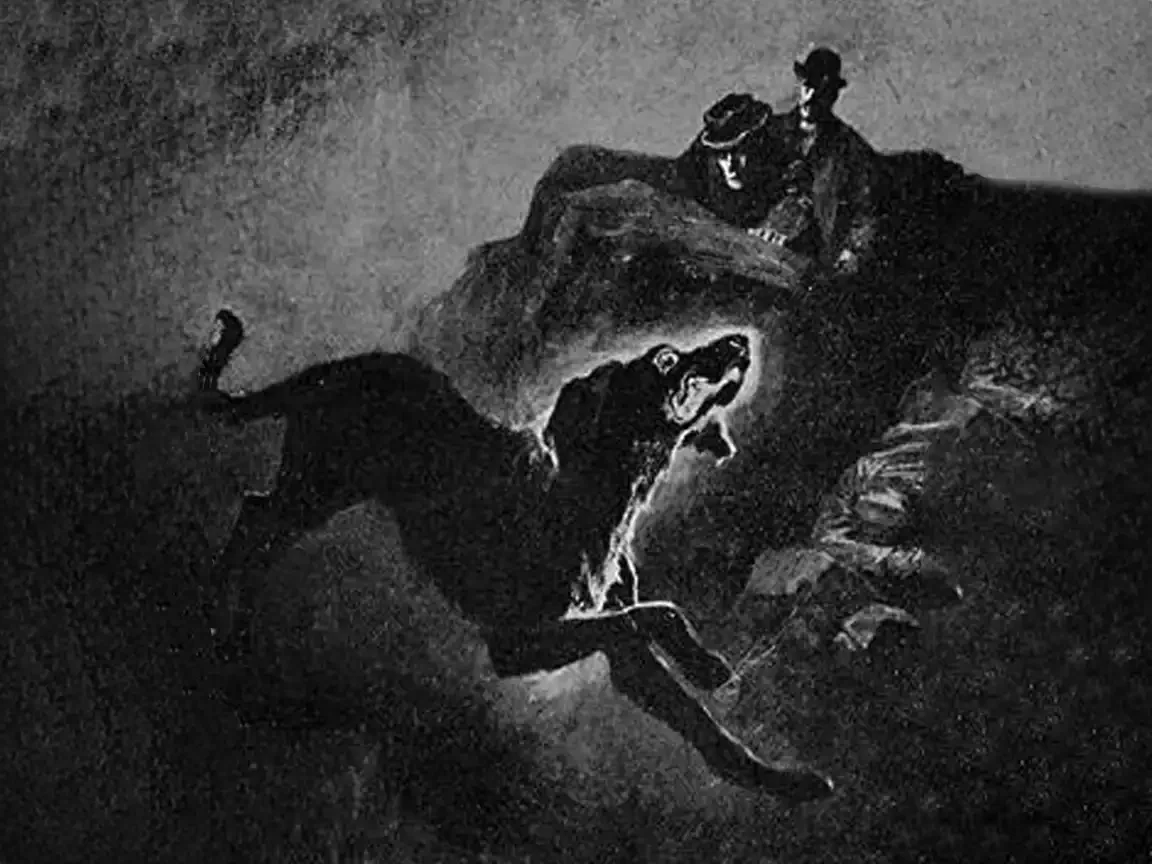
The witch’s-familiar trope had company. Our own story on the legendary Black Dog explores the same fear of canine familiars that fueled Boy’s reputation.
A 1643 pamphlet on the sack of Birmingham shrank Boy into a tiny lion crouched at Rupert’s horse, proof the joke had outgrown the dog himself.
John Cleveland, the poet who coined the line “that four-legg’d Cavalier,” was later arrested and briefly imprisoned by Parliament for his Royalist pamphleteering.
Historian Mark Stoyle, who has studied the pamphlets most closely, says nearly everything reliably known about Boy could fit on the back of a beer mat.
Later tradition holds that Boy held the honorary rank of “Sergeant-Major-General” and was Britain’s first official army dog. Both claims rest on thin, much-repeated sourcing.
Breed: Standard Poodle| Country of origin: Germany (also claimed by France) | First use: Hunting retrieving waterfowl | Origins: 15th century