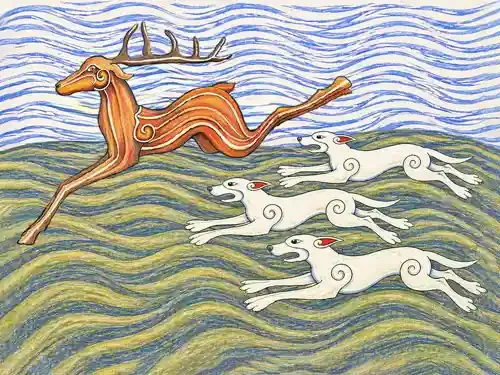
Garmr is remembered as the blood-stained hound chained at the gate of Hel, the Norse underworld. Read the old poems, though, and the blood belongs to another dog, the gate to someone else, and the road down was never empty.
An illustration to Baldrs draumar. Odin gallops down toward Hel while the dog heads up the road the other way. Here it lets him pass. W. G. Collingwood, 1908. Public domain, via Wikimedia Commons.
The dog came up out of Hel to meet him. Odin had saddled Sleipnir and ridden down toward Niflhel to wake a dead prophetess and ask about his son Baldr's dreams, and on the road something found him first. It was bloody across the front of its breast, and it bayed at him for a long time. Odin rode on.
For more than a century, English readers have known that dog by a name: Garmr, the great hound chained at the gate of Hel. The poem, Baldrs draumar, never names the dog, and puts it on the road rather than at any gate. What the poem calls it is hvelpr, a whelp. In plain English, a puppy. That leaves Garmr to be found somewhere else in the old poems, and the dogs who really went down that road still to be accounted for.
The Hound Before the Cave
Garmr himself is not hard to find. He is loud. In Völuspá, a prophetess tells Odin how the world will end, and as the last days of the gods arrive she keeps returning to one line. In Henry Adams Bellows's 1923 translation it reads: "Now Garm howls loud before Gnipahellir, / The fetters will burst, and the wolf run free." The poem sounds it three times, and each time the end is closer. Garmr's howl is the alarm.
Another poem treats him with something closer to pride. Grímnismál lists the best of everything: Yggdrasil of trees, Odin of gods, Sleipnir of steeds, "and Garm of hounds." The word there is hundr, a plain dog. In Völuspá the creature that runs free is a freki, a ravener, a word used for wolves, and scholars still disagree over whether Garmr and the wolf Fenrir are one animal or two.
Around 1220 the Icelander Snorri Sturluson gave Garmr the rest of his career. In Snorri's Prose Edda the dog is bound before Gnipahellir, breaks loose when the world ends, and meets the god Tyr, and "each become the other's slayer," in Arthur Brodeur's 1916 translation. Snorri never explains the match. Tyr was the god who had put his hand in Fenrir's mouth while the other gods chained the wolf. The wolf kept the hand.
None of these passages says where Gnipahellir is. None puts Garmr anywhere near the dead. To find who did guard that road, it has to be followed down.
Watchdogs Who Slept in Shifts
Norse myth did set dogs at doors. In Fjölsvinnsmál, a late poem preserved only in 17th-century paper manuscripts, two hungry hounds named Gif and Geri guard a hall. "One sleeps by night, the next by day," as Bellows has it, so no visitor could ever get past both. The only thing that distracts them is a particular meal: the wing-joints of a cock.
The gate of Hel had a guard as well, and Snorri describes it. When the god Hermod rides to Hel to bring back the dead Baldr, the road runs downward and northward to a bridge thatched in gold. A maiden named Modgud keeps the bridge and questions him. Past her, he reaches the gate of Hel, and his horse jumps it. In the one text that describes the gate of Hel and the one who keeps it, the keeper is a woman, and the only animal at the gate is a horse going over the top.
The bloody whelp that met Odin was on that road, coming up from below. It bayed, and it let him pass.
A Hellhound Assembled
By 1930 the poem’s unnamed whelp had become Garm, and in this plate he no longer lets Odin pass. C. E. Brock, The Heroes of Asgard, 1930. Public domain via MyNDIR.
Garmr and the bloody whelp were never the same dog in the poems. Translators and academics made them one, centuries later. In 1883 the scholars Guðbrandur Vigfússon and Frederick York Powell translated Garmr's line, found no hell-hound in it, and supplied one in brackets: "[the hell-hound]." In 1923 Bellows's footnote called Garm "the dog who guards the gates of Hel's kingdom" and pointed readers to the bloody whelp. In the notes and translations, a howling dog at a cave, a whelp on a road and a gate kept by a maiden merged into one animal.
The dog at Hel’s gate is hard to find in the sources. The dogs that went down the road to the dead are easier to find. They lie in graves across the Viking world.
Sent Down With the Dead
The people of the Viking Age did send dogs to the dead, and the evidence is bones. In 921 or 922, an envoy from Baghdad named Ahmad ibn Fadlan watched the funeral of a Rus chieftain on the Volga. Before the ship was burned, a dog was cut in two and thrown aboard; horses, cows, a cock and a hen followed it. The Rus were traders of Scandinavian descent a long way from home, and Ibn Fadlan was an outsider describing a rite he did not fully understand. Still, in his account the dog goes first.
Gilded fittings from the Ladby grave, c. 925 (inset), and a modern reconstruction of the whole leash, available to buy from the True History.
Around 925 a majestic 22-meter-long Viking warship was hauled ashore at Ladby, on the Danish island of Funen. The vessel was transformed into a grand burial chamber for a powerful king or chieftain. Discovered in 1935, the Ladby ship remains Denmark's only known Viking ship burial. The dead ruler buried in it with eleven horses and probably four or five dogs of different sizes. Among the finds is a gilded bronze fitting from a dog's leash.
At Gamla Uppsala in Sweden, the archaeologist Christopher Nichols has studied three dogs from a late Iron Age boat-grave cemetery, all buried whole. Two were tall, slender sight hounds, a male and a female. The female had a broken premolar and an abscess on one ankle, and her lower canines were worn, Nichols suggests, from carrying or tugging. She had a life behind her before she went into the ground.
Nichols reads the dog as a possible guide for the dead, moving from a sacrifice in its master’s grave to “an essential companion.”
Where the Poems Leave Garmr
Garmr's story ends where the poems leave it. He howls before the cave, he is the best of hounds, and at the end of the world he kills Tyr and dies. The gatekeeper of Hel lives on in English footnotes. The dogs who actually went down the road to the dead are still coming out of the ground.
Did You Know?
No dog would attack Odin. In the prose that opens Grímnismál, King Geirrod is told to seize a stranger whom no dog is fierce enough to jump at. The stranger is the god himself, in disguise.
Sherlock Holmes once hunted a hellhound. The black-dog legends of Dartmoor lie behind Arthur Conan Doyle's The Hound of the Baskervilles (1902). [Link: 27: Black Dog: The Dartmoor Terror Behind The Hound of the Baskervilles]
Geri was both a watchdog and a wolf. The same name belongs to one of the two hall hounds of Fjölsvinnsmál and to one of the two wolves Odin feeds from his own table in Grímnismál.
Garmr and Cerberus may share a growl. The historian of religion Bruce Lincoln traced both names to one ancient root meaning "to growl." The classicist Daniel Ogden counters that the two names need two different roots.
Uncover More Dogs History Almost Forgot…
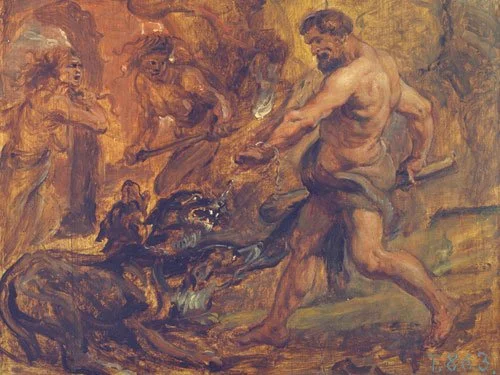
Odin rode past a bloody whelp on the road to Hel. Other dogs stood at the edges of death too — the hound Rubens painted in 1636, the ghost hounds of medieval Wales, and a greyhound whose grave near Lyon would not stay quiet.