The Hounds of Annwn: Wales’s Ghost Dogs Were Never Hellhounds
The white-and-red-eared pack that haunted the Welsh night sky weren’t demons. They were something stranger and more purposeful: the most prestigious hunting dogs in Wales — and their quarry was souls.
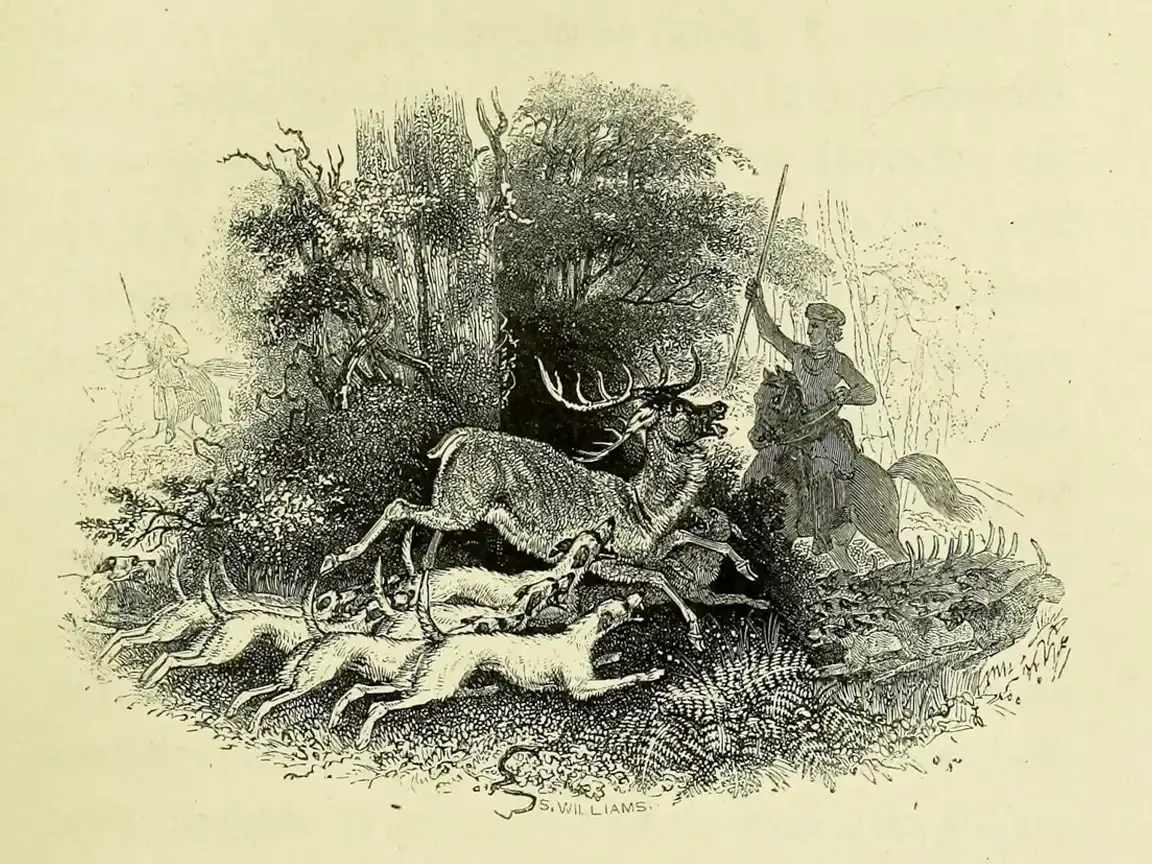
Hounds bring down a stag as a mounted hunter arrives — the scene Pwyll encounters in the forest of Glyn Cuch. Engraving by S. Williams from The Mabinogion from the Llyfr Coch o Hergest, and other ancient Welsh manuscripts / with an English translation and notes; by Lady Charlotte Guest, 1838-49. Welcome Collection licensed under CC BY 4.0
The stag was already down when Pwyll, Prince of Dyfed, arrived at the clearing in Glyn Cuch. A pack of dogs he had never seen before stood over the carcass — white as new wool, their ears the red of old iron, their voices still hanging in the cold air between the trees. Pwyll did what any Welsh nobleman would do when a rival’s pack had made the kill first: he drove the strange dogs off and let his own hounds take possession of the stag.
It was a reasonable decision. It was also an insult that would cost him a year of his life.
The animals he had chased from the clearing were not strays from a neighboring estate. They were the Cŵn Annwn — the Hounds of the Otherworld — and the man whose hunt he had interrupted was Arawn, King of Annwn itself. When Arawn appeared from the trees, his displeasure was not supernatural thunder and wrath. It was worse: the cold, measured disappointment of a king whose finest animals had just been treated as mongrels.
What the Mabinogion establishes in this opening scene — and what centuries of folklore would later obscure — is that the Cŵn Annwn were not monsters. They were the envy of every hunting lord in Wales.
The Finest Pack in the Kingdom
In the earliest Welsh mythological tradition, Annwn (pronounced roughly an-oon) was not hell. It was the Otherworld — a realm not of punishment but of abundance, a parallel Wales that existed alongside the visible one. Its king, Arawn, was a figure of dignity and power, and his hunting pack was the most visible expression of that status.
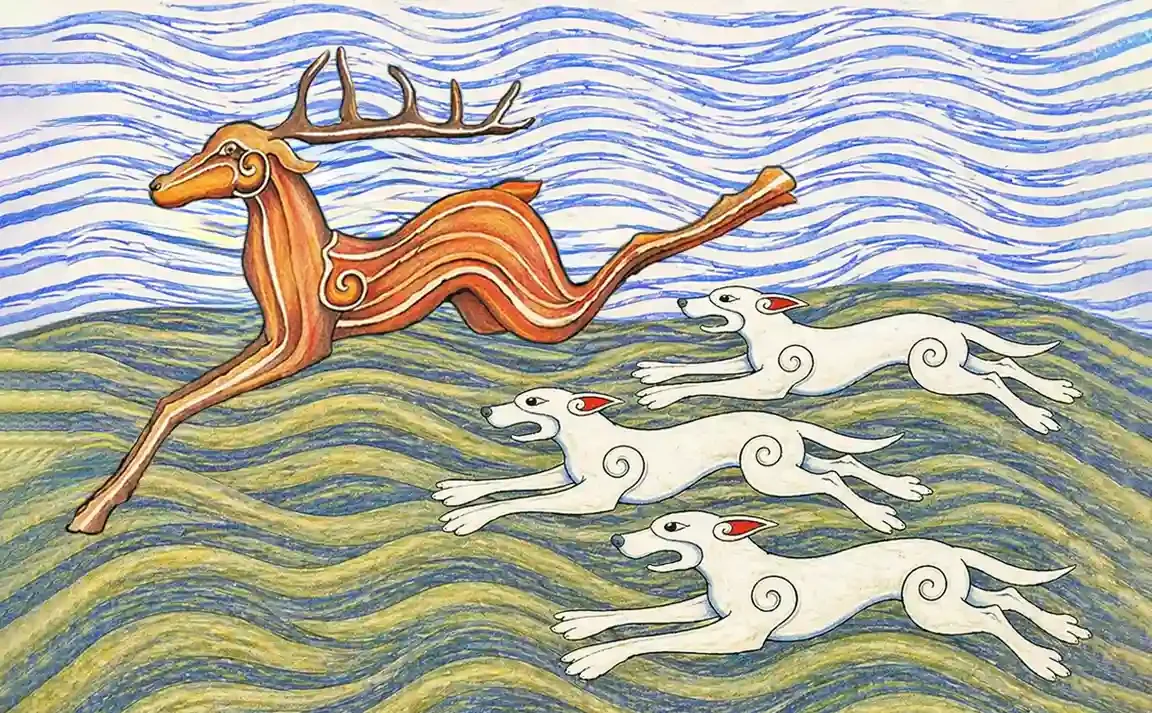
The Cŵn Annwn in pursuit of a stag — white-bodied, red-eared, and fast. Their coloring in Welsh myth was a mark of Otherworldly nobility, not menace. AI-generated illustration after painting attributed to Deb Holman.
The Cŵn Annwn’s description in the Mabinogion is precise: white bodies, red ears. This coloring was not arbitrary. In Celtic tradition across Britain and Ireland, white animals with red ears were consistently associated with supernatural origin — fairy cattle, Otherworldly horses, and hounds all share the marking. But the choice of white carried practical symbolism too: in a culture that hunted by sight as much as scent, a pale hound visible against dark woodland was a valuable animal, and a pure white one was extraordinary.
Extraordinary was exactly the point. The Laws of Hywel Dda — the 10th-century Welsh legal code attributed to the prince of that name — established that a trained hunting hound was worth more than a horse. Not metaphorically. In the legal schedules of compensation for stolen or killed animals, a greyhound or staghound commanded a higher price than the riding horse of a free man. Dogs were property of the highest order, and a king’s hunting dogs were a statement of sovereignty.
Arawn’s pack, in this context, was a theological argument made in animal form. To own the finest hounds in Wales was to be its highest lord. To own hounds beyond compare — gleaming white, red-eared, voices that carried across the sky — was to rule a kingdom beyond Wales entirely.
Their role in the earliest myths was correspondingly clear-eyed. They hunted stags in the forest of Glyn Cuch. They ran with the speed of sighthounds and the endurance of mountain dogs. They were not sent to terrify the living. They were working animals doing the most prestigious work available to a dog in medieval Wales: they hunted with a king.
What the Church Did to the Pack
Christianity reached Wales gradually, and its relationship with the older mythology was not always one of direct replacement. Welsh monks wrote down the Mabinogion stories rather than destroying them; the Otherworld was not immediately relabeled as hell. But over the centuries, the pressure of Christian cosmology reshaped what Annwn meant, and with it, what its hounds were.
If Annwn was the realm of the dead, and its king commanded the dead, then the dogs who herded souls across the sky were no longer noble working animals on a divine hunting estate. They became psychopomps — guides of the dead, their role shifting from the hunt to the escort. This transition had its own logic. The idea that death was not random but purposeful, that souls were gathered and accompanied rather than simply extinguished, carried genuine theological weight.
But the trajectory did not stop there. By the early modern period, the Cŵn Annwn had acquired a third identity: hunters of the wicked. A man who had wronged others, who had died unrepentant, might hear them coming. They would chase him across the sky until he could run no longer, mirroring, as folk accounts put it, what he had done to others in his life. The noble hunting pack had become an instrument of moral accounting.
Edmund Jones knew this version intimately. Jones — an 18th-century Nonconformist minister in Aberystruth, known to his contemporaries as the Prophet of Aberystruth — treated the Cŵn Annwn as literal, physical facts, divine instruments deployed by God to warn the living of impending death. His A Relation of Apparitions of Spirits in the County of Monmouth and the Principality of Wales (1780), a serious work of pastoral theology rather than folklore entertainment, recorded the dogs’ “yelling” in the night as divine warning. The hounds were God’s bailiffs, and when their voices rose in the dark, someone’s account was about to be settled.
Jones died in 1812. His books were reprinted and widely read in the late Victorian era, when Wales was losing something it could not quite name.
A Woman Who Refused Heaven
She appears in several accounts under different names, but the Welsh form is Mallt-y-Nos: the Woman of the Night. She was, the stories say, a noblewoman who loved hunting above all earthly pleasures. When she was told that there would be no hunting in heaven, she made a declaration that the accounts preserve with unnerving consistency: “If there is no hunting in heaven, then I would rather not go.”
Her wish was honored. Not as a mercy.
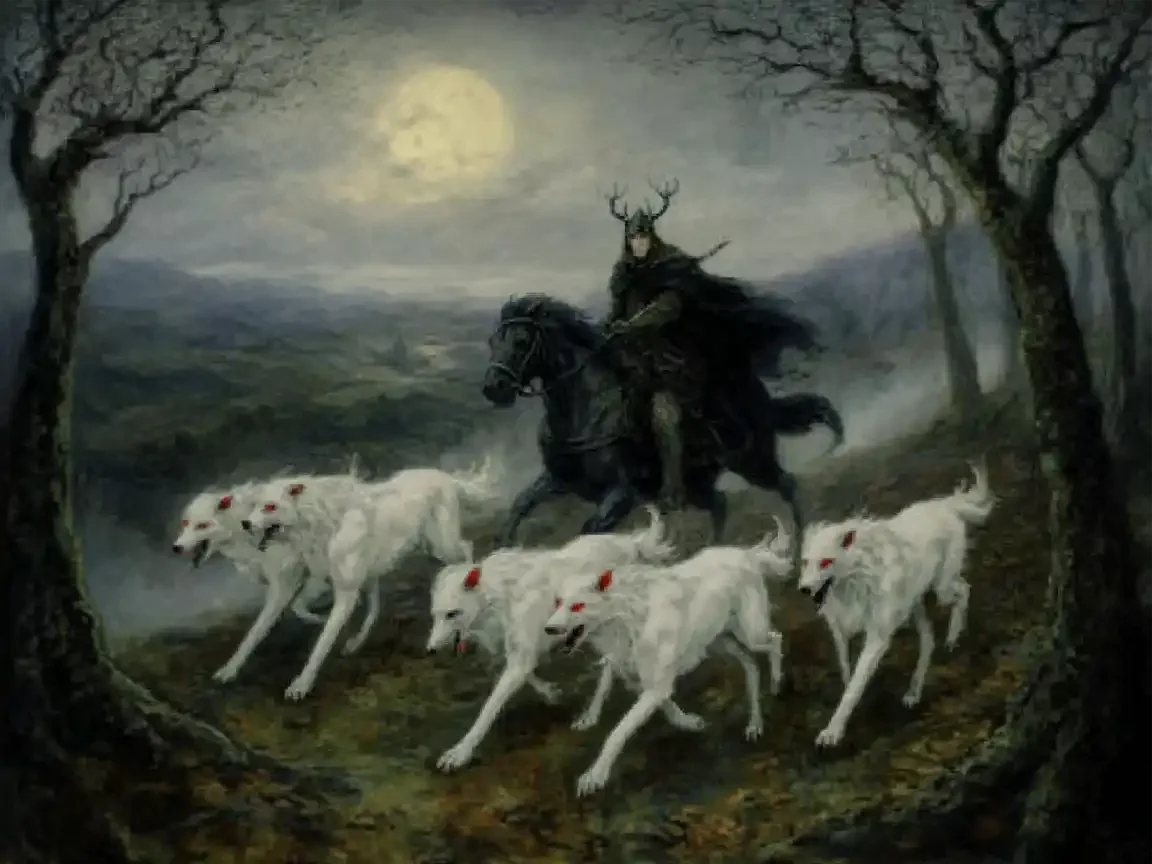
The Wild Hunt rides on — the Cŵn Annwn running ahead, their rider behind. Mallt-y-Nos follows, forever. AI-generated illustration.
Mallt-y-Nos rides with the Cŵn Annwn forever, her voice joining the pack’s cry in a sound that the folklore describes as shrieking — different from the hounds’ baying, higher, edged with something the accounts refuse to name as grief but that neighbors it closely. She does not lead the hunt. She is condemned to follow it. The dogs run ahead; she pursues, eternally and without arrival, through the cold sky over Wales.
She is the human note in the myth, the element that keeps it from being purely theological machinery. A woman who wanted what she wanted and got it, in the worst possible sense. The hunt goes on forever. And she, who loved it more than salvation, is part of its sound.
What Marie Trevelyan Heard
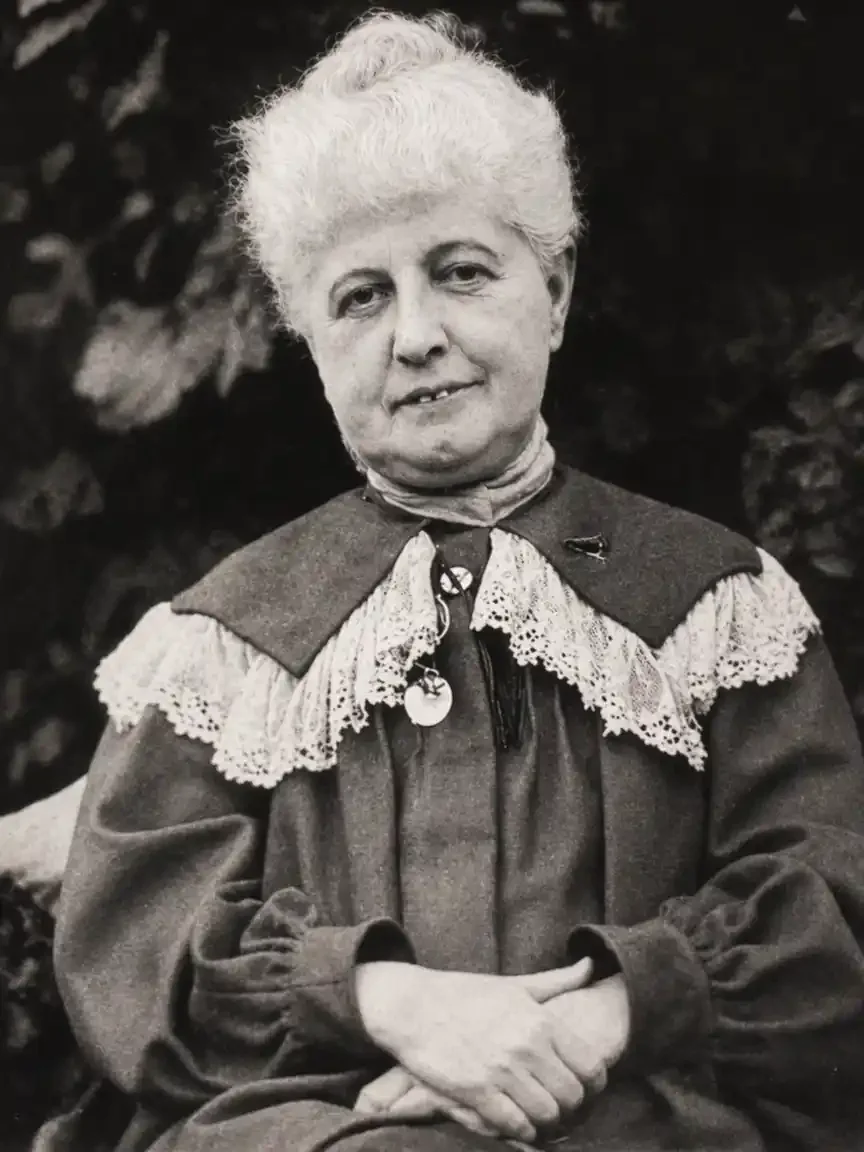
Marie Trevelyan was a pen name used by Emma Thomas (1853–1922), whose fieldwork in the Vale of Glamorgan produced the most detailed surviving accounts of the Cŵn Annwn's howling. Public domain. AI-restored photo.
By the 1890s, the industrial revolution was consuming the Welsh valleys at a pace that alarmed everyone paying attention. The collieries and ironworks were not merely changing the landscape; they were dismantling the world in which the old stories had circulated. The folklorist Marie Trevelyan understood that the window for collecting what remained was closing.
Trevelyan traveled the Vale of Glamorgan and the more remote upland valleys, interviewing elderly residents whose grandparents had grown up entirely within the oral tradition. What she gathered was eventually published as Folk-Lore and Folk-Stories of Wales, a volume that remains one of the primary sources for Welsh folk belief. Her informants described the howling of the Cŵn Annwn with a consistency and specificity that is striking at this distance.
The sound, they told her, was non-directional. You could not locate it to the north or south. It seemed to arrive from the air itself, from everywhere at once. The acoustic quality was strange: the pack’s voice was loudest when it was farthest away, high in the clouds, and became a thin, shivering whimper as it passed directly overhead. The lead hound’s howl came first, a single note that carried across the valley; then the rest of the pack, in a sequence that built and built before fading toward the hills.
In the remote valleys of mid-Wales, the howling was associated with specific nights — St. John’s Eve, the evenings of heavy autumn mist. The belief recorded by Trevelyan’s informants was not that the pack would harm the listener. It was that someone nearby would soon die. The Cŵn Annwn had not come to kill. They had come to collect.
The Geese
In the same decade that Trevelyan was walking the Vale of Glamorgan with her notebooks, naturalists were publishing a different kind of account in academic journals. They had noticed something.
The Brent Goose migrates through Wales in autumn and winter, flying in large formations at night, often at altitude. Its call — a rhythmic, rapid, yapping cry, repeated in sequence by bird after bird down the formation — carries extraordinary distances in cold air. From the ground, with no visual reference point against dark cloud, the sound is precisely what Trevelyan’s informants described: non-directional, appearing to come from the air itself, loud when distant and difficult to locate when directly overhead. A formation of several hundred birds sounds, at a distance, like a pack of small hounds baying in the dark.
The Seven Whistlers — a related folk belief recorded across rural Wales and England, naming a group of spectral birds or spirits whose call presaged disaster — may be the same phenomenon, approached from a different angle. Rural people across two centuries may have been hearing the autumn goose migrations and representing them, with considerable sensory accuracy, as something else entirely.
None of this makes the accounts less interesting. A myth that persisted from the pre-Christian era into the 1890s, reshaped by Christianity, refined by Nonconformism, and still heard by elderly farming families in remote valleys — that is a myth with extraordinary structural integrity. That it was built, in part, on the calls of migrating geese says something about the depth of the need it addressed. The dead have to go somewhere. Something has to escort them. And the sound of that escort, rising and falling in the dark sky over Wales, is exactly what those people heard.
Trevelyan published in 1909. Her informants were old when she spoke to them; the world they described was already receding. There are no reliable first-hand accounts of the Cŵn Annwn’s howling from the 20th century — or rather, none that can be distinguished from revivalists retelling Trevelyan back to herself.
But in the Vale of Glamorgan, every autumn, the Brent Geese still pass. They fly at night, in formation, calling to each other across the dark sky above Wales. If you stand in a field at the right moment, in the right kind of cold, on a night without moon, the sound that arrives from nowhere and fades back into it is exactly what those old Welsh farmers — who are gone — once said it was.
You would not argue with them. Not standing there, in the dark. Not with that sound overhead.
Did You Know?
The Welsh Laws of Hywel Dda specified that a greyhound could not be given as a gift to anyone below the rank of king or nobleman — making them, legally, aristocratic animals that commoners could not receive even as presents.
The Cù-Sìth of Scottish Gaelic mythology — a supernatural green dog of the Highlands — was said to bark exactly three times before killing its quarry, giving the victim time to reach safety. Or not.
Black Shuck — the spectral black dog of East Anglia — reportedly ran through St Mary's Church in Bungay, Suffolk, in August 1577, killing two worshippers. The event was recorded in a contemporary pamphlet and is still commemorated on Bungay's town coat of arms.
In the medieval Welsh poem Preiddeu Annwfn (The Spoils of Annwn), attributed to Taliesin, King Arthur leads a raid on the Otherworld and loses most of his men. Of the original company, only seven return.
Gwyn ap Nudd, the later commander of the Cŵn Annwn, was said by medieval Welsh chroniclers to dwell inside Glastonbury Tor — the Somerset hill long associated with the entrance to the Otherworld in both Welsh and English tradition.
Welsh folklorist Emma Thomas published under the pen name Marie Trevelyan, as women writers often did in the Victorian era. Her Folk-Lore and Folk-Stories of Wales remains a primary source for Welsh oral tradition more than a century after her death.