The Dogs of The Little Folks of Animal Land
In 1915, as the wider world lurched toward war, Harry Whittier Frees built a miniature Edwardian society where puppies teach, cook, and parent in tiny trousers and dresses. The charm endures—along with the awkward modern question: should they?
Blink was weighed every week, The Little Folks of Animal Land by Harry Whittier Frees, 1915. Public domain, via Wikipedia Commons
Inside Harry Whittier Frees Animal Nursery
Tucked among the buttoned-up rituals of Edwardian childhood, embroidered samplers, alphabet primers, and straight-backed chairs, there was a curious little world where puppies wear dresses and trousers, act as teachers and nursemaids, and bake pies and grow flowers. This isn’t a forgotten fairy tale, but The Little Folks of Animal Land, a 1915 children’s book where real animals, mostly dogs and cats, are photographed playing the parts of adults and well-behaved children.
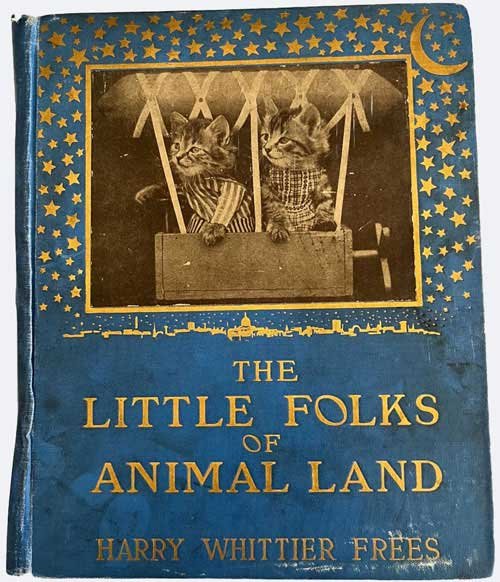
Internet Archive. Public domain
This enchanting realm was the brainchild of American photographer Harry Whittier Frees, a pioneer of anthropomorphic animal photography with more patience than most. A collection of charming tableaux featuring impeccably dressed animals, with canines often stealing the show. More than a century on, as we gaze upon these peculiar yet captivating images, questions arise: Who were these canine models? What was the world like when these pictures were taken? And how, in 2025, do we reconcile their undeniable charm with our modern understanding of animal welfare?
Meet the Cast: Dogs With Jobs
Harry Whittier Frees (1879–1953) was no ordinary photographer. Not content with snapping stiff portraits or still-life arrangements. His genius lay in turning pets into people, without taxidermy, trickery, or cruelty. His models were alive, and most often under six months old (puppies being easier to dress and pose).
In The Little Folks of Animal Land, the dogs aren’t decorative sidekicks. They having leading roles. There’s:
Mr. Adam Fourpaw (father), fond of sports, dancing and good at domestic chores.
Mrs. Fourpaw (mother), a devoted mother to sons Blink and Wink.
Blink Fourpaw (son), a friendly happy child who liked to box.
Miss Kindeyes, a kindergarten teacher.
Barker, a cook and general maid to the Bufkin family, and a piano player.
Hilda, new maid to the Bufkin family.
Each photograph is part storybook, part stage play. The dogs embody curiosity, diligence, and sibling squabbles. The whole theatre of childhood. They may be animals in clothes, but they feel eerily human.
Miss Kindeyes Kindergarten Class - The Little Folks of Animal Land by Harry Whittier Frees, 1915. Public domain, via Wikipedia Commons.
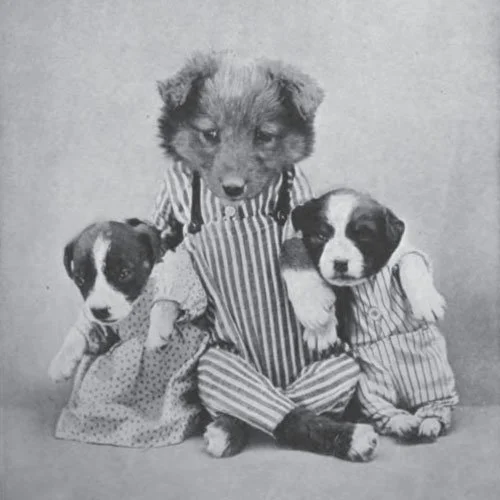
Mr. Fourpaw with sons Blink and Wink, The Little Folks of Animal Land by Harry Whittier Frees, 1915. Public domain, via Wikipedia Commons.
A Picture Book Escape from a World at War
To truly appreciate The Little Folks of Animal Land, one must consider the era in which it was created. When Frees’ book landed in 1915, the world was a grim place. It was a year of immense change and upheaval, yet also one where a certain innocence still lingered. The world was on the cusp of, and indeed already embroiled in, the First World War. While the horrors of the trenches were unfolding in Europe, back home in America, life continued, albeit with an increasing awareness of global events.
In this pre-television, pre-internet age, illustrated books and magazines were a primary source of entertainment and escapism. Children's literature, in particular, was booming, and there was a strong appetite for stories that fostered imagination and presented a gentle, often idealised, view of the world. Frees' photographs perfectly tapped into this desire for whimsy and wonder. They offered a charming antidote to the anxieties of the time, a delightful distraction that transported viewers to a simpler, more innocent dimension.
The rise of anthropomorphism in popular culture was also a significant trend. From Beatrix Potter's Peter Rabbit to Winsor McCay's Gertie the Dinosaur, animals were increasingly being depicted with human characteristics and emotions.
Frees' work fit perfectly within this artistic zeitgeist, pushing the boundaries of what could be achieved with real animals rather than illustrations. His ability to capture such expressive faces on his subjects, often appearing to convey genuine emotion, captivated audiences and contributed to the widespread appeal of his work. The sheer novelty of it – real animals dressed up and posed – was a marvel in itself.
The Little Folks of Animal Land by Harry Whittier Frees, 1915. Public domain, via Wikipedia Commons.
The Breeds Beneath the Costumes
So, who were the furry stars of this miniature theatre? Frees was practical as well as imaginative. He chose dog breeds that were small, expressive, and happy to sit still, well eventually. Terriers, with their inquisitive natures and often compact size, were frequently featured. Their alert expressions and willingness to hold a pose made them ideal candidates for depicting everything from school teachers to fishing. While specific breeds are not always explicitly identified, one can discern the familiar faces of Fox Terriers, both smooth and wire-haired, their intelligent eyes conveying a surprising range of human-like emotions.
Big dogs were out of the question, not just hard to dress, but too large to pull off the illusion that these animals were child-sized citizens of a very polite society.
The Studio: Part Nursery, Part Film Set
Creating these scenes took herculean patience and ingenuity. Frees designed every outfit, built custom sets, and used natural light to create his delicate compositions. His camera required long exposures—up to 1/5 of a second—which meant his animal actors had to stay remarkably still.
Dogs, it turned out, were naturals. Frees said they had “serene endurance,” which helped when posing beside tiny blackboards, tea sets, or laundry lines. He claimed never to force a pose, relying instead on treats and soft encouragement. This was less a circus and more a peculiar kind of collaboration.
Photographer Harry Whittier Frees poses beside a costumed puppy on a studio set. Public domain, via Wikipedia Commons.
The Ethical Lens: Dressing Up Dogs
This brings us to a more contemporary and often debated question. How ethical is it to dress up animals? Particularly dogs for entertainment. In 1915, the concept of animal welfare, while present, was not as formalised or widespread as it is today. Societies for the Prevention of Cruelty to Animals (SPCAs) existed, but the focus was often on preventing outright abuse rather than considering the psychological well-being of animals used in entertainment.
Frees himself insisted that he never harmed his animals. He claimed to work with them patiently, using food as motivation and only photographing them for short periods. He stated “These animals are my friends, and I do not use force with friends.”
Still, our modern eyes may see these images as quaintly unsettling. Can animals consent to being dressed like Edwardian children? Many animal behaviourists and welfare organisations advocate for animals to express natural behaviours and to avoid situations that might cause them stress or discomfort. While a dog might tolerate wearing a light costume for a brief period, prolonged dressing up, or being forced into uncomfortable poses, would be viewed as detrimental to their welfare.
Frees' era was one where animals were often seen primarily as resources or companions, and the nuanced understanding of their psychological needs was still in its infancy. We can appreciate his artistic vision while simultaneously acknowledging the evolution of our ethical understanding.
Amy Bell Teaches the Fox-Trot, The Little Folks of Animal Land by Harry Whittier Frees, 1915. Public domain, via Wikipedia Commons.
Puppies playing. Photo by Dogs in History.
Why It Still Works (and Still Charms)
So, are Harry Whittier Frees’ charming canine capers still relevant today? In a world of TikTok pets, Instagram cats, and AI-generated animal memes, you might expect century-old photographs of dogs in costumes to have lost their appeal. And yet The Little Folks of Animal Land still makes people pause.
Part of the answer lies in its historical value. The book offers a glimpse into the popular culture of the early 20th century, preserving a world of innocent amusement, careful artifice, and imaginative storytelling, where the boundary between human and animal could be playfully blurred.
Just as striking is the skill involved. Frees had no Photoshop, no digital retouching, and no modern shortcuts. Every prop was sourced or made by hand, every costume arranged, every set carefully composed, and every animal patiently posed. The result is not just novelty, but craft.
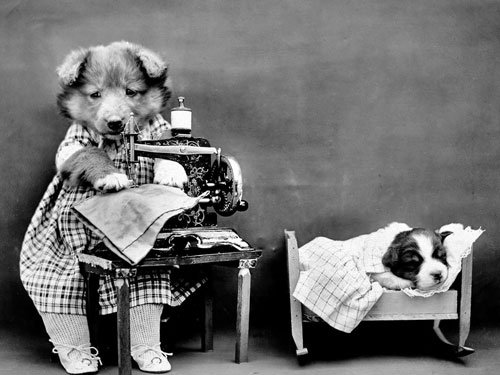
BARKER SEWING & BLINK IN BED - The Little Folks of Animal Land by Harry Whittier Frees, 1915. Public domain, via Wikipedia Commons.
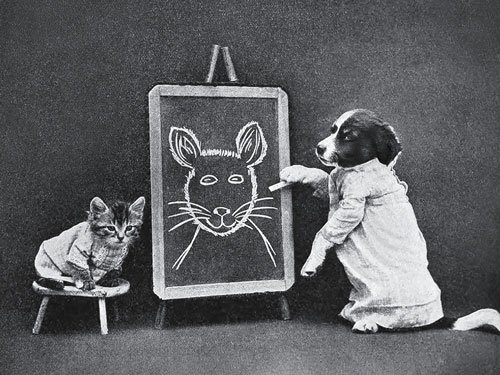
ROSIE WAS A PATIENT MODEL - The Little Folks of Animal Land by Harry Whittier Frees, 1915. Public domain, via Wikipedia Commons.
Then there is the enduring appeal of anthropomorphism. We still delight in seeing animals appear to share our habits, expressions, and little dramas. Frees’ photographs tap into that instinct with unusual charm, creating a whimsical world that feels like an early ancestor of today’s “cute animal content.” The medium has changed, but the impulse behind it has not.
Their continued relevance also lies in the questions they raise. However charming the scenes may be, modern viewers are more likely to think about animal welfare than audiences in 1915. As we admire Frees’ ingenuity, we are also reminded how much our understanding of animal comfort and dignity has evolved.
That tension is part of what gives The Little Folks of Animal Land its lasting power. Harry Whittier Frees created more than a novelty picture book. He made a tiny theatre of manners, imagination, and canine performance that still enchants, even as it invites reflection. More than a century later, his dogs remain memorable not only as curiosities, but as reminders of how readily humans turn to animals as mirrors of themselves.
Did You Know?
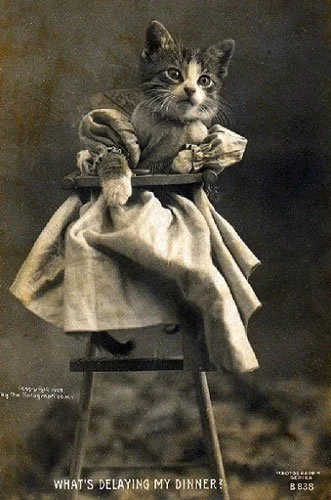
Harry Whittier Frees postcard. Public domain, via Wikipedia Commons.
Frees used long exposures - 1/5th of a second so dogs had to stay perfectly still.
Every costume and all the miniature props were handmade.
Most models were under six months old, easier to dress and more docile.
Frees often placed small, often delectable, treats just out of frame to encourage the animals to look in a particular direction or hold a pose.
Frees' work was widely reproduced on postcards, calendars, and advertisements throughout the early 20th century.
Frees faced criticism from some animal welfare advocates even in his own time, demonstrating that concerns about animal treatment in entertainment are not solely a modern phenomenon.