Lump: The Dog Who Ate a Picasso
In 1957, a combat photographer arrived at Pablo Picasso's villa on the Côte d'Azur with a dachshund in the passenger seat. He left without the dog.
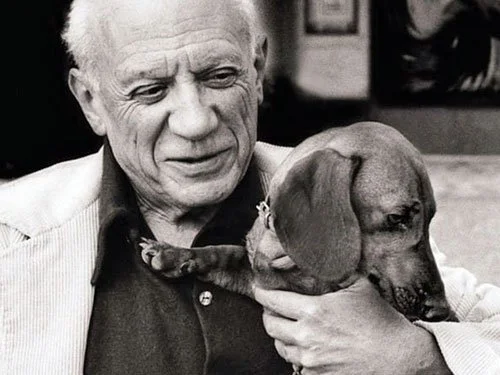
Picasso holds Lump at La Californie, Cannes, c. 1957. "Picasso had many dogs, but Lump was the only one he took in his arms." © David Douglas Duncan. Book cover, Public domain, via Wikipedia Commons.
On the morning of April 19, 1957, David Douglas Duncan drove his Mercedes 300 SL along the Côte d’Azur toward Cannes, with a small dachshund riding in the passenger seat. Duncan was one of the most decorated combat photographers in the world — he had photographed the Korean War, ridden with Marines into the Chosin Reservoir, and watched the Japanese surrender from the deck of the USS Missouri. His passenger had done none of these things. His name was Lump, he was thirteen months old, and he was about to walk into the home of Pablo Picasso and decide to stay.
The Man with the Leica
Duncan had first met Picasso the year before, in 1956, on the suggestion of photographer Robert Capa. He rang the doorbell of La Californie, the artist’s Belle-Époque villa on the hillside above Cannes, and Jacqueline Roque — Picasso’s wife — led him upstairs to find the artist in his bathtub. Picasso, who was notoriously guarded with photographers, waved him in. By the end of the visit, Duncan had been invited back. Over seventeen years, he would take more than ten thousand photographs of the man he called “a great Spanish gentleman.”
Lump was a more recent acquisition. Duncan had bought the dachshund in Stuttgart as a companion for his Afghan hound, Kubla — a plan that collapsed immediately. The Afghan treated Lump like a toy, rolling him around Duncan’s Rome apartment. Duncan was based in Rome, working constantly, and the life was no life for a small dog. That April morning, heading to Cannes, he brought Lump along.
Buenos Días, Amigo
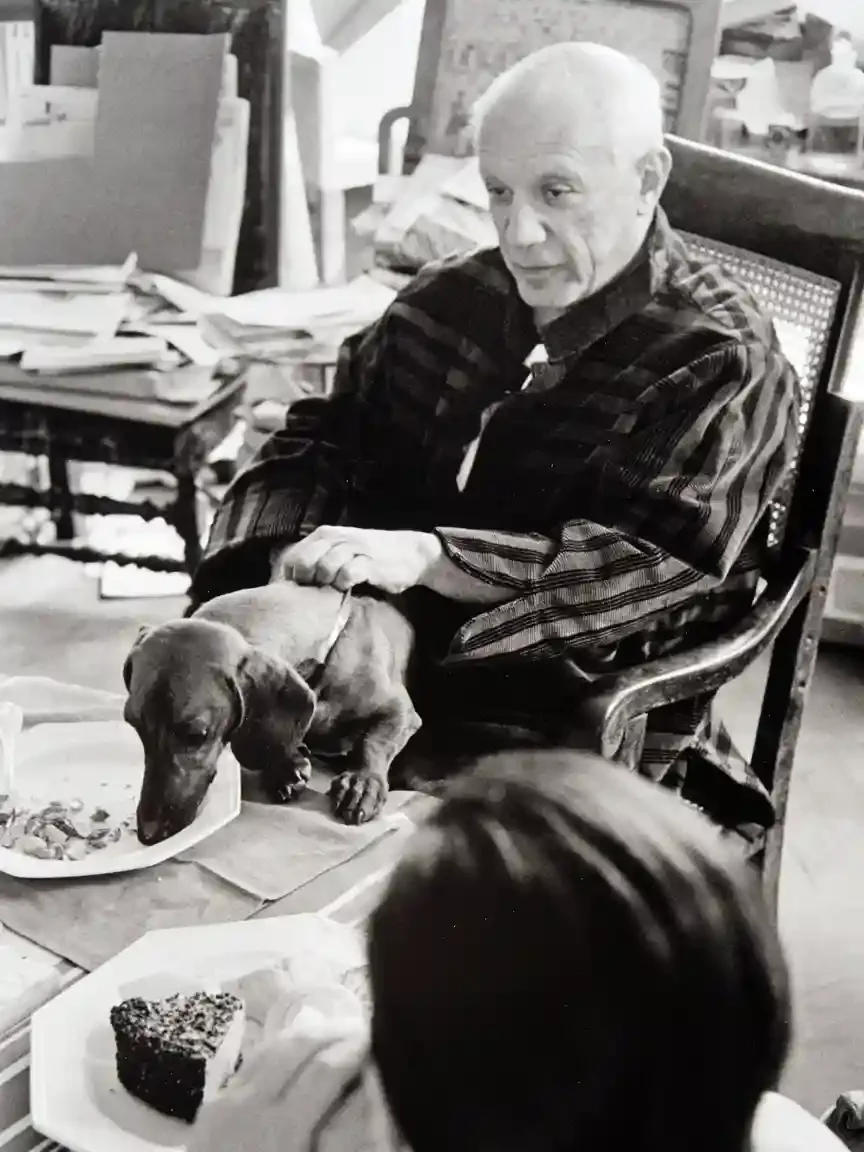
Lump eats from Picasso's lap at the dining table, La Californie, Cannes. Photo: David Douglas Duncan, American (1916–2018). Lump and Picasso, 1956-1959; printed 2013. Inkjet print, 20 15/16 × 13 3/4 inches (53.2 × 34.9 cm). The Nelson-Atkins Museum of Art, Kansas City, Missouri. Gift of David Douglas Duncan, 2014.11.37. © Harry Ransom Center, The University of Texas at Austin. Image courtesy of Nelson-Atkins Digital Production.
Picasso and Jacqueline were at lunch when Duncan arrived with the dachshund. The confident young dog walked directly to Picasso, put his front paws on the man’s knee, and looked up at him. Picasso looked down. “Buenos días, amigo,” he said. Lump jumped into his arms and kissed him. Jacqueline was taken aback. Picasso’s other dogs — including a Boxer named Yan — were kept in the studios, tolerated more than cherished. She had never seen Picasso take a dog into his arms.
Picasso picked up the luncheon plate in front of him, reached for a brush and paint that happened to be nearby — this was a house where paint was never far away — and painted Lump’s portrait on the ceramic surface. He dated it, inscribed it to Lump, and handed it to Duncan as a gift. It was the first Picasso ever made for a dog.
The Dog Who Ran the House
Lump did not return to Rome. He decided, with the certainty of small dogs everywhere, that La Californie was his home now, and that was the end of the matter. He stayed for six years.
At La Californie, where living and working spaces merged freely — canvases leaned against walls, sculptures occupied the garden, pigeons came and went through open windows — Lump moved through it all as if he owned the place. He followed Picasso into the studios. On one occasion he wandered too close to a fresh canvas and emerged covered in oil paint, requiring his first turpentine bath, an indignity he apparently resented. He slept on Picasso’s bed. He ate from the dining table. He used a seven-foot bronze sculpture as a private latrine.
Picasso, who in public was the genius, the bull, the force of nature, revealed something different to Lump. Duncan, who watched it all through his Leica, described it plainly:
“This was a love affair. Picasso would take Lump in his arms. He would feed him from his hand. Hell, that little dog just took over. He ran the damn house.”
When Picasso looked at Lump, Duncan said, a sweet gentleness glowed in his eyes.
Picasso himself put it most precisely: “Lump — he’s not a dog, he’s not a little man, he’s somebody else.”
The Cardboard Rabbit
One afternoon, Picasso cut a rabbit from a cardboard candy box and presented it to Lump with the ceremony of a gift. The odor of candy was irresistible. Lump carried it into the garden and tore it apart. Picasso was delighted.
It was a small moment in a six-year friendship — a playful man and a willing dog. But it captures something the world’s most scrutinized artist rarely permitted: the pleasure of being uncomplicated, if only for an afternoon.
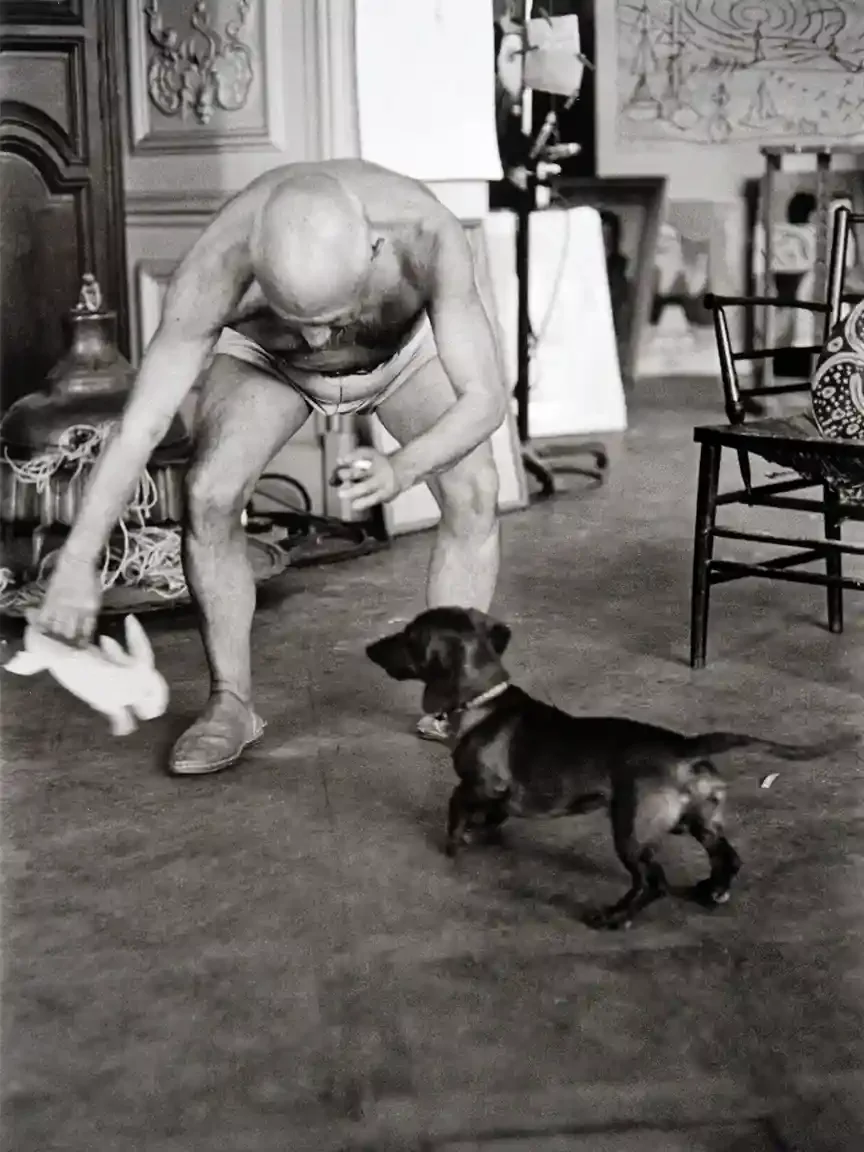
Picasso swings the cardboard rabbit toward Lump in his studio at La Californie, Cannes. Photo: David Douglas Duncan, American (1916–2018). Picasso, Lump, and rabbit made from an empty candy box, 1956-1959; printed 2013. Inkjet print, 20 7/8 × 13 7/8 inches (53 × 35.2 cm). The Nelson-Atkins Museum of Art, Kansas City, Missouri. Gift of David Douglas Duncan, 2014.11.108. © Harry Ransom Center, The University of Texas at Austin. Image courtesy of Nelson-Atkins Digital Production.
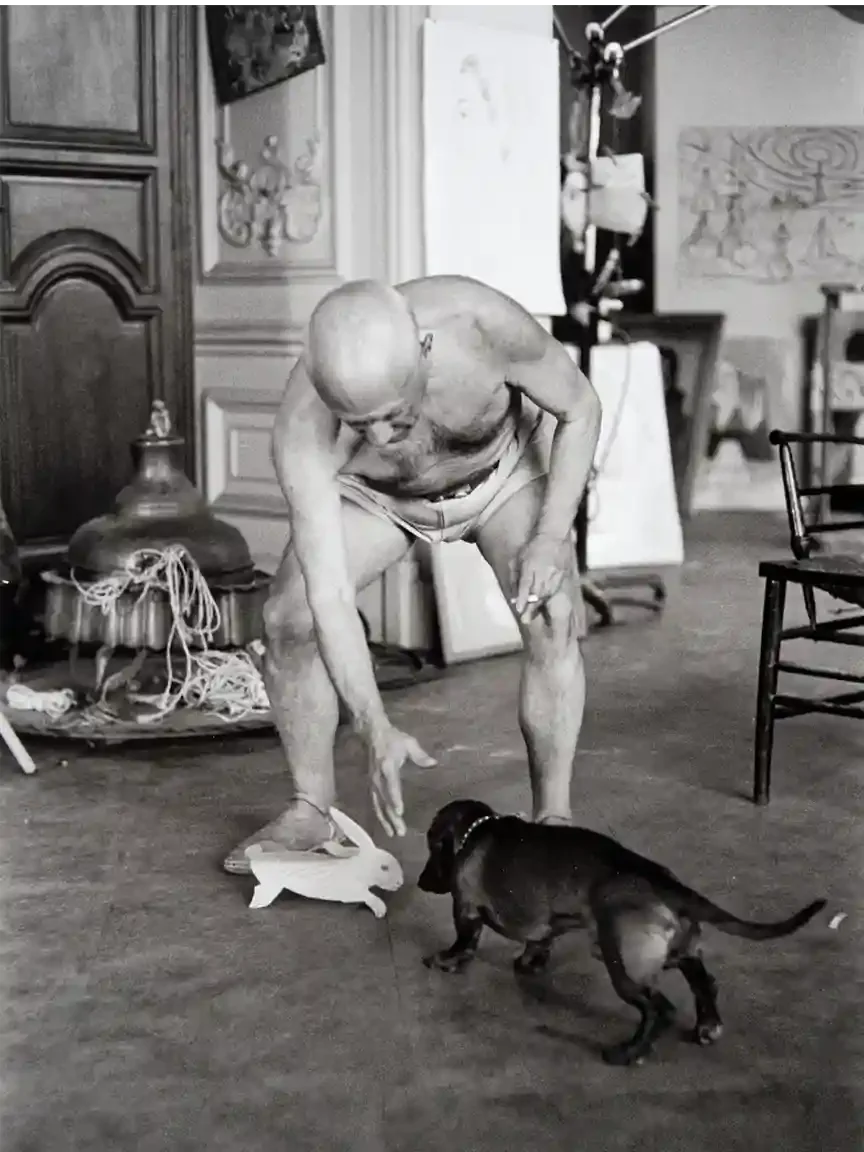
Picasso places the cardboard rabbit on the studio floor as Lump moves in to investigate, La Californie, Cannes. David Douglas Duncan, American (1916–2018). Photo: Picasso, Lump, and rabbit made from an empty candy box, 2014.11.109. Inkjet print, 20 7/8 × 13 13/16 inches (53 × 35.1 cm). The Nelson-Atkins Museum of Art, Kansas City, Missouri. Gift of David Douglas Duncan, 2014.11.109. © Harry Ransom Center, The University of Texas at Austin. Image courtesy of Nelson-Atkins Digital Production.
The Dog in the Painting
On August 17, 1957 — four months into Lump’s stay at La Californie — Picasso walked into his studio and began a painting. By the end of that day, he had completed a large-scale reinterpretation of Diego Velázquez’s Las Meninas, the seventeenth-century Spanish masterpiece he had studied since the age of sixteen. It was the first of fifty-eight paintings he would produce on the theme before December 30 of that year.
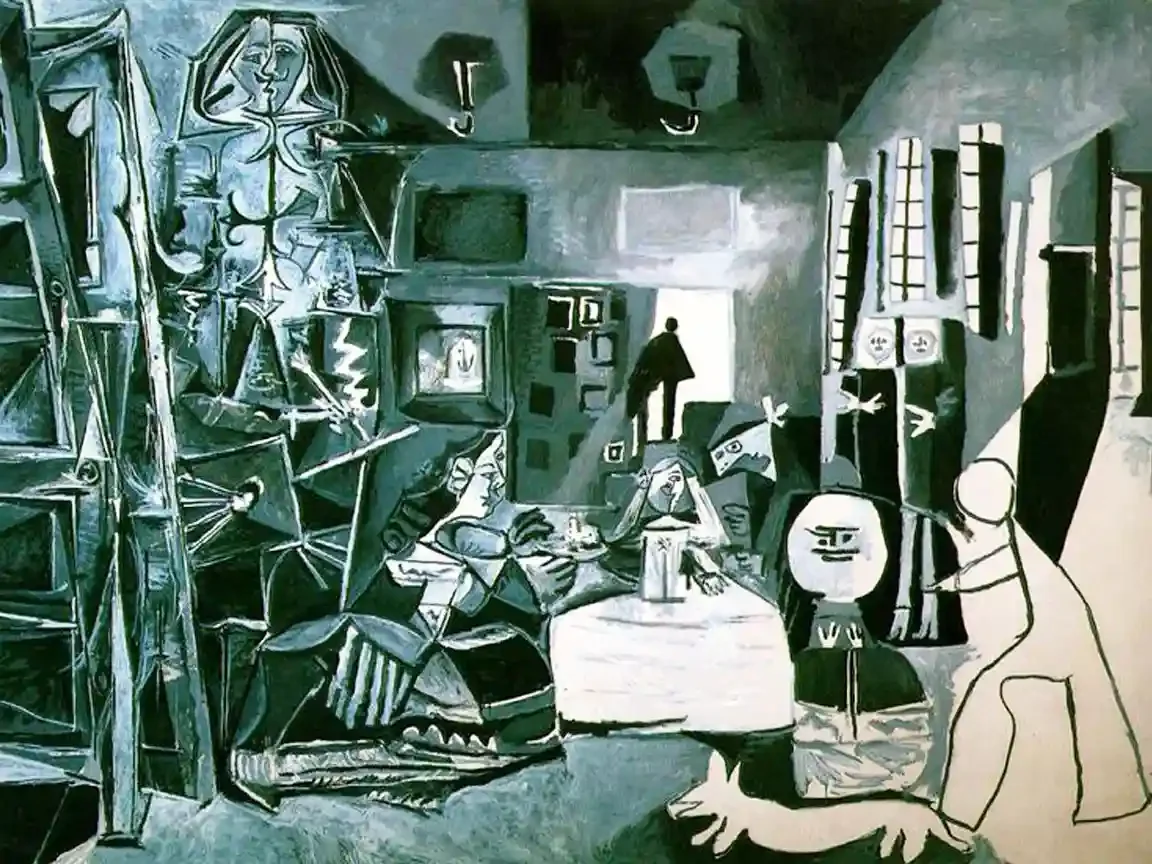
In Picasso's 1957 reinterpretation of Velázquez's Las Meninas, the royal mastiff is replaced by Lump, visible in the lower foreground. © Museu Picasso, Barcelona. Public domain, Wikipedia Commons.
In Velázquez’s original, a large Spanish mastiff occupies the foreground — enormous, impassive, indifferent to the royal scene arranged around it. In Picasso’s versions, the mastiff is gone. In its place, appearing in fifteen of the forty-five Las Meninas variations, is a small, low-slung dachshund with stubby legs and an unmistakable silhouette. Lump had walked into the painting the same way he had walked into the house: without being invited, and with complete confidence.
The Las Meninas series was not the only place Lump appeared. Across their six years together, Picasso worked the dachshund into sketches, drawings, and ceramics — around fifty works in total, by the reckoning of those who have catalogued them. Duncan, who watched Picasso work and photographed the results, believed the Las Meninas appearances were the heart of it. Having his dog preserved inside one of the most scrutinized paintings in the history of art was, Duncan said, “the darndest, and most moving, part of the whole story.”
Picasso donated the entire Las Meninas series to the Museu Picasso in Barcelona in 1968. It remains the only complete series of his work to have stayed together, and it hangs there still — fifty-eight paintings filling a suite of rooms, with a dachshund turning up in the foreground where a royal mastiff used to be.
Ten Days
In 1964, Duncan arrived at La Californie to find that Lump was unwell. A spinal condition had left him without the use of his back legs, and a local vet in Cannes had stopped feeding him, considering the case hopeless. Duncan took Lump back to Stuttgart — back to the city where he’d been born — and found a specialist willing to try. The treatment took months. Lump recovered, though he walked afterward, in Duncan’s description, “a bit like a drunken sailor.” He lived for another ten years.
By then, Picasso had moved on from La Californie, and Lump had returned to live with Duncan. They were apart in their final years. On March 29, 1973, Lump died. Ten days later, on April 8, Pablo Picasso died too.
The dachshund who had walked into a stranger’s home one April morning in 1957 and decided to stay had, in the end, stayed until nearly the last.
Did You Know?
Lump’s name comes from the German word for “rascal” — fitting for a dachshund who effectively appropriated the home of the world’s most famous living artist.
The painted plate Picasso created for Lump on the day they met is now held at the Harry Ransom Center at the University of Texas at Austin, donated by Duncan in 2011. It is one of the smallest and most unusual objects in Picasso’s output — not commissioned, not exhibited, made on impulse for a dog at a lunch table. Comparable painted plates by Picasso have sold at auction for amounts ranging from $20,000 to $90,000.
Lump appeared in fifteen of the forty-four paintings Picasso completed in his celebrated Las Meninas series between August and December 1957. In Velázquez’s original, the dog in the foreground is a massive mastiff. In Picasso’s versions, it became a dachshund. The entire series now forms the centerpiece of the Picasso Museum in Barcelona.
In 2013 David Douglas Duncan donate 163 Picasso photographs to the Picasso Museum in Barcelona in 2013. The collection highlights Picasso's daily life, his family, friends, and artistic techniques.
Breed: Dachshund | Country of origin: Germany | First use: Pursuing burrowing animals (badgers, foxes, rabbits) underground and on the surface | Origins: 15th century