Greyfriars Bobby: Edinburgh's Most Profitable Dog
The story is famous: a devoted terrier spent fourteen years guarding his master's grave in an Edinburgh kirkyard, refusing food, refusing shelter, steadfast until death. It has been told in children's books, Hollywood films, and a thousand tourist brochures. Almost none of it is true.
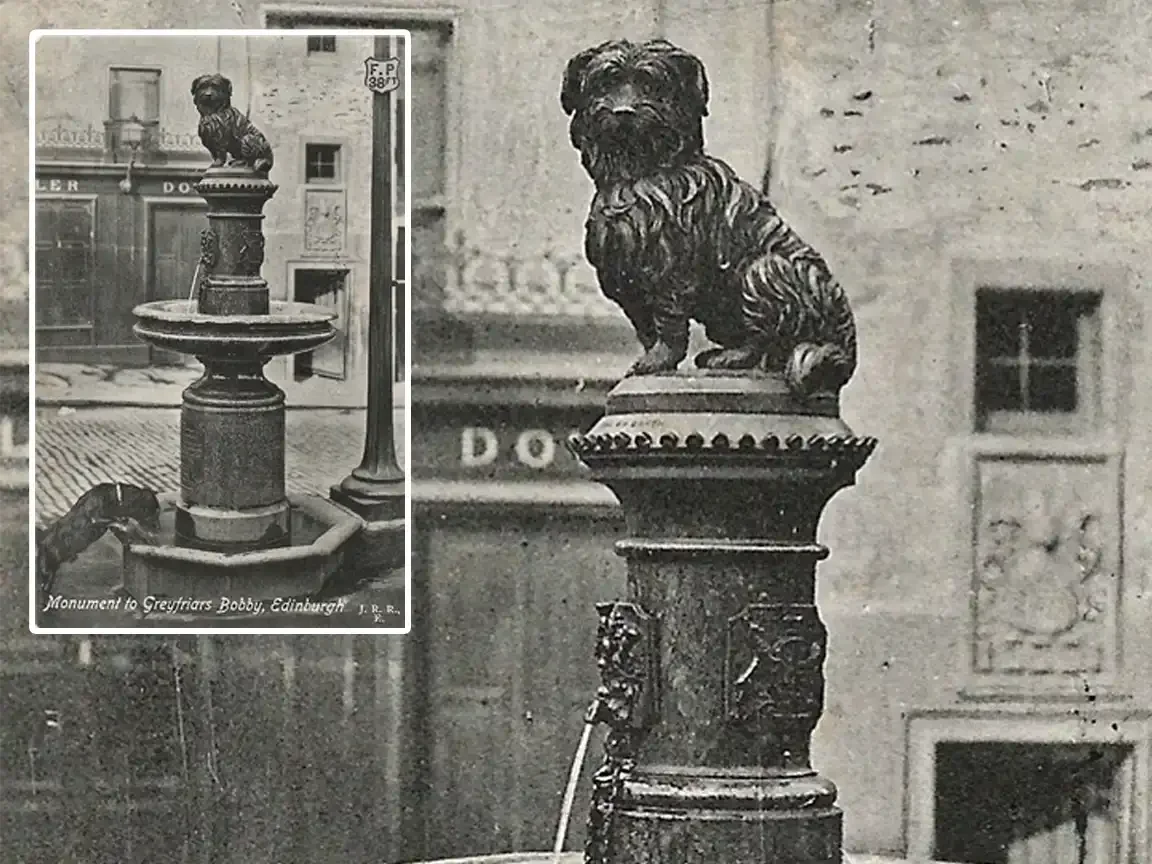
Monument to Greyfriars Bobby, souviner postcard posted in 1914. Public domain, via Wikimedia Commons
The Man Who Fed the Legend
James Brown was the cemetery caretaker at Greyfriars, and he was the first person to tell Bobby's story to visitors. By all accounts, he told it often. Researchers have noted that Brown would charm tourists with the tale, then guide them to John Traill's dining rooms just outside the kirkyard gate — where, conveniently, both Bobby and the visitors could be fed.
There is a timing problem here that the legend glosses over. John Traill did not own the restaurant until 1862 — four years after John Gray died. If Gray and Bobby had been regulars there during the policeman's lifetime, it was under different ownership, in a different establishment. The claim that Bobby returned each day to the place where he and his master once dined together does not survive contact with property records.
What Brown did provide was food. He fed the dog — or dogs — at the cemetery. This was not unusual. Victorian Britain had stray dogs in every churchyard, and a caretaker with a kind heart and table scraps could expect company. What was unusual was the story Brown attached to the feeding, and how effectively that story began to spread.
The Dog Tax Crisis
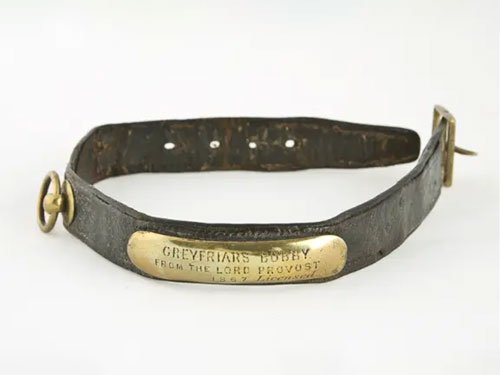
The brass-plated collar presented to Bobby by Lord Provost William Chambers in 1867, now held at the Museum of Edinburgh. The inscription reads 'Greyfriars Bobby from the Lord Provost. Museum of Edinburgh Public domain, via Wikimedia Commons.
In 1867, Edinburgh introduced a dog licensing law. Every dog required a collar and a seven-shilling license. Unlicensed dogs would be destroyed. Bobby had neither.
This created a crisis — or, more accurately, an opportunity. The story of the devoted cemetery dog was already circulating locally. Now it had urgency. Newspapers picked it up. The Scotsman ran a piece. Suddenly, Bobby was not just a graveyard fixture but a cause. William Chambers, Edinburgh's Lord Provost and a prominent publisher, personally paid for Bobby's license and presented him with an engraved collar. The gesture was civic theater, and it worked beautifully.
Visitor numbers to Greyfriars increased. Postcards were printed. The story spread beyond Edinburgh. By the time Bobby died in 1872, he was a Scottish institution — or, at the very least, a reliable attraction for anyone selling food, lodging, or sentiment in the Old Town.
The Photographs That Don't Match
In 2011, Swedish historian Jan Bondeson published research that examined surviving photographs of Bobby. What he found was difficult to reconcile with the official story.
The earliest known image of Bobby, a cabinet card from 1867, shows an elderly, rough-coated mongrel with cataracts. Later portraits — including those used for the famous statue — depict a handsome, alert Skye Terrier with a fine coat and clear eyes. The dogs do not appear to be the same animal.
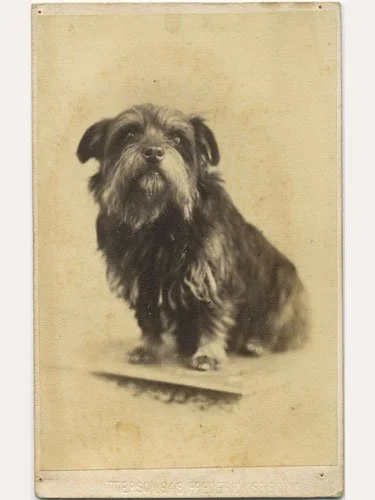
This 1867 photograph by Walter Greenoak Patterson is believed to be the final image taken of Bobby. It shows an elderly, rough-coated dog with visible cataracts. Friends of Dalry Cemetery, via Wikimedia Commons.
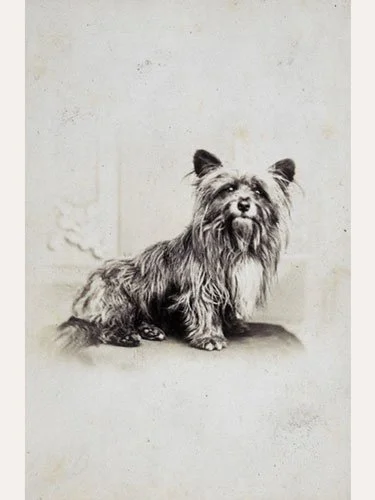
A later portrait showing a younger, finer-coated Skye Terrier. Historians question whether these are the same animal. National Galleries of Scotland, via Wikimedia Commons.
Bondeson's conclusion was cautious but firm: there were likely two dogs. The original Bobby, if there was one, may have died or disappeared partway through the fourteen-year vigil. A replacement was found — or simply appeared, as strays do — and the name, the story, and the commercial arrangement continued. By that point, too many people had an interest in keeping Bobby alive.
The evidence is not conclusive. Photographs from that era are unreliable, and dogs age. But the discrepancy is striking, and it fits a pattern that was common across Victorian Europe.
Cemetery Dogs Were Everywhere
Bobby was not unique. Bondeson documented forty-six similar cases across Europe and North America during the Victorian period: dogs said to be mourning at graves, refusing to leave, living on scraps provided by visitors or cemetery staff. The pattern was consistent. A stray dog appears in a graveyard. Someone feeds it. The dog learns that staying near a particular grave — usually one that attracts visitors — results in more food. A story forms. The story attracts more visitors. The cycle reinforces itself.
Most of these dogs were eventually forgotten. Bobby's fame was a matter of location, timing, and the effectiveness of the people promoting him. Edinburgh in the 1860s was a city conscious of its reputation, eager for tourist income, and rhetorically committed to sentimental narratives about loyalty and Victorian virtue. Bobby arrived — or was positioned — at exactly the right moment.
Skeptics at the Time
Not everyone believed it, even then. An 1889 letter to a local newspaper dismissed the story outright, noting that Bobby was simply a stray mongrel with enough sense to take shelter when it rained and enough charm to secure regular meals. The writer was unimpressed by the mythmaking.
But skepticism does not sell postcards. By the time Bobby died, the legend was too valuable to question. A year after his death, Baroness Burdett-Coutts — a wealthy philanthropist with a taste for sentimental causes — commissioned a statue. It was erected at the corner of George IV Bridge and Candlemaker Row, just outside the kirkyard, sculpted by William Brodie. The statue shows a Skye Terrier, alert and handsome, sitting on a granite plinth. It does not show an elderly mongrel with cataracts.
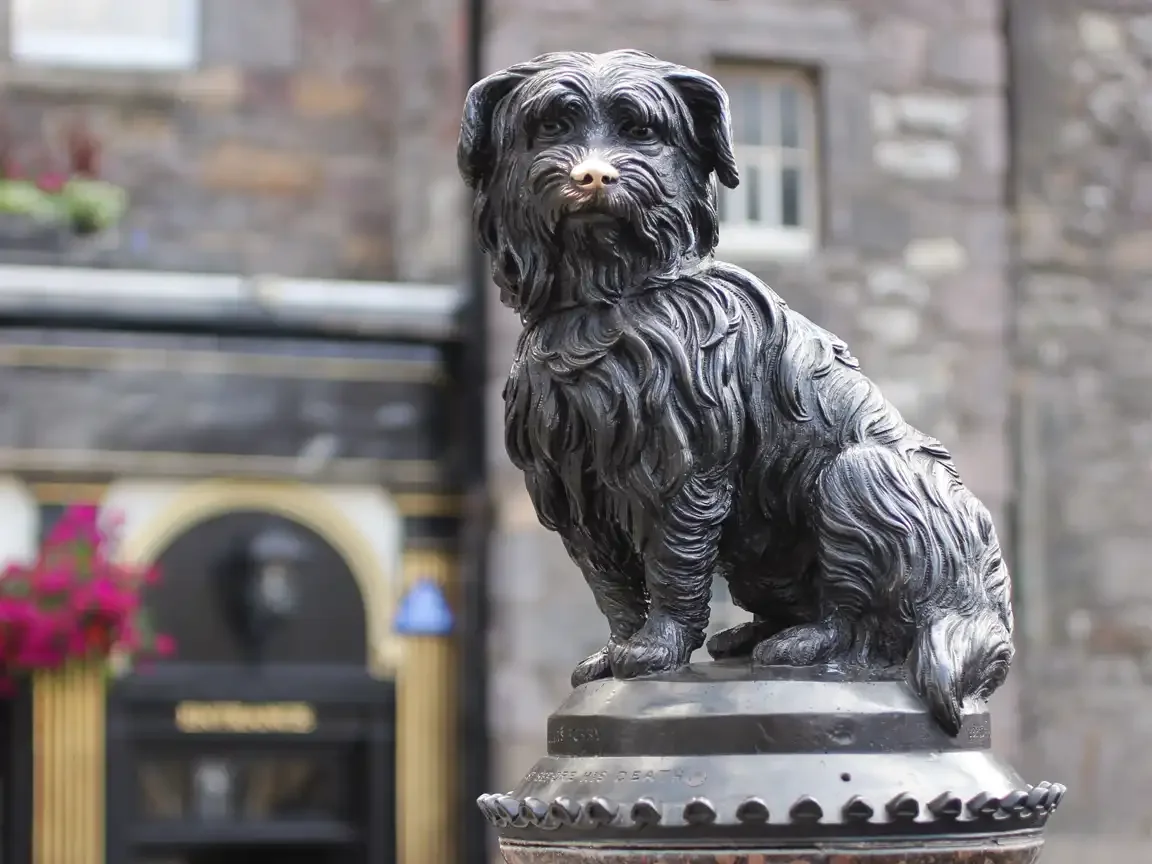
The statue still stands at the corner of George IV Bridge and Candlemaker Row. Tourists rub its nose for luck. Rock drum, CC BY-SA 3.0, via Wikimedia Commons
The statue became one of Edinburgh's most photographed landmarks. Tourists rub its nose for luck. The story is retold to schoolchildren. Walt Disney made a film about Bobby in 1961. None of it requires the story to be true. It only requires that people want it to be.
What Bobby Reveals
James Brown, the cemetery caretaker, was not a villain. He fed a dog, or several dogs, and told a story that people wanted to hear. John Traill, the restaurant owner, served meals to tourists who had come to see the famous Bobby. The Lord Provost issued a license and an engraved collar. The Baroness commissioned a statue. Everyone involved acted reasonably within the economy of Victorian sentiment.
What Bobby reveals is not a failure of human character but a success of civic storytelling. Edinburgh needed a symbol, and it found one in a scruffy terrier who had learned that cemeteries offered food, shelter, and the occasional pat on the head. The story that grew around him was not a lie, exactly. It was a collaborative narrative, maintained by people who had something to gain from its survival — whether that was income, civic pride, or the simple comfort of believing that such loyalty exists in the world.
The statue still stands. Tourists still visit. And somewhere in Greyfriars Kirkyard, beneath a small headstone near the gate, lies a dog — or possibly two dogs — who figured out that the best way to survive in Victorian Edinburgh was to let people tell the story they wanted to tell.
Did You Know?
Eleanor Atkinson's 1912 novel Greyfriars Bobby invented substantial portions of the legend, including the detail that Bobby slept on his master's grave every night. The book has been continuously in print for over a century and is often mistaken for biography.
Baroness Burdett-Coutts, who funded the statue, was one of the wealthiest women in England and a prolific supporter of animal welfare causes. She also funded drinking fountains for dogs across London and campaigned against vivisection.
The Disney film Greyfriars Bobby (1961) was shot on location in Edinburgh and became one of the studio's most successful live-action releases in the UK. It cemented the legend for a new generation and is still shown to Scottish schoolchildren.
Breed: Skye Terrier (disputed) | Country of origin: Scotland (Isle of Skye) | First use: Hunting and vermin control | Origins: 16th century