Snoopy: The Dog Who Could Fly Without Leaving the Yard
Charles Schulz gave Snoopy an imagination large enough to make him a flying ace, astronaut and novelist. The trick was keeping the fantasy believable without letting the dog stop being a dog.
Snoopy piloting his imaginary World War I "Sopwith Camel" fighter bi-plane, disguised as a doghouse. Restored illustration. Public domain, via Wikimedia Commons.
The Dawn Patrol
On Sunday 10 October 1965, Snoopy climbed onto the roof of his doghouse wearing a leather flying helmet, goggles and a red scarf. He was the World War I Flying Ace, setting out once more after the Red Baron, and his Sopwith Camel was waiting beneath him.
The airplane was a doghouse.
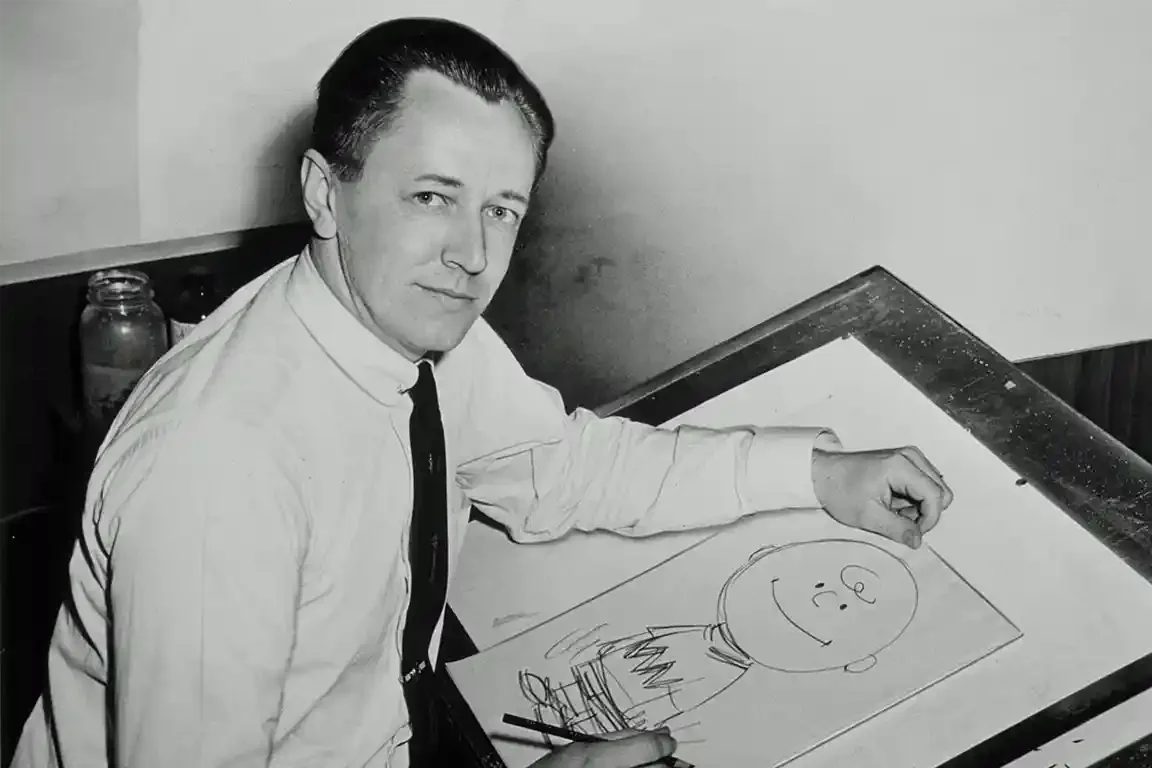
Charles M. Schulz at his drawing board in the 1950s, sketching the round-headed kid who made him famous: Charlie Brown. Roger Higgins, World Telegram staff photographer, Public domain, via Wikimedia Commons.
That was the joke, but it was also Charles Schulz’s answer to a problem he had been working on for years. Snoopy was becoming less like an ordinary dog every year. He could think, dance and imagine himself into lives far beyond the suburban yard. Schulz needed a way to let him become almost anything without asking readers to forget that he was still a dog.
The doghouse was part of the answer. Schulz later explained that Snoopy had become so unlike a dog that a realistic kennel no longer made sense, so he flattened it into a plain side view that gave the dog’s imagination somewhere to sit. For the next three decades, that simple arrangement carried an astonishing amount of fiction. The yard never had to get any bigger.
The Dog Who Came First
Li'l Folks, the single-panel cartoon Schulz drew before Peanuts, signed with his lifelong nickname, Sparky. Featuring the earliest prototypical version of Snoopy. Charles Schulz, Public domain, via Wikimedia Commons.
Snoopy was not invented for Peanuts. Before the strip existed, Schulz sold a weekly panel called Li’l Folks to the St. Paul Pioneer Press, and one dated May 30, 1948, shows a child named Charlie Brown talking to a dog that looks remarkably like an early Snoopy. When Peanuts launched on October 2, 1950, the dog appeared two days later. He had no name for another month, walked on four legs and was not even clearly Charlie Brown’s dog.
Schulz had drawn him loosely after Spike, the dog he owned as a boy. Spike was not a beagle, and Schulz waited most of a decade before calling Snoopy one.
Through the 1950s the dog changed shape. He began impersonating other creatures in 1951 and acquired thought balloons in 1952. By 1957 he was walking upright, and by December 1958 he had moved from inside the doghouse to its roof. Each step turned an ordinary pet into something stranger and more useful to Schulz: a character who could comment on the children around him and treat the backyard as whatever setting his imagination required.
The Dog Who Believed It
Schulz had a practical reason for building Snoopy this way. In a 1997 interview with Gary Groth, he described Peanuts as a repertory company that needed changes of pace. Snoopy could carry material that was “stupid, corny and dumb” because Snoopy himself did not realize how corny it was.
That gave Schulz enormous freedom. Charlie Brown was a boy to whom things happened, and readers needed to sympathize with him. Snoopy could fail spectacularly without losing his confidence. A terrible novel was still a masterpiece if its author believed in it, and a backyard could become a battlefield if the dog sitting in it was convinced he was a soldier.
The comedy lived in the gap between what Snoopy believed and what everyone else could see. Schulz’s job was not to close that gap but to protect it, and he did so with rules.
The Rules He Needed
The first rule was silence. Snoopy could think in elaborate sentences but never spoke them aloud. Schulz found out how tight that constraint could be in 1994, when he wanted a D-Day sequence to include a historical detail: Field Marshal Erwin Rommel had been away from Normandy on June 6, 1944, because it was his wife’s birthday. Snoopy could know that. He could not tell anyone. Schulz said he worked on the problem for months before handing the fact to Linus as a school report. Snoopy’s contribution was a single “Woof.”
The second rule kept the doghouse unreal. Its interior was never shown, although Snoopy could refer to books, records, a pool table or a Van Gogh as if all of them were inside.
The third rule was the most useful. When Snoopy disappeared into a fantasy, another character would eventually report what was really happening. In the same sequence, Schulz, himself a World War II veteran, sent Snoopy ashore as the World Famous G.I., charging through the surf at Omaha Beach in a steel helmet. Then Marcie telephones Charlie Brown to say that his dog is running back and forth through her wading pool.
Schulz never had to choose between the two versions. For Snoopy, the beach is real. For everyone else, it is a wading pool. Both fit inside the same strip.
Snoopy Skims the Moon
In March 1969, four months before Apollo 11, Schulz gave Snoopy his most ambitious fantasy yet. Across six daily strips, the dog became the World Famous Astronaut, lifting off from his doghouse, reaching the Moon and coming home.
The ordinary world kept pace with him. Charlie Brown greeted the mission by noting that it meant he would not have to feed the dog that night, and Snoopy, looking out over the lunar surface, found it fantastic one moment and like a dirty beach the next.
Then, on March 14, Schulz did something unusual. Snoopy lands on the Moon and declares himself the first beagle to get there, and the fantasy is allowed to stand. The doghouse is gone. For one day, no character and no panel reminds the reader where Snoopy really is.
Reality returned the next morning. Snoopy announced that he was heading home, and his only proof of a 240,000-mile journey was that he was now facing the other way.
Schulz did not have to puncture every fantasy straight away. He could let Snoopy become whatever he imagined, as long as the ordinary world was waiting when he came back.
The Last Doghouse
Schulz announced his retirement in December 1999. The final daily Peanuts strip appeared on January 3, 2000, carrying his farewell to readers. He had drawn every strip himself, and his family had decided that nobody else would continue it. Schulz died on February 12.
The final Sunday page appeared the following morning. It opens with Charlie Brown telling someone on the telephone that he thinks Snoopy is writing, then cuts to Snoopy at his typewriter on the roof of his doghouse.
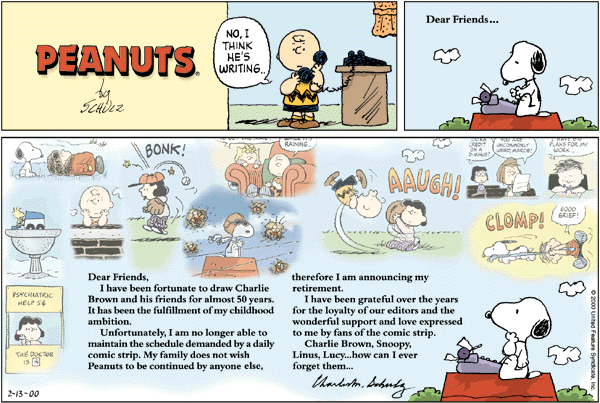
Schulz's farewell strip, announcing his retirement after nearly fifty years of drawing Charlie Brown and his friends. Public domain, via Wikimedia Commons.
The page is dominated by Schulz’s farewell letter, but the timing was not planned as a final message. The letter had already run in the daily strips six weeks earlier; the Sunday page simply happened to appear the morning after his death. Even so, it gives a fitting last glimpse of the dog Schulz spent half a century developing. Snoopy had been a flying ace, novelist, soldier and astronaut without ever ceasing to be a dog, and the doghouse had served as his airplane, his office and his spacecraft.
At the end of Peanuts, he is back on its roof, not flying, not fighting the Red Baron, not traveling to the Moon. Just writing.
Did You Know?
Snoopy went to the Moon twice. Apollo 10's lunar module was named Snoopy, while the command module was Charlie Brown. The spacecraft flew to within 50,000 feet of the lunar surface in May 1969.
NASA got Snoopy for free. After the Apollo 1 fire, NASA adopted Snoopy for its Manned Flight Awareness safety program. Schulz donated the drawings, and astronauts later awarded the Silver Snoopy pin.
A Snoopy pop song nearly topped the charts. The Royal Guardsmen's unauthorized "Snoopy vs. the Red Baron" reached No. 2 on the Billboard Hot 100 in December 1966, behind the Monkees.
Snoopy's real model was not a beagle. Schulz based the character loosely on his childhood dog Spike, whose appearance and markings supplied the main resemblance. Spike was a different breed.
Schulz first drew Spike at fourteen. His drawing of his childhood dog appeared in a 1937 Ripley's Believe It or Not! installment, years before Peanuts and Snoopy existed.
Breed: Beagle | Country of Origin: England | First Use: Hunting hare and rabbit by scent, followed on foot rather than horseback | Origins: 19th century
Explore More Dogs in Art and Literature…
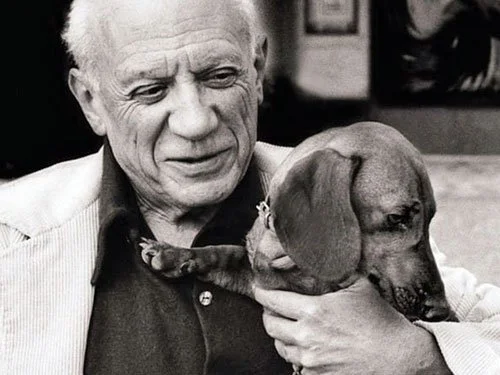
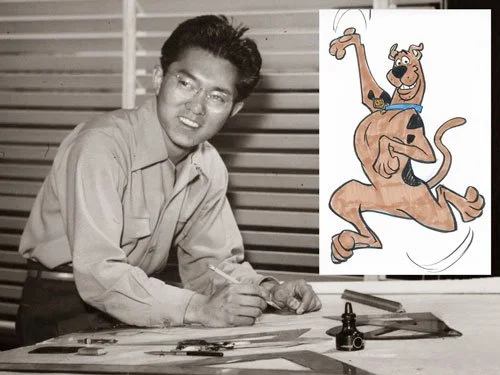
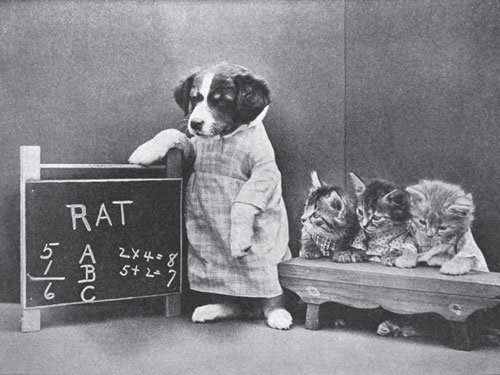
Like Snoopy, these dogs cross the line between ordinary animals and artistic invention: Picasso’s dachshund companion, a Great Dane built for cartoon comedy, and a 1915 cast of storybook dogs each entered a creative world where the line between dog and character shifts.