The Dogs China's Emperors Kept in Their Sleeves
For a thousand years, the Chinese imperial court bred a dog small enough to carry inside a robe sleeve — ranked above courtiers, protected by death penalty, fed on shark fins and antelope milk. In 1860, British soldiers found five of them in a burning palace. They knew what a sleeve dog was. They had no idea what that meant.
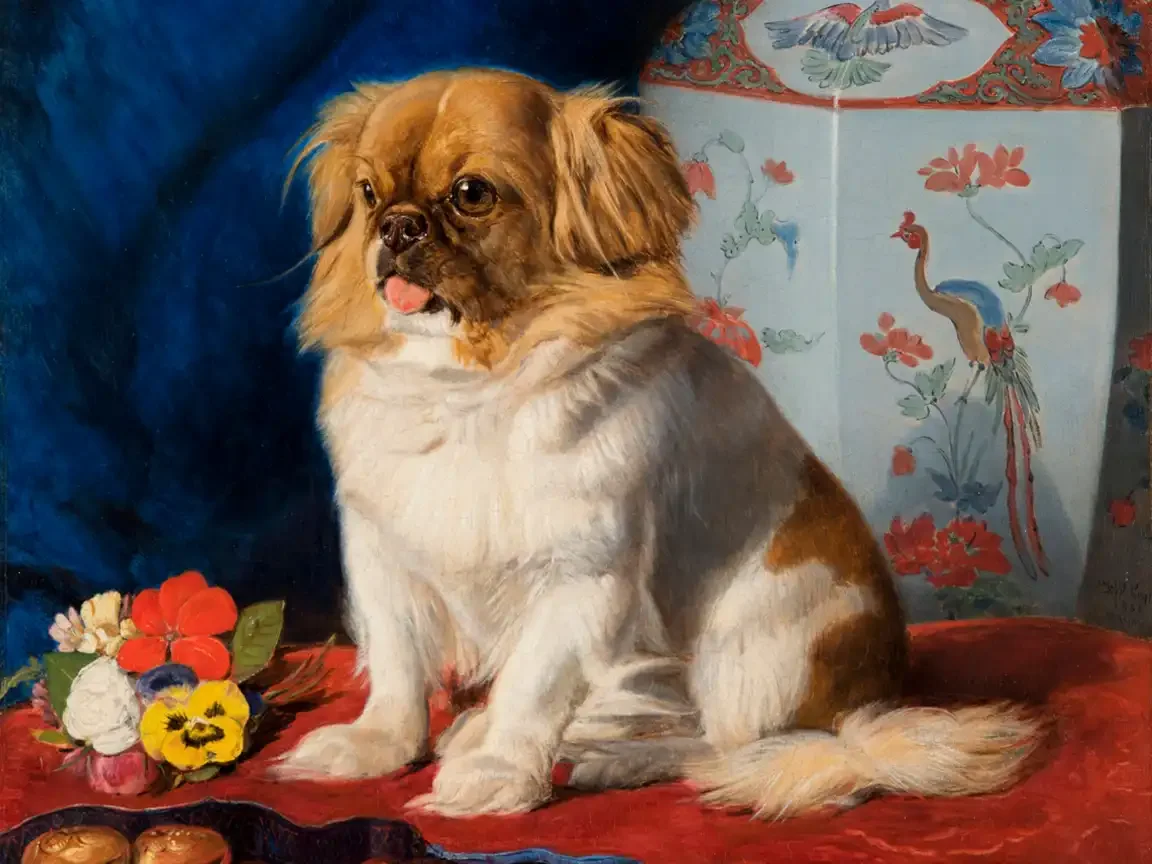
Looty, painted by Friedrich Wilhelm Keyl, 1861 — Victoria's instruction to the painter was to "put something to show its size." Royal Collection Trust. Friedrich Wilhelm Keyl, Public domain, via Wikimedia Commons
On October 6, 1860, Captain John Hart Dunne of the 99th Regiment walked through the smoldering ruins of the Old Summer Palace outside Beijing and found a dog.
What Dunne had walked through was the Yuanmingyuan — the Gardens of Perfect Brightness, 800 acres of imperial palaces, lakes, and pleasure grounds that the Emperor had fled days earlier as the British and French forces approached. The soldiers used imperial silk to tie their horses, smashed porcelain, and stripped the buildings of anything portable. When they had taken what they could carry, they set the structures alight. The cedar buildings burned for two days. It has since been called China’s Ground Zero.
The ruins of the Yuanmingyuan, photographed after the Anglo-French burning of October 1860 — the palace where Dunne found the five surviving dogs. Los Angeles County Museum of Art, Public domain, via Wikimedia Commons.
Amid the wreckage, Dunne came across five small dogs in the private apartment of the Emperor’s aunt, who had taken her own life as the forces arrived. The other dogs in the palace had been killed — or so it was intended — to keep them from foreign hands. These five were overlooked. Dunne kept the smallest, described in his diary as “a pretty little dog, smaller than any King Charles Spaniel, a real Chinese sleeve dog” with silver bells around her neck.
Looty, photographed at Windsor, 1865 — five years after Captain Dunne carried her home in his forage cap. Photo by William Bambridge. Royal Collection Trust. Public domain.
Dunne presented her to Queen Victoria, who named her Looty — a direct reference to how she had been acquired. Victoria commissioned a formal portrait: the painter was told he “must put something to show its size — it is remarkably small.” The resulting painting placed the dog on a red cushion, documented her carefully, and recorded the bells at her collar. Then Victoria moved on to her other dogs. Looty was transferred to the Windsor kennels, where later accounts describe her as “a very lonely little creature, the other dogs taking exception to her.”
Nobody in that transaction paused to consider what the dog had been before she became a name for what was taken.
A Dog That Could Not Wander
The Pekingese had been present in the Chinese imperial court since at least the Tang Dynasty of the seventh century, when palace records describe small dogs bred specifically as companions to the imperial household. By that period they had already acquired their defining title: Shih Tzu Kou. The Lion Dog.
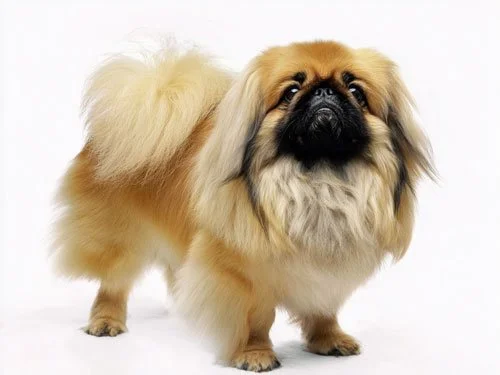
The Pekingese today — the lion's mane, the bowed front legs, the rolling gait. Every feature was deliberate. © Dogs in History.
The name was not decorative. Buddhist tradition held the lion sacred — guardian of temple gates, companion of the Buddha himself — and the imperial breeding program had been working, for generations, toward a dog that embodied leonine qualities in miniature: a broad, flat face, a heavy mane of fur at the neck and shoulders, a bearing that communicated authority rather than anxiety. The rolling gait, the bowed front legs, the compressed features were not accidents. They were intentions, refined across hundreds of years.
By the Qing dynasty, the rules governing these dogs had hardened into something closer to law. Only members of the imperial household could own one. The punishment for stealing a Pekingese was death. For killing one, the same. When an emperor died, his favorite dogs were sometimes sacrificed and buried beside him, so that the two might travel together into whatever followed.
Their daily lives reflected their standing. In 1903, an American artist named Katherine Carl was granted rare access to the court of Empress Dowager Cixi, the formidable de facto ruler of the Qing dynasty’s final decades. What she found in the palace dog pavilion she described in her memoir Two Years in the Forbidden City: “The dogs at the Palace are kept in a beautiful pavilion with marble floors. They have silken cushions to sleep on and special eunuchs to attend them… around the neck of each was a rich collar with gold bells, tassels and other ornaments in most fanciful arrangement.”
The Pekingese Hierarchy, illustrated by C.J.A. for the Pekingese Scrapbook (1954) — the dog sits directly below the Buddha and above the imperial family. © Elsa and Ellic Howe.
Their diet ran to shark fins, curlew livers, quail breasts, and the milk of antelopes grazing in the imperial parks. These were not the incidental treats of a pampered pet. They were provisions appropriate to rank, and rank in the Forbidden City was a precise science. A British publication on the breed reproduced an illustration — said to derive from an older Chinese original — showing the divine Buddha at the summit of a hierarchy: below him, in descending order, came the Pekingese dog, then the imperial family, then courtiers and tradesmen, with ordinary people lower still, and fish, insects, and demons at the bottom. The dogs occupied the second tier of the known universe. Not as pets. As minor divine presences with official standing.
Some were given titles to match. Tang dynasty records describe at least one emperor granting a favored Pekingese a formal scholarly court rank — a title that came with designated attendants and official precedence. His human ministers were reportedly furious. The dogs did not notice.
Small Enough to Carry
Within this already extraordinary world, the sleeve dog represented a further refinement. From at least the Tang period, the imperial kennels had been selecting for size — working toward a dog that could disappear entirely inside the wide sleeves of an imperial robe. The target weight was under six pounds. The smallest specimens are said to have weighed considerably less.
The practical purposes were several. A dog carried against the wrist provided warmth in the unheated corridors of the Forbidden City. Its presence signaled status. And the color of the dog was coordinated to the robe carrying it. A description of the ideal specimen — attributed, with some scholarly dispute, to Empress Dowager Cixi, though historians note it may partly reflect Western enthusiasts writing in her name — specifies that golden sable dogs were to be carried in the sleeve of a yellow robe, while other colors matched other costumes in the imperial wardrobe. The dog was, in part, an accessory. But it was an accessory that outranked the courtiers watching it pass.
Empress Dowager Cixi with two Pekingese in her imperial sleeves. AI-generated illustration after Katharine A. Carl's portrait of Cixi, 1903, Smithsonian Institution.
What the description makes clear, wherever it originated, is that the physical form of the sleeve dog was not accidental. “Let its forelegs be bent,” it reads, “so that it shall not desire to wander far, or leave the Imperial precincts.” The bowed front legs that give the Pekingese its distinctive rolling walk were, in this account, a deliberate selection: a dog whose gait makes swift movement uncomfortable is a dog that stays close. The body was shaped, across generations of breeding, to fit the world it was born into.
The methods used to achieve the very smallest specimens were grimmer than the marble pavilions suggest. A 1948 British account of the breed documents practices including feeding puppies rice wine and encasing them in tight wire mesh waistcoats to prevent normal growth. Cixi is said to have forbidden such practices in her own kennels — a detail that, whatever its precise accuracy, implies the methods were common enough to require prohibition.
The Breed That Outlasted Its World
The burning of the Yuanmingyuan in October 1860 marked the beginning of the breed’s long dispersal westward. The five dogs that had survived the looting were the first imperial Pekingese most Westerners had ever encountered — and the terms on which they arrived set the tone for everything that followed.
The other four dogs went to England separately. Over the following decades, a handful more followed — some smuggled out by palace servants at considerable personal risk, one account describing a dog concealed inside a crate of Japanese deer. These were not curiosities being acquired. They were the remnants of a living institution, removed by people who understood them as exotic and charming without having any context for what they represented.
Cixi, in her later years, gave Pekingese as diplomatic gifts to foreign physicians who had earned her favor and to well-connected Western visitors she wished to honor — among them financier J.P. Morgan and Alice Roosevelt Longworth, daughter of the American president. When the Qing Dynasty fell in 1911 and the imperial court dissolved entirely, the breed’s survival passed almost completely to the Western enthusiasts and show breeders who had developed a taste for it.
The civilization that had spent a thousand years making the sleeve dog — that had encoded its divine status in court law, shaped its body through selective breeding, organized the daily labor of eunuchs around its comfort, and placed it above the emperor’s own family in the hierarchy of the universe — had lost it to the world that helped to end it.
The Pekingese is still bred today, shown at Crufts and Westminster, catalogued by kennel clubs that have standardized the bowed legs and the lion’s mane and the rolling walk into a printable breed profile. The marble pavilion is a ruin. The eunuchs are gone. The hierarchy — Buddha, then the dog, then the emperor, then everyone else — survives only in an illustration reproduced in a 1954 British book on the breed, occasionally digitized, occasionally uploaded.
The breed survived. The world that knew what it meant did not.
Did You Know?
According to legend, the Pekingese was created by the Buddha, who shrank a lion to the size of a dog so it could stay with its butterfly lover — but allowed it to keep its lion heart and dignity.
Empress Dowager Cixi kept Pugs and Shih Tzu alongside Pekingese in her palace kennels. Her breeding program was among the most carefully managed in the imperial court’s history — and the most closely guarded.
In 1896, a Pekingese named Ah Cum was smuggled out of China hidden inside a crate of Japanese deer. He arrived safely in Britain and became one of the founding sires of the Western breed line.
A Tang dynasty emperor reportedly granted his favorite Pekingese a senior scholarly court title — outranking his human ministers. The Chinese insult (“dog officer”), still used today, may trace back to this appointment.
Queen Victoria received Looty in 1861, the same year she sat for Edwin Landseer, who painted her collie Noble. Looty was assigned to the less celebrated Keyl. Noble’s portrait is considerably larger.
Breed: Pekingese | Country of origin: China | First use: Companion dog | Origins: Tang Dynasty, 7th century AD