Artemis and Her Hounds: The Dogs Who Made a Goddess
Artemis, the Roman Diana, was the Greek goddess of the hunt — always pictured with hounds at her heels. Almost no one knows the pack itself: just thirteen dogs, given to her all at once, and bred to down their quarry or bring it back alive.
Diana's Hunt, by Peter Paul Rubens, part of the collections of the Liechtenstein Museum (Vienna). Public domain, via Wikipedia Commons.
In an Arcadian fold, the god Pan crouches over the carcass of a lynx, cutting it into portions for his own hounds. A girl comes down out of the hills and asks him for dogs. She is still a child, and she has come to assemble a goddess.
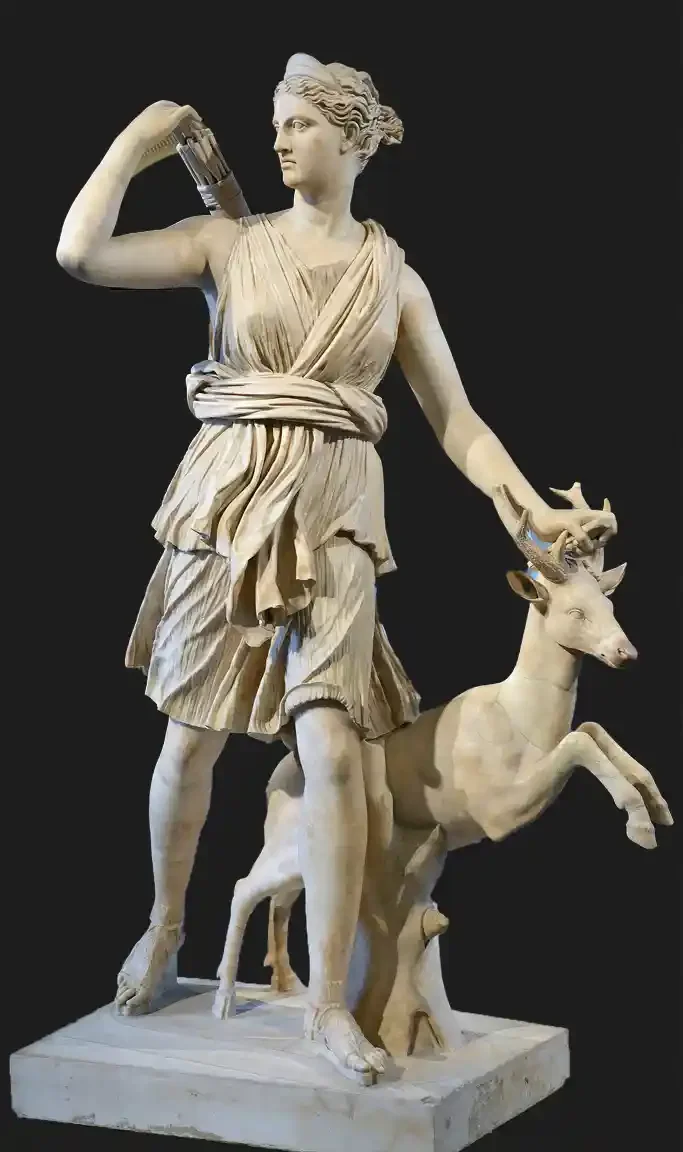
Diana of Versailles, Roman marble after a Greek original, Musée du Louvre, Paris. Commonists, CC BY-SA 4.0, via Wikimedia Commons.
The scene belongs to Callimachus, the Alexandrian poet who, in the third century BCE, set down the fullest surviving account of how Artemis acquired her attributes. His hymn opens with her as a small girl on the knee of her father, Zeus, reciting what she wants: to stay unmarried forever, to carry many names, to have a bow, mountains to live in, a chorus of nymphs. Then she goes out and gathers it all, item by item, the way a hunter lays out gear before dawn. The Cyclopes forge her bow. Pan supplies the dogs. And of everything on that list, the dogs are the one element Callimachus counts and describes — not a vague pack at her heels, but individuals, sorted by color and by the work they were bred to do.
The Romans would later take Artemis as their own and call her Diana — the name attached to most of the marble huntresses we picture, a hound at the heel. But the dogs in this story are Greek, and they come to her all at once, in Pan's fold.
A Kennel Built for Two Jobs
Pan hands over thirteen dogs, and they are not interchangeable. Six come first: two black-and-white, three the color of rust, and one spotted or brindled. These are the heavy hounds, and Callimachus is exact about their purpose — they are strong enough to pull down lions, closing on the throat and hauling the animal back to the fold while it still lives. Then come seven more, all female, the swift hounds he calls Cynosurian, built for the opposite kind of quarry: fawns, hares, the stag in its lair, the gazelle on open ground. Even, he adds, the porcupine in its burrow.
None of that precision is mysterious. Callimachus catalogued Greek literature for the Library of Alexandria. Here he catalogues a kennel. He wrote what any Greek reader would recognize: not lions and monsters in the abstract, but the animals a hunter in the hills would actually pursue, the porcupine among them, awkward and armored and hardly the stuff of legend. Read the list closely and a working kennel appears, organized the way any serious hunter organizes one. The six are grip and weight: dogs that catch and hold what turns to fight. The seven are speed and nose: dogs that find a scent and run it down over distance. A mortal huntsman would recognize the split at once — it is the difference between the hound you send after a boar and the one you send after a hare.
What sets this pack apart is not its organization but its reach. No kennel in Greece held dogs that could take a lion. Six of Artemis's could — and that claim, dropped without emphasis among the coats and colors, is what the heavy half of the kennel exists for.
The Deer She Took Alone
The first thing Artemis hunts after leaving Pan’s fold, she hunts without the dogs.
Beyond the Arcadian hills she finds a herd of deer larger than bulls, their horns shining gold — five of them, grazing by a dark river. She wants them, and she takes four on foot, running them down by her own speed to harness to her chariot. The fifth escapes. Hera — Zeus's wife, and the lifelong enemy of his son Heracles — sends it to the hill of Ceryneia, held in reserve for a day when Heracles will be sent to fetch it alive and will spend a year at the task rather than risk wounding a creature sacred to Artemis.
It would be easy to read this as the pack upstaged on its first outing — thirteen dogs handed over, then left behind while the goddess does the catching herself. Look again, though, at what the seven female hounds were bred for: fawns, hares, the stag in its lair. Deer are precisely their work. Ordinary deer, that is. These five stand larger than bulls and carry gold on their heads, and nothing in Pan’s fold was bred for them. Running them down is not hunting in the working sense at all. It is a demonstration, and it is about her — proof that the goddess of the hunt can take a miracle on her own feet, and harness four of them to her chariot afterward.
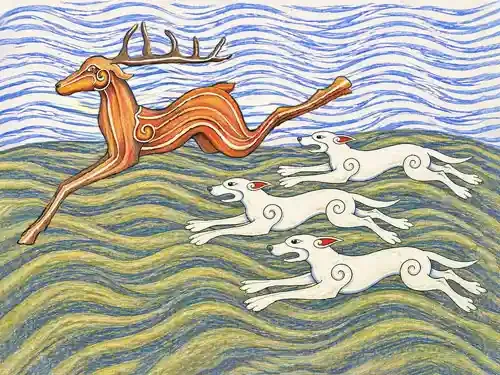
The seven Cynosurians at the work they were bred for: running a stag down over open ground, where speed is enough. AI-generated illustration in the style of Peter Paul Rubens.
The pack is for the world as it actually is. The seven will spend their lives on the stag and the hare, on everything that runs and can be overtaken. The six exist for the quarry that does not run — the animal that turns at bay and has to be seized and held. That is the one thing speed cannot accomplish, however much of it a goddess has. She did not need the hounds for these deer. She needed them for the lions.
Dogs with No Names
Here is the strange thing about the pack, once you notice it: not one of the thirteen comes down to us with a name.
Mortal Greeks named their dogs, and thought carefully about it. Xenophon, the soldier who wrote a manual on hunting a few generations before Callimachus, advised keeping the names short — a syllable or two, easy to call across a hillside — and listed his own: Psyche, “Soul”; Thymos, “Spirit”; Lonche, “Lance”; Phylax, “Guardian.” A name was a small act of ownership. It was a claim, a summons, a thread you could pull to bring a half-wild animal back to your side. To name a hunting dog was, in a sense, to bring it across — to make it answer to a human voice.
Artemis’s pack comes down to us without any of that. Even in the older Homeric hymn, where she cheers on the hounds across the shadowed mountains, no names appear — only the call, and the pack moving to it. The silence fits her, because Artemis herself lives on the far side of the line that names are drawn to cross. Her oldest title, older than classical Greece and reaching back into the Bronze Age, is Potnia Theron, Mistress of Animals. Her sanctuaries were built at edges: where farmland gave out into marsh, where the forest met the shore, ground that was neither settled nor fully wild. She guarded the young of every species and killed without appeal anyone who broke the rules of her country.
The dog belongs on that edge more than any other animal alive. It is the single predator that crossed over — the wolf that came to the fire and stayed, half kept and half kept apart. A hunting hound is wild enough to bring down a stag and tame enough to lay the body at a person’s feet. Artemis’s pack sits precisely on that seam: dogs enough to run with a goddess through country no farmer would enter, and dogs enough to come when she calls.
There is one hound in Artemis’s orbit that does carry a name, and it sharpens the pattern rather than breaking it. Laelaps — the word means something like hurricane — never failed to catch what it chased. Accounts of where it came from disagree: in some it is a gift from Zeus to Europa, handed down through Minos of Crete; in others Artemis herself gives it to Procris, a mortal woman who hunted in her company. Either way, the naming happens on the human side of the line. Laelaps belongs to the world of Procris and Cephalus, of inheritance and marriage and a hunt that ends in an accidental killing — a dog with a name, a history, and an owner who can lose it.
Artemis’s thirteen have none of that. They come down to us unnamed not because they were forgotten, but because nothing in the record ever brings them across. She stands where the naming stops.
Lions to the Fold
Callimachus gives it one line. The six heavy dogs take lions by the throat and drag them to the fold still living.
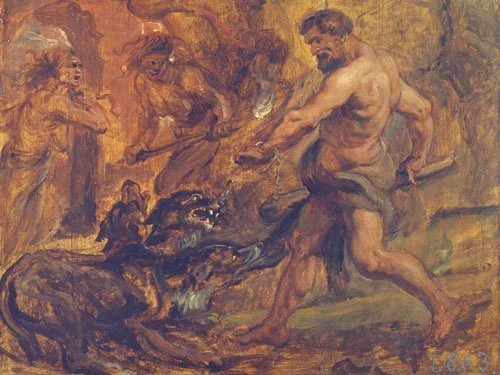
The six heavy hounds do the one thing speed cannot — they seize and hold, pinning the lion so it can be taken alive. AI-generated illustration in the style of Peter Paul Rubens.
Sit with the picture. Not a lion killed in the field and left for the birds, but a lion clamped and hauled — the emblem of everything that cannot be tamed, brought in alive to the edge of the enclosure where the flocks are kept. No mortal pack has ever done such a thing; no mortal pack could. This is not natural history. It is Callimachus telling us, in the plainest terms he has, what a goddess’s dogs are for. Mortal dogs run down hares and earn short names for it. Six of Artemis’s dogs bring the wildest creature in the world to the threshold, breathing, and set it down.
Picture the end of that hunt: a lion at the mouth of the fold, alive, its breath still coming hard, and around it the pack — not tearing, not feeding, simply holding. That is what Pan gave her in the Arcadian fold, and it is closer to the source of her power than the bow ever was. Not the arrows. The animals at her side that could take the wild alive and carry it, whole, to the exact place where the human world ends.
Did You Know?
In Callimachus’s hymn, the young Artemis also asks her father for twenty nymphs of the Cretan river Amnisus, whose specific duty is to tend her hounds and rub down her chariot-deer once the hunting is done. The pack came with divine kennel staff.
The long roster of individually named hounds many readers associate with Artemis — Melampus, Ichnobates, and dozens more — did not belong to her at all. They were the dogs of the hunter Actaeon, whom she turned into a stag for glimpsing her bathing; his own pack, no longer knowing him, tore him apart.
Pan, who stocked Artemis’s kennel, was remembered as a breeder of hounds for gods. In Nonnus’s late epic the Dionysiaca, he gives one of his dogs to Dionysos, who speaks to the animal on the hunt as though it could understand him.
The Cretan Hound, still bred on Crete today, is claimed by its enthusiasts as one of Europe’s oldest breeds, with ancestors depicted on Minoan seal-stones more than three thousand years old — a living echo of the swift Greek hunting dogs Callimachus described.
Artemis’s bond with dogs outlasted antiquity by centuries. The Orphic Hymn to Artemis, composed long after Callimachus, still praises her as a lover of dogs who delights in the wild and the pack — one of the last classical texts to keep the goddess and her hounds together.