Peritas: The Truth Behind Alexander the Great’s Dog
Every account of Peritas tells the same story: a war dog who saved Alexander the Great, then died in his arms. There is just one problem — almost none of it appears in any ancient source.
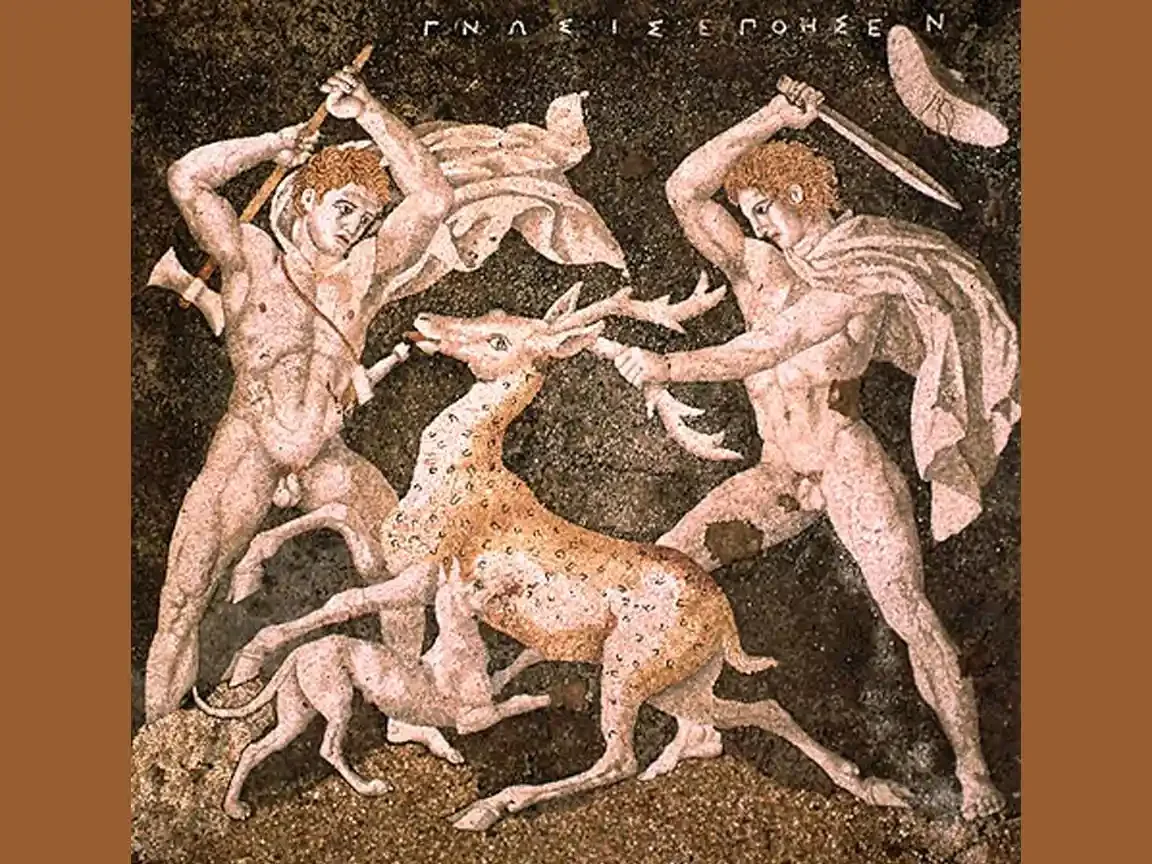
The Stag Hunt Mosaic, c. 300 BC, Pella. The dog at the base of the scene has been tentatively identified as possibly Peritas. Archaeological Museum of Pella. Public domain, via Wikipedia Commons.
The legend has been repeated so often it has acquired the texture of fact. Peritas, war dog of Alexander the Great, saved his master’s life on the battlefield — biting the lip of a war elephant, or holding off a crowd of enemy warriors until help arrived, depending on which version you encounter. He died of his wounds. Alexander grieved. He named a city after him. It is a story that has been told, and retold, and believed.
Almost none of it is in any ancient text.
The Dog Who Bit an Elephant
Precise accounts of Peritas vary — dramatically. In one telling, the dog leapt at an elephant during the Battle of Gaugamela in 331 BC, clamping its teeth around the animal’s lip and turning it back long enough for Alexander to escape. In another, set five years later during Alexander’s assault on the fortified city of the Mallians in India, Peritas fought through enemy soldiers to reach a wounded Alexander who had been cut off from his troops, and died of his injuries at his master’s side. Both versions end the same way: the dog’s head in Alexander’s lap, and a city founded in grief.
These are vivid, plausible-sounding stories. They have the internal logic of legend — a feat worthy of the honor that followed. The problem is their sources. Arrian, whose Anabasis of Alexander is considered the most historically reliable account of the campaigns — based on the firsthand testimony of Ptolemy, one of Alexander’s senior generals — covers both Gaugamela and the Mallian campaign in careful detail. He mentions Alexander’s hunting dogs. He does not name Peritas. Diodorus Siculus, writing a comprehensive history of the ancient world in the first century BC, covers the same campaigns in similar detail. He too is silent on the subject of any dog named Peritas performing any heroic act.
What Diodorus does record from the Punjab, in the same campaigns, is an episode involving a different set of dogs entirely: one hundred and fifty animals presented to Alexander by a local ruler named Sophytes, said to have the strength and courage to take on lions. Diodorus describes one of those dogs holding its grip on a lion while its own leg was being severed — uttering no sound, not releasing its bite, dying on top of the animal. It is one of the most vivid scenes in any ancient account of a dog. Peritas is not in it. The story of Peritas is the one that grew large. The story of those one hundred and fifty unnamed dogs is the one the ancient sources actually recorded.
The battlefield stories attached to Peritas, as far as the historical record shows, are not ancient. They are the shape that grief takes when it needs an explanation.
One Sentence, Four Hundred Years Later
The Alexander Mosaic (crop), c. 100 BC, after a 4th-century BC original. Alexander charges Darius at Issus. Naples National Archaeological Museum. Public domain, via Wikipedia Commons.
The only ancient authority to mention Peritas by name is Plutarch, the Greek biographer writing in the late first and early second centuries AD — roughly four hundred years after Alexander’s death in 323 BC. Plutarch’s Life of Alexander is an indispensable source, but Plutarch himself was clear about what kind of source it was. “I am writing biography, not history,” he explained in the opening of that very work. His method was to seek out the anecdote that revealed character: a king’s response to bad news, a general’s private attachment, the detail so small that historians overlooked it and biographers seized upon it.
In that spirit, after describing the death of Bucephalus, Alexander’s horse, and the city founded in the horse’s name on the banks of the Hydaspes River, Plutarch adds a single line: “It is said, too, that when he lost a dog also, named Peritas, which had been reared by him and was loved by him, he founded a city and gave it the dog’s name.”
The hedge matters. Plutarch does not claim to have verified this. He records the story as one that circulated — a story he found worth repeating, without staking his credibility on its particulars. And the story he repeats has none of the battles, none of the elephants, none of the warriors. It has only three things: a dog raised, a dog loved, and a city.
The question of what Plutarch had access to is itself worth pausing on. By the time he was writing, Alexander had been dead for four centuries, and the sources Plutarch worked from — earlier historians, court memoirs, anecdote collections — were already a curated version of a curated version of events. The detail about Peritas, hedged as it is, may derive from something reliable: a lost account, a coin, a local tradition in the Punjab. Or it may derive from a story that attached itself to a city name, working backward from the monument to invent the reason for it. Plutarch doesn’t say, and the gap cannot now be bridged.
Reared By Him, Loved By Him
Plutarch’s phrase is precise in its way. Reared by him suggests not a dog acquired as tribute from a conquered king or presented by an ally seeking favor — which happened to Alexander regularly, and which produced extraordinary animals — but a dog Alexander had raised from puppyhood. That places the beginning of their relationship somewhere in the years before the campaigns. Alexander crossed the Hellespont (modern-day Dardanelles) into Asia in 334 BC, aged twenty-two. If the account is accurate, Peritas was with him from early in his life, and went east when the army marched.
Alexander's route of conquest, 334–323 BC, from Macedonia to the Punjab. Bucephala — and the lost city of Peritas — lie at the eastern edge. Map provided by TheCollector.com
To say a dog traveled with Alexander is to say something about the conditions of that travel. The campaigns lasted eleven years, from the crossing into Asia Minor to the army’s refusal to march further east in India in 326 BC. The route passed through what is now Turkey, Syria, Lebanon, Israel, Egypt, Iraq, Iran, Afghanistan, and Pakistan. It crossed the Hindu Kush — twice. It endured the Gedrosian desert on the return march, one of the most punishing environments on earth, which killed a significant portion of the army. Alexander’s horse died in India. His closest companion, Hephaestion, died in Persia on the way back.
The practical life of a dog on such a campaign resists easy imagination. Alexander’s army on the march was not an army in any modern sense but a traveling city: soldiers, camp followers, engineers, physicians, historians, and the animals — horses, mules, and dogs. The logistics of feeding such a column were a near-constant crisis. That any non-military animal survived the full span of the campaigns is remarkable. Whether Peritas did — whether the city was named for a dog who had been present through most of those eleven years, or one who died early and was remembered later — the sources do not say.
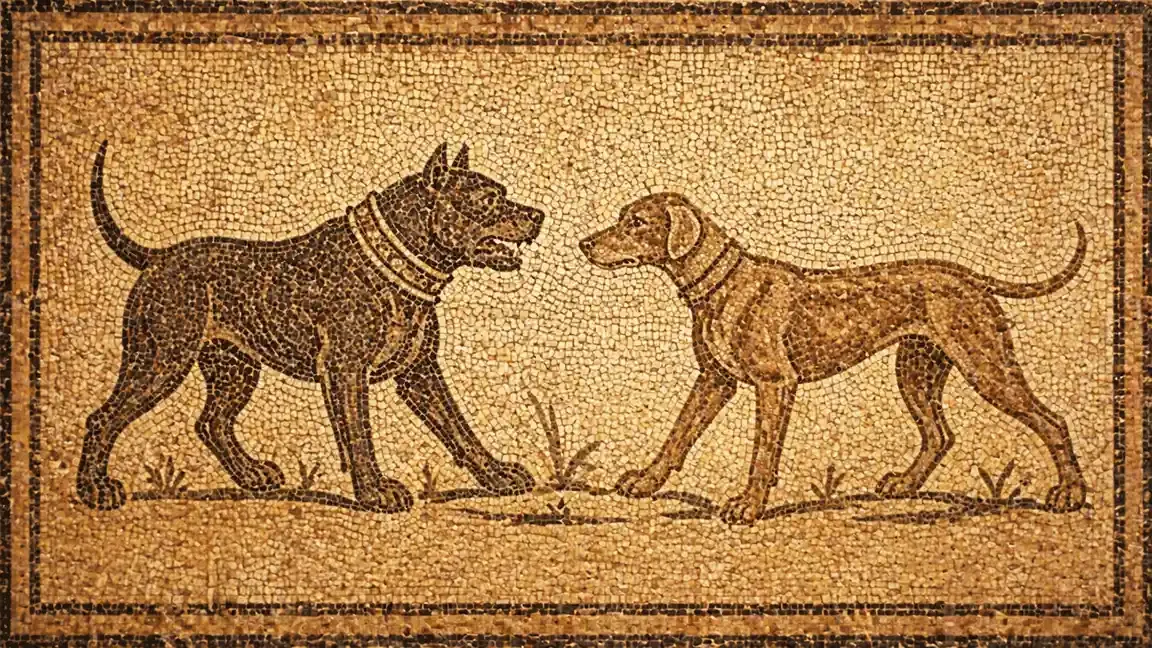
A Molossian mastiff (left) and a Laconian hound (right). Which breed traveled with Alexander remains unknown. AI illustration, © Dogs in history.
What breed Peritas was, no one can say with confidence. The Molossian mastiff is the popular assumption: large, heavy, the breed associated with Macedonian and Epirote military culture, bred for combat rather than speed. But the Stag Hunt Mosaic, a pebble mosaic of exceptional quality made in Alexander’s home city of Pella around 300 BC, depicts a hunting scene that scholars have tentatively identified as possibly showing Alexander and his general Hephaestion. The dog in that image is a Laconian hound — lean, long-limbed, built for running. If the identification is correct, Peritas was a hunter’s dog: a companion on the ride rather than a weapon in the front rank. That distinction changes nothing about the grief, but it changes something about the picture.
The City That Cannot Be Found
Alexander named three categories of things after the beings he loved. One was himself: the chain of Alexandrias, some dozen or more cities planted across his empire from Egypt to Afghanistan. One was his horse: Bucephala, founded on the banks of the Hydaspes River after Bucephalus died following the battle against King Porus in 326 BC. And one was a dog.
Bucephala has been located. Scholars believe it corresponds to a site near the west bank of the Jhelum River (ancient Hydaspes) in modern-day Pakistan. Coins have been found there. Traces of the settlement survive in the archaeological record. The city Alexander built for his horse has left enough to be placed on a modern map.
The city of Peritas has not. The Pleiades, the authoritative scholarly database of ancient places compiled by classicists and archaeologists, classifies it as “unlocated”: a settlement confirmed by a single literary reference, with no archaeological footprint, no coin, no inscription, no stone so far identified. It was probably near Bucephala — both cities would have been founded around the same time, after the same battle, in the same region. But proximity to a known site has not helped. If the city existed in any substantial form, the Punjab has not yet given it back.
This may simply be a matter of incomplete excavation. Alexander’s eastern campaigns remain archaeologically underexplored, and the Punjab has yielded significant discoveries in recent decades. It may also be that the city of Peritas was too small, or too briefly inhabited, to leave anything recoverable. Many of Alexander’s eastern foundations did not outlast him. The soldiers settled in distant garrisons began drifting home within months of his death in 323 BC. Local populations absorbed or renamed what remained.
What is left is the asymmetry. A man who bent the political geography of the ancient world — who named places after himself on three continents, who shaped the region’s history for three centuries — named a patch of the Punjab after a dog. The dog probably did not save his life. The dog probably ran alongside him through some part of those eleven years, slept in the camp, and did what dogs do: stayed near. When it died, Alexander named a city after it. The city lasted long enough for the story to reach Plutarch, four centuries later. Plutarch wrote one sentence with a hedge in it. The city itself has left nothing we have found.
The legend needed the elephant to make sense of the city. But the city already makes its own kind of sense. A dog was reared. A dog was loved. The rest, it turns out, was addition.
Did You Know?
The name Peritas derives from Peritios — the fourth month of the ancient Macedonian calendar, roughly corresponding to January and February. No ancient source explains why Alexander chose it for his dog.
Neither the Molossian mastiff nor the Laconian hound survived as distinct breeds. The Molossian lives on in the Neapolitan Mastiff, Cane Corso, and Saint Bernard. The Laconian's closest living relative is thought to be the Hellenic Hound (Greek Harehound), still bred in Greece.
Alexander’s official campaign historian, Callisthenes — nephew of Aristotle — was arrested by Alexander in 327 BC and died in custody during the Indian campaigns. His written account of the expedition, which might have mentioned Peritas, has not survived.
The Stag Hunt Mosaic was signed by its maker, an artist named Gnosis — a rare distinction in ancient art. Almost nothing else is known about him. The mosaic is now in the Archaeological Museum of Pella, Greece.
Alexander received a dog from the king of Caucasian Albania reported to have defeated both a lion and an elephant. He had first ordered a previous Albanian dog killed for refusing to fight lesser prey, then immediately regretted the decision when the king sent a replacement.