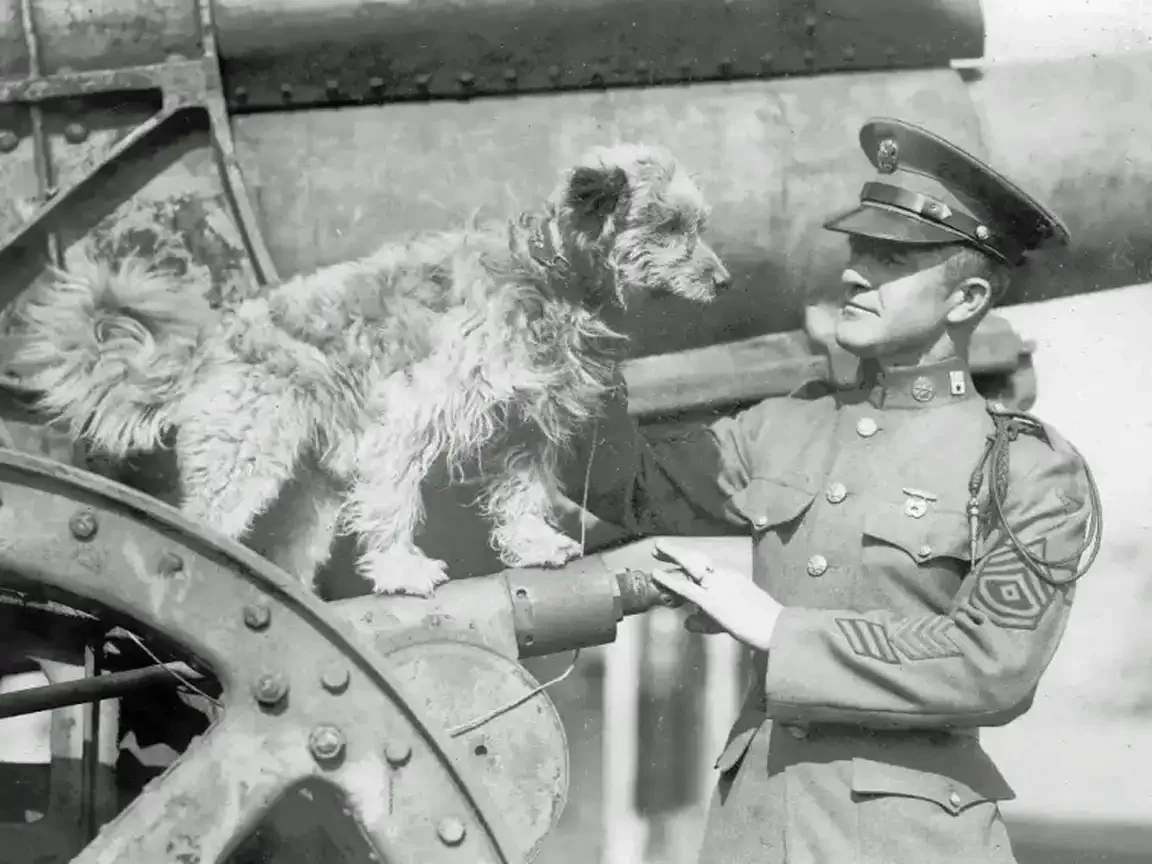
Smoky: The WWII Dog Who Ran the Wire
A four-pound Yorkshire Terrier found in a New Guinea foxhole became the unlikeliest hero of the Pacific War — a dog who was never officially a soldier, never owed anything to the Army, and saved 250 men by trusting a voice she couldn't see.
Smoky in Wynne's GI helmet — the photograph that won her Champion Mascot of the Southwest Pacific Area, 1944. Wynne also used the helmet to bathe her. © Smoky War Dog LLC
In January 1945, the Allied airfield at Lingayen Gulf on the Philippine island of Luzon was under daily Japanese attack. The 26th Photo Reconnaissance Squadron urgently needed telephone wire run under the runway to connect three squadrons back to headquarters. The pipe was 70 feet long and eight inches wide. They had a dog.
Two Australian Pounds
Bill Wynne with Smoky, 1944. The four-pound terrier he bought for poker money. © Smoky War Dog LLC
March 1944. Bill Wynne was twenty-two years old, an aerial photographer from Cleveland, Ohio, stationed at Nadzab, New Guinea, with the 5th Air Force's 26th Photo Reconnaissance Squadron. His tent mate, Ed Downey, had found a small dog in an abandoned foxhole on the side of a jungle road. A Yorkshire Terrier, fully grown, weighing four pounds. Downey was looking to sell her. He needed money to get back into a poker game.
Wynne paid two Australian pounds. At the time, that was $6.44. He named her Smoky.
The soldiers initially assumed she was Japanese — left behind by retreating enemy forces. They brought her to a nearby prisoner-of-war camp. The Japanese prisoners showed no recognition. She did not respond to English commands either. Whatever her past, it was unknowable. She was already a young adult, fully grown, and she had come from nowhere.
Wynne knew something about arriving from nowhere. He had grown up on the west side of Cleveland, the son of a woman raising three children alone. His father had left when Bill was three and was never seen again. During the worst years of the Depression, he and his brother had spent time at Parmadale Orphanage, run by the Sisters of Charity. He graduated from high school at twenty. He was, by his own account, an introverted kid who had learned to observe rather than participate — running the streets, he later said, was not conducive to study. At West Technical High School he found photography. The Army Air Force noted it. That was how he ended up in New Guinea, developing reconnaissance film in a jungle laboratory.
He was skilled at being alone. But Smoky changed the terms of it.
The Squadron's Most Ineligible Soldier
Smoky was not an official war dog. She had no military classification, no veterinary care, no issue of dog rations. She shared Wynne's C-rations and the occasional can of Spam. She slept in his tent on a square of green felt cut from a card table cover. He bathed her daily in his helmet to keep the jungle ticks off. She flew with him on combat missions in his backpack, suspended near the machine guns for hours at a stretch, and not once was she listed in any military record.
Over eighteen months, she survived more than 150 Japanese air raids in New Guinea, a typhoon at Okinawa, and kamikaze attacks in the Pacific. She warned Wynne of incoming shellfire on a landing ship transport; the attack killed eight men standing nearby. Wynne credited her with saving his life more than once, and said so plainly. He was not the type to embellish.
In 1944, Yank Down Under magazine ran a competition for the best mascot in the Southwest Pacific Theater. Wynne photographed Smoky sitting inside his GI helmet and entered her. She won. The helmet photograph became the image most associated with her — though it was also a practical one. It was how he bathed her.
Trailblazing Therapy Dog
Smoky on ward rounds at aU.S. Army hospital - the work that established her as the first documented therapy dog in history. © Smoky War Dog LLC
The therapy work began by accident. Wynne contracted dengue fever and was admitted to the 233rd Station Hospital in New Guinea. His friends brought Smoky to visit. The nurses, struck by the dog and by the response she drew from the other men in the ward, asked if they could take her on rounds. The commanding officer — Dr. Charles Mayo of the Mayo Clinic — gave permission. For five days Smoky went out with the nurses each morning and returned to Wynne's bed each evening. The wounded men, many back from the Biak Island invasion, stopped looking at the ceiling. They watched a four-pound dog chase Queen Alexandra's birdwing butterflies — butterflies with a wingspan of fourteen inches, nearly twice her height — and, for a few minutes, they were somewhere else entirely.
Smoky's work in military hospitals would continue for twelve years, through the rest of the war and long after it. She is the first documented therapy dog in recorded history.
Into the Pipe
Bill Wynne (left) and linesman Bob Gapp send Smoky into the drainage culvert at Lingayen Gulf, Luzon, 1945. She emerged the other end with the string to help lay telephone wire beneath an airstrip. © Smoky War Dog LLC
January 1945. The 26th Photo Recon Squadron had moved to Lingayen Gulf on the island of Luzon. The Japanese were hitting the airfield daily, and communication lines urgently needed to be established between the photo-reconnaissance unit and headquarters. The kind of wire that meant the difference between calling up reinforcements in time and not calling at all.
There was already a drainage culvert running under the taxiway. Seventy feet long, eight inches in diameter. The problem was the silt. At the joints between each four-foot section, soil had packed in until some passages gave no more than four inches of clearance. To dig a trench by hand would take three days, require dozens of men working in open ground while Japanese planes came over, and mean moving forty aircraft out of their sheltered positions to make room — leaving them exposed on the runway for the duration.
Sergeant Bob Gapp looked at Smoky. Then he went to find Wynne.
Could the dog make it through the pipe with a string tied to her collar? If she reached the other side, they could use the string to pull the cable through. Wynne took Smoky out to the airfield first and let her investigate — the sounds, the smells, the ground around the pipe opening. When she seemed settled, he tied the string to her collar, left her at the near end with Gapp, and ran across the runway to the far end. He lay down on his belly in the dirt. He called her name into the dark.
Smoky went in. She took a few steps and ran back out. Wynne called again, sharply this time. She started through again. Ten feet in, the string snagged on something and went taut. She stopped and looked back over her shoulder toward Gapp, as if asking what was holding things up. Wynne called again. She kept moving.
"The line's moving again," Gapp shouted across the taxiway.
Wynne heard a sound in the darkness. Two amber eyes appeared. Smoky shot out of the pipe and into his arms, trailing the string the full length of the culvert behind her. The signal section grabbed the line and threaded three telephone cables through. The airfield stayed operational. The men stayed under cover.
She was credited with saving 250 ground crew and 40 aircraft from three days of exposure to enemy fire. Sergeant Gapp gave her a steak dinner.
TINY DOG HOME FROM THE WAR
Smoky wearing the miniature uniform coat made for her bearing 5th Air Force patches and corporal chevrons. © Smoky War Dog LLC
When the war ended, the Army ordered all soldiers to leave their animals behind. Wynne modified an oxygen mask carrying case to fit a four-pound dog and carried her aboard the USS General William H. Gordon undetected. She came home in a bag.
On December 7, 1945, the Cleveland Press ran a front-page story: Tiny Dog Home From The War. Four photographs. The New York Daily News, the Chicago Tribune, and the Chicago Sun all followed. Wynne and Smoky performed at veterans' hospitals across the country for the next decade — the same act they had developed in the wards of the Pacific, now taken to men recuperating from the same war closer to home.
She died on February 21, 1957, in her sleep, at the family home in Parma Heights. She was approximately fourteen years old. Wynne buried her in a .30-caliber ammunition box in the Rocky River Reservation on the west side of Cleveland. In 2005, a bronze memorial by sculptor Susan Bahary — Smoky sitting inside a GI helmet, mounted on a two-ton blue granite base — was placed directly above the ammunition box.
The question that had followed her from the beginning was never answered in her lifetime. Where had she come from? How had a Yorkshire Terrier ended up alone in a New Guinea foxhole? After Smoky's obituary ran in the Cleveland Plain Dealer, a local woman named Grace Heidenreich called Wynne. She had been an army nurse in New Guinea in early 1944. Her fiancé had bought her a Yorkshire Terrier in Brisbane as a Christmas gift — so she had named her Christmas. The dog had disappeared at a Bob Hope USO show. She had photos of the dog to show Wynne. He thought back and "Christmas" was one of the words that got Smoky excited and turning in circles. Wynne concluded, there was only one conclusion. Heidenreich lived two blocks away from him in Cleveland.
Did You Know?
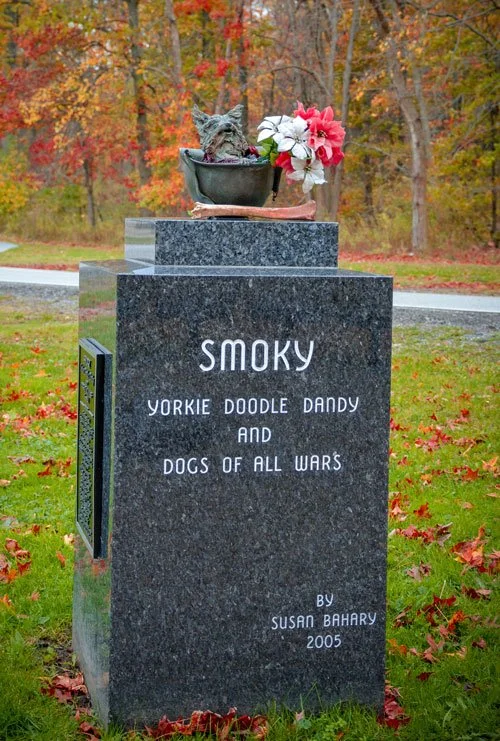
The Smoky and Dogs of All Wars memorial by sculptor Susan Bahary, Rocky River Reservation, Cleveland, Ohio. Public domain, via Wikipedia Commons.
Smoky was trained to parachute from 30 feet using a custom-made miniature parachute — Wynne built it after fellow soldiers jokingly argued over who would inherit her if he was killed in combat.
When Smoky's pipe mission was first reported in a photo-reconnaissance newsletter in the Philippines, the details were deliberately kept vague for security reasons. The full account wasn't published until December 7, 1945 — four years to the day after Pearl Harbor.
In 2005, a memorial with a bronze sculpture of Smoky sitting in a GI helmet was placed above her grave in Cleveland's Rocky River Reservation — funded by Vietnam veteran Jim Strand, who spent two years raising money after learning where she was buried. Its full title honors all war dogs, not Smoky alone.
Bill Wynne was a 1973 Pulitzer Prize finalist for photojournalism at the Cleveland Plain Dealer — the same discipline of patient observation he had trained in the reconnaissance labs of the Pacific.
Yorkshire Terriers were so rare in 1945 that only around 65 puppies were registered with the American Kennel Club that year. Smoky is credited with reviving interest in the breed, which is now among America's most popular.
Breed: Yorkshire Terrier | Country of origin: England (Yorkshire) | First use: Hunting rats and vermin | Origins: 19th century