In the 1930s, William Randolph Hearst and Marion Davies were the most watched unmarried couple in America. Each of them kept a small dachshund who watched everyone else back. When the dogs died, the newspapers had one more thing to say.
Main: Helen, Hearst’s “little sentry,” went with him to work, to meals and into business conferences. UC Berkeley, Bancroft Library, Public domain. Inset: American actress and philanthropist Marion Davies posing with her dachshund Gandhi. Publicity photo by James Manatt / MGM. Public domain.
Helen attended William Randolph Hearst’s business conferences, where she kept a watchful brown eye on him and on anyone who came too near. Elsewhere in the same household, a small tan dachshund named Gandhi did the same job for Marion Davies, and growled at any stranger who approached her. Hearst and Davies were the most watched unmarried couple in America, and each of them had a dog that watched everyone else.
When the dogs died, two years apart, both got obituaries in the same Hearst newspaper.
Power Couple Under Guard
Hearst and Davies at Bad Nauheim, Germany. After a 1931 stay in Germany, Davies came home with a dachshund puppy named Gandhi. Bettmann, Public domain.
By the 1930s, Hearst was the most powerful press baron in America, owner of 28 major newspapers and 18 magazines, along with radio stations and newsreels. Davies was a gifted screen actress who made her own fortune from films and real estate.
They had met in 1916, when she was dancing in the Ziegfeld Follies, and were a couple by 1917. He was married, and his wife would not divorce him, so the two lived together openly for more than thirty years. Hearst produced her pictures and praised them relentlessly in his papers. In 1937, when he nearly went bankrupt, she sold assets to give him $1 million.
The Puppy From Germany
Marion Davies and Gandhi on a terrace at Hearst Castle, 1930s. A 1933 paper called him her “self-appointed bodyguard.” Public domain.
Gandhi came home from Europe in 1931. Hearst and Davies spent part of that August at Bad Nauheim in Germany, and by November the San Francisco Call-Bulletin was describing Davies’s new dog as “a dachshund she recently brought from Germany.” His full name was Mahatma Gandhi.
In early December the San Francisco Chronicle’s Hollywood columnist reported that Davies had brought “her dachshund puppy” to a dinner dance at the Embassy Club, and reviewed his performance: “As the pup is as solemn and meditative as his namesake, he interfered not a whit with the progress of events, but proved to be the hit of the evening.”
A puppy had been taken to a nightclub and written up like a guest. He would spend the rest of his life at Davies’s side, and he would not always be so restful about it.
A Bodyguard on the Lot
Actress Marion Davies posing with her dachshund Gandhi. Publicity photo by James Manatt / MGM. Public domain.
By 1933, Gandhi had a job description. When Davies was filming at MGM, he heralded her every appearance on the lot, and the Oakland Post-Enquirer stated his position plainly: “He is her constant companion, her self-appointed bodyguard.”
The same item carried a story with every mark of studio publicity, and it is best told the way the studio told it. Davies was making Peg o’ My Heart, and the film’s dog, Michael, was played by an Irish mongrel. Gandhi was said to object. To show him why he could not play the part himself, Davies had a green coat and a feathered hat made for him and stood him in front of a mirror.
“Gandhi took one look at himself in the mirror, dressed up in the Irish outfit. That was enough. He wasn’t the type.”
He sulked through the production.
True or not, the story only worked because readers already accepted its premise: whoever else shared Davies’s working day, Gandhi did not intend to share her. Hearst, by then, had a dachshund of his own who took the same view of him.
Helen Keeps Watch
Dachshunds were Hearst’s favorite breed, and by 1937 his kennels were known locally as “the famous Hearst Dachshund Kennels at San Simeon.” One Australian visitor later remembered a pack of 93 dachshunds cavorting round the property. Helen’s place was Hearst’s own room.
Hearst’s description of her routine reads like a guard’s duty roster. She slept on a big chair in his room, watched him into bed at night and was there to greet him in the morning. By day she went where he went: to work, to meals, to social gatherings and into business conferences. He called her his “little sentry.”
A sentry decides who gets near, and Helen did not pass many people. Dr. Frank F. Barham, Hearst’s editor at the Los Angeles Herald and Express, told him she had “rather resented anybody else coming very near you. However, she seemed to accept me.” Hearst explained the exception: “I guess she liked you because you are a ‘regular fellow,’ and she knew it. Dogs are pretty wise.” About himself he was less generous. “An old bozo is a nuisance to almost everybody—except his dog.”
Barham’s letter was not a social note. He had written it on April 20, 1942, after a telephone call with Hearst, and only afterward did he learn, as he put it, “that you had lost little Helen.”
A Hillside at Wyntoon
Hearst and Davies had moved north to Wyntoon, his estate near McCloud in Northern California, before Christmas 1941. Helen died there that April. Hearst’s reply to Barham, dated April 23, said how: “Helen died in my bed and in my arms.”
Within about three days he had buried her on the hillside above the lawn, “where she used to run—and surrounded by the flowers.” Her stone read “Here Lies Dearest Helen—My Devoted Friend.” Hearst wrote that he would not need a monument to remember her. Then he gave her something larger.
Front Page, Column One
On April 29, 1942, the Los Angeles Examiner printed Barham’s condolence letter and Hearst’s reply as Hearst’s signed column, “In the News,” starting in the first column of the front page, beside reports of RAF raids and Roosevelt’s price freeze. Hearst used the reply to pick a quarrel with Aldous Huxley:
“Aldous Huxley says: ‘Every dog thinks its master Napoleon, hence the popularity of dogs.’ That is not the strict truth. Every dog adores its master notwithstanding the master’s imperfections of which it is probably acutely aware . . . So as your dog loves you, you come to love your dog. Not because it thinks you are Napoleon, not because YOU think you are Napoleon. Not because you WANT to be Napoleon. But because love creates love, devotion inspires devotion, unselfishness begets unselfishness and self-sacrifice.”
The column went out across the Hearst chain, and letters came back to Wyntoon from all over the country. Damon Runyon told Hearst it outclassed Senator Vest’s celebrated tribute to a dog as the most touching writing of its kind in American literature. The San Antonio Light gave readers’ letters a full page and, when they asked to see Helen, printed a photograph of Hearst with her. TIME covered the affair, and its account was reprinted as far away as Ontario.
The front page of a Hearst paper went to a toy dachshund whose whole career had consisted of keeping people away from its owner.
Davies’s dog was still alive, still at her side and still growling at strangers. His obituary would come from somebody else entirely.
Gandhi Gets His Notice
Gandhi died two years later on July 11, 1944. His obituary ran the next day in the Los Angeles Examiner, the paper that had carried Helen’s, but it did not come from Hearst. It came from Louella Parsons, the most powerful gossip columnist in Hollywood. He had “returned from Europe with Marion about 12 or 13 years ago,” she wrote, and “since that time he has been her shadow, jealously guarding her and growling at any stranger who came near her.”
The two notices match the two lives. Hearst’s dog was mourned by Hearst, in his own column, on his own front page. Davies’s dog was mourned in the voice of the industry she worked in, by the columnist who covered it. Both writers remembered the same thing: a small dachshund who had appointed itself to stand between one person and everybody else.
Hearst lived seven more years. At the end, there was still a dachshund in the room.
The Last Sentry
Helena on the bed where Hearst died, recreated from a blurred 1951 newspaper photograph. Dogs in History (AI)
Hearst died at Davies’s house in Beverly Hills on August 14, 1951. The dachshund in the house was called Helena.
Davies had sat up with him all night, then accepted a sedative, and was asleep when he died. When she woke, TIME reported, his sons had removed the body, and most of his belongings were gone too. “They didn’t even let me say goodbye,” she said. Helena was still there. The next day Davies sat behind drawn shades, “Hearst’s doleful dachshund Helena beside her.”
That November, the Minneapolis Sunday Tribune printed a photograph taken upstairs in the same house, and its caption read: “Hearst’s lonely dachshund Helena sits on the white satin spread on the antique canopied bed where her master died.”
Did You Know?
Hearst once took back a dachshund he had given away. A San Simeon guest said he had the car intercepted, kept the dog and gave his Army friend a pet-shop dachshund instead.
Picasso borrowed a dachshund and kept him six years. Lump arrived at Picasso’s villa with photographer David Douglas Duncan in 1957 and stayed.
Dachshunds were bred to fight badgers underground, alone. Their standard still calls them “courageous to the point of rashness,” and owners call them one-person dogs.
Discover More Dogs From Different Worlds...
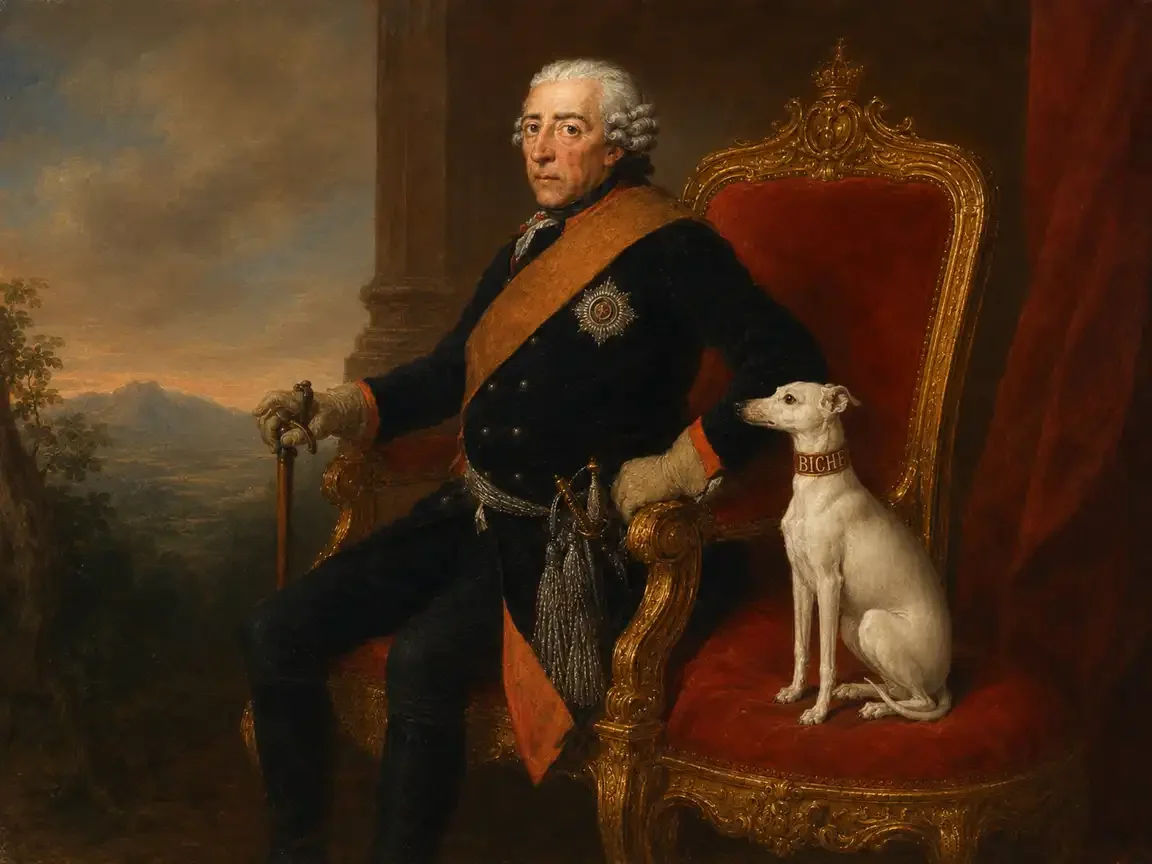
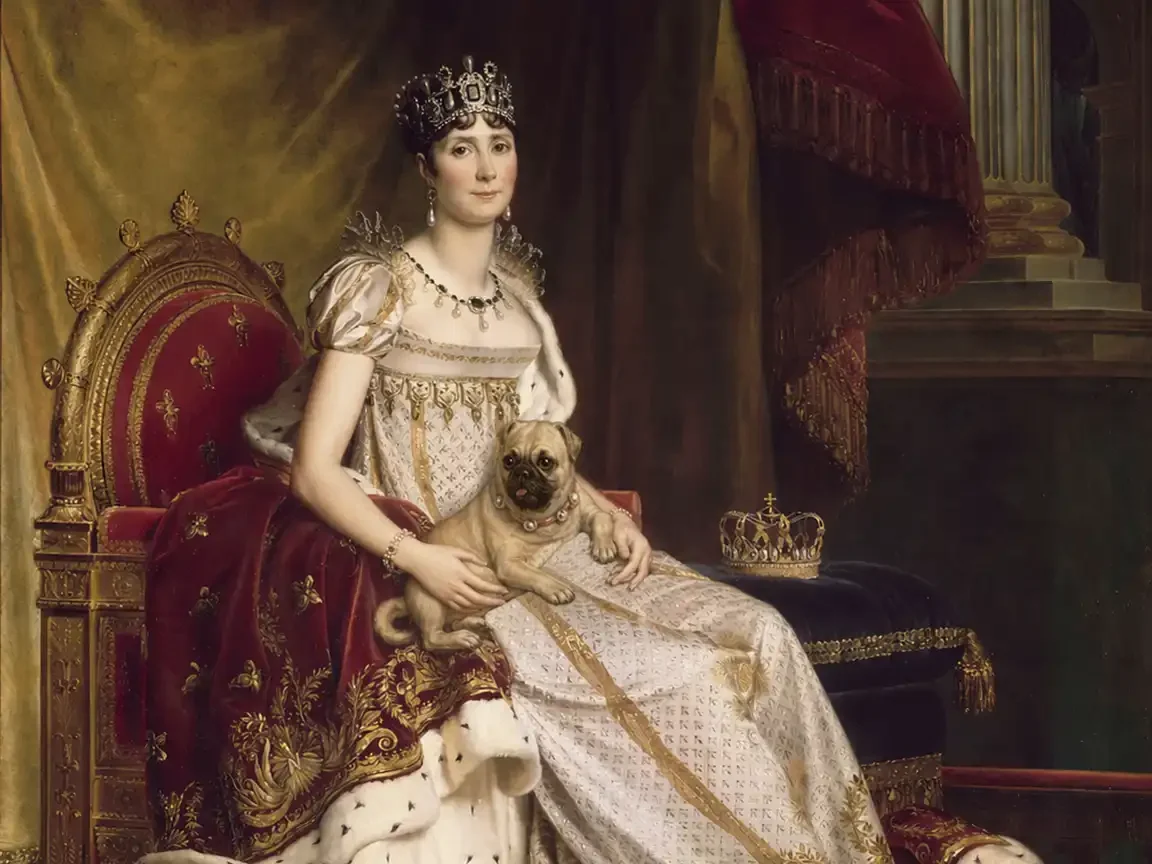
Helen and Gandhi kept the most watched couple in America at a distance from everyone else. Other dogs attached themselves as firmly to one powerful person — a king’s terrier, a pug with views on Napoleon, and Frederick the Great’s greyhound, carried off by enemy cavalry.