A century before internet dog memes, Harry Whittier Frees filled novelty postcards and children’s books with puppies cooking, teaching and sewing in miniature clothes. With no Photoshop or AI, he swore every scene was real and kept his methods secret.
Weighing the baby, Harry Whittier Frees, 1914. It appears in the book The Little Folks of Animal Land. Library of Congress (LC-DIG-ds-04058). Public domain.
Blink lies wrapped in a white shawl in the pan of a toy scale, while two puppies in a striped dress and striped overalls stand over him on their hind legs, playing his anxious parents. None of them is old enough to be anybody’s parent, and every one had to stay exactly where it was put. Harry Whittier Frees took the picture in 1914, at his studio in Oaks, Pennsylvania.
Any dog owner with a phone will know the formula: dress your dog up as a person, give it a household chore and add a caption. Frees’s photographs were published during the golden age of the picture postcards, when Americans bought and mailed them by the billions. His career began when he sold his first dressed-up picture to a postcard printer who, LIFE reported, “clamored for more and more.” Frees printed his own titles on his photographs: “Weighing the baby,” “Making a date,” “A joy-ride.” By 1937 his pictures were being published in America, Europe and beyond. Today, a viral puppy meme takes a smartphone, a ten-second camera burst and an editing app. A century ago, it took a costume sewn to fit, a great deal of human patience and a puppy holding still for a full second.
Too Real to Believe
Frees’s puppies looked so real that people doubted they could be. When The Little Folks of Animal Land was published in 1915, he opened it with a note admitting his work had raised “a doubt in some minds that the pictures are genuine.” He gave his “personal assurance” that every one was “photographed from life,” and said the difficulty of posing puppies had been overcome “only by the exercise of great patience and invariable kindness.”
Patience and kindness became the book’s selling point. The Detroit Evening Times admitted it was taking Frees on trust: “He tells us, and we believe him.”
Not everyone did. Nine years later, a newspaper feature reported that many critics still dismissed the pictures as impossible and assumed they relied on “some method of faking”. By 1929, in the preface to his sequel, Animal Land on the Air, Frees was answering wilder theories: that his puppies were stuffed, drugged or hypnotized. Every theory was wrong. The puppies were alive and awake, which made them harder to explain, not easier.
Puppies on Their Hind Legs
Patches Are No Disgrace. In the story, Mr. Fourpaw finds his trousers dangerously thin and patches them himself. Harry Whittier Frees, The Little Folks of Animal Land, 1915. Public domain, via Wikimedia Commons.
Mr. Fourpaw stands at an ironing board in a striped jacket, one paw on the iron, pressing a pair of trousers with two dark patches on the seat. The puppy playing him is a few weeks old and upright on his hind legs, and nobody has ever explained how he was kept there.
Frees’s models were babies. The best period for a young animal model, he wrote in his 1929 preface, was “a short one, being when they are from six to ten weeks of age.” Frees chose for age, not pedigree, renting whatever puppies were young enough from neighbors, breeders and pet shops. By 1937 his only assistant was his housekeeper, Annie Edelman, who sewed every costume.
Frees was aware that some readers suspected “unnatural means, savoring of cruelty,” and he insisted it was “impossible to mistreat an animal in any way and secure such pictures.” Asked by LIFE, he would say only that objects such as forks and needles were tied to the puppies’ paws. That might explain a paw resting on an iron. It does not explain the puppy standing. LIFE guessed at concealed wires, and noted that no animal protective society had ever accused him of cruelty.
Standing was half the job. The other half was not moving at all.
Holding Still for the Camera
Frees with a costumed model and the tube that fired his camera’s shutter. Houston Chronicle, February 17, 1924. Public domain, via Wikimedia Commons.
In a 1924 newspaper photograph, Frees stands beside his camera in a flat cap and bow tie, holding a long rubber tube. Next to him, a puppy in a pointed straw hat sits up on a heap of hay with a rake in its paws. The tube fired the shutter, and Frees was waiting for the moment the puppy stopped moving.
That moment had to last. The feature that ran with the photograph reported that none of his pictures was taken with less than a half-second exposure and most were given a full second. A twitching ear or a wagging tail in that time blurred the plate, and only about thirty plates in every hundred came out. By 1937 he had cut his exposures to a fifth of a second and was still throwing away two negatives in three.
Keeping a puppy’s attention was the hard part. A kitten will watch anything that moves, but a puppy, the feature explained, “will only listen to a word of command—and not always to that.”
Frees knew how much he was asking. “Young animals cannot hold a pose any better than human babies,” he wrote, “and the situation is complicated when they are called upon to be precocious in situations naturally foreign to them.” These were babies being asked to behave like grown-ups. He found the work so nerve-racking that he photographed for only three months a year. The ones who could stand and stay still were given names.
The Dogs of Dogville
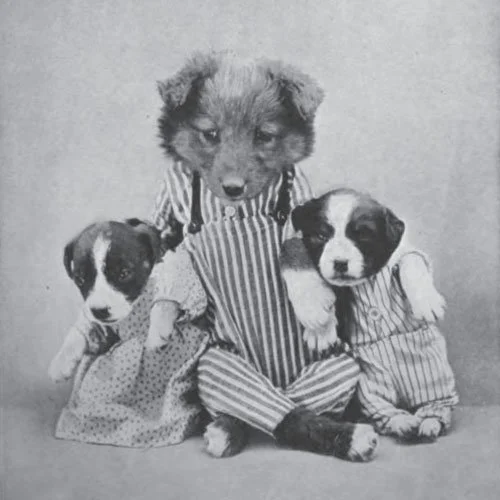
Daddy Fourpaw with Blink and Wink. Harry Whittier Frees, The Little Folks of Animal Land, 1915. Public domain, via Wikimedia Commons.
Daddy Fourpaw sits in striped overalls with a son under each arm. Blink and Wink are smaller still, one in a spotted dress, as the youngest boys still often wore in 1915, and one in a striped suit. No record names their breeds, but the book’s cast falls into two types: fluffy brown puppies with dark muzzles, like Daddy Fourpaw, and smooth black-and-white ones with a white blaze down the face, like his sons.
In The Little Folks of Animal Land, nobody in Dogville, “quite the nicest suburb of animal Land,” is better liked than their father. Around them is a whole respectable community: two maids, Barker and Hilda, who keep house for a family of cats, and a kindergarten teacher whose pupils include kittens.
Within the book, the same puppies turn up again and again. A Maine reviewer noticed that “one soon comes to recognize the different characters in the pictures, even before reading the text.” Frees, it seems, kept using the puppies who could do the job.
On Their Way. The Fourpaws start out for the dancing class. Frees wrote the story as well as taking the photographs. Harry Whittier Frees, The Little Folks of Animal Land, 1915. Public domain, via Wikimedia Commons.
Sometimes the book's story lets slip how the pictures were made. On the way to a dancing class, Mr. Fourpaw wears a suit he has pressed and mended, and his wife declares that it looks quite like new “if he could only remember to stand facing people.” A costume, like a photograph, only had to work from the front.
Still Trying to Keep Still
Barker Takes a Stitch in Time. Harry Whittier Frees, The Little Folks of Animal Land, 1915. Public domain.
By 1929, in Animal Land on the Air, a catnip factory had turned Dogville into the city of Catnip Corners, and Frees was calling the kitten “the most versatile animal actor.” He was still photographing puppies in 1937, and the pictures have outlasted every dog in them.
In the 1915 book, Blink is old enough for trousers, and Barker sews patches onto a hand-me-down pair while he is still wearing them. She warns him that he “must be careful not to wiggle the least little mite.” Blink, the book says, tried to keep still.
Did You Know?
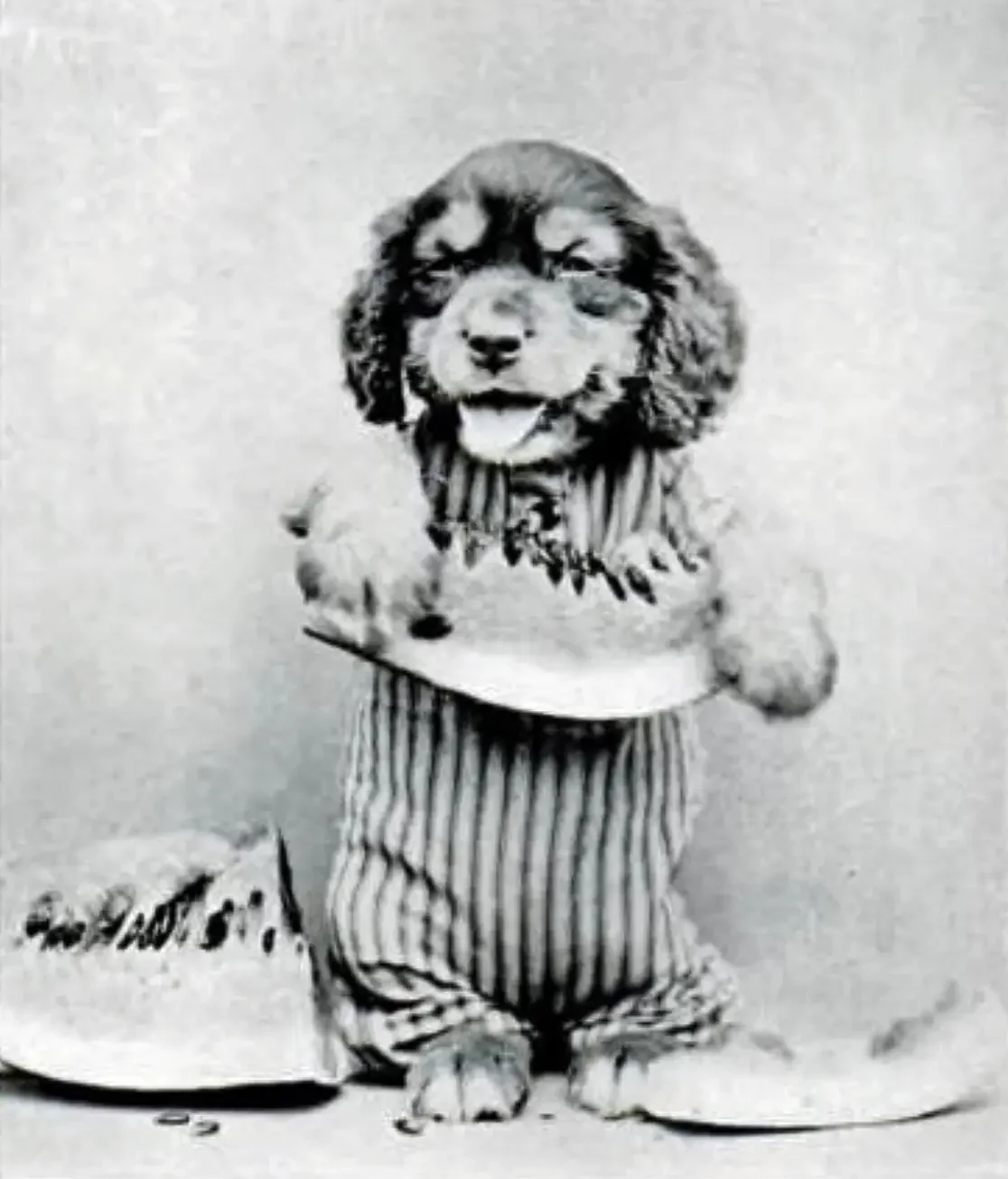
Frees's watermelon picture, which LIFE called one of his most successful photographs. Harry Whittier Frees, Public domain.
One of Frees’s most successful puppies hated the job. LIFE said the watermelon picture was hard to take because the puppy ate the melon, disliked it and wanted no more to do with it.
Frees’s puppies had a Victorian ancestor in a top hat. In the 1890s a Hamburg studio posed a dog in a top hat with a clay pipe. Find out why Victorians dressed dogs as humans.
The most famous dog meme was a casual snapshot. In 2010 a Japanese teacher photographed her rescue Shiba Inu, Kabosu, on the sofa. As Doge, it later sold as an NFT for $4 million.
Discover More Dogs From Different Worlds…
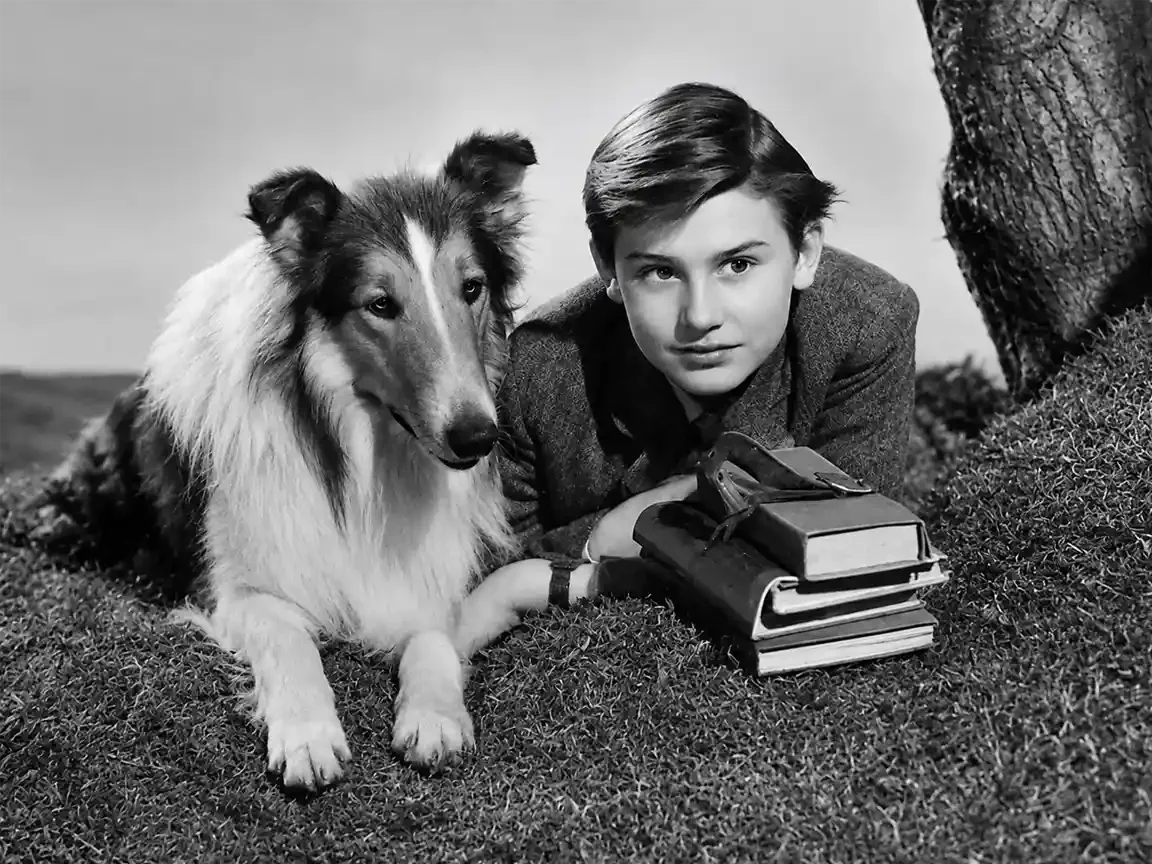
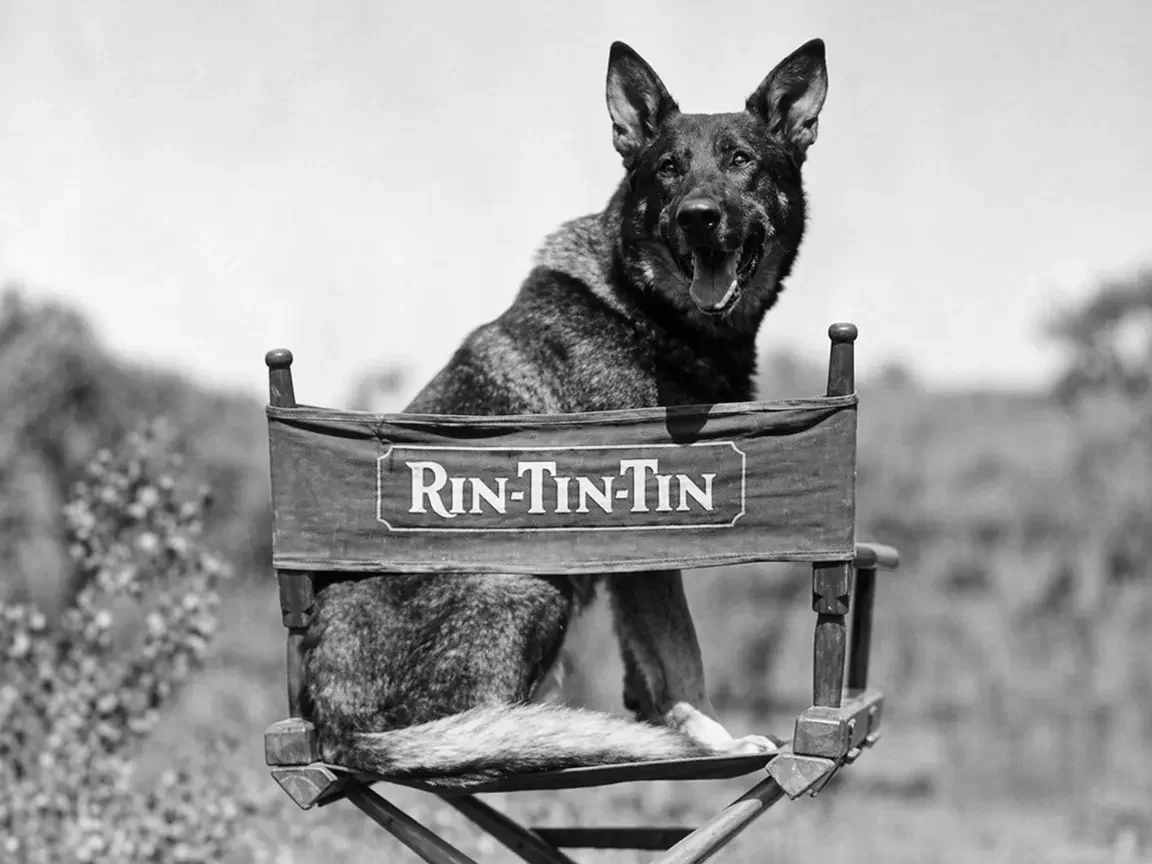
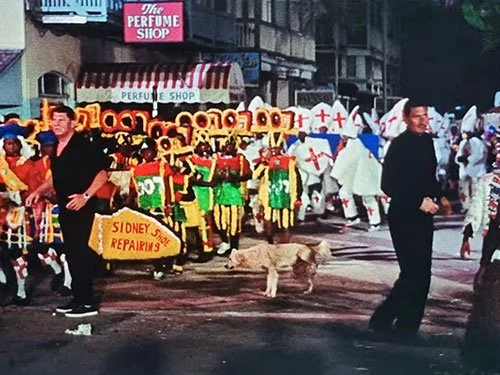
Frees’s puppies only had to look right from the front. Other dogs had to hold their marks for bigger movie cameras: one who upstaged James Bond, a German war dog who kept a Hollywood studio afloat, and the male collie cast as Lassie.